Kaal Sarp Dosha Effects Types and Proven Vedic Removal Remedies
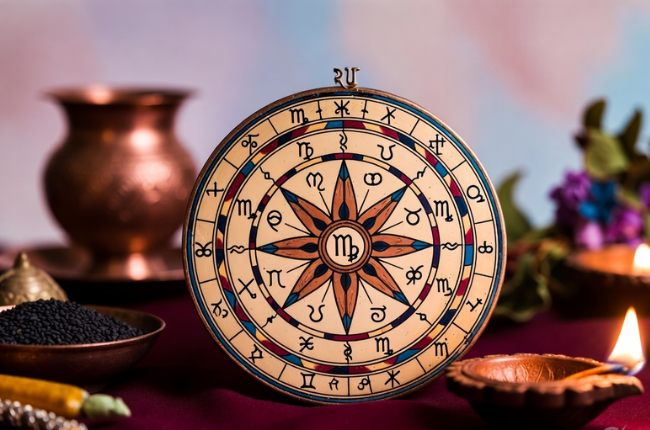
There is a kind of quiet suffering that families sometimes carry for years without a name for it. Work picks up, then falls apart. A marriage that seemed certain suddenly stalls. Sleep is broken by strange, unsettling dreams — serpents, water, dark corridors. One family member stabilises, and almost immediately another one faces a crisis. Nobody can explain it. The astrologer who finally looks at the kundali pauses, then says two words: Kaal Sarp.
Kaal Sarp Dosha is a planetary configuration in Vedic astrology — Jyotish — where all seven main planets become enclosed between Rahu and Ketu, the two shadow planets that govern karma, ancestral debt, and the deeper currents of fate. When every planet is hemmed inside this axis, the native's life moves in compressed cycles — intense effort followed by abrupt reversals, gifts that arrive and are taken away, progress that happens in bursts rather than steadily.
What most articles on this topic miss entirely is the role the specific house axis plays in shaping how the dosha actually expresses. A Kaal Sarp Dosha in the 1st-7th axis behaves completely differently from one in the 4th-10th axis — and the remedies that work for one will be insufficient for the other. This article covers all 12 named types, the full range of real effects, what the classical texts actually say, and what a family can do starting today — with precision, not generalities.
What Kaal Sarp Dosha Actually Means in Your Kundali
Kaal Sarp Dosha forms when all seven classical planets — Sun, Moon, Mars, Mercury, Jupiter, Venus, and Saturn — are positioned within the 180-degree arc between Rahu and Ketu in the birth chart. Rahu sits at one end, Ketu at the other, and every planet falls within that enclosed half of the zodiac. No planet escapes outside the Rahu-Ketu axis.
The name itself carries the meaning plainly. Kaal means time — and in the deeper Vedic sense, death and fate. Sarp means serpent. Dosha means affliction or imbalance. The combined image — a serpent of time encircling all planetary energies — describes precisely what this configuration does: it constricts the natural flow of planetary blessings.
Rahu and Ketu are not visible planets. They are the lunar nodes — the mathematical points where the Moon's orbital path intersects the ecliptic. In the Brihat Parashara Hora Shastra, the foundational classical text of Parashari Jyotish, Rahu and Ketu are described as shadow grahas with the power to swallow the Sun and Moon during eclipses and to amplify or distort the results of every planet they contact. When all planets are enclosed between them, that amplification becomes total — nothing in the chart operates freely of their influence.
An important distinction that most families do not know: a planet sitting exactly on the Rahu or Ketu degree is not inside the dosha — it is at the boundary. Whether that boundary planet breaks the dosha or not is a matter of active debate between Parashari and Nadi traditions, and a qualified Jyotishi must examine the specific degree before making a determination. This distinction alone changes the diagnosis for a significant number of kundalis.
Internal link: For the complete foundation of how planets are read in a birth chart, see the Complete Kundli Reading Guide to Understand Houses and Planets.
How to Perform Kaal Sarp Dosha Remedies at Home Today
Not every family can travel to Trimbakeshwar or Ujjain immediately. These home-based remedies, drawn from the Navagraha upaya tradition and consistent with what practising Pandits across India recommend, can be started without delay. The intent with which they are performed matters as much as the items used.
- Begin on a Saturday or Tuesday — both are days associated with Rahu and Ketu's governing energies. Start in the early morning, preferably within the Brahma Muhurta window before sunrise.
- Prepare a copper or clay vessel filled with clean water. Add a pinch of black sesame seeds (kala til), a few drops of raw cow's milk, and a tulsi leaf. Place this at your puja space facing east.
- Recite the Rahu Beej Mantra — Om Bhram Bhreem Bhroum Sah Rahave Namah — 108 times, using a Rudraksha mala. For Ketu, follow with Om Shram Shreem Shroum Sah Ketave Namah — 108 times. Do not skip either; the Rahu-Ketu axis must be addressed together.
- Offer the prepared water at the base of a Peepal tree after completing the mantra recitation. Peepal is sacred to the Navagraha tradition and is considered a direct offering point for shadow-planet remedies.
- Light a mustard oil lamp (sarson ka diya) at the puja space each Saturday evening. Keep it burning for the full evening — do not extinguish it early.
- Donate black items on Saturday — black sesame, black cloth, iron, or black lentils (urad dal) — to a temple or directly to someone in need. The act of giving willingly releases the constricting quality of the Rahu-Ketu axis.
- Avoid meat, alcohol, and sharp arguments on the day of the remedy. The purity of conduct on the day the remedy is performed directly affects its reception.
As astrological tradition holds, individual outcomes vary with karma and sincerity. These remedies support the process — they do not override it.
All 12 Types of Kaal Sarp Dosha and What Each One Does
The type of Kaal Sarp Dosha in a kundali is determined by the house where Rahu is placed. Each of the 12 placements carries a distinct name and a distinct life-area where the constriction is felt most sharply. A blanket remedy applied without knowing the type is significantly less effective than one targeted to the specific axis.
Anant and Kulik — The First Two Types
Anant Kaal Sarp Dosha (Rahu in the 1st house, Ketu in the 7th) directly affects self-identity, physical health, and marriage. The native often experiences a push-pull between personal ambition and partnership — achieving one seems to cost the other. Kulik Kaal Sarp Dosha (Rahu in the 2nd, Ketu in the 8th) strikes the family finances and speech. Accumulation of wealth happens, but exits quickly — often through sudden expenses, medical costs, or losses the family could not anticipate.
Vasuki, Shankhpal, Padma — The Middle Range
Vasuki (Rahu 3rd, Ketu 9th) — sibling relationships and short efforts repeatedly run into obstacles. Fortune and father's support feel distant. Shankhpal (Rahu 4th, Ketu 10th) — domestic peace suffers; career growth is erratic despite genuine ability. Padma (Rahu 5th, Ketu 11th) — children's matters and speculative investments are deeply affected; gains feel delayed or blocked.
Mahapadma Through Sheshnag — The Later Types
Mahapadma (Rahu 6th), Takshak (Rahu 7th), Karkotak (Rahu 8th), Shankhachur (Rahu 9th), Ghatak (Rahu 10th), Vishdhar (Rahu 11th), and Sheshnag (Rahu 12th) — each brings a specific area of life under the shadow axis, from litigation and health crises in the 6th-12th types to career instability in the 10th-axis type and foreign-land difficulties in the 12th.
As many families discover when they sit with their Pandit, knowing the specific type changes the entire approach to remedy — a Trimbakeshwar puja targeting Anant Dosha uses a different Sankalpa than one targeting Shankhpal.
What Kaal Sarp Dosha Actually Does to a Person's Life
Kaal Sarp Dosha does not operate like a simple affliction that strikes one area and leaves the rest untouched. Because all planets are enclosed within the Rahu-Ketu axis, the constriction is felt across multiple life dimensions simultaneously — though the primary area of impact depends on the specific type.
Career and Financial Effects
Effort and result become misaligned. A native with strong professional qualifications finds that promotions are delayed, projects are cancelled at the last moment, or colleagues seem to advance faster despite less ability. Businesses hit a ceiling that cannot be explained by market conditions alone. Financial gains arrive but are accompanied by equally unexpected drains — a medical emergency, a legal dispute, an obligation to a relative. The pattern is one of two steps forward, one and a half steps back.
Marriage and Relationship Effects
The 7th house — governing marriage and partnership — is directly affected when Rahu occupies the 1st or 7th in the Anant and Takshak types. More broadly, the emotional instability that Rahu introduces through the axis creates difficulty in sustained intimacy. The native may attract partners but struggle to build stable, trusting relationships. Delays in marriage are among the most commonly reported effects across all 12 types.
Mental and Psychological Effects
This is the dimension most consistently absent from online content on this topic. The Rahu-Ketu axis governs the subconscious, dreams, and the boundary between the material and the subtle. Natives with a strong Kaal Sarp Dosha frequently report vivid, disturbing dream patterns — serpents, water, being chased, seeing deceased relatives. Anxiety that has no clear external cause, a persistent sense of being held back by an invisible force, and difficulty in feeling settled in any one place are reported across communities from Tamil Nadu to Punjab, suggesting a genuine cross-regional pattern in how this configuration expresses.
Myth vs. Fact
MYTH: Kaal Sarp Dosha means the native will never succeed in life.
FACT: Classical Jyotish, including the framework of the Brihat Parashara Hora Shastra, does not treat any single configuration as an absolute determinant of life outcome. Several well-documented historical figures — including individuals who rose to significant positions in public life — carried Kaal Sarp Dosha in their charts. The dosha creates obstacles and delays, not permanent blockage. The strength of the lagna lord, the placement of Jupiter, and the Dasha period running at any given time all modify the dosha's expression substantially. A Pandit who claims absolute outcomes from this configuration alone is not reading the full chart.
What the Classical Texts Actually Say About Rahu and Ketu
The Brihat Parashara Hora Shastra, composed by the sage Parashara and considered the primary foundational text of Parashari Jyotish, dedicates specific chapters to the nature, significations, and remedial measures for Rahu and Ketu. Parashara describes Rahu as a tamas graha — one that operates through desire, illusion, and the amplification of worldly craving. Ketu is described as equally tamas in nature but oriented toward moksha — dissolution, liberation, and detachment from material form.
The enclosure of all planets between these two poles is, in the classical view, a condition in which every planetary blessing is filtered through the Rahu-Ketu lens before it reaches the native. Jupiter's wisdom arrives tinted with confusion. Saturn's discipline arrives with added harshness. Venus's pleasures arrive with attachment and subsequent loss. The filtering is not random — it is karmic. The Brihat Parashara Hora Shastra places Rahu-Ketu remediation firmly within the framework of karma-phala — the fruits of past actions maturing in the present life.
The Skanda Purana, in its Reva Khanda section, addresses the power of Nag worship as a remedial tradition for those afflicted by the serpent axis. The Nag Panchami observance — feeding milk to serpents, worshipping the Nag deity, reciting serpent-related stotras — is described as a tradition that reduces the agitation of the Rahu-Ketu axis in the kundali over time. This is not a single-event remedy; the Purana frames it as a sustained devotional practice across successive years.
Vedic Essence: Classical tradition holds that Rahu and Ketu, as karmic agents, do not merely obstruct — they accelerate the maturation of unresolved karma. Their remedies, therefore, work not by erasing the karma but by helping the native meet it with greater clarity and steadiness.
The Question Families Actually Ask: What If the Remedies Do Not Work
Many families carry this question for years before someone finally says it plainly. They have performed the puja. They have donated on Saturdays. They have worn the gemstone their astrologer suggested. And the problems have not stopped. Here is what actually matters.
Some karma runs deeper than a single remedy cycle can reach. Classical Jyotish does not promise that one puja neutralises decades of karmic accumulation. What it promises is that sincere, sustained practice — combined with correct conduct — reduces the intensity of the dosha's expression over time. The Vimshottari Dasha period running at the time the remedy is performed matters enormously. A person in Rahu Mahadasha performing a Kaal Sarp remedy during that period is working at the most powerful possible window. The same remedy performed during a Jupiter Mahadasha will have a different quality of result.
If the situation has not eased after sustained home remedies, the next step is a properly performed Kaal Sarp Shanti Puja at one of the three principal locations — Trimbakeshwar in Maharashtra, Mahakaleshwar in Ujjain, or Srikalahasti in Andhra Pradesh — where the specific Sankalpa is set for the individual's kundali and the puja is performed by Pandits trained in the relevant tradition. Generic online pujas performed without a proper Sankalpa lack the specificity the classical system requires.
Personal results, as always, depend on individual karma, the quality of practice, and divine grace. This is not a concession — it is the honest position the classical texts themselves hold.
As many practitioners note, the families who see the clearest shift after remedy are not always the ones who performed the most elaborate rituals — they are the ones who combined the remedy with a genuine change in conduct and a sustained daily practice.
One Question No Article Answers: Does Kaal Sarp Dosha Affect All Family Members Equally
One question that appears repeatedly in community threads — on Quora, in astrology Facebook groups, in YouTube comment sections of videos on Kaal Sarp Dosha — and that receives almost no proper answer anywhere: if one person in a family has Kaal Sarp Dosha, does the rest of the family also experience its effects? And what happens when two members of the same household both have it?
The classical answer, drawn from the principle of Graha Drishti and the Parashari understanding of family karma, is this: the dosha is personal — it belongs to the individual's kundali and expresses through their own Dasha and transit sequence. But Rahu and Ketu, as karmic shadow planets, also operate through family systems. When a parent carries a strong Kaal Sarp Dosha and is in a difficult Rahu period, the household as a whole can feel the ambient instability — financial pressure, emotional friction, health events — even if the other members do not have the dosha in their own charts.
When two family members — particularly spouses — both carry Kaal Sarp Dosha, the Nadi tradition holds that the karmic intensity is not simply doubled. Instead, the specific house axes of both charts must be examined. If the axes are different (one carries Anant, the other carries Shankhpal), the effects manifest in different life areas and the family can often work through them sequentially. If the axes are the same, the overlapping pressure in the same life area — marriage, finances, children — becomes the concentrated point of difficulty. In such cases, a joint Kaal Sarp Shanti Puja — with separate Sankalpas for each individual — is the appropriate remedial direction.
Pandit's Tip — Focus: Bhakti
Rahu is satisfied not by fear but by fearless worship. Families who perform the Rahu remedy out of anxiety — racing through the mantra, distracted, watching the clock — report the least shift. Families who sit with the practice as a genuine act of surrender, even imperfectly, report steadier results over time. The Skanda Purana framing of Nag Panchami is instructive here: the observance is described not as an appeasement of an enemy but as an honouring of a cosmic force. That distinction in intent — appeasement versus honouring — changes what the practice becomes in the body and the mind.
What Most Articles Completely Miss: Partial Kaal Sarp Dosha
This is the content gap absent from every major competing article on this topic — and it directly affects a far larger number of kundalis than the full Kaal Sarp configuration.
Partial Kaal Sarp Dosha occurs when one or more planets fall outside the Rahu-Ketu axis — meaning the axis does not enclose all seven classical planets. Strict Parashari tradition holds that if even one planet falls outside the axis, the full Kaal Sarp Dosha does not apply. However, the Nadi tradition takes a more nuanced position: a near-complete enclosure — six planets inside, one outside — still creates a significantly compressed chart where the free planet carries disproportionate weight in the life of the native.
The practical consequence is this: if your kundali has six planets enclosed and one outside, that free planet becomes the single point of karmic release. Its strength, its house placement, its Dasha timing, and its natural significations become the path through which the dosha's pressure finds relief. A free Jupiter in the 9th house in such a chart becomes far more significant than Jupiter would be in a chart without this configuration. That planet must be strengthened deliberately — through its specific upaya, its associated day's observance, and conduct aligned with its significations.
This distinction is why two people who both receive a Kaal Sarp Dosha diagnosis and perform the same remedy can have completely different outcomes. One may have the full dosha; the other may have the partial configuration with a strong free planet that was never examined.
Internal link: For the relationship between planetary periods and when this free planet's relief is most accessible, see the Vimshottari Dasha Complete Guide How Planetary Periods Affect Life Career.
Kaal Sarp Dosha and the Famous People Who Carried It
This dimension of the topic is searched repeatedly by real users — and the answers available online are largely inaccurate, unverified, or vague. What the classical tradition actually teaches about prominent individuals with this configuration is instructive not as celebrity trivia but as a correction to the fatalistic reading of the dosha.
Several political leaders, scientists, and artists across Indian history have been identified by practising Jyotishis as having had Kaal Sarp configurations in their charts. Without confirmed birth data — exact time and place — no Jyotishi can make a responsible claim about a public figure's kundali. Any article that states with certainty that a specific celebrity has Kaal Sarp Dosha without citing a verified birth time is speculating, not practising.
What the tradition does teach, and what these cases illustrate, is that the dosha intensifies effort while compressing ease. Natives with this configuration frequently describe their path as one of unusually hard work for results that come, but always later than expected, and always accompanied by a parallel loss or challenge. The classical teaching holds that this is the karmic design — not punishment, but accelerated processing of unresolved karma within a single lifetime.
Internal link: For the complete context of how Rahu and Ketu operate as a pair in the kundali, see Rahu Ketu Negative Effects and Complete Balance Guide.
FAQ
Q1: How do I know if I have Kaal Sarp Dosha in my kundali? Kaal Sarp Dosha is confirmed when all seven classical planets — Sun, Moon, Mars, Mercury, Jupiter, Venus, Saturn — fall within the arc between Rahu and Ketu in the birth chart. This requires an accurate kundali drawn from your exact birth time, date, and place. Self-assessment from generic birth date tools is insufficient for a reliable determination. As astrological tradition holds, individual configurations vary significantly with karma and exact birth data.
Q2: How do I reduce the effects of Kaal Sarp Dosha at home? Recite the Rahu Beej Mantra 108 times on Saturday mornings using a Rudraksha mala, followed by the Ketu Beej Mantra. Offer the prepared water at the base of a Peepal tree. Light a mustard oil lamp on Saturday evenings and donate black sesame or urad dal to someone in need. Begin these consistently — effects observed over months, not days.
Q3: Is Kaal Sarp Dosha permanent in a kundali? The configuration in the birth chart is permanent — Rahu and Ketu do not move in the natal chart. What changes is the intensity of its expression over time, governed by the Vimshottari Dasha sequence and planetary transits. Rahu and Ketu Mahadashas are the most active periods. Sustained remedy and correct conduct progressively reduce the dosha's disruptive force.
Q4: Does Kaal Sarp Dosha cause repeated failures in career? Career disruption is a commonly reported effect, particularly when Rahu occupies career-relevant houses such as the 10th (Ghatak type) or 2nd (Kulik type). The pattern is typically one of effort without proportional reward, or sudden reversals after apparent progress. The dosha does not eliminate career success — it delays and tests it. Jupiter's placement and current Dasha period significantly modify this outcome.
Q5: Which temple is best for Kaal Sarp Dosha puja? Trimbakeshwar in Nashik, Maharashtra, is the most widely recognised location for Kaal Sarp Shanti Puja in the Parashari tradition. Mahakaleshwar in Ujjain and Srikalahasti in Andhra Pradesh are also authoritative locations with specific traditions for this puja. The effectiveness depends on the Pandit's knowledge of the correct Sankalpa for the individual's specific type of Kaal Sarp Dosha — the location alone is insufficient.
Q6: Can Kaal Sarp Dosha affect my children if I have it? The dosha is personal to the individual kundali. However, when a parent is in a difficult Rahu or Ketu Dasha period, the household environment can carry elevated instability — financial, emotional, or health-related — that affects all family members. Children born to a parent during a strong Rahu period should have their own kundali examined independently. The dosha is not genetically transmitted, but karmic family patterns can echo across charts.
Q7: What is the difference between Kaal Sarp Dosha and Pitra Dosha? These are distinct configurations often confused with each other. Kaal Sarp Dosha arises from the Rahu-Ketu axis enclosing all planets and is primarily associated with blocked karma in the current life. Pitra Dosha arises from afflictions to the 9th house, Sun, or ancestral karma markers and is associated with unfulfilled ancestral obligations. Both can be present in the same chart. Their remedies differ substantially and must not be substituted for each other.
Conclusion
Kaal Sarp Dosha is the kundali's way of saying that certain karma has been brought into this life for accelerated resolution — not for suffering alone, but for completion. The native who understands this stops fighting the configuration and starts working with it: through sustained remedy, honest conduct, and the kind of perseverance that this axis, by its very nature, builds in those who carry it.
The single most useful step a family can take today is to get an accurate kundali drawn from the exact birth time and place, have the specific type of Kaal Sarp Dosha identified, and begin the targeted home remedy for that axis. General remedies help; targeted ones help more.
Personal results, as classical tradition holds, depend on individual karma, sincerity of practice, and divine grace — not on ritual completeness alone. Every family that has walked this path with genuine intent has found that the dosha, over time, becomes less a wall and more a direction.
If your kundali shows Kaal Sarp Dosha and you want a precise assessment of your specific type, Dasha timing, and the right remedy sequence, connect with an experienced Jyotishi at AtoZPandit.com. Our Pandits identify your exact configuration and guide you through the correct Sankalpa-based remedy — whether at home or at a sacred temple — with no generic answers.
Disclaimer:This article is written for educational and cultural awareness purposes only. The information provided does not substitute professional medical, psychological, or legal advice. For personalised Vedic guidance on your specific situation, connect with a qualified Pandit at AtoZPandit.com.