
Manglik Dosha Marriage Delays Causes Severity Levels and Vedic Remedies
There are families where a daughter crosses thirty, then thirty-two, and the proposals keep falling through at the last moment. A boy who is educated, earning well, and genuinely ready for marriage finds that every match either withdraws or simply does not feel right to anyone involved. The horoscopes are shown to three different astrologers, and all three say the same thing — Mars is in the wrong house. Manglik Dosha.
Manglik Dosha, called Mangal Dosha in classical Jyotish, forms when Mars — Mangal or Kuja — occupies specific houses in the birth chart that directly govern marriage, the self, domestic peace, and longevity of the partner. Mars is a planet of fire, drive, and aggression. When it sits in positions that face the 7th house of marriage directly, it can introduce friction, delay, and in severe configurations, genuine strain into a marital relationship. This is not superstition — it is a reading of planetary energy and house signification that the Brihat Parashara Hora Shastra addresses with considerable precision.
What almost no article explains clearly is that the majority of people diagnosed with Manglik Dosha do not actually carry the full dosha — because the cancellation rules that classical texts provide are extensive, and most popular astrology content never mentions them. This article covers which houses truly cause the dosha, the complete cancellation conditions, the full effect on marriage and daily life, what families can do at home today, and the remedies that the classical tradition actually endorses — without exaggeration and without unnecessary fear.
Which Houses in the Kundali Actually Cause Manglik Dosha
Manglik Dosha forms when Mars occupies specific houses in the birth chart. The classical definition, rooted in the Brihat Parashara Hora Shastra and elaborated in the Phaladeepika by Mantreswara, identifies five houses as the primary positions of Mangal Dosha formation.
These five houses are the 1st (the self and physical body), the 4th (home, domestic peace, and the mother), the 7th (marriage and partnership directly), the 8th (longevity of the spouse, hidden matters, and transformation), and the 12th (bed pleasures, foreign residence, and loss). When Mars sits in any of these five positions in the lagna chart — the ascendant-based birth chart — Manglik Dosha is said to be present.
The South Indian Tradition Adds the 2nd House
The North Indian classical tradition, following strict Parashari rules, identifies five houses. The South Indian Jyotish tradition — particularly the Kerala school — additionally includes the 2nd house as a Manglik position, because the 2nd house governs family, speech, and the immediate domestic environment that sustains a marriage. This is a genuine regional variation in classical practice, not an error in either tradition. A Pandit trained in the Kerala or Tamil Nadu tradition will diagnose Manglik Dosha from six house positions rather than five.
Lagna Chart vs. Moon Chart vs. Venus Chart
Here is the distinction that most families never hear: the Brihat Parashara Hora Shastra specifies that Manglik Dosha should be assessed from three chart positions — the ascendant (lagna), the Moon sign (Chandra Lagna), and the Venus position (Shukra Lagna). If Mars falls in a Manglik house from all three reference points, the dosha is considered strong. If it falls from only one of the three, many classical interpreters hold that the dosha is mild and substantially cancelled by the cancellation rules.
This is why two people can have Mars in the 7th house and one carries a serious Manglik Dosha while the other carries a configuration that a careful Jyotishi would consider effectively cancelled.
For a complete understanding of how house positions are read across chart types, see the Complete Kundli Reading Guide to Understand Houses and Planets.
Complete Manglik Dosha Remedies to Perform at Home Today
These remedies are consistent with what the Navagraha upaya tradition prescribes for Mars affliction and are endorsed across practising Pandit communities from Maharashtra to Rajasthan. Begin on a Tuesday — the day governed by Mangal — and maintain consistency.
- Begin on a Tuesday morning, preferably at sunrise or within the first hour of daylight. Bathe before performing any remedy. Clean the puja space and face east.
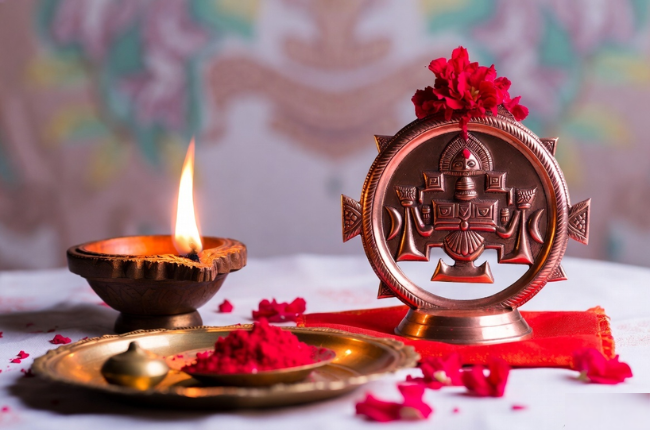
- Prepare the offering plate with red flowers — ideally red roses or red hibiscus (gudhal) — red vermillion (sindoor), a small copper vessel with clean water, and a lit ghee lamp. Copper is the metal associated with Mars in the classical Navagraha tradition.
- Recite the Mangal Beej Mantra — Om Kraam Kreem Kraum Sah Bhaumaya Namah — 108 times using a red coral mala or a Rudraksha mala. Do not substitute a plastic counter — the mala itself is part of the remedial tradition.
- Offer red flowers and red lentils (masoor dal) at a Hanuman temple on every Tuesday. The Skanda Purana and consistent Pandit practice associate Hanuman worship directly with the pacification of Mars energy — Hanuman carries the same fire and strength as Mangal but directs it toward dharma rather than conflict.
- Light a ghee lamp at the Hanuman idol or at your home puja space every Tuesday evening without interruption. If a Tuesday is missed, restart the count — the continuity of the practice is part of its effectiveness.
- Donate red items on Tuesday — red lentils, red cloth, copper coins, or jaggery — to a temple or to someone in genuine need. The act of release counteracts the holding, possessive quality of Mars in a difficult position.
- Recite the Hanuman Chalisa in full on every Tuesday. This is not a substitute for the Beej Mantra — both serve a purpose. The Beej Mantra addresses the planetary energy directly; the Hanuman Chalisa addresses the devotional dimension that amplifies the remedy's reception.
- Avoid arguments and confrontation on Tuesdays throughout the remedy period. Mars's energy is most active on its own day — feeding it through conflict on that day counteracts the remedy's direction.
As astrological tradition holds, individual outcomes vary with karma and sincerity of practice. These remedies are most effective when sustained across a minimum of 40 consecutive Tuesdays.
The Real Effects of Manglik Dosha on Marriage and Relationship
Manglik Dosha does not produce identical effects in every chart. The intensity of its expression depends on Mars's strength, the sign it occupies, the aspects it receives, and the Dasha period running at the time of marriage. What the classical tradition describes as the core effect is this: Mars introduces agni — fire — into the house it occupies and the houses it aspects. In marriage-related positions, that fire manifests as friction, urgency, and a quality of force that can overwhelm the softer energies that sustain long-term partnership.
Marriage Delay Effects
The most commonly experienced effect — and the one that brings families to an astrologer — is delay. Proposals that come close to finalisation fall through. Families agree in principle, then withdraw over small disagreements that escalate unexpectedly. The native reaches a marriageable age and finds that every promising match carries an obstacle that could not have been predicted. This delay pattern is especially pronounced when Mars occupies the 7th house directly, or when the native is running a Mars (Mangal) or Rahu Mahadasha during the marriage-seeking years.
Effects Within Marriage
When a Manglik person marries without awareness of the dosha or without any remedial support, the classical tradition — and consistent practitioner observation — notes that the first years of marriage carry a higher-than-usual degree of conflict, power struggle, and emotional friction. This is not inevitable separation; it is a period of testing. Mars in the 8th house, in particular, is associated with the longevity dimension of the spouse's chart — this is the root of the concern that Manglik Dosha can harm the partner. The severity of this concern depends heavily on the full chart reading, and it is significantly overstated in popular media.
Effects on Daily Temperament
A Manglik native — even outside of marriage matters — often carries a quality of intensity that others find difficult to manage in close quarters. Quick to anger, strong in opinion, physically energetic, and resistant to compromise: these are Mars qualities that the dosha amplifies in personal relationships. Recognising this pattern is itself remedial — the native who knows their Mars placement can consciously moderate the aggression before it damages relationships.
Did You Know
The fear that a Manglik person will cause the death of their spouse is a folk amplification of a classical principle — not what the classical texts themselves state. The Phaladeepika by Mantreswara, one of the most respected medieval Jyotish texts, describes Mars in the 8th house as capable of producing ayur-bhanga — disruption to the lifespan dimension of the 8th house — but only when Mars is severely afflicted, without benefic aspect, and the spouse's own chart confirms the vulnerability. A single placement of Mars in the 8th house, without examining the full chart and the spouse's kundali, is insufficient ground for the severity of fear that popular astrology attaches to it. The classical texts are more careful than the folklore.
Manglik Dosha Cancellation Rules — Who Actually Has It
This is the information gap that is absent from virtually every popular article on Manglik Dosha — and it is the most practically important section for the majority of people who have been told they are Manglik.
The same classical texts that define Manglik Dosha also define the conditions under which it is cancelled or substantially neutralised. When any of the following cancellation conditions apply, the dosha is considered either fully cancelled or reduced to a degree where a standard remedial practice is sufficient without further concern.
Cancellation by Sign
When Mars occupies the 1st, 4th, 7th, 8th, or 12th house but falls in specific signs, the dosha is cancelled by sign placement. Mars in Aries or Scorpio — its own signs — in any of the Manglik houses is considered a strong placement that neutralises the malefic expression. Mars in Capricorn — its exaltation sign — in these houses is similarly cancelled by classical reckoning, because an exalted Mars has the dignity to direct its energy constructively rather than destructively.
Cancellation by Jupiter's Aspect
When Jupiter aspects Mars in the birth chart — either by its direct opposition or by its 5th or 9th aspect — the classical tradition holds that Jupiter's wisdom and sattvic quality tempers Mars's fire sufficiently to cancel the Manglik concern for marriage purposes. Jupiter is the natural karaka for husband in a female chart; its aspect on Mars directly counteracts the threat Mars poses to the partnership dimension.
Cancellation by Mutual Manglik Status
When both partners in a prospective marriage carry Manglik Dosha — regardless of the specific house each carries it in — the dosha is considered cancelled by mutual presence. The fire of one Mars meets the fire of the other, and equilibrium is restored. This is the most widely known cancellation rule, though it is commonly misapplied: the cancellation applies when both have a genuine Manglik Dosha, not when one has a full dosha and the other has a mild or technically cancelled configuration.
Cancellation by Mars in Its Own or Friend's House
When Mars occupies a house that is naturally friendly territory for it — governed by a planet that is Mars's natural friend — the dosha's malefic edge is significantly reduced. Mars's natural friends are the Sun, Moon, and Jupiter. When the 7th or 8th house is governed by these planets and Mars sits there, many classical interpreters do not apply the full Manglik classification.
As many families discover when they sit with their Pandit, a complete cancellation assessment requires examining all four of these conditions simultaneously — not checking one rule and stopping.
For how planetary friendships and sign placements modify dosha severity across the full chart, see the Kundali Matching Why 36 Gunas Are Not Enough for Marriage.
What the Classical Texts Say About Mangal Dosha
The Brihat Parashara Hora Shastra — the foundational text of Parashari Jyotish, attributed to the sage Parashara — describes Mars as a krura graha, a harsh or fierce planet, whose natural energy is rajas — action, passion, and aggression. When Mars occupies houses that face the 7th house by placement or aspect, its krura quality enters the domain of marriage and partnership, where what is needed is the sattvic quality of Venus and the balanced energy of Jupiter.
The Phaladeepika, composed by Mantreswara, provides specific verse-level treatment of Mars's house-by-house effects on marriage. It distinguishes between Mars as a badhaka — an obstructing planet — and Mars as a yoga-karaka — a planet capable of producing significant positive results — depending on the ascendant. For Aries and Scorpio ascendants, Mars is the lagna lord itself; its placement in the 7th or 8th house carries a completely different reading than it would for a Cancer or Libra ascendant, where Mars is a natural functional malefic.
Vedic Essence: The classical teaching on this point holds that no planet is inherently malefic in the absolute sense — it is the combination of house placement, sign dignity, aspect received, and the current Dasha period that determines whether a planet's energy produces obstruction or opportunity in a given life area.
The Muhurta Chintamani by Ramadaivagna, the primary classical text on auspicious timing, addresses the importance of selecting a marriage Muhurat that strengthens the 7th house and reduces the active influence of Mars during the marriage ceremony itself — a practical remedial measure that operates at the timing level rather than the kundali level.
What Families Never Ask But Should: Manglik Dosha After Age 28
One question that appears consistently in astrology community threads on Reddit and Quora — and that receives almost no clear answer in published content — is this: does Manglik Dosha weaken or cancel automatically after the native crosses a certain age?
The answer draws from both the Parashari tradition and the Nadi tradition, and the two differ in an instructive way.
The popular belief — widely circulated in family conversations across North India — holds that Manglik Dosha automatically weakens after age 28. This belief has a partial classical basis. Mars's natural maturity age in the Jyotish system — the age at which a planet is said to reach its full developmental expression — is 28 years. The reasoning is that after a planet matures, its dosha quality peaks and then begins to stabilise rather than actively disrupt.
However, the Parashari tradition does not endorse automatic cancellation by age as a formal rule. The Brihat Parashara Hora Shastra does not contain a verse that states Manglik Dosha dissolves at 28. What practising Pandits across generations have observed — and what the Nadi tradition codifies more explicitly — is that Mars's disruptive energy in marriage matters tends to express most forcefully during the years before the planet matures. After 28, the native's own experience and self-awareness have often developed enough to manage the Manglik temperament more consciously, which reduces the relational friction that the dosha produces in practice.
The practical guidance: age 28 is not a cancellation threshold. If the kundali shows an uncancelled Manglik Dosha, the appropriate remedy should be completed regardless of the native's age. What changes after 28 is the intensity of the expression — not the configuration itself.
Pandit's Tip — Focus: Karma
Honestly, this surprises most people when a Pandit says it plainly: the most effective Manglik remedy is not a one-time puja — it is the sustained practice of Tuesday worship across at least one full year, combined with a genuine moderation of the Mars temperament in daily conduct. Families who perform an elaborate Kumbh Vivah ceremony and then return to the same patterns of heated argument and control in their relationships report no lasting shift. Families who pair the ceremonial remedy with an actual change in how the Manglik person handles conflict — learning to pause, to listen, to yield where yielding is right — report the clearest improvement in their relationships over time. The remedy works from outside in and inside out, simultaneously.
When Two Manglik People Marry Each Other: What Really Happens
This is the second piece of Uncovered Territory that no published article addresses directly — and it is a real question that families face when both the prospective bride and groom carry Manglik Dosha.
The standard answer given in popular astrology — and repeated in most online content — is that two Mangliks can marry freely because their doshas cancel each other. This is partially correct but dangerously incomplete as a standalone answer.
The cancellation applies at the level of the concern about harm to the spouse. The fire of one Mars is matched by the fire of the other — neither partner is a non-Manglik being exposed to an unchecked Mars. That specific concern is neutralised. What the cancellation rule does not address is the quality of the relationship itself when two Mars-strong personalities share a household.
Both partners will carry the Mars temperament — the urgency, the directness, the resistance to compromise, the physical intensity. In a marriage where one partner is Manglik and the other is not, the non-Manglik partner often plays the softening, balancing role. When both are Manglik, that natural balance is absent. The household requires a deliberate, ongoing practice of the qualities that Mars does not supply naturally — patience, gentleness, and the willingness to absorb rather than reflect heat.
The Nadi tradition holds that when both partners are Manglik, their shared Dasha periods become the primary indicator of difficult years. When both simultaneously run Mars or Rahu Mahadashas, the household tension peaks. Planning major decisions — property, children, career changes — outside those overlapping periods is the practical guidance that emerges from this reading.
Personal results, as always, depend on individual karma, the quality of practice, and divine grace — but for two Manglik partners, the quality of daily conduct toward each other is the remedy that no puja can substitute.
For how to read and work with Dasha periods that affect marriage and family decisions, see the Mahadasha Complete Reading Guide to Know Best Success Periods.
FAQ
Q1: How do I know if I truly have Manglik Dosha in my kundali? Manglik Dosha is confirmed when Mars occupies the 1st, 4th, 7th, 8th, or 12th house in the birth chart drawn from your exact birth time, date, and location. The South Indian tradition additionally includes the 2nd house. Generic online calculators that use only birth date — without exact time — cannot confirm this accurately. A complete assessment also requires checking all cancellation conditions before the diagnosis is finalised.
Q2: Can a Manglik person marry a non-Manglik without any remedy? Classical tradition advises against it when the dosha is uncancelled and strong — specifically when Mars is in the 7th or 8th house without benefic aspect or sign cancellation. However, if any of the formal cancellation conditions apply — Jupiter's aspect, exalted or own-sign Mars, or mutual Manglik status — the concern is substantially reduced. A proper kundali assessment from a qualified Jyotishi is necessary before any conclusion is drawn.
Q3: Does Kumbh Vivah actually remove Manglik Dosha for marriage? Kumbh Vivah — the ritual marriage of the Manglik person to a Kumbh (pot), Peepal tree, or Vishnu idol before the actual marriage — is a recognised remedial ceremony in the Parashari tradition. Its purpose is to absorb the first expression of the Mars energy into a symbolic union, protecting the human partner. As astrological tradition holds, individual outcomes vary with karma and the sincerity with which the ritual is performed and followed by sustained practice.
Q4: How long does it take for Manglik Dosha remedies to show results? Home-based remedies — Tuesday Hanuman worship, Mangal Beej Mantra, red lentil donations — are typically sustained across a minimum of 40 consecutive Tuesdays before any assessment of shift is made. A full Mangal Shanti Puja performed by a qualified Pandit with the correct Sankalpa works at a more concentrated level and is often paired with home practice for sustained effect. Results in marriage-delay situations depend heavily on the concurrent Dasha period.
Q5: What is the difference between Manglik Dosha and Kaal Sarp Dosha? Manglik Dosha arises from Mars occupying specific marriage-sensitive houses and introduces friction and delay primarily in partnership matters. Kaal Sarp Dosha arises from all planets being enclosed between Rahu and Ketu and creates compressed karmic cycles across multiple life areas simultaneously. Both can be present in the same chart. Their effects overlap in some areas — particularly marriage delay — but their remedies are distinct and must not be substituted for each other.
Q6: Is Manglik Dosha more severe for a girl than a boy? Classical Jyotish texts do not make this distinction at the level of planetary analysis — Mars in the 7th house carries the same house-signification effect regardless of the native's gender. The cultural weight placed on Manglik Dosha in female horoscopes is a social amplification, not a classical one. The Brihat Parashara Hora Shastra applies the same five-house rule uniformly. What differs is the karaka analysis: in a female chart, Jupiter is the karaka for husband; in a male chart, Venus is the karaka for wife. This affects how the dosha is modified by benefic aspects — but the base diagnostic rule is identical.
Q7: Can Manglik Dosha affect career and finances, not just marriage? Mars in the 1st house affects temperament and physical health in addition to marriage. Mars in the 4th house affects domestic peace and sometimes property matters. Mars in the 12th house can affect expenditure and foreign residence. The marriage dimension receives the most attention because the 7th house aspect of Mars is the defining feature of the dosha — but yes, depending on the specific house, adjacent life areas are also touched. A complete chart reading identifies which areas are most active.
Conclusion
Manglik Dosha is the kundali's signal that Mars — the planet of fire, will, and action — has been placed where its energy meets the tender domain of marriage most directly. It is not a sentence. It is a condition that the classical tradition has understood, mapped, and provided remedies for across centuries of careful observation.
The most useful step a family can take today is to get an accurate, cancellation-checked kundali reading before making any marriage decision based on a Manglik diagnosis alone. Begin Tuesday worship and Hanuman devotion as a sustained practice — not as a one-time ritual — and pair it with the honest, internal work of moderating the Mars temperament in how the native engages with those closest to them.
As classical tradition holds, outcomes depend on individual karma, sincerity of practice, and divine grace. Every family that has approached this dosha with clarity rather than fear has found that what first appeared as a barrier was, in time, a path toward a more conscious and lasting marriage.
If your kundali shows Manglik Dosha and your family needs a complete assessment — including cancellation conditions, Dasha timing, and the right remedy sequence for your specific chart — connect with an experienced Jyotishi at AtoZPandit.com. Our Pandits provide a full Mangal Dosha reading with personalised remedy guidance, not a generic diagnosis.
Disclaimer:This article is written for educational and cultural awareness purposes only. The information provided does not substitute professional medical, psychological, or legal advice. For personalised Vedic guidance on your specific situation, connect with a qualified Pandit at AtoZPandit.com.