Pitra Dosha Symptoms and Vedic Remedies to Clear Ancestral Debt
Some families carry a pattern they cannot explain. A son who cannot hold a job no matter how qualified he is. A daughter whose marriage keeps breaking at the last moment. A home where one health crisis resolves and another begins almost immediately, as if illness is moving through the family in rotation. Grandparents who passed away without proper last rites. A father who never forgave his own father. These things feel separate. In Vedic astrology, they are not. They are the recognisable face of Pitra Dosha — an ancestral karmic imbalance that the Brihat Parashara Hora Shastra identifies as one of the most potent multi-generational afflictions a family can carry. The word Pitra means ancestors, and Dosha means fault or imbalance — but the classical understanding goes deeper than both words suggest. Pitra Dosha is the consequence of unresolved karma between the living and the departed: ancestors who left unfulfilled desires, unresolved debts, or improper last rites, and who remain — in the classical framework — energetically connected to their bloodline until those debts are honoured.
What most articles on this subject miss entirely is the distinction between the two types of Pitra Dosha — one formed in the birth chart through planetary placement, and one formed through family behaviour across generations. These two types require completely different remedies, and applying the wrong correction to the wrong type is why so many families report that their Pitra Dosha puja produced no visible change. This article covers both types in full, maps every major symptom to its classical cause, and gives the complete home remedy sequence that families can begin this Amavasya — with or without a Pandit present.
What Pitra Dosha Actually Is — and What It Is Not
Pitra Dosha is a karmic affliction passed through the paternal bloodline, arising when the souls of departed ancestors have not attained Sadgati — peaceful onward movement after death. The Garuda Purana, which is among the most authoritative classical texts on the journey of the soul after death, explains that an ancestor's soul remains in a state of longing (trishna) when three conditions are unmet: proper Antyesti (last rites), regular Shraadh offerings during Pitru Paksha, and the continuation of the family's Kula Dharma — the specific ritual duties that define the ancestral lineage.
When these three conditions are broken — through neglect, ignorance, or family conflict — the ancestral connection becomes a source of obstruction rather than support. Classical Jyotish tradition holds that the ninth house of the birth chart is the house of the father, dharma, and ancestral blessings. When this house is afflicted — particularly through the Sun's association with Rahu, Ketu, or Saturn — Pitra Dosha becomes readable in the chart itself.
What Pitra Dosha Is Not
This distinction matters enormously, and very few articles draw it clearly:
- Pitra Dosha is not a curse placed by an angry ancestor in the way popular culture portrays it
- It is not irreversible — every major classical text that documents Pitra Dosha also documents its remedies
- It is not the same as Pitru Paksha — Pitru Paksha is the annual 16-day period for ancestor worship; Pitra Dosha is an ongoing chart-level and behavioural affliction
- It is not only about death rites — it also arises from how a family treated its elders while they were alive
As many families discover when they sit with their Pandit for the first time, the most common cause of Pitra Dosha in modern urban families is not forgotten last rites — it is a living son who stopped speaking to his father, or a family that dismantled its ancestral worship practice across two generations of migration.
For families whose birth chart shows a ninth house affliction alongside Pitra Dosha symptoms, the Complete Kundli Reading Guide explains how to read the ninth house and its planetary relationships in full detail.
How to Identify Pitra Dosha Symptoms in Your Family
Pitra Dosha symptoms operate across three levels simultaneously — in the birth chart, in the family's lived experience, and in recurring behavioural patterns across generations. A single symptom from this list is not sufficient for diagnosis. When three or more symptoms from different categories are present together, and particularly when they recur across more than one generation, classical Jyotish tradition treats the Pitra Dosha diagnosis as confirmed.
Symptoms in the Birth Chart
A qualified Jyotishi looks for these planetary configurations when assessing Pitra Dosha:
- Sun conjunct Rahu in any house — especially the ninth, first, or fifth
- Sun conjunct Ketu — particularly in the ninth or twelfth house
- Sun conjunct Saturn in the ninth house — a severe configuration associated with deep father-son karmic debt
- Ninth house lord weakened — debilitated, combust, or placed in the sixth, eighth, or twelfth house
- Rahu or Ketu in the ninth house without any benefic aspect
- Jupiter afflicted in the ninth house — Jupiter is the natural karaka (significator) of dharma and ancestral blessing
Symptoms in Family Life
These are the lived patterns that families report most consistently:
- Repeated marriage delays or broken engagements across the family — particularly on the paternal side
- Children born with unexplained health difficulties, especially related to bones, skin, or the nervous system
- Financial recovery that stalls — income exists but wealth does not accumulate, debts recur
- Male members of the family experiencing repeated career failures despite qualification and effort
- Recurring miscarriages or difficulty conceiving, with no medical explanation found
- Accidents or injuries that seem to follow a pattern — the same body part, the same type of incident
- Dreams of deceased ancestors appearing troubled, wet, hungry, or asking for something
Symptoms in Behaviour Patterns
- A persistent sense of guilt or heaviness in the family that cannot be named or traced to a specific event
- Family members who feel inexplicably disconnected from their roots, culture, or religious practice
- Fathers and sons in the family who consistently fail to maintain a warm relationship across generations
- An inability to complete things — projects, marriages, education, business ventures — that begins and then stops
The Two Types of Pitra Dosha — A Distinction Most Articles Miss
This is the single most important distinction in the entire subject of Pitra Dosha, and it is absent from almost every competing article and YouTube video on this topic.
Type 1 — Chart-Based Pitra Dosha (Jyotish Pitra Dosha)
This type is formed at birth through specific planetary configurations in the ninth house or involving the Sun. It is individual — one family member may carry it while another in the same family does not. The Brihat Parashara Hora Shastra dedicates specific verses to this configuration, identifying it as karma carried forward from the soul's previous birth, not only from the current family lineage. The remedy for chart-based Pitra Dosha is primarily astrological — targeted mantras, Sun-strengthening practices, and chart-specific Daan (charity) prescribed by a qualified Jyotishi based on the exact afflicting planet.
The Vimshottari Dasha system is essential here — Pitra Dosha's most intense manifestations typically arrive during the Mahadasha or Antardasha of the afflicting planet (Rahu, Saturn, or Sun Dasha in an afflicted chart). Knowing which Dasha a person is running explains why symptoms that were quiet for years suddenly intensify. For a complete understanding of how Dasha periods trigger dormant chart conditions, the Vimshottari Dasha Complete Guide maps this in full detail.
Type 2 — Lineage-Based Pitra Dosha (Kula Pitra Dosha)
This type is not readable in any single birth chart — it runs through the entire paternal bloodline and affects all members of the family, regardless of their individual charts. It arises from:
- Incomplete Antyesti rites for one or more ancestors
- Abandonment or neglect of an elder parent in the final years of life
- Land or property taken unjustly from another family across generations
- A family vow (Kula Vrata) that was made and then broken without resolution
- A family member who died by suicide, accident, or violence and whose Shraadh was never separately performed
The remedy for lineage-based Pitra Dosha is ritual — Shraadh, Tarpan, Pind Daan, and where necessary, a specific Narayan Bali or Tripindi Shraddha ceremony performed at a classical pilgrimage site such as Gaya, Nashik, or Varanasi.
Most families carry both types simultaneously. Applying only ritual remedies without addressing the chart-based affliction, or applying only astrological remedies while neglecting the ancestral rites, is why so many families feel their Pitra Dosha work is incomplete.
⚠️ Myth vs. FactMYTH: Pitra Dosha only affects the eldest son, because he is the one responsible for performing last rites.
FACT: Classical tradition, as documented in the Garuda Purana, holds that Pitra Dosha affects the entire paternal bloodline — sons, daughters, and grandchildren equally. A daughter carries the lineage's karmic imprint through her birth chart as fully as any son. The eldest son has the primary ritual duty, but the dosha's effects are not limited by gender or birth order.
Pitra Dosha Home Remedies You Can Begin This Amavasya
These remedies follow the classical Shraadh and Tarpan framework as preserved in the Grihyasutra tradition. They do not require a Pandit present for the daily and monthly practices, though the annual Pitru Paksha Shraadh and any Narayan Bali ceremony require a qualified Pandit.
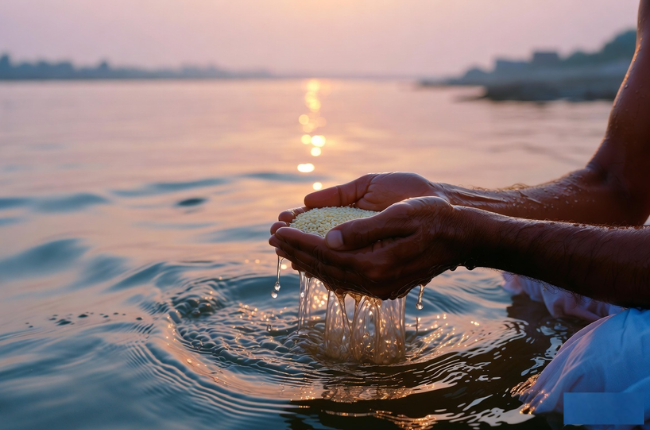
- Perform Jal Tarpan every Amavasya. On every new moon day, stand facing south, cup both hands, fill with clean water mixed with black sesame (kala til), and pour southward three times while mentally naming your father, grandfather, and great-grandfather. This is the minimum ancestral offering and requires no ritual qualification to perform.
- Feed a crow every Saturday and Amavasya. Classical Pitru tradition holds that crows are the form through which departed ancestors most readily receive offerings. Place cooked rice mixed with sesame and a small amount of ghee on the rooftop or an open space before eating your own meal on these days.
- Feed Brahmins on the death anniversary (Tithi) of each ancestor. If feeding Brahmins is not practical, offer cooked food, white cloth, and dakshina at a temple on the ancestor's Tithi date. The Tithi — not the calendar date — is the correct timing marker.
- Light a sesame oil lamp facing south every Saturday evening. Place the lamp at the south wall of the home, light it at dusk, and let it burn for at least 15 minutes. South is the direction of Yama, the lord of death, and a lamp in this direction on Saturn's day is among the simplest and most consistently recommended Pitra Dosha remedies across multiple Shastra traditions.
- Recite the Pitra Gayatri Mantra 108 times daily. The mantra — "Om Pitrabhyah Devatabhyah Mahayogibhyash cha Vaishnavebhyah, Swadhayai Swaahayai Nityameva Namah" — is recited facing south in the morning after bathing. Begin on a Saturday or Amavasya for strongest alignment.
- Donate on behalf of departed ancestors. The classical Daan items for Pitra Dosha are: black sesame, rice, black lentils (urad dal), a black cloth, and iron items. Donate to a poor family or a temple on a Saturday or during Pitru Paksha. The donation must be made in the name of the ancestor — say their name aloud before giving.
- Avoid meat, alcohol, and family conflict during Pitru Paksha. The 16-day period of Pitru Paksha (Bhadrapada Purnima to Sarvapitri Amavasya) is the primary window for ancestral remediation. Classical Shraadh tradition holds that the ancestors are most receptive during this period and that the family's conduct during these 16 days carries amplified karmic weight.
What the Garuda Purana Says About Ancestor Peace
The Garuda Purana is the primary classical authority on the post-death journey of the soul and the obligations of the living toward the departed. It is among the 18 Mahapuranas and is traditionally recited in the home during the mourning period after a death — its content is directly relevant to Pitra Dosha because it maps precisely which ancestral conditions create ongoing obstruction for the living family.
The Garuda Purana identifies three categories of souls that are most likely to generate Pitra Dosha for their descendants:
- Souls who died with strong unfulfilled desires — particularly desires related to property, unresolved family disputes, or the wish to see a child married or established
- Souls who experienced a sudden or violent death — accident, suicide, or death in war — whose transition was incomplete and whose prana did not complete its natural departure cycle
- Souls whose last rites were performed incorrectly, partially, or not at all — including those who died far from family, whose bodies were never recovered, or whose Shraadh was discontinued after one or two years
The Purana specifies that for the third category, a Tripindi Shraddha — a special Shraadh ceremony for ancestors whose rites were incomplete — is the prescribed remedy. This ceremony must be performed at a Kshetra (pilgrimage site) associated with ancestral rites: Gaya in Bihar is the most authoritative, followed by Nashik in Maharashtra and Rameswaram in Tamil Nadu. The ceremony involves three-generation Pind Daan and is conducted by a Pandit specialising in ancestral rites, not a general puja Pandit.
Vedic Essence: The classical teaching on this point holds that a soul that has received complete Shraadh — offered with sincerity, in the correct Tithi, with water and sesame — releases its attachment to the living family and becomes instead a source of protection and blessings rather than obstruction. The transformation of an afflicted Pitr into a protective Pitr is the actual goal of all Pitra Dosha remediation.
One Question Families Never Find Answered: Does Pitra Dosha Transfer Through the Daughter's Bloodline
This question appears consistently in Reddit threads on r/jyotish and r/hinduism, and in Quora discussions on ancestral karma — with almost no satisfying classical answer provided anywhere online. The concern is real: when a daughter marries into a new family, does she carry her paternal Pitra Dosha into her husband's household, potentially affecting her children through both bloodlines simultaneously?
The classical framework, drawing from the Dharmashastra tradition and the Grihyasutra's treatment of Gotra (ancestral lineage), provides a clear answer that is almost never published. A daughter carries her father's Gotra and its karmic imprint in her birth chart — this does not disappear at marriage. Her chart-based Pitra Dosha (Type 1) remains active regardless of which household she enters. However, the Kula Pitra Dosha (Type 2) — the lineage-based ancestral affliction — transfers alignment at the time of the Saptapadi (the seven steps in the marriage ceremony). At that point, the Grihyasutra tradition holds that the daughter formally enters her husband's Gotra and her primary ancestral obligations shift to her husband's lineage.
This means a married daughter with Type 1 chart-based Pitra Dosha must continue her own individual remedies (Tarpan for her paternal ancestors, Sun-strengthening practices) while also participating in her husband's family's Shraadh and Kula Dharma practices. The two streams of obligation are parallel, not competing. A Pandit familiar with the family's Gotra tradition will know exactly how to balance both streams in the annual Pitru Paksha observances.
The Pitru Paksha Connection — Why One Month Changes Everything
Pitru Paksha — the 16-day lunar fortnight in the month of Bhadrapada, falling between Purnima and Sarvapitri Amavasya — is the single most powerful window in the entire year for Pitra Dosha remediation. The Vishnu Purana explains that during this period, the gates between the Pitru Loka (the realm of ancestors) and the living world are open in a way that does not occur at any other time in the year. Ancestral souls are at their most receptive, and the karmic weight of offerings made during Pitru Paksha is described in the classical texts as multiplied many times beyond the same offering made on an ordinary day.
What Must Be Done During Pitru Paksha
- Shraadh on the ancestor's Tithi — every ancestor should be offered Shraadh on the lunar date that corresponds to the day they passed away. If the Tithi is unknown, Sarvapitri Amavasya (the final day of Pitru Paksha) covers all ancestors simultaneously.
- Pind Daan — rice balls mixed with sesame, barley flour, honey, and ghee, offered at a riverbank or in the home while facing south, accompanied by Tarpan water
- Brahmin feeding or temple donation — on each Shraadh day, a donation of food or materials in the ancestor's name
What to Avoid During Pitru Paksha
- No auspicious ceremonies (weddings, Mundan, Griha Pravesh) should be scheduled during these 16 days
- No purchase of new property or vehicles
- No meat or alcohol consumption within the household
- No family disputes — classical tradition is emphatic that internal family conflict during Pitru Paksha directly undermines the Shraadh's efficacy
For the complete Pitru Paksha ritual framework including Tarpan Vidhi, Pind Daan steps, and Tithi-matching guidance, the Pitru Paksha Tarpan Complete Guide provides the full sequence. For families also dealing with Pitra Dosha effects on marriage timing, the Marriage Delay Solutions and Complete Vedic Poojas Guide addresses the intersection of ancestral karma and marriage obstruction in detail.
🗣️ Community Voice A question that comes up repeatedly across Quora and r/jyotish: "My father passed away two years ago but we could not perform proper last rites because we were in a foreign country. The family has been through financial loss and one broken engagement since then. Is this Pitra Dosha?"
Classical Vedic tradition holds that incomplete last rites are among the most clearly documented causes of Kula Pitra Dosha. Distance does not break the ancestral bond — it delays the remedy. The correct response is a Tripindi Shraddha or Narayan Bali ceremony performed at a Kshetra, combined with a dedicated Pind Daan session during the next Pitru Paksha. This can now be arranged as a Live E-Pooja through AtoZPandit.com for families living outside India, with a verified Pandit performing the ceremony at the appropriate Kshetra on the family's behalf.
FAQ: Pitra Dosha Symptoms and Remedies
Q1. What are the main Pitra Dosha symptoms to look for in a family? The clearest signs are repeated marriage delays on the paternal side, recurring financial loss without logical cause, difficulty conceiving or recurring miscarriages, and male members unable to sustain career progress. When three or more of these patterns repeat across two generations, classical Jyotish tradition treats Pitra Dosha as a confirmed diagnosis.
Q2. How do I know if I have Pitra Dosha in my birth chart? Pitra Dosha in a birth chart appears as Sun conjunct Rahu, Sun conjunct Ketu, or Sun conjunct Saturn in the ninth house. A weakened ninth house lord — placed in the sixth, eighth, or twelfth house — is another strong indicator. A qualified Jyotishi reads these placements alongside the current Dasha period to assess the dosha's active intensity.
Q3. Can Pitra Dosha affect daughters, or only sons in the family? Pitra Dosha affects all family members through the paternal bloodline — sons, daughters, and grandchildren equally. A daughter carries the chart-based affliction in her own birth chart regardless of her gender. After marriage, her lineage-based obligations shift toward her husband's Gotra, but her individual chart remedies remain unchanged. Personal outcomes vary with individual karma and sincerity of practice.
Q4. What is the fastest home remedy for Pitra Dosha without a Pandit? Jal Tarpan on every Amavasya — water mixed with black sesame offered southward while naming three generations of paternal ancestors — is the most accessible and classically grounded home remedy. Feeding crows on Saturdays and lighting a sesame oil lamp facing south at dusk on Saturn's day are the two supporting practices. These three together form the minimum home practice.
Q5. How do I know if Pitra Dosha in my Kundli has been removed after remedies? The classical indicators of Pitra Dosha resolution are gradual and observed across months, not days. Marriage obstructions lift, financial accumulation begins where leakage was constant, and disturbing dreams of ancestors are replaced by peaceful or absent dream states. As astrological tradition holds, individual outcomes vary with karma — remedies create the correct conditions, not guaranteed results.
Q6. What happens if Pitra Dosha is never remedied across generations? The Garuda Purana is direct on this point: unaddressed Pitra Dosha compounds across generations. Each generation that fails to perform Shraadh adds to the ancestral longing, and the obstructions in health, marriage, and finance deepen accordingly. The dosha does not disappear through time alone — only through conscious ritual action and behavioural change toward living elders.
Q7. Which is the best day to perform Pitra Dosha remedies at home? Which day of the week is best for doing Pitra Dosha puja at home? Saturday is the most powerful weekly day for Pitra Dosha remedies because Saturn governs karmic debt and ancestral obligation in Vedic astrology. Amavasya — the new moon day — is the strongest monthly window. The annual Pitru Paksha fortnight carries the greatest cumulative power for all ancestral remediation practices.
Conclusion
Pitra Dosha carries a principle that runs through the heart of Vedic family tradition — the living and the departed are not separated by death but remain connected through karma, memory, and ritual obligation. The ancestors who came before you shaped the conditions of your birth, and your treatment of their memory shapes the conditions of your children's lives. Begin this Amavasya with Jal Tarpan — stand facing south, pour water mixed with black sesame in the names of your father, grandfather, and great-grandfather, and speak the offering aloud. That single act, done with sincerity, begins the correction. Classical Vedic practice holds that the peace and prosperity that ancestral harmony brings are fully available to any family willing to honour the connection — and the reminder always holds that outcomes rest with karma, genuine intention, and the grace of the Pitrs themselves.
Connect with AtoZPandit.com to book a verified Pandit for Pitru Paksha Shraadh, Tarpan, Pind Daan, or a Narayan Bali ceremony — performed onsite or as a Live E-Pooja at the Kshetra of your choice. For ancestral dosha assessment, Kundali-based Pitra Dosha reading, and personalised remedy prescription, reach AtoZPandit.com today.
Disclaimer: This article is intended for educational and cultural awareness purposes only. The Vedic and Jyotish information provided is rooted in classical tradition and does not substitute for professional medical, psychological, or legal advice. For personalised guidance on ancestral remediation, connect with AtoZPandit.com.