Evil Eye Protection Rituals How to Remove Nazar and Clear Home Energy
Most Indian families know the feeling without being able to name it precisely. The business was doing well — genuinely well — and then suddenly, without any clear external reason, everything slowed. The child who was healthy and thriving began falling ill every other week for no reason the doctor could identify. The new home that felt so full of possibility started carrying a heaviness that no amount of cleaning or rearranging could remove. The elders in the family nod when they hear this. They know what to look for. They know what to do. But the generation that grew up without sitting close enough to watch and learn is left with a feeling they cannot name and a gap where the knowledge should be.
What the Vedic tradition calls Nazar Dosha — and what most Indian families know as Buri Nazar or the evil eye — is among the most widely experienced and least formally documented phenomena in classical Indian knowledge. It is not a superstition in the dismissive sense that word implies. The Atharva Veda, one of the four foundational Vedic texts, contains specific hymns — Drishti Dosha Shanti verses — addressed to the harm caused by an envious or intensely focused human gaze. The Garuda Purana describes the mechanism by which concentrated negative emotion, projected through the eyes or the mind, can disturb the energetic field of another person, a household, or a child. The classical tradition took this seriously enough to preserve detailed remedial protocols across multiple text traditions — protocols that most Indian families have lost access to in the last two generations.
What most articles on this subject miss is the distinction between the folk remedies that circulate widely — the lemon, the chilli, the blue bead — and the classical Vedic protocols that explain why those remedies work, what they are actually doing energetically, and under what conditions they are sufficient versus when a more complete ritual intervention is required. This guide covers the classical understanding of evil eye and negative energy, how to identify its presence in a home or on a person, the complete step-by-step ritual remedies the tradition prescribes, the specific mantras and their mechanisms, and two questions that real families ask that no published article has answered with genuine Vedic grounding.
What Evil Eye and Negative Energy Actually Are — The Classical Framework
The Vedic tradition does not treat Nazar Dosha as a single, undifferentiated phenomenon. Classical texts distinguish between several types of harmful energetic influence, and the remedy prescribed depends on which type is operating.
The Three Classical Categories of Harmful Energetic Influence
- Drishti Dosha — harm caused by a concentrated, emotionally charged gaze. The Atharva Veda uses the term Abhichara Drishti for a gaze charged with envy, desire, or malice. The classical understanding is that the human eye, under certain emotional conditions, projects a concentrated energy that can disturb the Prana (vital force) field of the person or object it is directed at. Children, pregnant women, new businesses, and recently acquired wealth are considered most susceptible — because their energetic fields are either underdeveloped, transitional, or newly formed and therefore less stable.
- Nazar Dosha — the broader category that includes not just gaze-based harm but the cumulative effect of repeated admiration, envy, or concentrated attention from multiple sources. A family that has recently experienced visible success — a new home, a business expansion, a child's achievement — draws collective attention that can, in the classical framework, create an accumulation of energetic disturbance even without any single source of malice.
- Grihya Dosha — negative energy that has accumulated in a home's physical space through a history of conflict, suffering, or incomplete ritual — without necessarily being directed at the current residents by any external source. This is distinct from Nazar Dosha in both its cause and its remedy. A home that carries Grihya Dosha requires a different remedial sequence from a home or person affected by Buri Nazar.
How the Classical Texts Explain the Mechanism
The Garuda Purana describes the mechanism of Drishti Dosha in terms of Teja — the radiant energy field that surrounds every living being and every newly created or acquired thing. When a person with strong emotional charge — particularly envy — directs their gaze or thought toward another's Teja field, the classical tradition holds that a portion of the observing person's own energetic disturbance is transferred into the field of the observed. The remedy protocols are therefore not merely symbolic — they are designed to clear the received disturbance from the affected person's or home's energetic field and restore the integrity of the Teja.
How to Identify Evil Eye and Negative Energy — Signs the Classical Tradition Recognises
Identifying whether a home or person is genuinely affected by Nazar Dosha — as opposed to ordinary illness, financial difficulty, or household conflict — requires looking for a specific pattern of signs that the classical tradition documents across the Atharva Veda hymns and the Grihya Dosha Shanti texts.
Signs of Evil Eye on a Person
- Sudden unexplained fatigue or heaviness that begins after a public success, gathering, or occasion where many people were present
- Repeated minor illnesses in a child that begin after a period of visible health and growth — particularly after the child has received extensive admiration from visitors
- Persistent headache, eye discomfort, or a feeling of mental fog that arrived abruptly without physical cause
- Loss of appetite or disturbed sleep beginning after a positive life event — a promotion, a new purchase, a wedding — rather than a difficult one
- A general feeling of being watched or followed, accompanied by inexplicable unease in social settings
Signs of Evil Eye or Negative Energy in a Home
- A household that was harmonious experiencing sudden, repeated conflict among family members without identifiable cause
- A business or income source that was growing steadily plateauing or declining immediately after becoming publicly visible
- Persistent heaviness in a specific room — particularly the entrance, the main bedroom, or the kitchen — that cleaning and rearranging does not remove
- A series of small but cumulative misfortunes — appliances breaking, minor accidents, financial leakages — arriving in clusters rather than in isolation
- Plants dying repeatedly in the home despite proper care — classical Vastu tradition holds that plants are sensitive indicators of a home's energetic quality
The Classical Diagnostic Test — Rai or Salt Method
The most widely practised classical diagnostic for Nazar Dosha — documented in the Grihyasutra folk commentary traditions — uses mustard seeds (Rai) or rock salt (Sendha Namak). Circle the affected person's head seven times with a fistful of Rai or salt in a clockwise direction while holding the sincere intention of drawing out the Nazar. Then throw the Rai or salt into a fire or flowing water. If the seeds crackle loudly and pop when they hit the flame — more than would be expected from their natural moisture content — the classical tradition interprets this as confirmation of Nazar Dosha's presence. This test is diagnostic, not remedial — it identifies the presence of the condition but does not remove it.
Complete Step-by-Step Home Protection Rituals — What to Do Today
The classical tradition prescribes a graduated remedial approach — beginning with the simplest daily protective practices and moving toward more complete ritual interventions where required.
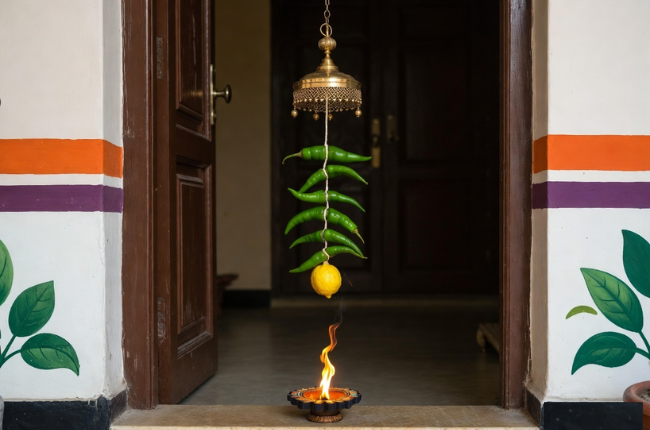
- Hang Nimbu Mirchi at every entrance. Thread one lemon and seven green chillies on a cotton thread and hang it at the main door and any secondary entrance used regularly. Replace every Saturday — the old Nimbu Mirchi is disposed of at a road crossing away from the home, never in the home's own dustbin. The lemon absorbs negative energy through its acidic composition, which the Tantra tradition associates with Shoshana — absorption and neutralisation. The chillies, through their sharp Tikshna quality, are held to repel incoming negative energy before it crosses the threshold.
- Perform the Rai and Red Chilli Nazar Utarna for family members weekly. Take seven dried red chillies and a fistful of mustard seeds. Circle them around the head of each family member seven times in a clockwise direction on Saturday evening. Burn them on the gas flame or in a small fire outside the home. Do not inhale the smoke — stand upwind. Perform this for every family member, beginning with the youngest child and ending with the eldest.
- Apply a black Tilak or Kajal dot behind the ear or on the sole. For infants and young children particularly susceptible to Nazar — classical tradition holds that children under five have not yet developed stable Teja fields — a small black dot (Kala Tika) placed behind the ear or on the sole of the foot serves as a protective deflector. The black colour absorbs rather than reflects the incoming gaze. This is why a small asymmetrical Kajal dot is traditionally placed on a child's forehead or cheek — to deliberately create an aesthetic imperfection that breaks the concentrated admiring gaze before it can form a directed energetic transfer.
- Salt-water floor mopping — weekly for negative energy clearance. Dissolve two tablespoons of rock salt in a bucket of water and use it to mop all floors of the home on Saturday morning before sunrise. The classical rationale — documented in the Tantra household protection traditions — is that salt absorbs and neutralises accumulated negative energetic residue in the home's physical space. After mopping, dispose of the salt water outside the home — pour it at the base of a large tree or at a road crossing.
- Light camphor (Kapoor) in every room weekly. Burn a camphor tablet in a small brass holder and carry it through every room of the home in a clockwise direction on Thursday or Saturday evening. The camphor smoke is held in the classical tradition to purify the Vayu (air element) of the space — its sharp, penetrating quality clears energetic residue that incense alone does not address. Ensure every corner, the space under beds, and the area behind doors is reached by the smoke.
- Place a Nazar Battu or black horseshoe at the main entrance. A black ceramic or iron Nazar Battu — the eye-shaped protective symbol — hung above the main door deflects incoming Drishti Dosha before it enters the home's energetic field. A black horseshoe (Kala Ghoda ki Naal) nailed above the door with the open end facing upward is prescribed specifically for Saturn-related negative energy — particularly effective for homes that have experienced repeated financial difficulty or conflict.
- Perform Dhoop with Guggul or Loban on Saturdays. Burn Guggul (Indian bdellium resin) or Loban (frankincense) on a piece of burning charcoal and carry it through the home in a clockwise direction. These specific resins are prescribed in the Atharva Veda tradition for energetic purification — their smoke is described as carrying a Raksha (protective) quality that ordinary incense does not.
The Mantras for Evil Eye Protection — Classical Sources and Correct Application
Mantra is the most powerful tool in the classical evil eye protection system — more lasting than any physical remedy and more precise in its application. The following mantras are prescribed across the Atharva Veda and Drishti Dosha Shanti traditions.
Suktam for Drishti Dosha Removal
The Atharva Veda contains specific Drishti Dosha Nashaka hymns — verses directly addressed to the dissolution of harm caused by a concentrated harmful gaze. These hymns are recited by a trained Pandit during a formal Nazar Dosha Shanti Puja — they are not casual recitations because their correct Sanskrit pronunciation is essential to their vibrational efficacy.
The Hanuman Chalisa for Daily Protection
The Hanuman Chalisa — the forty-verse devotional composition by Tulsidas — contains within its structure specific protective verses that the Ramacharitmanas tradition holds to be effective against Buri Nazar, evil eye, and negative entities. Verse 36 of the Chalisa specifically addresses Hanuman's power to remove all difficulties and afflictions. Daily recitation — particularly on Tuesdays and Saturdays — is the most widely prescribed daily protective mantra practice in the North Indian tradition for Nazar Dosha protection.
Maha Mrityunjaya Mantra for Severe Cases
Where the Nazar Dosha has produced physical symptoms — persistent illness in a child, sudden health decline in an adult — the Maha Mrityunjaya Mantra from the Rigveda is the classical prescription. Its 108 repetitions, performed over twenty-one consecutive days, are described in the Shiva Purana as restoring the depleted Prana field that severe Drishti Dosha produces.
Navagraha Stotra for Home Protection
When the negative energy affecting the home appears connected to planetary influences — the classical tradition sometimes identifies Rahu and Saturn as amplifiers of incoming Nazar Dosha — the Navagraha Stotra recitation on Saturdays, combined with the physical remedies above, creates a layered protection that addresses both the energetic and the astrological dimensions simultaneously.
Did You Know The Atharva Veda — the fourth and youngest of the four Vedas — devotes an entire section to protective hymns against Drishti Dosha, negative entities, and harmful energies. This section, the Kanda dealing with Abhichara and Raksha, contains over fifty hymns specifically addressing the phenomenon that modern families call the evil eye. This makes the Vedic documentation of evil eye protection one of the oldest recorded systems of energetic protection in human civilisation — predating similar traditions in the Middle Eastern, Mediterranean, and European cultures by centuries.
The Classical Distinction Most Families Miss: Nazar Dosha Versus Graha Dosha
One of the most important — and most consistently confused — distinctions in Indian protective ritual is the difference between Nazar Dosha (evil eye, externally projected) and Graha Dosha (planetary affliction, internally generated through the natal chart). The remedies for each are different. Applying evil eye remedies to a planetary affliction — or vice versa — produces no benefit because the two conditions operate through entirely different mechanisms.
How to Tell the Difference
Nazar Dosha typically has a clear onset point — the difficulty began after a specific event, occasion, or period of heightened visibility. Its effects are often sudden rather than gradual, affect multiple family members or domains simultaneously, and respond to the physical and mantra remedies described above within a relatively short time when correctly applied.
Graha Dosha operates through the natal chart — it is a pattern the person or family carries from birth, unfolding through the planetary Dasha and transit system. Its effects are typically more persistent, more structured in their timing, and do not respond to Nazar Dosha remedies because its cause is not external projection but internal karmic configuration.
When Both Are Present Simultaneously
The classical tradition recognises a third category — a household or individual carrying an active Graha Dosha that has also attracted Nazar Dosha, because the weakened energetic field that a difficult planetary period creates makes the person more susceptible to external energetic disturbance. In this case, both must be addressed — the Nazar Dosha remedies clear the external disturbance, and the Graha Shanti Puja addresses the underlying planetary affliction. Applying only one without the other produces partial and temporary relief.
As many families discover when they sit with their Pandit for a complete assessment — the question of whether the family is experiencing Nazar Dosha, Graha Dosha, or both is the most important diagnostic question in the entire remedial process. The remedy map changes completely depending on the answer.
Protecting Children From Evil Eye — The Tradition's Most Urgent Priority
The classical tradition's most detailed evil eye protection protocols are written specifically for children — because children, particularly those under five, are the most susceptible to Drishti Dosha. The Grihyasutra traditions across multiple regional schools contain dedicated sections on child protection from the evil eye, reflecting how central this concern was to classical household practice.
Why Children Are Most Vulnerable
The classical explanation is physiological in the Vedic sense: a young child's Teja field — the radiant energetic envelope that surrounds every living being — is not yet fully consolidated. Unlike an adult's Teja, which has been strengthened through years of experience, social interaction, and accumulated personal karma, a child's Teja is fluid, bright, and undifferentiated. It is this brightness — the vitality and innocence that makes a child so attractive to the admiring gaze — that also makes the child most susceptible to the disturbance that a concentrated emotional gaze can introduce.
Classical Child Protection Practices
- The Kala Tika — the small black dot placed on the child's forehead, chin, or behind the ear after bathing, renewed daily. The asymmetry it creates in the child's appearance breaks the concentrated admiring gaze before it can form a directed energetic transfer.
- The protective black thread (Kala Dhaga) — tied around the child's wrist or ankle on a Saturday by the eldest female member of the household, with a sincere protective intention. Replaced monthly on the next Saturday.
- Avoiding public display of the child's achievements immediately after they occur — classical family tradition held that a child's new accomplishment — first steps, first words, a school award — should not be broadly shared or celebrated publicly for at least three days after the event. The delay allows the child's energetic field to stabilise around the new capacity before it draws concentrated attention.
- The Nazar Utarna ritual after every large gathering — whenever a young child has been exposed to many people at a social event, a family gathering, or a religious occasion, the Rai and red chilli ritual is performed that same evening before the child sleeps.
Community VoiceA mother on a parenting forum asked: "My one-year-old was perfectly healthy until we had a big family gathering for his birthday. Within three days he had a fever, then an ear infection, then a stomach issue — all within two weeks. The doctor says nothing is seriously wrong but he just won't settle. Could this be Nazar?"
The classical answer is yes — this pattern precisely matches the Drishti Dosha timeline documented in the Grihyasutra tradition. A large gathering with many emotionally charged adults directing concentrated admiration at a young child is the highest-risk scenario for Nazar Dosha in classical household protection literature. The remedy is immediate: perform the Rai and red chilli Nazar Utarna that same evening, apply the Kala Tika daily for the next twenty-one days, and recite the Hanuman Chalisa over the child's head for seven consecutive evenings. If symptoms persist beyond seven days of this practice, a formal Nazar Dosha Shanti Puja performed by a qualified Pandit is the next step.
What Almost No Article Covers: How Negative Energy Accumulates in a Home Over Generations — and How to Clear It Completely
This question surfaces in Reddit and Quora threads on home energy and Vastu — typically from families who have moved into an ancestral property or an older home and cannot understand why the protective rituals they perform produce only temporary relief. The Nimbu Mirchi is replaced weekly. The camphor is burned regularly. But the heaviness returns.
The classical answer draws on the concept of Vastu Dosha combined with Grihya Sanchita Karma — the accumulated karmic residue of everyone who has lived, suffered, and died within a home's walls over multiple generations. A home that has housed a long illness, a suicide, a significant betrayal, or repeated financial failure carries an energetic imprint in its physical structure — particularly in its walls, foundations, and the space beneath the main threshold — that the standard Nazar Dosha remedies are not designed to clear. These remedies address incoming negative energy. They do not address accumulated historical energy that has settled into the space itself.
The classical remedy for this deeper form of negative energy accumulation is a Vastu Shanti Puja combined with a Griha Dosha Shanti — a formal ritual sequence that the Grihyasutra tradition prescribes for homes that carry the energetic residue of past suffering. The ritual sequence includes:
A Navagraha Homa to address any planetary afflictions associated with the land the home stands on. A Vastu Purush Mandala Puja — the invocation and appeasement of the Vastu Purush, the classical entity held to govern the energetic integrity of a built space. A Griha Shanti Japa — the recitation of specific protective mantras in every room of the home, consecrating each space fresh. And a Kshetrapal Puja — the honouring of the protective deity of the land itself, asking for the release of whatever karmic residue has accumulated on that ground.
This is not a ritual that can be approximated with daily home practices. It requires a trained Pandit who knows the complete Vastu Shanti Vidhi — and it is most effective when performed on a day specifically chosen for its Muhurta alignment with the home's founding date or the current residents' Lagna charts. After a correctly conducted Vastu Shanti and Griha Dosha Shanti, the standard weekly protective practices — camphor, salt mopping, Nimbu Mirchi — maintain the cleared field rather than fighting against accumulated residue.
FAQ
What are the signs of evil eye on my home and family? Classical signs of Nazar Dosha include sudden unexplained conflict in a previously harmonious household, repeated minor illness in children after social gatherings, a business plateauing immediately after becoming publicly visible, and persistent heaviness in the home that cleaning does not remove. The onset is typically sudden and linked to a specific event or period of heightened visibility rather than building gradually over time.
How do I remove evil eye from my child at home using Vedic methods? Perform the Rai and red chilli Nazar Utarna the same evening after any large social gathering — circle seven red chillies and mustard seeds around the child's head seven times clockwise and burn them outside the home. Apply a Kala Tika daily after bathing. Recite the Hanuman Chalisa over the child's head for seven consecutive evenings. If symptoms persist beyond seven days, a formal Nazar Dosha Shanti Puja performed by a qualified Pandit is the classical next step.
Which mantra is most effective for evil eye protection at home? The Hanuman Chalisa recited daily — particularly on Tuesdays and Saturdays — is the most widely prescribed protective mantra in the North Indian tradition for Nazar Dosha. For severe cases involving physical symptoms, the Maha Mrityunjaya Mantra recited 108 times over twenty-one consecutive days is the classical prescription from the Shiva Purana tradition. As astrological tradition holds, individual outcomes vary with karma and sincerity.
Is evil eye the same as Graha Dosha in Vedic astrology? Nazar Dosha and Graha Dosha are distinct conditions requiring different remedies. Nazar Dosha is externally projected — caused by a concentrated emotional gaze — and typically has a clear onset point linked to a specific event. Graha Dosha is internally generated through the natal chart and unfolds through the planetary Dasha system. Both can be present simultaneously. A qualified Pandit's assessment is essential to identify which condition — or combination — is operating before prescribing remedies.
How often should I perform evil eye protection rituals at home? The classical tradition prescribes weekly protective maintenance — Nimbu Mirchi replacement on Saturdays, salt-water floor mopping on Saturday mornings, and camphor burning through the home on Thursday or Saturday evenings. The Rai and red chilli Nazar Utarna for family members is performed weekly on Saturdays and additionally after any large social gathering. Daily practices — Kala Tika for children, Hanuman Chalisa recitation — maintain the protective field between weekly rituals.
What is the difference between Nimbu Mirchi and other evil eye protection methods? Nimbu Mirchi — one lemon and seven green chillies on a cotton thread — is a threshold protection device, absorbing and deflecting incoming Nazar before it enters the home. The Kala Tika protects individuals from direct gaze. Salt-water mopping clears accumulated negative residue from the home's physical space. Camphor burning purifies the air element. Each method addresses a different dimension of protection — the classical tradition prescribes all of them in combination, not as alternatives to each other.
When should I get a formal Nazar Dosha Shanti Puja done by a Pandit? A formal Nazar Dosha Shanti Puja is indicated when home remedies produce only temporary relief, when physical symptoms in a child persist beyond seven days of home practice, when business or financial difficulty continues despite the absence of any identifiable practical cause, or when the home carries a heaviness that standard weekly practices do not clear. A Vastu Shanti Puja is additionally indicated for older or ancestral homes carrying accumulated historical negative energy.
Conclusion
Evil eye protection is one of the oldest and most practically grounded areas of Vedic household knowledge — preserved across the Atharva Veda, the Grihyasutra traditions, and two thousand years of family practice because it addresses something real that Indian families have consistently observed and consistently needed tools to manage.
Begin today with the simplest practices: hang Nimbu Mirchi at your main entrance this Saturday, perform the salt-water floor mopping before sunrise, and recite the Hanuman Chalisa in the evening. These three practices together form the foundational layer of classical evil eye protection that the tradition prescribes for every household, regardless of whether active Nazar Dosha is present — because protection is most effective before the disturbance arrives, not after.
As is commonly observed among families who maintain these practices with genuine consistency and sincerity — the home's atmosphere shifts in ways that are difficult to attribute to any single cause but impossible to dismiss. Classical Vedic tradition holds that the outcomes depend on karma, the regularity of the practice, and the sincere intention behind each ritual act. The evil eye is real. The protection is real. The tradition has held both truths for three thousand years, and the knowledge is available to every family willing to apply it correctly.
If your home or family is experiencing persistent negative energy, repeated illness, or unexplained difficulty that home practices have not resolved — AtoZPandit.com connects you with trained Vedic Pandits who conduct complete Nazar Dosha Shanti Puja, Vastu Shanti, and Griha Dosha Shanti rituals both onsite and through live online Pooja for families abroad. Book your Nazar Dosha assessment and Puja on AtoZPandit.com and give your home and family the complete classical protection they deserve.
Disclaimer This article is written for educational and cultural awareness purposes only. The Vedic ritual and protective practice information provided here does not substitute professional medical, psychological, or legal advice. For a complete and personalised Nazar Dosha or Vastu assessment, connect with a qualified Pandit at AtoZPandit.com.