
Face Reading Guide What Facial Features Reveal About Luck and Future
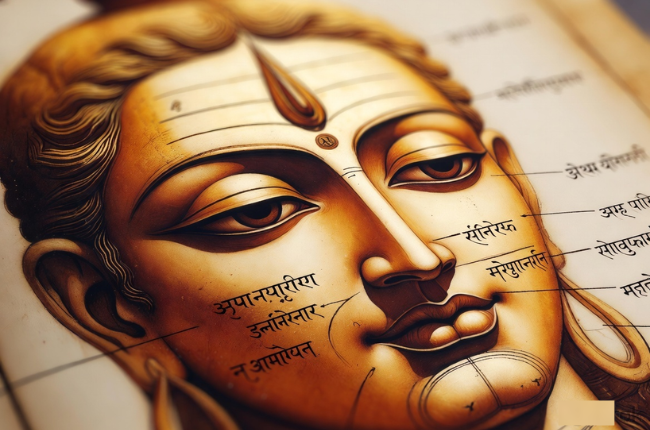
Most people have looked at someone's face and felt, without being able to explain why, that this person carries something heavy — or that they are going to be alright. That instinct is older than language. Long before psychology gave it a name, Indian classical tradition built an entire science around it. A grandmother who watched a prospective bride's forehead before saying yes to a match. A village elder who looked at a newborn's ears and nodded with quiet satisfaction. These were not superstitions — they were the living application of Samudrika Shastra, the classical Vedic science of body and face reading that has been transmitted in India for thousands of years.
Samudrika Shastra — whose name comes from the Sanskrit samudra (ocean) and lakshana (sign), meaning the reading of signs as vast as the ocean — holds that every feature of the human face is a map of the soul's journey: its karma, its planetary influences, its innate strengths, and the obstacles it carries. The Brihat Samhita of Varahamihira, one of the foundational classical texts of Indian predictive science, devotes entire chapters to Anga Lakshana — the reading of bodily and facial signs — as a legitimate and precise diagnostic tool used alongside Jyotish for a complete life reading.
What almost no face reading article in English explains is the planetary correspondence layer — the direct mapping between each facial zone and a specific Navagraha planet that governs it. Without this layer, face reading becomes surface observation. With it, the face becomes a second Kundali — readable, precise, and deeply illuminating. This guide covers every major facial feature in the classical system, what each reveals about luck, career, marriage, and character, and how the planetary map overlays the human face from forehead to chin.
Samudrika Shastra — The Classical Science Behind Face Reading
Samudrika Shastra is not a modern trend imported from Chinese or Western palmistry traditions. It is a structured classical science with documented roots in the Vedic tradition, transmitted across generations of Indian Pandits, royal court advisors, and Jyotishis as a companion discipline to Kundali reading.
The foundational principle of Samudrika Shastra is Yatha Pinde Tatha Brahmande — as in the microcosm, so in the macrocosm. The human body, and particularly the face, is understood as a physical record of the soul's karmic inheritance, planetary influences at birth, and the trajectory of the life being lived. Nothing on the face is arbitrary. Every prominence, every line, every proportion carries meaning within the classical framework.
The Classical Texts That Document Face Reading
The Brihat Samhita of Varahamihira — composed in the sixth century CE and regarded as one of the most comprehensive encyclopaedias of classical Indian predictive science — includes dedicated sections on Anga Lakshana (reading bodily signs) and Saamudrika (the science of marks). Varahamihira's treatment is systematic: facial features are categorised, their classical interpretations documented, and their correspondence with planetary forces mapped with precision.
The Garuda Purana also contains chapters on body-mark reading — Saamudrika Lakshana — establishing the tradition's authority within the Puranic canon. Regional Jyotish traditions, particularly in Kerala (Kerala Jyotisha) and Tamil Nadu (Nadi astrology), have preserved detailed face-reading protocols that extend Varahamihira's framework with regional specificity.
The Nine Planetary Zones of the Face
The classical Samudrika system maps the nine Navagraha planets directly onto nine zones of the human face. This planetary mapping is the framework that elevates face reading from observation to Vedic science:
- Sun (Surya) — the forehead centre; governs authority, fame, and professional standing
- Moon (Chandra) — the left cheek and lower facial fullness; governs emotional life, intuition, and family harmony
- Mars (Mangal) — the right eyebrow and brow ridge; governs courage, drive, and conflict patterns
- Mercury (Budha) — the nose bridge and tip; governs intelligence, communication, and commercial acumen
- Jupiter (Guru) — the right cheek and facial fullness overall; governs wisdom, fortune, and spiritual orientation
- Venus (Shukra) — the lips, mouth, and chin area; governs relationships, sensory life, beauty, and creative expression
- Saturn (Shani) — the jaw, lower cheeks, and facial bone structure; governs discipline, endurance, and karmic weight
- Rahu — the left eyebrow; governs unconventional traits, foreign connections, and hidden dimensions of character
- Ketu — the hairline and crown area of the face; governs spiritual inclinations, detachment, and past-life markers
As is commonly observed among Pandits trained in both Jyotish and Samudrika, a face reading that maps each zone against the corresponding Navagraha — and then cross-references the birth chart — produces a reading of extraordinary precision that neither tool alone can achieve.
How to Begin Reading a Face — The Classical Method Step by Step
The classical Samudrika method for reading a face is not random observation. It follows a structured sequence — from the overall facial shape down to individual features — that mirrors the way a Jyotishi reads a Kundali: broad strokes first, specific details second.
Step-by-Step Classical Face Reading Method
- Observe the overall facial shape first. Before looking at any individual feature, note the dominant shape of the entire face. Classical Samudrika identifies five primary face shapes — round, oval, square, triangular, and oblong — each with a distinct character and fortune profile .
- Assess the three facial zones. Divide the face horizontally into three equal zones:
- Upper zone (hairline to eyebrow line) — governs early life, education, and mental capacity
- Middle zone (eyebrow line to base of nose) — governs the middle years of life, career, and social standing
- Lower zone (base of nose to chin) — governs later life, relationships, material comfort, and legacy A face where all three zones are roughly equal in depth is the classical sign of a balanced life across all three phases. When one zone is significantly larger than the others, that phase of life carries the most activity — both opportunity and challenge.
- Read the dominant features. After the overall shape and three-zone assessment, move to the specific features in this classical order: forehead, eyebrows, eyes, nose, cheeks, lips and mouth, chin, ears, and facial lines. Each feature is read within its planetary zone before any interpretation is offered.
- Look for harmony and proportion. Classical Samudrika places great emphasis on proportion and harmony between features. A face where the features are proportionate and symmetrical — even if no individual feature is conventionally striking — is considered more auspicious than a face with one dramatically prominent feature surrounded by weak ones. Harmony across the face indicates harmony across life's domains.
- Note skin quality and natural complexion. The Brihat Samhita specifically notes that a clear, healthy skin tone — regardless of the specific shade — is associated with vitality, good health, and positive planetary influence. Persistent dullness, unusual marks, or asymmetric discolouration in specific facial zones are classical indicators of pressure in the corresponding planetary area.
- Never read a single feature in isolation. This is the most important rule in classical Samudrika. A broad forehead alone does not indicate leadership. A broad forehead combined with strong eyebrows, clear eyes, and a well-proportioned nose — read together — indicates leadership with the intelligence, drive, and judgment to sustain it. Always read the complete face before drawing conclusions about any single feature.
📿 MICRO-REMEDY BOX 1 — Did You Know
The word Samudrika is frequently translated as "palmistry" in popular English texts — a translation that misrepresents the science entirely. Classical Samudrika Shastra covers the complete body: face, hands, feet, skin marks, gait, voice, and even the quality of a person's shadow. Face reading is one chapter within a vastly larger system. Varahamihira's Brihat Samhita treats facial signs and palm signs as complementary readings — never substitutes for each other. A Pandit trained in the full Samudrika tradition reads both face and palm together, then cross-references the birth chart, before offering a complete life reading. What most people call "face reading" or "palmistry" is, in the classical system, one lens in a three-lens instrument.
Face Shape and What It Reveals About Fortune and Character
The overall shape of the face is the first and broadest indicator in classical Samudrika. It reveals the dominant life theme — the overarching quality that colours every area of fortune, character, and challenge.
Round Face — Moon Dominance
A round face with soft, full contours and a gentle jawline indicates strong Moon influence. Classical Samudrika associates round-faced individuals with emotional intelligence, intuition, nurturing instincts, and deep social warmth. These individuals build strong family networks and attract genuine loyalty from others.
Fortune profile: Well-suited to careers in public welfare, education, healthcare, and hospitality. Strong domestic luck — the home and family life tend to be stable and harmonious. Financial fortune comes through people and relationships rather than independent enterprise. The challenge for round-faced individuals is indecision — the same emotional sensitivity that makes them warm can make firm choices difficult.
Oval Face — Jupiter Dominance
An oval face — slightly longer than wide, with a gently rounded forehead and a softly tapered chin — is considered the most classically auspicious face shape in the Samudrika tradition. The Brihat Samhita describes the oval face as the sign of balanced planetary influence and the absence of extreme karmic pressure in any single life domain.
Fortune profile: Adaptable across career paths, naturally diplomatic, and capable of sustained professional and personal relationships. Fortune arrives steadily rather than dramatically. Marriage prospects are strong. The oval-faced person rarely experiences the violent peaks and troughs that other face shapes encounter — their path is consistent, if rarely spectacular.
Square Face — Mars and Saturn Dominance
A square face with a broad forehead, prominent jaw, and roughly equal width across all facial zones indicates strong Mars and Saturn influence. Classical Samudrika associates this shape with determination, physical stamina, administrative capability, and a strong sense of personal justice.
Fortune profile: Naturally suited to leadership, military, law enforcement, construction, and engineering. Professional life tends to be marked by sustained hard work rewarded over time — Saturn's pattern of slow but permanent gain. The challenge for square-faced individuals is rigidity — an unwillingness to adapt when circumstances change that can create unnecessary professional conflict.
Triangular Face — Mercury and Venus Dominance
A triangular face — wide at the forehead and narrowing significantly to a pointed or fine chin — indicates Mercury and Venus prominence. Classical tradition associates this shape with intellectual sharpness, creative intelligence, and strong communicative ability.
Fortune profile: Suited to careers in creative fields, communication, technology, writing, law, and commerce. Ideas come easily and social charm is natural. The narrow lower zone — chin and jaw — in classical Samudrika indicates that material consolidation and long-term security require deliberate effort. The person earns well but must work consciously to hold and build wealth.
Oblong Face — Sun Dominance
An oblong face — significantly longer than wide, with a prominent forehead and a well-defined chin — indicates Sun dominance. Classical Samudrika associates this shape with ambition, authority, self-reliance, and a strong need for recognition and respect.
Fortune profile: Naturally drawn to leadership, public life, government, and positions of authority. Professional fortune tends to be strong in the second half of life — the Sun's full expression takes time to develop. Marriage requires a partner who respects the person's strong sense of self. The challenge is pride — the same Sun-strength that creates authority can create inflexibility in personal relationships.
The Forehead — What It Reveals About Destiny, Mind, and Early Fortune
The forehead is governed by the Sun in the classical Samudrika planetary map and is considered the most important single feature for reading overall fortune, mental calibre, and professional destiny. The Brihat Samhita devotes more interpretive detail to the forehead than to any other single facial feature — a measure of its importance in the classical system.
Forehead Height and Width
- High, broad forehead: The classical sign of strong intellectual capacity, leadership potential, and good fortune in the first and middle phases of life. The person processes information quickly, thinks independently, and attracts respect from peers and authority figures. In career astrology terms, this forehead corresponds with a strong Sun placement — authority, recognition, and the ability to rise in hierarchical settings.
- Low or narrow forehead: Indicates a more cautious, methodical mental approach — the person thinks carefully before acting and prefers established systems over independent innovation. Fortune is more stable than spectacular. Not a negative indicator — many of the most consistent professional achievers carry a narrower forehead that reflects disciplined, structured thinking.
- Very wide forehead with prominent temples: Classical Samudrika associates this with exceptional memory, analytical depth, and the capacity for original thought. Often found on individuals drawn to research, scholarship, law, and strategic planning.
Forehead Lines and Their Classical Meanings
The horizontal lines that develop on the forehead with age are not merely signs of ageing in the Samudrika system — they are read as records of the life being lived.
- Three clear, well-defined horizontal lines: The classical sign of a fortunate, long, and respected life. The Brihat Samhita specifically mentions three full forehead lines as an auspicious marker associated with sustained prosperity and social standing.
- One strong central line: Associated with focused ambition and a life lived with singular purpose — often found on individuals in leadership, spiritual practice, or dedicated professional pursuit.
- Broken or fragmented lines: Indicate interrupted efforts — starts that do not complete, plans that are derailed before fruition. The specific zone of the break corresponds to the life phase affected.
- Vertical lines between the eyebrows (worry lines): Indicate sustained mental pressure, responsibility carried alone, and a tendency to absorb others' difficulties. One strong vertical line is associated with determination. Two vertical lines suggest persistent internal conflict between competing priorities.
A complete Kundli reading alongside the forehead reading gives the most precise indication of when forehead-line patterns will manifest most strongly — because the Kundali's Dasha timeline governs when natal potential activates.
Eyes, Eyebrows, and Ears — The Planets Closest to the Soul
In the classical Samudrika tradition, the eyes are described as the windows through which the soul's karma is most directly visible. No feature reveals character, emotional depth, and hidden fortune as immediately or as accurately as the eyes — which is why classical texts spend considerable detail on their reading.
What the Eyes Reveal
- Large, clear, well-spaced eyes: Associated with generosity, emotional openness, good fortune in relationships, and the capacity for genuine empathy. The Brihat Samhita identifies large, luminous eyes as a consistently auspicious marker — both for the person themselves and for those in close relationship with them.
- Deep-set eyes: Indicate a contemplative, inward nature — the person thinks before speaking, observes before acting, and carries emotional depth that is not immediately visible. Fortune tends to arrive through careful planning rather than spontaneous opportunity.
- Small, sharp eyes: Associated with analytical precision, business acumen, and the capacity to see details others miss. Can indicate a guarded emotional nature where trust is extended slowly and deliberately.
- Uneven eyes (one noticeably larger than the other): Classical Samudrika notes this as an indicator of imbalance between the public life (larger eye) and the private emotional life (smaller eye). The person projects strength in one domain while carrying quiet difficulty in the other.
- Eye colour and luminosity: Clear, bright eyes — regardless of colour — are consistently associated with vitality, positive planetary influence, and good health. Dullness or persistent redness in the eyes is read as a marker of Saturn or Rahu pressure in the corresponding Kundali period.
Eyebrows and Their Planetary Meaning
The right eyebrow is governed by Mars and the left by Rahu in the classical Navagraha facial map. Together, the eyebrows reveal drive, courage, relationship patterns, and the hidden dimensions of character.
- Full, well-arched eyebrows that do not meet: The classical sign of balanced drive and social grace — the person pursues goals with energy but with sufficient diplomacy to maintain relationships in the process.
- Eyebrows that meet at the centre (sandhiyukta bhrū): The Brihat Samhita treats this feature with nuance — in a woman's face, it is described as an indicator of strong personal will and independent character. In both contexts, it indicates a person who carries strong internal determination, sometimes at the cost of external harmony.
- Thin or sparse eyebrows: Associated with reduced Mars energy — the person may lack the sustained drive to push through sustained professional resistance. Often indicates a need for external support and encouragement to maintain momentum.
- High-arched eyebrows: Associated with strong aesthetic sense, high personal standards, and a natural tendency toward idealism in both relationships and professional life.
Ears — The Feature Nobody Reads Carefully
Ears are governed by Saturn in the classical system and are among the most consistently overlooked features in popular face reading. Classical Samudrika, however, treats the ears as a primary indicator of longevity, karmic endurance, and the quality of wisdom accumulated over a lifetime.
- Large, well-formed ears with a defined lobe: The classical sign of longevity, patience, and the capacity to accumulate wisdom over time. Large-eared individuals are described in the Brihat Samhita as people who build slowly but keep what they build — Saturn's characteristic pattern.
- Small ears: Associated with quicker decision-making, less patience for long-term processes, and a life that moves through phases rapidly. Not negative in itself — but combined with an impatient facial profile overall, may indicate difficulty sustaining long-term commitments.
- Ears that protrude noticeably: Classical tradition associates prominent ears with strong independent thinking — the person forms their own opinions and resists external pressure to conform. Often found in individuals drawn to unconventional career paths or independent enterprise.
- High-set ears (top of ear above eyebrow line): Associated in the classical system with high intelligence and the capacity for abstract or conceptual thinking. Common among individuals drawn to philosophy, mathematics, and strategic planning.
📿 MICRO-REMEDY BOX 2 — Myth vs. Fact
MYTH: Face reading is the same as physiognomy — the Western pseudoscience that linked facial features to criminal character or racial typology in the 19th century.
FACT: Classical Samudrika Shastra and Western physiognomy are entirely different in both origin and method. Samudrika Shastra is a Vedic science grounded in planetary correspondence and karmic inheritance — it reads the face as a map of the soul's journey, not as a deterministic biological stamp. It makes no claims about racial or ethnic features. Its interpretations are contextual, proportional, and always read in combination — never from a single isolated feature. The Brihat Samhita explicitly states that no single feature determines fortune; it is the harmony of the whole face, read alongside the birth chart, that reveals the complete picture.
Nose, Cheeks, and Lips — What the Middle and Lower Face Reveal
The middle and lower zones of the face — governed primarily by Mercury, Venus, Jupiter, and Saturn in the Navagraha facial map — reveal the quality of the middle and later years of life: career fruition, wealth accumulation, relationship depth, and the nature of the legacy a person builds.
The Nose — Mercury's Feature
The nose is governed by Mercury in the classical Samudrika system and is the primary feature for reading intelligence, commercial ability, and the quality of the middle years of professional life.
- Straight, well-proportioned nose: The classical indicator of balanced Mercury energy — clear thinking, honest communication, and steady professional progress through the middle years of life. The Brihat Samhita describes a straight nose as a consistent marker of trustworthiness in professional dealings.
- Broad, rounded nose tip (bulbous nose): Associated with material comfort and a strong instinct for financial accumulation. The person may not be a dramatic wealth creator but builds comfortable, sustained material security over time.
- Narrow, sharp nose: Indicates precision, analytical ability, and high standards — but can also indicate a tendency toward criticism of others and difficulty with compromise in professional relationships.
- Nose that turns upward at the tip: Classical Samudrika associates an upturned nose tip with difficulty in retaining wealth — money flows in and flows out with equal ease. The gemstone guide for Rashi and Lagna covers Mercury-strengthening gemstones for those seeking to address this pattern.
- Prominent nose bridge: Associated with strong willpower and the capacity for independent professional achievement.
Cheeks — Jupiter and Moon's Territory
Full, rounded cheeks indicate strong Jupiter and Moon influence — warmth, generosity, and the capacity to attract loyal relationships and professional supporters. Classical Samudrika consistently associates well-developed cheeks with social fortune.
Flat or hollow cheeks indicate reduced Jupiter energy in the facial map — the person may struggle to build and sustain the social network that professional advancement and personal happiness both require. This is not a permanent condition — Jupiter remedies, including Rudraksha selection and Thursday fasting, are classical supports for Jupiter-deficient facial profiles.
Lips and Mouth — Venus's Domain
The lips and mouth are governed by Venus and reveal the quality of relationships, sensory life, speech, and creative expression.
- Full, well-defined lips: The classical sign of Venus strength — warmth in relationships, natural sensory enjoyment, creative talent, and the capacity for deep personal loyalty. Strong marriage and partnership prospects in the classical reading.
- Thin lips: Associated with precision in speech — the person says exactly what they mean, no more. Can indicate emotional reserve and a difficulty with open emotional expression that requires conscious effort to overcome in close relationships.
- Upper lip significantly fuller than lower lip: Indicates generosity in giving but difficulty in receiving — the person gives freely but struggles to ask for or accept help from others.
- Lower lip significantly fuller than upper lip: Associated with strong sensory appetites and a tendency toward self-indulgence that requires discipline to channel productively.
- Corners of mouth that turn naturally upward: The classical sign of an optimistic nature and consistently positive social fortune — people are drawn to this person and doors open through personal connection.
Chin, Jaw, and Facial Marks — What the Lower Face Reveals About Later Life
The lower face — chin, jaw, and the area below the mouth — is Saturn's territory in the Samudrika planetary map. It governs the later years of life: material security in old age, the quality of legacy and memory left behind, endurance through difficulty, and the structural foundation of character.
The Chin — Saturn's Marker of Endurance
- Strong, well-defined, forward-set chin: The classical indicator of determination, resilience, and the capacity to endure sustained difficulty without breaking. The person finishes what they start. Saturn's most positive expression in the facial map — this chin belongs on those who achieve the most in the later decades of life.
- Receding chin: Associated with reduced capacity for confrontation and a tendency to yield under sustained pressure. Not an indicator of weak character — but of a person who needs a strong supportive structure around them to achieve their full potential.
- Cleft chin: Classical Samudrika treats a cleft chin as a Venus-Saturn combination marker — the person carries both strong relational warmth and significant personal endurance. Often found on individuals who build lasting professional and personal legacies through sustained emotional investment.
- Very broad, square chin: Mars-Saturn combination — strong physical endurance, competitive drive, and the capacity for extended sustained effort. Common in athletes, builders, and those who work with their hands or bodies.
The Jaw — The Foundation Line of Character
The jaw in classical Samudrika is read as the structural foundation of the personality — the part of the face that holds everything else together. A strong, well-defined jaw indicates a clear sense of personal identity and the structural integrity to maintain that identity under pressure. A soft or undefined jaw indicates fluidity of identity — the person adapts easily to social environments but may struggle to know and hold their own ground when it matters most.
Facial Marks, Moles, and Birthmarks
Classical Samudrika devotes considerable attention to tilaka — natural marks, moles, and birthmarks on the face. Their interpretation depends on position, colour, and shape. Key classical readings include:
- Mole on the right cheek: Associated with wealth, social fortune, and good family relationships — a consistently auspicious placement in both North and South Indian Samudrika traditions
- Mole on the left cheek: Indicates emotional sensitivity and a life that carries meaningful personal challenge alongside genuine warmth
- Mole on the forehead centre: The Brihat Samhita describes this as a sign of strong destiny — the person's life has a clear direction and a visible public impact
- Mole on the nose tip: Associated with financial impulsiveness — spending that arrives faster than it should — requiring conscious financial discipline
- Mole on the chin: Saturn's placement here indicates a person destined for endurance — a life that tests and ultimately strengthens the character through sustained challenge
As many families discover when they sit with a Pandit trained in Samudrika alongside their Kundali, the mole positions in the birth chart's Navamsha often correspond precisely with the most significant mole positions on the physical face — a correspondence that the classical texts document and that experienced practitioners find consistently reliable.
Two Questions No Face Reading Article Has Ever Answered — The Planetary Shift and the Child's Face
Two questions appear repeatedly in Reddit's r/hinduism and r/jyotish communities and across Quora threads on Samudrika Shastra — with no published answer anywhere in the existing web or YouTube landscape. Both deserve a classical response.
Can a Face Change Its Meaning Over Time — Does the Reading Shift?
This question — does a face reading done at 25 still hold at 45? — appears in dozens of unanswered community threads. The classical answer is nuanced and important.
Samudrika Shastra distinguishes between sthira lakshana (fixed signs) and chara lakshana (changing signs). Fixed signs — bone structure, facial shape, ear size, and birthmarks — are determined at birth and carry consistent interpretive value throughout life. They represent the soul's karmic inheritance and do not change.
Changing signs — forehead lines, skin quality, the development of cheek fullness or hollowness, the deepening of the chin line — evolve with age and with the active planetary Dasha periods. The Brihat Samhita notes that the face in the middle years of life reflects the active planetary influences of the current Dasha more than it reflects the birth condition. This is why a person under Saturn Mahadasha often develops a more angular, defined lower face over time — Saturn's structural energy shapes the physical features it governs.
The practical implication is significant: a face reading at 25 reads the natal potential. A face reading at 45 reads how that potential has been lived, which planetary period has most shaped the person, and what the later years are likely to bring. Both readings are valuable — but they are reading different layers of the same face.
What Does a Child's Face Reveal — and Is It Appropriate to Read It?
Another question that generates genuine community anxiety: is it appropriate to read an infant or young child's face, and what can it reveal about the child's future?
Classical Samudrika tradition holds that a child's face can and should be read — but with specific constraints. The sthira lakshana (fixed signs) present at birth — bone structure, ear shape and size, the basic facial proportions — are fully readable from the early months and are considered reliable indicators of the child's innate nature, dominant planetary influence, and general life trajectory.
What classical practitioners specifically caution against is over-reading the chara lakshana in a child's face — forehead lines, which are not yet formed, and cheek development, which is still in process. Drawing strong conclusions about career, marriage, or misfortune from a child's unformed features is considered a practitioner error in the classical tradition.
The most appropriate use of a child's face reading, as recorded in regional Samudrika traditions across Kerala and Tamil Nadu, is the identification of the dominant planet — the primary Navagraha whose features are most prominent in the child's face — and the corresponding strengthening of that planet through the child's Nakshatra birth star remedies and appropriate gemstone or deity practices suited to the child's age.
Face Reading for Marriage Compatibility — The Classical Approach
One of the most consistently searched applications of Samudrika Shastra — and one that carries the deepest emotional stakes for Indian families — is face reading for marriage compatibility. Before Kundali matching became the primary tool, face reading was the first layer of compatibility assessment used by families and Pandits across India.
What Face Reading Assesses in a Prospective Match
Classical Samudrika does not use face reading to judge attractiveness or social status — it reads the planetary harmony between two faces. The question it answers is: do the dominant planets in these two faces complement or conflict with each other?
- Sun-dominant face (oblong, strong forehead) matching with Moon-dominant face (round, soft contours): Classically considered harmonious — the Sun's drive and structure is balanced by the Moon's emotional warmth and adaptability. Strong marriage compatibility in the classical reading.
- Two Mars-dominant faces (square jaw, prominent brow) matching: Classical tradition flags this combination with caution — both partners carry strong will and confrontational energy. The marriage can work with exceptional mutual respect and conscious conflict management, but requires more deliberate effort than most combinations.
- Jupiter-dominant face (oval, full cheeks) matching with Venus-dominant face (full lips, soft chin): The most consistently auspicious combination in the classical reading — wisdom and warmth together. Strong domestic harmony, financial stability, and mutual support.
The Features Read for Marriage Compatibility
- Forehead harmony: Two people whose forehead proportions are roughly matched — both broad, or both moderate — carry natural intellectual compatibility. Significant mismatch in forehead proportion can indicate different thinking speeds and communication styles that require conscious bridging.
- Eye quality: Eyes of similar depth and clarity in both partners are considered a positive harmony marker. The Brihat Samhita notes that a person with dull eyes and a person with very bright, expressive eyes often experience a perceptual gap — one feels the other does not truly see them.
- Chin compatibility: A strong-chinned person matched with a receding-chinned partner creates a classical imbalance — one partner carries the structural endurance for both, which over time creates resentment. Roughly matched chin strength is preferred.
Classical tradition holds that face reading for marriage compatibility is a supplement to — never a replacement for — Kundali matching based on the 36 Gunas. The face reading adds the planetary harmony layer. The Kundali matching adds the full karmic compatibility layer. Used together, they give a complete picture.
FAQ
Q1. What does face reading mean in Vedic tradition? Face reading in Vedic tradition refers to Samudrika Shastra — the classical science of reading bodily and facial signs as a map of karmic inheritance, planetary influence, and life trajectory. Documented in Varahamihira's Brihat Samhita and the Garuda Purana, it reads each facial zone as the physical expression of a specific Navagraha planet governing that life domain.
Q2. Which facial feature reveals the most about a person's luck? The forehead is considered the primary fortune indicator in classical Samudrika — governed by the Sun, it reveals mental capacity, destiny, authority, and the quality of early and middle life fortune. The number, clarity, and continuity of forehead lines are read as direct markers of life's overall trajectory. No single feature is read alone — the forehead is always assessed alongside the full face.
Q3. What does a broad forehead say about a person's future? A broad, high forehead in classical Samudrika indicates strong Sun influence — intellectual capacity, leadership potential, and good fortune in professional and public life. The person thinks independently, attracts respect from authority figures, and tends to rise in hierarchical settings. Combined with strong eyebrows and clear eyes, a broad forehead is among the most consistently auspicious facial configurations in the classical system.
Q4. How do I use face reading for marriage compatibility? Classical Samudrika assesses the dominant planetary type of each person's face and checks whether the two planetary profiles are harmonious or conflicting. Sun-Moon combinations are considered highly compatible. Two Mars-dominant profiles require careful management. Face reading for marriage is always used alongside Kundali matching — not as a standalone tool. Personal compatibility depends on karma, individual character, and sincere mutual respect.
Q5. Can face reading predict career and financial success? Classical Samudrika reads career and financial potential through the forehead, nose, cheeks, and chin together. A well-proportioned forehead with three clear lines, a straight nose, full cheeks, and a strong chin is the classical composite of sustained professional and material success. As astrological tradition holds, individual outcomes vary with karma, planetary periods, and the quality of effort applied.
Q6. What does a mole on the right cheek mean in face reading? A mole on the right cheek is one of the most consistently auspicious placements in classical Samudrika across both North and South Indian traditions. It is associated with wealth, warm social fortune, and strong family relationships. The Brihat Samhita lists right-cheek marks among the positive facial signs associated with prosperity and respected social standing.
Q7. Is face reading accurate — does it actually work? Classical Samudrika Shastra is a structured science with a documented textual tradition spanning over fifteen hundred years. Its accuracy, like all Vedic predictive sciences, depends on the practitioner's depth of training, the completeness of the reading (face plus Kundali together), and the understanding that Samudrika reads tendencies and karmic patterns — not fixed, unchangeable outcomes. As tradition holds, individual results depend on karma, planetary periods, and the choices made within those periods.
Conclusion
Samudrika Shastra holds that the face is not merely the front of the head — it is the most visible record of the soul's journey. Every proportion, every line, every mark is the physical expression of a planetary force, a karmic pattern, and a life being lived. This is the deepest principle the science embodies: that the inner and the outer are not separate, and that what is carried within will, over time, be written on the surface for those trained to read it.
The most practical step for any person genuinely interested in their face reading is this — sit with a Pandit trained in both Samudrika Shastra and Jyotish, bring your birth chart, and ask for a combined reading. The face and the Kundali read together tell a story that neither can tell alone.
Outcomes in every life domain — luck, career, marriage, and health — depend on karma, the active planetary period, and the sincerity of the choices made within it. The face reveals the map. What the person does with that map remains entirely their own.
Curious what your face reveals about your luck, career, and relationships in the classical Samudrika tradition? AtoZPandit.com connects you with Pandits trained in both Samudrika Shastra and Jyotish — for a combined face and Kundali reading that gives you the complete classical picture, not just one layer of it.
DISCLAIMER This article is published for educational and cultural awareness purposes only. The Samudrika Shastra interpretations described here are part of India's classical Vedic tradition and do not substitute for qualified medical, psychological, or professional advice. For personalised guidance, connect with AtoZPandit.com.