Yantra Selection Guide: Which Sacred Geometry Solves Your Life Blocks for Wealth, Health, and Success
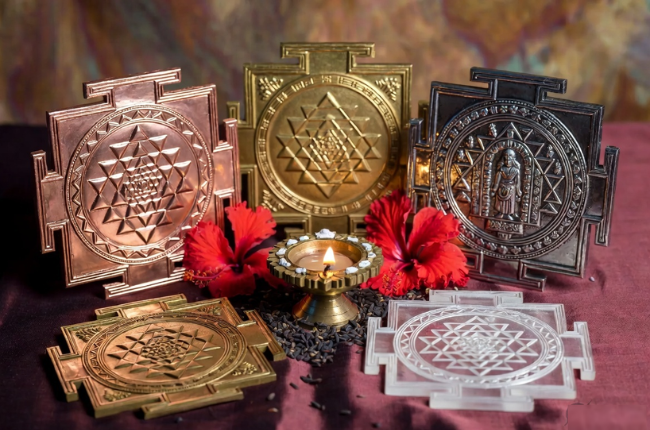
There are households where money comes but never stays. Families where health problems circle the same two or three members year after year, as if the difficulty has an address. Homes where the head of the family works with genuine effort and genuine sincerity but the results never quite match the input. And then there are households where the energy simply feels different — where opportunities seem to find their way in without being forced, where the family members sleep deeply and wake without dread, where the work and the reward are roughly in proportion to each other. The difference, in the Vedic tradition, is rarely explained by luck alone. It is explained, among other things, by the presence or absence of a correctly selected, correctly energised, and correctly placed Yantra.
Most people who search for Yantras find the same two things: a list of available designs and a purchase button. What almost no article explains is that a Yantra is not a decorative object or a passive lucky charm. In the classical Tantric and Shakta Agama traditions, a Yantra is a geometric body — the physical form of a specific deity's energy compressed into a two-dimensional or three-dimensional structure. Its benefit is not symbolic. It is functional. And its function depends entirely on three things being correct: the selection based on the actual problem and the birth chart, the energisation through the correct Mantra and Prana Pratishtha ritual, and the placement according to directional and elemental Vastu principles.
This guide covers the complete Yantra system — what Yantras are and how they work classically, which Yantra addresses which life domain, how to select the correct one for your specific situation, how to energise and install it at home, and what the classical Agama texts say about the most commonly misunderstood aspects of Yantra use.
What a Yantra Is and How It Works According to Classical Tradition
The word Yantra comes from the Sanskrit root yam — meaning to hold, sustain, or control — combined with the suffix tra, indicating an instrument. A Yantra is therefore, in the most literal classical sense, an instrument that holds and sustains a specific form of cosmic energy in physical space. This definition distinguishes the Yantra from a mere symbol or diagram. A symbol points toward an idea. A Yantra, when correctly consecrated, embeds a specific energetic frequency into matter and maintains that frequency as a living field in its environment.
The Three-Part System: Yantra, Mantra, Tantra
The classical Shakta Agama tradition — documented in texts including the Devi Bhagavata Purana, the Tantrasara, and the regional Shakta Nibandhas — presents Yantra as one part of a three-part unified system:
- Yantra — the geometric body. The physical form that anchors the deity's energy in space.
- Mantra — the sonic body. The sound vibration that activates the deity's energy and establishes communication between the devotee and the deity's field.
- Tantra — the procedural body. The ritual methodology through which the Yantra is energised and the Mantra is applied correctly.
A Yantra without its Mantra is a geometric drawing. A Mantra without its Yantra has sound but no anchor in physical space. The Tantra — the procedure — is what unites the two and produces a functional energetic device. This three-part understanding is the reason a Yantra purchased without energisation produces no result — and the reason why the energisation ritual is the most critical and most commonly neglected step in the entire process.
How the Geometry Works
Every Yantra is built from a combination of specific geometric elements, each carrying a precise energetic meaning in the classical system:
- Bindu (central point) — the source point of the deity's energy. The still centre from which all geometric expansion radiates.
- Trikona (triangle) — upward-pointing triangles represent Shiva (masculine, fire, upward movement). Downward-pointing triangles represent Shakti (feminine, water, downward movement). The Sri Yantra's interlocking triangles represent the complete union of Shiva and Shakti.
- Shatkonam (six-pointed star) — the union of two interlocking triangles. Represents the complete balance of masculine and feminine energies.
- Vrittas (circles) — represent cyclical time, completeness, and the boundary of the deity's field.
- Bhupura (square with four gates) — the outermost boundary of all Yantras. Represents the four directions and the earthly plane within which the Yantra's energy operates.
- Lotus petals — represent the unfolding of consciousness. Eight petals represent the eight directions. Sixteen petals represent the sixteen Kalas (aspects) of the Moon.
The Tantrasara specifies that the geometric proportions of a correctly drawn Yantra are not approximate — they are precise mathematical ratios. A Yantra whose proportions are incorrect does not carry the deity's energy regardless of how many Mantras are recited over it.
The Prana Pratishtha — Why an Unenergised Yantra Is Inert
Prana Pratishtha — literally "the establishment of life force" — is the consecration ritual through which a qualified Pandit invokes the deity's living presence into the Yantra's geometric body. The Devi Bhagavata Purana is specific: a Yantra that has not undergone Prana Pratishtha is jada — inert, lifeless, incapable of function. This is the single most important distinction between a Yantra that works and one that does not. The Prana Pratishtha ritual involves the recitation of the specific deity's root Mantra (Mula Mantra) a prescribed number of times — typically 1,008 or 10,008 repetitions — combined with specific Nyasa (ritual placement of Mantra on the Yantra's geometric points), Abhisheka (ritual bathing), and the formal invocation of the deity's presence into the Yantra's Bindu point.
The Major Yantras and Their Specific Benefits
Each Yantra corresponds to a specific deity, a specific domain of life benefit, and a specific set of classical prescriptions for its use. What follows covers the most widely used Yantras in Indian household practice, their classical source and deity, and the specific life domains each one addresses.
Sri Yantra — The Supreme Instrument of Abundance
Deity: Tripura Sundari (Lalita Maha Tripura Sundari) — the supreme form of Adi Shakti. Classical Source: Documented extensively in the Lalita Sahasranama (embedded in the Brahmanda Purana) and the Soundaryalahari attributed to Adi Shankaracharya. Geometry: Nine interlocking triangles — four upward-pointing (Shiva) and five downward-pointing (Shakti) — generating 43 smaller triangles around a central Bindu. Surrounded by two rings of lotus petals (8 and 16) and a square Bhupura with four gates. Primary benefits:
- Attraction of material abundance, wealth, and financial opportunity
- Enhancement of all-round prosperity including health, relationships, and career
- Removal of Lakshmi Dosha — the classical condition of prosperity blockage
- Activation of the divine feminine energy of abundance in the home or workplace
- Considered the most comprehensive of all Yantras — the Soundaryalahari describes it as containing within itself the energetic capacity of all other Yantras simultaneously
Who should use it: Anyone seeking general prosperity, financial flow, and the removal of persistent abundance blockage. The Sri Yantra is the most universally applicable Yantra in the classical system and is appropriate for any birth chart without restriction — unlike planetary Yantras, which require chart-specific verification. Metal: Gold for maximum potency; copper for daily household use; crystal for meditation spaces. Placement: On the altar, facing east, or on the north wall of the home or workspace — Kubera's direction.
Kubera Yantra — The Instrument of Wealth and Treasury
Deity: Kubera — the Vedic lord of wealth, treasurer of the gods, regent of the North direction. Classical Source: Referenced in the Atharva Veda and the Yaksha Kanda of the Skanda Purana in the context of wealth protection and treasury guardianship. Primary benefits:
- Direct activation of financial inflow and wealth accumulation
- Protection of existing wealth from loss, theft, and unexpected expenditure
- Support for business growth, trade success, and investment returns
- Particularly powerful for those experiencing consistent financial outflow despite adequate income
Who should use it: Business owners, traders, and families experiencing persistent financial drain despite income. The Kubera Yantra works most effectively when placed on the north wall of the home or the north-facing side of a business's cash or accounts area. For the complete directional framework for wealth energy in the home, the Vastu Guide Without Demolitioncovers north-wall activation in detail. Metal: Gold or brass preferred. Placement: North wall of living room or workspace. The Yantra faces south — Kubera faces north, so the Yantra's front faces toward the south where the devotee stands.
Mahamrityunjaya Yantra — The Instrument of Health and Liberation from Death
Deity: Shiva in his Mrityunjaya (death-conquering) aspect.
Classical Source: The Mahamrityunjaya Mantra is documented in the Rigveda (Mandala 7, hymn 59) as the Tryambaka hymn. The corresponding Yantra's geometric structure and usage protocol is detailed in the Shiva Purana and verified Shaiva Agama commentaries.
Primary benefits:
- Protection from serious illness and acceleration of recovery from chronic health conditions
- Removal of fear of death and the mental suffering associated with severe illness
- Protection during surgeries, difficult medical procedures, and hospitalisation
- Benefit for family members suffering from long-term illness when the Yantra is energised and placed in their healing space
- Classical Shaiva tradition holds that the Mahamrityunjaya Yantra, correctly energised, creates a protective field that reduces the Maraka (death-causing) potential of difficult planetary Dasha periods
Who should use it: Families with members experiencing chronic illness, those entering surgical procedures, those in difficult Maraka Dasha periods as identified in the birth chart, and those seeking protection from health-related fear and anxiety. Metal: Silver preferred for health applications; copper acceptable. Placement: In the bedroom of the person experiencing illness, or in the northeast corner of the home.
Lakshmi Yantra — The Instrument of Domestic Prosperity
Deity: Maha Lakshmi — the goddess of wealth, beauty, domestic harmony, and material abundance. Classical Source: Sri Sukta (embedded in the Rigveda's Khilani section) and the Lakshmi Tantra of the Pancharatra Agama tradition. Primary benefits:
- Attraction of domestic prosperity and household financial stability
- Enhancement of marital harmony and the quality of home life
- Support for women's financial independence and career growth
- Removal of poverty consciousness and persistent scarcity mindset
- Activation of Grihya Lakshmi — the household Lakshmi who governs the family's domestic abundance specifically
Who should use it: Families experiencing domestic financial instability, households where money is earned but domestic peace remains elusive, and individuals seeking to attract Lakshmi's grace in their personal and family life. The Lakshmi Yantra is distinct from the Sri Yantra — the Sri Yantra activates Tripura Sundari's universal abundance, while the Lakshmi Yantra specifically addresses domestic and household prosperity. Metal: Gold or silver. Placement: Prayer room or northeast corner of the home. Never in the bedroom or bathroom.
Baglamukhi Yantra — The Instrument of Protection and Victory
Deity: Baglamukhi — the eighth of the ten Mahavidyas, the paralyser of enemies. Classical Source: Baglamukhi Tantra and the Shakta Mahapitha traditions of Himachal Pradesh and Rajasthan, where Baglamukhi temples preserve the complete Prayoga system. Primary benefits:
- Protection from enemies, legal disputes, and deliberate harm from others
- Victory in court cases, competitive examinations, and legal proceedings
- Silencing of those who spread false information or work against the devotee's interests
- Protection from black magic, evil eye (Nazar), and deliberate negative energy directed at the family
- Success in competitive situations including government examinations, business tenders, and contested situations
Who should use it: Those engaged in active legal disputes, those experiencing deliberate harm from identified enemies, those facing competitive examinations where rivals are actively working against them, and those experiencing persistent evil eye or psychic attack. The Baglamukhi Yantra requires strict ritual compliance and should ideally be energised by a qualified Pandit with training in the Baglamukhi Prayoga tradition — it is among the more powerful protective Yantras and incorrect use can produce unintended effects. For protection remedies in the home environment, the Evil Eye Protection guide covers the complementary household protective practice. Metal: Copper or gold. Placement: South wall of the home or workplace — facing north, toward the enemy's direction.
Saraswati Yantra — The Instrument of Knowledge and Creative Excellence
Deity: Saraswati — the goddess of learning, music, arts, and the spoken and written word. Classical Source: Saraswati Stotra traditions preserved in the Skanda Purana and Devi Bhagavata Purana, with the Yantra's geometric form documented in regional Shakta Nibandha literature. Primary benefits:
- Enhancement of memory, concentration, and academic performance
- Support for artists, musicians, writers, and creative professionals
- Removal of speech impediments and communication difficulties
- Improvement in examination results and academic competitive performance
- Support for those learning classical arts, languages, and scriptural knowledge
Who should use it: Students at all levels, particularly those preparing for competitive examinations, creative professionals seeking to enhance their output quality, and those experiencing persistent memory and concentration difficulties. Metal: Silver or copper. Placement: Study room, east wall. The student faces east, the Yantra faces west — the student and the deity face each other.
Surya Yantra — The Instrument of Authority, Health, and Career Elevation
Deity: Surya (the Sun) in his Yantra form. Classical Source: Surya Siddhanta and the Saura Purana document the Sun's geometric form and the Yantra's application in the context of authority, health of the eyes, and career advancement. Primary benefits:
- Enhancement of career authority and professional recognition
- Improvement in government relations, father relationships, and leadership capacity
- Health benefit for eye conditions, heart health, and bone strength
- Support during Sun Mahadasha and for those with a weak or debilitated Sun in the birth chart
- Removal of obstacles related to government permissions, approvals, and official recognition
Who should use it: Those with a weak Sun in the birth chart — particularly those in Sun Mahadasha or experiencing career authority problems. Cross-referencing the birth chart's Sun placement is essential before selecting a Surya Yantra. The Vimshottari Dasha Complete Guide covers the Sun Mahadasha's specific characteristics and the planetary context for Surya Yantra use. Metal: Copper or gold. Placement: East wall, facing west.
Shani Yantra — The Instrument of Saturn's Grace and Karmic Relief
Deity: Shani (Saturn) in his Yantra form. Classical Source: Referenced in the Skanda Purana's Shani Mahatmya section and in the classical Navagraha Yantra traditions of Tamil Nadu and Karnataka. Primary benefits:
- Reduction of Saturn's difficult transit and Mahadasha effects
- Support during Shani Sade Sati — the seven-and-a-half-year Saturn transit period
- Karmic relief from persistent obstacles rooted in past-life Saturn debts
- Protection from accidents, chronic illness, and prolonged adversity associated with Saturn affliction
- Support for those in service, construction, agriculture, and Saturn-ruled professions
Who should use it: Those experiencing Shani Sade Sati, those in Saturn Mahadasha with a poorly placed Saturn, and those experiencing persistent Saturn-type obstacles — chronic delays, structural difficulties, and the slow erosion of effort without reward. For the complete Sade Sati remedy framework, the Shani Sade Sati Remedies guide covers the full classical remedy system of which the Shani Yantra is one component. Metal: Iron or lead for classical tradition; copper as an accessible alternative. Placement: West wall, facing east. Worship on Saturdays specifically.
Rahu and Ketu Yantras — The Instruments of Shadow Planet Relief
Deity: Rahu and Ketu — the lunar nodes, considered shadow planets (Chaya Graha) in classical Jyotish. Classical Source: The Navagraha Yantra traditions of Tamil Nadu preserve the most systematic treatment of Rahu and Ketu Yantras in regional Shaiva and Shakta temple practice. Primary benefits of Rahu Yantra:
- Reduction of Rahu Mahadasha's instability, obsessive thinking, and sudden reversals
- Protection from deception, fraud, and foreign-related complications
- Support for unconventional careers, technology work, and international travel
- Relief from persistent confusion and the feeling of being misled by circumstances
Primary benefits of Ketu Yantra:
- Support during Ketu Mahadasha's inward withdrawal and apparent career stagnation
- Enhancement of spiritual practice, intuition, and meditative depth
- Relief from unexplained physical symptoms and mysterious recurring health patterns
- Support for those on a path of detachment and spiritual liberation
Who should use them: Those in active Rahu or Ketu Mahadasha with the respective node poorly placed in the birth chart. Both Rahu and Ketu Yantras require specific chart verification before use — a poorly placed Rahu Yantra installed without chart confirmation can amplify Rahu's destabilising qualities rather than reducing them. The Rahu Ketu Negative Effects guide covers the complete nodal affliction and remedy system.
📦 Micro-Remedy Box — Myth vs. Fact
MYTH: The Sri Yantra is the most powerful Yantra in existence and works for everyone regardless of birth chart, current Dasha, or specific problem.
FACT: The Sri Yantra is the most comprehensive abundance Yantra and is appropriate for general prosperity without chart restriction — this much is correct. What it is not is a universal substitute for specific Yantras addressing specific problems. A family experiencing severe legal threats needs the Baglamukhi Yantra, not the Sri Yantra alone. A person in a difficult Saturn Mahadasha with chronic health complications needs the Mahamrityunjaya Yantra and the Shani Yantra working in combination, not the Sri Yantra as a catch-all solution. The Tantrasara is clear: each Yantra's geometric form is calibrated to a specific deity's energy and a specific domain of function. Using one Yantra to address problems that belong to a different deity's domain is the equivalent of taking the wrong medicine — not harmful in itself, but not curative of the actual condition.
How to Select the Correct Yantra for Your Specific Situation
Selection is the step where most families go wrong — not from lack of sincerity but from lack of information. The correct Yantra selection follows a three-step assessment that considers the presenting problem, the birth chart's planetary configuration, and the current Dasha period simultaneously.
Step 1 — Identify the Primary Problem Domain
Before examining any Yantra, identify which life domain is the source of the primary difficulty:
- Financial flow and wealth accumulation — Kubera Yantra or Sri Yantra
- Domestic prosperity and marital harmony — Lakshmi Yantra
- Health — chronic illness, surgical protection, Maraka Dasha — Mahamrityunjaya Yantra
- Career authority, government recognition, leadership — Surya Yantra
- Legal disputes, enemy protection, competitive victory — Baglamukhi Yantra
- Education, memory, creative excellence — Saraswati Yantra
- Saturn transit, Sade Sati, karmic obstacles — Shani Yantra
- Rahu Mahadasha, confusion, deception — Rahu Yantra
- Ketu Mahadasha, spiritual stagnation, mysterious illness — Ketu Yantra
- General all-round prosperity with no specific acute problem — Sri Yantra
Step 2 — Verify Against the Birth Chart
Once the problem domain identifies a candidate Yantra, the birth chart must confirm that the corresponding planet or deity is indeed the source of the problem — not merely a correlating factor. A family experiencing financial difficulty whose birth chart shows a strong, well-placed Jupiter and a strong Venus is unlikely to benefit primarily from the Lakshmi Yantra — their financial difficulty may have a different planetary root, such as an afflicted second house lord or a debilitated Mercury affecting commercial thinking. The Yantra must address the actual planetary cause, not merely the symptom. For a complete understanding of how planetary positions create specific life difficulties, the Complete Kundli Reading Guide covers house-by-house analysis in accessible terms.
Step 3 — Cross-Reference With the Current Dasha Period
The Yantra's benefit is amplified when it corresponds to the current Dasha lord's needs. A person in Saturn Mahadasha with Saturn afflicted benefits most from the Shani Yantra during this specific period — not as a permanent fixture but as a Dasha-period correction. A person in Jupiter Mahadasha with Jupiter well-placed may find the Sri Yantra or Lakshmi Yantra most responsive in the current period, because Jupiter's expansive energy amplifies abundance-related Yantras during its own Dasha.
How Many Yantras Can Be Used Simultaneously
A question that appears consistently in Yantra forums on Quora and Reddit — and is almost never answered clearly in published articles: is it acceptable to use multiple Yantras at the same time, and does their energy conflict? The classical Tantric answer, from the Tantrasara and verified Pandit consultation traditions, is that multiple Yantras can be used simultaneously provided:
- Each is separately energised with its own Prana Pratishtha ritual
- Each is placed in its correct directional position without overlap
- The devotee maintains a separate — even if brief — daily worship practice for each Yantra
Three Yantras is the practical household maximum for most families — beyond three, the maintenance discipline required for each Yantra's daily activation practice exceeds what most households can sustain consistently. An under-maintained Yantra is not harmful — it simply becomes inert again over time, like an unenergised one.
How to Energise Your Yantra at Home — Complete Step-by-Step Vidhi
A Yantra purchased from a shop or online — even one described as "pre-energised" — must undergo Prana Pratishtha before use. The term "pre-energised" in commercial contexts typically means the manufacturer performed a brief blessing ritual at the time of production — this is not equivalent to a full Prana Pratishtha performed by a qualified Pandit with the correct Mula Mantra count and Nyasa protocol. The home energisation procedure below is appropriate for household Yantras and can be performed by the devotee themselves on an auspicious day.
- Select an auspicious day for energisation — Friday is universally auspicious for Lakshmi and Sri Yantras. Saturday for Shani Yantra. Sunday for Surya Yantra. The Panchami, Ashtami, and Purnima Tithis are considered especially powerful for any Yantra energisation regardless of the day of the week. Check the Panchang guide for the correct Tithi and Nakshatra confirmation for the selected date.
- Prepare the energisation space — clean the Pooja area thoroughly. Lay a clean red or yellow cloth (red for Shakta Yantras, yellow for planetary Yantras). Place the Yantra at the centre of the cloth on an elevated platform — never directly on the ground.
- Bathe the Yantra (Abhisheka) — pour Panchamrit (milk, curd, honey, ghee, sugar combined) over the Yantra in a slow, steady stream while reciting the deity's Gayatri Mantra. Follow with clean water. Wipe gently with a clean white cloth.
- Apply sandalwood paste to the Yantra's Bindu point — using the ring finger of the right hand, apply a small dot of sandalwood paste (chandan) to the central point of the Yantra. This is the Nyasa — the formal placement of the deity's presence at the geometric centre.
- Apply kumkum — apply a second dot of kumkum directly over the sandalwood paste at the Bindu point.
- Offer flowers — place fresh red hibiscus or marigold at the four corners and the centre of the Yantra.
- Light incense and a ghee diya — the diya must remain lit for the duration of the recitation.
- Recite the Mula Mantra — the root mantra of the Yantra's deity, recited the prescribed number of times. The minimum household standard is 108 repetitions. The classical full energisation is 1,008 repetitions. For the Sri Yantra, the Mula Mantra is Om Shreem Hreem Shreem Kamale Kamalalaye Praseed Praseed Shreem Hreem Shreem Mahalakshmyai Namah. For the Mahamrityunjaya Yantra, it is the Tryambaka Mantra from the Rigveda. Each Yantra has its own specific Mula Mantra — these must be verified against a classical source or confirmed by a qualified Pandit before use. The Mantra Power and Sound Frequencies guide covers the classical sound science framework underlying Mantra application.
- Perform Prana Pratishtha declaration — after completing the Mantra recitation, formally declare aloud: "O [deity name], I have recited your Mula Mantra [number] times. I request your living presence to reside within this Yantra for the purpose of [specific intention]. Accept this Yantra as your geometric body and this home as your dwelling."
- Perform Aarti — conclude the energisation with a camphor Aarti directed at the Yantra, ringing a bell continuously during the Aarti.
- Place the Yantra in its correct position — immediately after energisation, while still in the ritual space, move the Yantra to its designated directional placement. The Yantra should not be set aside or stored after energisation — it is now a living ritual object and must go directly to its permanent position.
Where to Place Yantras in the Home — Directional Rules
The placement of a Yantra determines which directional energy it draws upon and how its activated field interacts with the home's existing Vastu energy map. Incorrect placement does not destroy the Yantra's energy — but it does reduce its effectiveness significantly by misaligning the deity's directional force with the home's spatial energy flow.
Directional Placement Map
- Northeast — Prayer room Yantras. Lakshmi Yantra, Sri Yantra for spiritual use, Mahamrityunjaya Yantra for health protection. The northeast is the home's primary energy entry point and is appropriate for Yantras whose primary function is invocation and protection.
- North wall — Kubera Yantra and Sri Yantra for financial abundance. The north is Kubera's directional home and activates the wealth energy of these Yantras most powerfully.
- East wall — Surya Yantra and Saraswati Yantra. The east receives solar energy first and is the correct placement for Yantras governing authority, knowledge, and career.
- South wall — Baglamukhi Yantra. The south is the direction of power, authority, and the containment of hostile forces. The protective Yantras belong here.
- West wall — Shani Yantra. The west is Saturn's directional home in the classical Navagraha directional map.
Height and Surface Rules
- All Yantras must be placed at eye level or above — never below waist height and never on the floor
- Yantras must face the devotee — the Yantra's front (the face with the geometric design) faces the direction from which the devotee approaches for worship
- No Yantra may be placed in the bedroom — the exception is the Mahamrityunjaya Yantra for an actively ill family member, which is placed at the head of the sick person's bed temporarily during illness
- No Yantra may be placed in the bathroom or toilet
- Yantras must be placed on a clean, elevated surface — a wooden platform, a brass plate, or a designated Yantra pedestal. Never directly on a shelf alongside miscellaneous objects
As many families discover when they sit with their Pandit, the placement discipline is as important as the energisation ritual. A correctly energised Yantra placed on a dusty shelf between a television remote and a water bottle is a living deity housed in undignified conditions — and the Tantra Shastra tradition is clear that the deity's grace flows most freely when the physical conditions of worship reflect genuine reverence.
What Classical Texts Say About Yantra That No Other Article Covers
The Tantrasara — one of the most comprehensive classical texts on Yantra Vidya — makes a statement that virtually every popular article on Yantras omits: the Adhikara (qualification) of the devotee is as important as the correctness of the Yantra's geometry and Mantra. Adhikara refers to the devotee's readiness to receive and sustain the deity's energy — a combination of ritual purity, consistency of practice, and the depth of genuine intention.
The Adhikara Principle
The Tantrasara specifies four levels of Adhikara for Yantra use:
- Mridu (gentle) — the basic household devotee who maintains daily worship with sincerity but without deep Mantra training. Appropriate for: Sri Yantra, Lakshmi Yantra, Saraswati Yantra.
- Madhyama (intermediate) — the devotee with consistent Mantra practice and some training in classical ritual. Appropriate for: Kubera Yantra, Surya Yantra, Shani Yantra.
- Adhimatra (advanced) — the devotee with extended classical training and Diksha (initiation) from a qualified Guru. Appropriate for: Baglamukhi Yantra, Rahu and Ketu Yantras, and advanced Mahavidya Yantras.
- Adhimatratama (supreme) — the fully initiated Sadhaka with decades of Mantra practice. Appropriate for: Chhinnamasta Yantra, Dhumavati Yantra, and the advanced Tantric Yantras whose Prayoga (application method) is held in oral tradition only.
This Adhikara framework explains why certain Yantras — particularly the Baglamukhi and the advanced Mahavidya Yantras — consistently produce unintended effects when used by untrained devotees without qualified guidance. The deity's energy is real and powerful — and its real power requires a proportional level of readiness in the person through whom it operates.
The Soundaryalahari on the Sri Yantra
The Soundaryalahari — attributed to Adi Shankaracharya and considered the most authoritative classical hymn on Sri Vidya — describes the Sri Yantra's nine levels (Avaranas) as corresponding to the nine concentric layers of the cosmos itself. The text specifies that the worship of the Sri Yantra's nine Avaranas in sequence — beginning from the outer Bhupura and moving inward to the central Bindu — is equivalent to the worship of the entire manifest universe. This nine-level worship structure (Navavarana Puja) is the complete classical Sri Yantra practice and takes several hours in its full form. The simplified household practice of Sri Yantra worship — offering flowers at the Bindu and reciting the Lakshmi Ashtakam — is a genuine but partial expression of the complete system.
Two Yantra Questions That Almost No Article Answers
What Happens to the Yantra's Energy When the Family Moves House
This question appears consistently across Yantra and Vastu forums on Reddit and Quora — with genuine practical urgency from families relocating — and receives almost no published answer. Classical Tantra Shastra, as preserved in the Shakta Agama tradition and verified Pandit consultation practice across Maharashtra and Tamil Nadu, addresses this directly. A consecrated Yantra's energy is not permanently bound to a physical location — it is bound to the deity's geometric body itself. When a correctly consecrated Yantra is moved to a new home, its Prana Pratishtha remains intact provided the Yantra is treated with ritual continuity during the move: wrapped in clean red or yellow cloth, not packed with household goods, carried separately by a family member or placed in the vehicle with incense and a brief recitation of the deity's Mula Mantra during transit. On arrival at the new home, a brief re-installation ritual is performed — Abhisheka with Panchamrit, fresh flowers, incense, and 21 repetitions of the Mula Mantra — and the Yantra is placed in its new directional position. This re-installation is not a full Prana Pratishtha — it is a renewal of the existing consecration in the new spatial context. A Yantra that is carelessly packed in a removal box and unpacked weeks later without any ritual continuity does experience a reduction in its active energetic field — not a permanent loss, but a dormancy that requires the full re-installation ritual to reactivate.
Can a Yantra Be Used by Multiple Family Members or Does It Belong to One Person
A second question absent from virtually every published Yantra guide — asked repeatedly in Quora threads and Facebook Yantra groups: is a consecrated Yantra the personal property of one family member, or does it serve the entire household? The classical answer, from the Tantrasara and verified Shakta Agama practice, distinguishes between two types of Yantra use. A Griha Yantra (household Yantra) — such as the Sri Yantra placed in the main prayer room or the Kubera Yantra on the north wall — is consecrated for the benefit of the entire household and its energy field extends to every person living within the home. A Vyaktigat Yantra (personal Yantra) — such as a Mahamrityunjaya Yantra placed in the bedroom of a specific ill family member, or a Saraswati Yantra on a student's desk — is consecrated for a specific person's benefit and carries a directional energy tuned to that individual's need. The Prana Pratishtha Sankalpa establishes which category the Yantra belongs to — and this is why the Sankalpa declaration during energisation must specify clearly whether the Yantra's benefit is dedicated to the household collectively or to one named individual. A personal Yantra energised for one family member and then used by another without a renewed Sankalpa creates an energetic mismatch — not a dangerous one, but an ineffective one.
📦 Micro-Remedy Box — Classical Warning
The Devi Bhagavata Purana narrates the story of a merchant who obtained a Sri Yantra from a travelling Sadhu, placed it in his home without performing Prana Pratishtha, and then attributed his subsequent business losses to the Yantra's presence — concluding that Sri Yantras bring misfortune. The Purana uses this story to make a precise classical point: an unenergised Yantra placed in a home and then neglected is not a source of misfortune — it is simply an inert geometric object. The merchant's losses came from other causes entirely. What the story establishes is the danger of attribution error — blaming the remedy for the illness it was never activated to address. Classical Shastra is clear: a Yantra that has not undergone Prana Pratishtha cannot harm the household. It also cannot help it. The harm comes from the false sense of security that leads a family to believe they have taken a remedial action when they have only acquired an object. A consecrated Yantra correctly maintained is a genuine energetic ally. An unenergised Yantra is a decorative piece of metal with a beautiful geometry and no active function.
Daily Maintenance and Worship of Installed Yantras
A Yantra's energetic field requires regular renewal through daily worship to maintain its full active strength. The minimum daily practice for any installed Yantra is brief but non-negotiable.
Daily Minimum Practice (5 Minutes)
- Light one incense stick before the Yantra each morning after bathing
- Recite the deity's Mula Mantra 11 times while looking at the Yantra's Bindu point
- Offer a flower — even a single fresh petal — at the Yantra's surface
- Light a diya for at least the duration of the Mantra recitation
Weekly Renewal Practice (Friday for Shakta Yantras, Saturday for Shani, Sunday for Surya)
- Full Abhisheka with clean water or Panchamrit on the Yantra's designated day
- Fresh sandalwood paste at the Bindu point
- 108 Mula Mantra recitations
- Fresh flower offering and full Aarti
Annual Reconsecration
Once per year — ideally on the deity's most auspicious festival day (Navratri for Shakta Yantras, Diwali for Lakshmi Yantra, Mahashivaratri for Mahamrityunjaya Yantra) — a full Prana Pratishtha renewal is recommended to restore the Yantra's energetic field to its original activation level. This annual renewal is among the most consistently overlooked aspects of Yantra maintenance and is the primary reason why families report that their Yantra "worked for the first year and then stopped."
FAQ
Which Yantra is best for money and financial problems at home? The Kubera Yantra addresses direct financial inflow and wealth protection. The Sri Yantra addresses general prosperity and the removal of abundance blockage across all domains. For persistent financial drain despite adequate income, the Kubera Yantra placed on the north wall of the home or workplace is the primary classical recommendation. For all-round prosperity including career, health, and relationships, the Sri Yantra is the more comprehensive choice. As astrological tradition holds, individual outcomes depend on the correctness of the Yantra's energisation and the consistency of its daily maintenance practice.
How do I know if my Yantra is working or not? The classical indicators that a correctly energised Yantra is functioning include: increased ease in professional interactions and opportunity arrival, improved quality of sleep in the home, reduced frequency of unexpected financial losses, and a felt sense of energetic stability in the home environment. These shifts are typically gradual — appearing over three to six months of consistent daily worship — not sudden. If no shift is felt after six months of daily practice, the energisation should be reviewed by a qualified Pandit. The most common cause of non-performance is incomplete Prana Pratishtha or inconsistent daily maintenance.
Can I buy a Yantra online and energise it myself at home? A Yantra purchased online can be energised at home using the step-by-step Vidhi described in this guide — provided the geometric proportions of the purchased Yantra are correct, the Mula Mantra used is verified against a classical source, and the Prana Pratishtha declaration is made with a clear Sankalpa. The limitation of home energisation is the Mula Mantra count — 108 repetitions is the household minimum but is significantly less than the 1,008 or 10,008 repetitions of a full Pandit-conducted energisation. For Baglamukhi and advanced Mahavidya Yantras, home energisation without qualified Pandit oversight is not recommended regardless of the devotee's sincerity.
What is the difference between a 2D Yantra and a 3D Meru Yantra? A two-dimensional Yantra is engraved or printed on a flat metal surface. A three-dimensional Meru Yantra — most commonly seen as the Meru Sri Yantra — replicates the same geometric structure in a raised, pyramidal form that projects upward from the flat base. Classical Shakta tradition holds that the three-dimensional Meru form carries a more concentrated energetic field because the geometric ratios project in all three spatial dimensions simultaneously rather than radiating from a flat plane. The Meru Sri Yantra is considered the most powerful form for placement in a permanent household altar. The two-dimensional form is equally valid for regular use and is more appropriate for placement on walls and in workspace environments.
How long does a Yantra's energisation last before it needs renewal? A correctly performed Prana Pratishtha, supported by consistent daily worship practice, maintains its full energetic activation indefinitely — classical texts do not specify an expiry period for a well-maintained Yantra. What reduces the energetic field over time is neglect — cessation of daily practice, exposure to ritual impurity, damage to the Yantra's geometric surface, or placement in prohibited locations such as bathrooms. An annual renewal Prana Pratishtha, performed on the deity's primary festival day, is the classical standard for maintaining the Yantra at full activation throughout its use.
Can Yantra replace gemstone remedies for planetary problems? Yantras and gemstones address planetary problems through different mechanisms and are complementary rather than interchangeable. A gemstone works by absorbing the planetary ray through a specific crystalline structure and transmitting it into the wearer's physical energy field through skin contact. A Yantra works by anchoring the planetary deity's energy in a specific physical space and creating an environmental field that influences everyone in that space. For a personal planetary problem requiring consistent body-level remedy, a correctly selected gemstone provides more direct benefit. For a household-level or workplace-level planetary problem, the Yantra provides broader environmental coverage. For severe planetary afflictions, classical Pandit tradition recommends both working in combination rather than choosing one over the other. The Gemstone Complete Guide covers the gemstone selection and verification framework in detail.
What should I do if a Yantra gets damaged or broken? A damaged Yantra — one with a crack, a bent surface, or a partially erased geometric design — is considered to have lost its energetic integrity in the classical tradition. The Tantra Shastra specifies that a damaged Yantra should be respectfully immersed in a flowing water body — river, lake, or the sea — after a brief farewell ritual involving incense, flowers, and the recitation of the deity's Mula Mantra 21 times as a closing Sankalpa. The Yantra is not discarded in domestic waste under any circumstances. After immersion, a new Yantra is obtained, energised with a fresh Prana Pratishtha, and installed in the same position.
Conclusion
The Yantra tradition teaches that the sacred is not separate from the practical — that the same geometric intelligence that organises the cosmos can be anchored in a copper plate on a north wall and made to work for a family's financial wellbeing, health protection, and professional clarity. Select with precision. Energise with sincerity. Maintain with consistency. These three qualities determine everything that follows. A Yantra selected carelessly, energised incompletely, and maintained sporadically produces nothing — not because the system does not work, but because the system requires genuine participation to function. Begin with one Yantra, correctly matched to your primary life challenge and correctly installed with a qualified Pandit's guidance. Classical Vedic practice holds that one well-maintained Yantra in a home of sincere devotion outperforms a collection of un-maintained Yantras in the most elaborately decorated altar. Personal results, as always, depend on individual karma, the quality of practice sustained over time, and divine grace.
The right Yantra, correctly selected and properly energised for your specific birth chart and life challenge, is among the most powerful long-term remedial tools in the Vedic tradition. Connect with a verified AtoZPandit.com consultant for a personalised Yantra selection, Prana Pratishtha service, and placement guidance for your home or workplace.
Disclaimer: This article is published for educational and cultural awareness purposes only. The information presented does not substitute for professional medical, psychological, or legal advice. For personalised Yantra guidance based on your specific birth chart, current Dasha period, and life situation, connect with a qualified consultant at AtoZPandit.com.