Saptapadi Seven Pheras True Meaning of Each Marriage Vow in Vedic Wedding
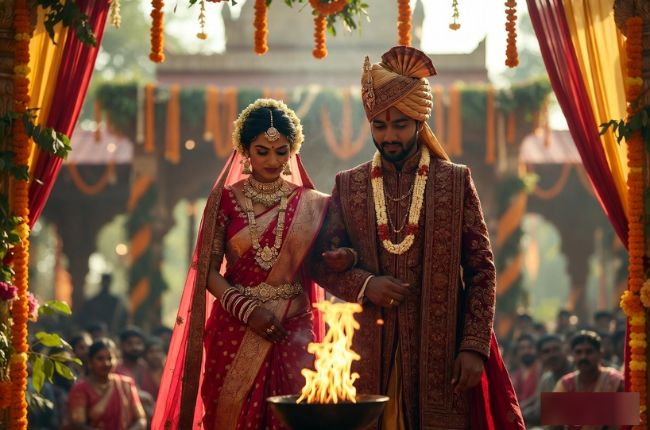
Every person who has attended a Hindu wedding has stood around the mandap and watched the couple walk those seven circles around the fire. The priest recites Sanskrit. The couple moves. The family watches. And somewhere in the middle of it — usually around the fourth or fifth circle — someone leans over and whispers to the person next to them: what exactly are they promising right now? Most people at a Hindu wedding, including many of the family members who have arranged it, cannot answer that question. They know the seven pheras matter. They feel the weight of the moment. But what the couple is actually saying — and why it takes seven circles, and why fire is the witness — stays just out of reach.
That gap is not the family's fault. Saptapadi — the seven-step ritual at the heart of the Hindu Vivah Sanskar — is one of the most precisely structured ceremonies in all of Vedic tradition. The vows are drawn from the Ashvalayana Grihyasutra, one of the oldest household ritual texts in Sanskrit literature, which prescribes the exact words, the sequence, and the conditions under which the ceremony becomes legally and spiritually binding. The Agni — the sacred fire — is not a backdrop. It is the primary witness, more ancient in its ritual role than any human officiant.
What most articles on this topic miss is the content of each individual vow and what it actually commits the couple to — not in a general spiritual sense, but in the specific, practical, household-level language the classical texts use. This guide covers every phera and its vow, the classical source behind the ceremony, what makes the Saptapadi legally binding under Hindu law, and the two questions real families ask that no published article has answered directly. By the end, you will understand not just what the seven pheras are but why they are the oldest and most enduring marriage contract in Indian civilisation.
What Saptapadi Means and Where It Comes From
Saptapadi is a Sanskrit compound: sapta means seven, padi means steps or strides. The literal meaning is "seven steps" — though in common practice, the steps are taken as circles (parikrama) around the sacred fire rather than seven steps in a straight line. Both forms are classically valid and appear in different regional traditions.
The ceremony is prescribed in the Ashvalayana Grihyasutra, a foundational household ritual text from the Rigvedic tradition. The Grihyasutras are the classical texts governing domestic ceremonies — birth, naming, thread ceremony, marriage, and death rites — and the Ashvalayana Grihyasutra is among the most widely followed across North Indian Brahminical traditions. The Saptapadi section specifies the exact moment the marriage becomes complete: after the seventh step is taken, the union is considered irrevocable.
The Legal Standing of Saptapadi
The Hindu Marriage Act of 1955 — the law governing Hindu marriages in India — specifically recognises the Saptapadi as the moment at which a Hindu marriage is legally solemnised. Section 7 of the Act states that a Hindu marriage may be solemnised in accordance with customary rites and ceremonies, and that where such rites include the Saptapadi, the marriage becomes complete and binding upon the completion of the seventh step. This is not a cultural acknowledgement — it is a legal threshold. A Hindu marriage ceremony that includes pheras but is interrupted before the seventh is not considered legally complete under Indian law.
Why Agni Is the Witness
The sacred fire — Agni — holds a role in Vedic ritual that predates the Grihyasutras. In the Rigveda, Agni is described as Vivaha Sakshi — the witness of marriage. Fire in Vedic thought is the mediating principle between the human and the divine: what is offered into fire reaches the gods, and what is spoken before fire is heard by all three worlds. The couple's vows spoken before Agni are not simply promises to each other — they are declarations made before a cosmic witness whose memory, the classical tradition holds, does not fade.
How to Perform the Seven Pheras at Home — Step by Step
Families occasionally need to understand the practical sequence of the Saptapadi — whether for a smaller home ceremony, for preparation before the main wedding, or simply to understand what will happen at the mandap. Here is the classical sequence as prescribed in the Grihyasutra tradition.
- Prepare the sacred fire (Agni Kund). The fire must be consecrated before the pheras begin. A qualified Pandit performs the Agni Sthapana — the ritual installation of fire using specific woods (mango wood is traditionally preferred), ghee, and the Agni Mantra invocation. Do not begin the pheras over an unconsecrated fire.
- Tie the garment connection (Granthi Bandhan). The groom's upper garment (uttariya) is knotted to the bride's pallu (the edge of the saree). This physical connection must remain tied throughout all seven circles. It symbolises the binding of two lives that the vows will confirm.
- Establish the direction of circumambulation. The couple moves clockwise (pradakshina) around the fire — the direction of auspicious movement in all Vedic ritual. In most North Indian traditions, the groom leads the first six pheras and the bride leads the seventh. In South Indian traditions, the sequence and leading partner may vary by community.
- First phera — spoken before stepping. The Pandit recites the Saptapadi mantra for the first step. The couple steps together. Pause after each step for the mantra to be completed — do not rush the circuit.
- Repeat for pheras two through seven. Each phera has its own mantra and its own vow. The Pandit recites; the couple follows. The couple must complete each full circle before the next mantra begins.
- Complete the seventh step fully. The seventh step must be completed entirely — the circle closed, both partners having returned to the starting position. This moment is the point of legal and ritual completion.
- Perform Saptapadi Sthirikaran. After the seventh step, the Pandit recites the stabilisation verse — asking Agni to witness and confirm the union. The groom traditionally touches the bride's right shoulder and recites the closing affirmation. This seals the ceremony.
The Seven Pheras — Each Vow and Its Meaning
This is the content most articles either summarise in a single sentence or skip entirely. Each of the seven pheras carries a specific vow — a commitment to a defined domain of the shared life. The vow text below follows the Ashvalayana Grihyasutra tradition as practised across most North Indian communities, with explanatory meaning for each.
Phera One — Food and Nourishment
The first step is taken with a prayer for anna — food, nourishment, and sustenance. The groom commits to providing for the household's material needs. The bride accepts the role of steward of that provision — managing the home's nourishment with care and intention. The classical texts frame this not as a division of labour but as a shared commitment: the household that eats well together, the tradition holds, holds together.
Phera Two — Strength and a Righteous Life
The second step invokes bala — physical strength, vitality, and the capacity to live a righteous life. Both partners commit to supporting each other's physical wellbeing and to conducting their shared life according to dharma. The Agni witnesses the couple's agreement to hold each other to a standard of right action — not perfection, but intention.
Phera Three — Prosperity and Wealth
The third step is taken for dhana — wealth, prosperity, and financial security. The couple commits to building material stability together — and to managing it with discipline rather than excess. Classical Vivah Vidhi texts note that the third phera is specifically associated with the household's relationship to Lakshmi — the goddess of abundance — and that the vow taken here carries the implication of charitable giving as part of the household's wealth practice.
Phera Four — Happiness, Family, and Ancestral Blessings
The fourth step is taken for the happiness of the family — specifically invoking sukha and the blessings of the ancestors (Pitru). Both partners commit to honouring the family lineages they are joining. The fourth phera is the one in which the couple's responsibility to their extended families — not just to each other — is formally acknowledged before Agni.
Phera Five — Children and the Continuation of Lineage
The fifth step is taken for praja — progeny, children, and the continuation of the family line. The couple commits to welcoming and raising children within the framework of dharma, providing them with the Vedic Sanskaras — the sixteen ritual milestones of a well-lived life. The fifth phera is considered particularly significant in families where lineage continuity carries weight, as the vow made here is directed specifically at the Pitru — the ancestral lineage — as much as at each other.
Phera Six — Health and Long Life
The sixth step is taken for arogya — health, freedom from disease, and the long life of the household. Both partners commit to caring for each other through illness and age — a vow the classical tradition treats with more gravity than modern readings suggest. The Grihyasutra framing of this phera acknowledges explicitly that the body ages and that the commitment made here covers the full arc of physical life, not only its strong years.
Phera Seven — Friendship, Companionship, and the Highest Vow
The seventh step is the culmination — taken for sakhya, which translates as friendship, companionship, and the deepest form of mutual understanding. This is the vow that the classical tradition considers the highest of the seven. Where the first six pheras commit the couple to material, familial, and physical dimensions of life, the seventh commits them to the interior life — the friendship of two minds walking together across decades. The Ashvalayana Grihyasutra states that after the seventh step, the couple has become sakhya — companions in the truest Vedic sense — and that this bond, witnessed by Agni, carries across lifetimes.
What the Classical Texts Say About Saptapadi's Binding Power
The Saptapadi is described in three separate classical layers — the Grihyasutra prescriptions, the Dharmashastra commentaries, and the Puranic narrative tradition — and each layer adds a dimension to why the ceremony carries the weight it does.
The Grihyasutra Foundation
The Ashvalayana Grihyasutra, in the section governing Vivah Karma, specifies that the Saptapadi is the conclusive act of the marriage ceremony. Earlier in the ceremony, the Kanyadan (the father's gift of the daughter), the Panigrahana (the clasping of hands), and the Agni Parikrama are performed — but none of these alone completes the marriage. The Grihyasutra explicitly states: saptame pade sakhayau bhavtah — upon the seventh step, they become companions. Before the seventh step, the marriage is in process. After the seventh step, it is complete.
The Dharmashastra Confirmation
The Manusmriti — the classical Dharmashastra that governed household law for centuries — references the Saptapadi in the context of marriage validity. Commentators on the Manusmriti, including the medieval scholar Kulluka Bhatta, confirm that the Saptapadi transforms the ritual marriage into a dharmic bond — one that generates both social and cosmic obligation for both partners. The dharmic bond, the Dharmashastra tradition holds, is not dissolved by separation — only by the completion of the karma it carries.
Did You Know The Saptapadi is mentioned in the Rigveda itself — making it one of the oldest documented marriage rituals on Earth. The tenth Mandala of the Rigveda contains the Vivah Sukta, the wedding hymns, which reference the seven steps taken together as the moment of union. This places the Saptapadi tradition at a minimum of 3,500 years of continuous practice — uninterrupted from the Vedic period through to the mandaps of 2026.
North India, South India, and Regional Differences in the Seven Pheras
One of the most genuinely searched questions about the seven pheras — and one that almost no article addresses in full — is how the ceremony differs between regional traditions. The Saptapadi is universal across Hindu marriages, but its execution carries meaningful regional variation.
North Indian Tradition
In most North Indian communities — across Brahmin, Kshatriya, and Vaishya traditions — the groom leads the first six pheras and the bride leads the seventh. The leading partner steps first in each circle, pulling the following partner forward by the tied garment. The seven vows are recited in Sanskrit by the Pandit, with the couple repeating or affirming each vow before the step.
South Indian Tradition
In South Indian Tamil, Telugu, and Kannada traditions, the pheras are often replaced or supplemented by Sapta Padi in a slightly different form — the couple takes seven steps in a line rather than circles in many Telugu and Kannada ceremonies. In Tamil Brahmin (Iyer and Iyengar) weddings, the Ashtapadhi — eight steps — is used in the Iyengar tradition, adding an additional vow to the seven. The fire remains central, but the spatial execution of the steps differs significantly from the North Indian circular model.
Maharashtrian and Gujarati Traditions
In Maharashtrian weddings, the pheras are called Saptapadi and follow the North Indian circular model closely, but the number of circuits is sometimes reduced to four in certain communities. In Gujarati Saat Phere traditions, the seven circles are taken with the couple holding a betel nut (supari) together — a regional element not found in the Grihyasutra prescription but established by centuries of community practice.
As many families discover when they sit with their Pandit — the regional variation in phera execution does not diminish the ceremony's validity. What the classical texts require is that seven vows be taken before a consecrated fire with both partners present and willing. The spatial form of the circuit is a regional adaptation of that timeless requirement.
What Happens If the Seven Pheras Are Incomplete — The Question Most Families Are Afraid to Ask
This is the question that appears repeatedly in Reddit threads and Quora discussions — asked quietly, often by families where something went wrong at the ceremony. The groom fainted after the fifth phera. The bride's family broke up the ceremony after the fourth. A health emergency interrupted after the sixth. Is the marriage valid?
Classical Jyotish and Dharmashastra tradition address this with more nuance than a simple yes or no.
The Ashvalayana Grihyasutra's position is unambiguous: the marriage is complete only upon the seventh step. Before the seventh step, the ceremony is in progress but not concluded. This classical position is reflected in the Hindu Marriage Act's language — the marriage becomes binding "upon the completion of the seventh step."
Where the ceremony is interrupted before the seventh phera for reasons beyond the couple's control, classical tradition prescribes a Vivah Shanti ritual — a remedial ceremony performed by a qualified Pandit to seal what was interrupted and establish the karmic completion of the bond. The Pandit assesses the specific circumstance — which phera was reached, the nature of the interruption, and the current planetary positions — before prescribing the Shanti ritual's specific form. A ceremony interrupted at the sixth phera is treated differently from one interrupted at the third.
What the classical tradition does not support is the assumption that the ceremony is automatically invalid and must be entirely repeated. The Grihyasutra tradition recognises the concept of pratipad — a ritual continuation point — where a ceremony interrupted by genuine circumstance can be resumed with appropriate preliminary rites rather than restarted from the beginning.
Some karma runs deeper than a single ceremony. Where families carry this question, the right step is to bring it to a qualified Jyotishi and Vedic Pandit together — the astrological assessment and the ritual prescription work together in these situations, and personal outcomes depend on individual karma, the quality of the subsequent practice, and divine grace.
What Almost No Article Answers: Can the Saptapadi Carry Different Vow Texts for Different Families?
This question surfaces consistently in Quora threads and Facebook wedding planning groups — particularly from families where one partner has a different regional background or where the couple wants to understand the vows in their own language before the ceremony. Can the Saptapadi vow text be adapted, translated, or personalised?
The classical answer draws a precise distinction between the Mantra component and the Sankalpa component of the Saptapadi.
The Sanskrit mantras recited by the Pandit during each phera — drawn from the Ashvalayana Grihyasutra — are the fixed, non-negotiable component of the ceremony. Their specific syllable sequence and pronunciation is what activates the ritual's Vedic validity. These cannot be replaced with translated text, modern vow language, or personalised additions without removing the ceremony from the classical framework entirely.
The Sankalpa component — the couple's affirmation of each vow — is the element where regional and family tradition introduces variation. In many North Indian families, the Pandit translates each vow into Hindi or the regional language after reciting the Sanskrit, and the couple affirms in their native tongue. In South Indian Iyer families, the groom recites a portion of the vow in Sanskrit directly. In some progressive family traditions, the Pandit provides a written vow card in English alongside the Sanskrit so the couple understands exactly what they are affirming before each step.
None of these affirmation-layer variations compromise the ceremony's classical validity — because the Sanskrit mantra layer remains intact. What matters, in the Grihyasutra tradition, is that the Agni is consecrated, the vow mantras are recited completely, and the seven steps are taken. The language in which the couple privately understands and affirms those vows is a family decision, not a ritual constraint.
FAQ
What are the seven pheras and why are they taken around fire? The seven pheras — called Saptapadi — are the seven circles taken around a consecrated sacred fire during a Hindu wedding. Each circle carries a specific vow covering food, strength, prosperity, family, children, health, and friendship. Agni, the sacred fire, serves as the divine witness to each vow as prescribed in the Ashvalayana Grihyasutra tradition.
Is a Hindu marriage valid without completing all seven pheras? The Hindu Marriage Act of 1955 states that where the Saptapadi forms part of a Hindu marriage ceremony, the marriage becomes legally binding upon the completion of the seventh step. A ceremony interrupted before the seventh phera is not considered legally complete. Classical tradition prescribes a Vivah Shanti ritual for ceremonies interrupted by genuine circumstance before completion.
What does each phera mean in simple words? Each phera carries one specific commitment: the first for food and sustenance, the second for strength and righteousness, the third for prosperity, the fourth for family happiness and ancestral blessings, the fifth for children and lineage, the sixth for health and longevity, and the seventh — considered the highest — for lifelong friendship and companionship. As astrological tradition holds, individual outcomes vary with karma and sincerity.
How do I reduce problems in marriage if pheras were done incorrectly? If any doubt exists about whether the Saptapadi was performed correctly — incomplete mantras, wrong sequence, or interrupted ceremony — approach a qualified Pandit for a Vivah Shanti ritual assessment. At home, begin by performing a simple Agni prayer on Friday evenings and reciting the Vivah Sukta from the Rigveda. Do not apply generic remedies without a proper assessment of the specific circumstance.
Which phera is most important in a Hindu wedding? All seven pheras form a single unbroken ritual unit — none can be skipped. If a hierarchy exists within classical tradition, the seventh phera is considered the most significant because it completes the ceremony and establishes sakhya — true companionship — as the highest marital bond. The Ashvalayana Grihyasutra specifically states that the couple becomes companions upon the seventh step.
Is the Saptapadi the same in North and South Indian weddings? The Saptapadi is universal across Hindu traditions, but its execution varies regionally. North Indian traditions use circular parikrama around the fire. South Indian Telugu and Kannada traditions often use seven steps in a line. Tamil Iyengar traditions extend to eight steps. The sacred fire and the seven vow commitments remain constant — the spatial form of the steps is the element that varies by community tradition.
What is the Saptapadi's significance beyond just wedding ritual? The Saptapadi is considered one of the sixteen Shodasha Sanskaras — the sixteen sacred rites of passage in a complete Vedic life. Its significance extends beyond the wedding day: the Dharmashastra tradition holds that the bond formed at the seventh step generates a karmic connection between two souls that carries across lifetimes, making the Saptapadi one of the most consequential ritual acts a person performs in this birth.
Conclusion
The Saptapadi is not a ceremonial formality that surrounds the real wedding. It is the wedding — the moment the classical tradition, the Hindu Marriage Act, and three and a half millennia of Vedic practice all agree that two lives have become one household. The marigolds, the music, and the feast celebrate what the seven pheras create.
Before the ceremony, sit with the Pandit and ask for the meaning of each phera to be explained in your family's language — not as a translation of the Sanskrit, but as a preparation for what you are about to commit to. That preparation is itself a form of respect for the ritual.
As is commonly observed among families who enter the Saptapadi with full understanding of each vow — the seven circles around the fire stop feeling like a ritual and start feeling like a decision made with open eyes. The fire witnesses the vow. The life that follows is where it is kept. Personal outcomes depend on individual karma, the sincerity of each partner's intention, and the grace that Agni carries into the household from that first circle forward.
If your family is planning a Hindu wedding and wants the Saptapadi performed with complete classical Vidhi — every mantra correct, every vow explained, every regional tradition honoured — AtoZPandit.com connects you with verified Vedic Pandits experienced in Vivah Sanskar across all Indian traditions. Book your Vivah Pandit consultation on AtoZPandit.com and give the seven pheras the ceremony they deserve.
Disclaimer This article is written for educational and cultural awareness purposes only. The Vedic ritual information provided here does not substitute professional legal, medical, or personal advice. For a complete and authentic Vivah Sanskar consultation, connect with a qualified Pandit at AtoZPandit.com.