
Vedic Baby Naming Guide Choose Lucky Name Using Nakshatra and Rashi
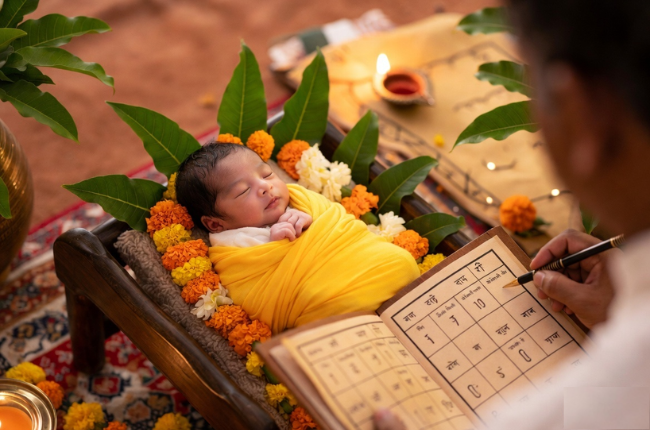
When a child is born, the first gift the family gives them costs nothing to buy and lasts their entire life. It is their name. In most Indian families, the naming decision begins immediately — relatives suggest names, elders recall family traditions, parents scroll through lists on their phones, and somewhere in all of that, a quiet but important question gets lost: what does this child's own birth chart say their name should begin with?
That question is not sentimental. In the Vedic tradition, a child's name is a vibrational signature — the sound that will accompany every introduction, every document, every achievement, and every prayer throughout their life. The Grihyasutras — the classical Vedic texts governing household rites — establish naming as one of the sixteen essential Samskaras (life-passage ceremonies), not because it is a formality but because the name given at birth, aligned with the child's Nakshatra (birth star) and Rashi (Moon sign), becomes one of the primary channels through which the child's planetary energies are either supported or disrupted throughout their life.
What almost no baby naming article explains clearly is the three-layer system — Nakshatra syllable, Rashi compatibility, and Numerology alignment — that the classical Vedic tradition uses together for name selection. Using only one layer while ignoring the other two produces a name that is culturally valid but not fully Vedically complete. This guide covers all three layers in full: the Nakshatra-based syllable system drawn from classical Jyotish, the Rashi compatibility framework, the Numerology alignment method, the complete Namkaran Sanskar Vidhi step by step, and the most common naming mistakes that families make without realising their classical significance. By the end, every family reading this will know exactly how to choose a name that honours the child's birth chart, their family lineage, and the classical Vedic tradition they are born into.
What Is Namkaran Sanskar — The Classical Foundation of Baby Naming
Namkaran — from the Sanskrit nama (name) and karana (making or performing) — is the formal naming ceremony prescribed as the fifth of the sixteen Samskaras in the Vedic household tradition. It is not merely a celebratory gathering. It is a structured ritual act that introduces the child to the world, to the family lineage, and to the cosmos — with a name that is selected, not randomly chosen, but derived from the specific cosmic coordinates of the child's birth moment.
Understanding what Namkaran Sanskar actually is — and why it is structured the way it is — transforms the ceremony from a cultural milestone into a conscious act of classical Vedic science.
The Classical Textual Authority for Namkaran
The Grihyasutras — the foundational texts of Vedic household ritual, including the Ashvalayana Grihyasutra, the Paraskara Grihyasutra, and the Gobhila Grihyasutra — each contain dedicated sections on the Namkaran ceremony. Their teaching is consistent: the name must be derived from the child's Janma Nakshatra (birth star), must be auspicious in syllable and meaning, and must be formally given in the presence of the sacred fire, the family elders, and the child's birth chart.
The Manusmriti adds a social dimension to the classical naming framework: names should be easy to pronounce, not offensive in sound, carry an auspicious meaning in Sanskrit or a regional sacred language, and reflect the family's Gotra (lineage) and Kula (clan) tradition.
The Four Classical Name Categories
Classical Vedic tradition prescribes that every person ideally has four names — not one. This is a dimension of the Namkaran tradition that almost no modern guide documents:
- Nakshatra Nama (the secret name): Derived directly from the Janma Nakshatra syllable — this is the child's sacred name known only to the family and the Pandit. It is whispered into the child's right ear during the ceremony and is not used in daily life. Its purpose is protective — it is the name by which the child is addressed in all subsequent Vedic ceremonies and prayers.
- Vyavaharika Nama (the social name): The everyday name by which the child is known publicly — chosen to be pleasant, meaningful, and culturally accessible. This is what goes on the birth certificate and school register.
- Masa Nama (the monthly name): Derived from the deity governing the birth month in the lunar calendar. Rarely used in daily life but invoked in specific ceremonial contexts.
- Kula Nama (the lineage name): The family name or surname, which carries the Gotra and ancestral identity forward.
Most modern Indian families use only the Vyavaharika Nama — the social name — without realising that the Nakshatra Nama (the sacred secret name) is the classical foundation from which the social name is ideally derived. A Pandit performing the Namkaran ceremony correctly will assign the Nakshatra Nama first and then guide the family toward a Vyavaharika Nama whose syllable aligns with it.
The Timing of Namkaran — When the Ceremony Should Be Performed
The Ashvalayana Grihyasutra prescribes Namkaran on the tenth or twelfth day after birth — a timing that most classical commentators associate with the completion of the birth pollution period (Sutaka) and the establishment of the child's foundational health. Regional traditions vary:
- North India: tenth, eleventh, or twelfth day most commonly
- South India: twenty-eighth day or the first auspicious day after the mother's ritual purification
- Maharashtra and Gujarat: eleventh or twelfth day, with strong preference for the twelfth
- Bengali tradition: Annaprashana (first solid food) is sometimes combined with a formal naming ceremony at six months
The Muhurta Chintamani by Ramadaivagna adds that whatever the regional convention for day count, the Namkaran ceremony must be performed during an auspicious Muhurat — a time when the Tithi, Vara (weekday), and Nakshatra of the ceremony day are all compatible with the child's birth Nakshatra. A ceremony performed on the correct day count but at an inauspicious Muhurat is classically considered incomplete.
As is commonly observed among families who consult a Pandit for the Namkaran — those who follow the correct Nakshatra syllable system and the correct ceremony timing consistently report that the child's name feels settled from the beginning. There is no later uncertainty about whether the name was right. The chart confirmed it.
How to Find Your Baby's Nakshatra and Its Naming Syllable — Step by Step
The Nakshatra is the Moon's position at the exact moment of birth — expressed as one of twenty-seven lunar mansions (Nakshatras) that divide the zodiac into equal sections of thirteen degrees and twenty minutes each. It is the single most important factor in classical Vedic baby naming — the Nakshatra syllable is the foundation from which the child's name is built.
Finding the correct Nakshatra requires the child's exact birth time, birth date, and birth location. These three data points together determine the Moon's precise position at the moment of birth.
Step-by-Step Nakshatra Identification
- Record the exact birth time, date, and location. Even a ten-minute error in birth time can shift the Moon into a different Nakshatra in borderline cases — particularly when the Moon is transitioning between Nakshatras at the time of birth. If the hospital record shows a range rather than an exact time, use the midpoint of the range and flag this to the Jyotishi who calculates the chart.
- Generate the birth chart (Janam Kundali). The birth chart calculated from the exact time, date, and location will show the Moon's position in degrees and minutes within a specific zodiac sign. This position determines the Nakshatra. For a complete understanding of how the birth chart is structured and read, the complete Kundli reading guide provides the foundational framework.
- Identify the Nakshatra from the Moon's degree position. Each Nakshatra spans exactly thirteen degrees and twenty minutes of arc. The Moon's position in degrees within the zodiac determines which of the twenty-seven Nakshatras it occupies at birth.
- Identify the Pada (quarter) within the Nakshatra. Each Nakshatra is divided into four Padas (quarters) of three degrees and twenty minutes each. The specific Pada of the Moon's position determines the exact syllable from which the name should begin. Each Pada has a specific syllable assigned to it in the classical Jyotish system.
- Consult the Nakshatra-to-syllable table (provided below) to find the precise starting sound for the child's name.
- Confirm with a qualified Jyotishi. Particularly when the Moon is within two degrees of a Nakshatra boundary, a Jyotishi's confirmation ensures the correct Nakshatra is used. A borderline Moon position requires precise degree-level calculation — an approximate chart or an app calculation may place the Moon in the wrong Nakshatra in such cases.
The Complete Nakshatra Naming Syllable Table
The syllables below are drawn from the classical Jyotish naming tradition. Each Nakshatra has four Padas and therefore four syllables — one per Pada. The child's name should begin with the syllable corresponding to their birth Nakshatra's specific Pada.
Nakshatra | Pada 1 | Pada 2 | Pada 3 | Pada 4 |
Ashwini | Chu | Che | Cho | La |
Bharani | Li | Lu | Le | Lo |
Krittika | A | I | U | E |
Rohini | O | Va | Vi | Vu |
Mrigashira | Ve | Vo | Ka | Ki |
Ardra | Ku | Gha | Ng | Chha |
Punarvasu | Ke | Ko | Ha | Hi |
Pushya | Hu | He | Ho | Da |
Ashlesha | Di | Du | De | Do |
Magha | Ma | Mi | Mu | Me |
Purva Phalguni | Mo | Ta | Ti | Tu |
Uttara Phalguni | Te | To | Pa | Pi |
Hasta | Pu | Sha | Na | Tha |
Chitra | Pe | Po | Ra | Ri |
Swati | Ru | Re | Ro | Ta |
Vishakha | Ti | Tu | Te | To |
Anuradha | Na | Ni | Nu | Ne |
Jyeshtha | No | Ya | Yi | Yu |
Mula | Ye | Yo | Bha | Bhi |
Purva Ashadha | Bhu | Dha | Pha | Da |
Uttara Ashadha | Be | Bo | Ja | Ji |
Shravana | Ju | Je | Jo | Sha |
Dhanishtha | Ga | Gi | Gu | Ge |
Shatabhisha | Go | Sa | Si | Su |
Purva Bhadrapada | Se | So | Da | Di |
Uttara Bhadrapada | Du | Tha | Jha | Na |
Revati | De | Do | Cha | Chi |
Note: The syllable table above follows the North Indian classical Jyotish tradition as documented in the Brihat Parashara Hora Shastra naming framework. Minor regional variations exist in South Indian traditions — a Pandit from the relevant regional tradition should confirm the specific Pada syllable for borderline cases.
📿 MICRO-REMEDY BOX 1 — Did You Know
The Nakshatra Nama — the sacred secret name whispered into the child's ear during Namkaran — is not a formality invented by modern Pandits. It is documented in the Ashvalayana Grihyasutra as the name by which the child will be addressed in all future Vedic ceremonies, including their thread ceremony (Upanayana), their marriage (Vivaha Sanskar), and their death rites (Antyesti). A person whose Nakshatra Nama was never assigned — because the Namkaran was skipped or simplified — is technically without the ceremonial identity that the entire sequence of Vedic Samskaras is built around. Families who discover this gap later can perform a retroactive Namkaran with a qualified Pandit at any age — the ceremony assigns the sacred name and reconnects the person to their birth Nakshatra's ceremonial identity.
The Rashi Layer — How the Moon Sign Shapes Name Compatibility
Once the Nakshatra syllable is identified, the second layer of classical Vedic name selection is the Rashi — the Moon sign. The Nakshatra determines the starting syllable. The Rashi determines the broader phonetic character and elemental quality that should run through the name as a whole.
The twelve Rashis are each governed by a specific planet and element. A name that begins with the correct Nakshatra syllable but whose overall sound character conflicts with the Rashi's elemental nature creates a subtle dissonance in the name's vibrational quality — noticeable over time in how the name settles on the child and how it resonates in different contexts.
Rashi-Based Name Guidance — Element and Sound
Aries (Mesha) — Fire, Mars: Names with strong, assertive consonant sounds — those beginning with hard consonants (K, Ch, A) — align with Aries's Mars energy. The name should project energy and directness. Soft, extended vowel-heavy names work less harmoniously with this Rashi's active fire character.
Taurus (Vrishabha) — Earth, Venus: Names with grounded, melodic sounds — those that feel stable and aesthetically pleasing when spoken — align with Venus-ruled Taurus. Names with a natural rhythm and beauty in their syllable pattern carry the Rashi's Venus quality well. Harsh or abrupt-sounding names create dissonance.
Gemini (Mithuna) — Air, Mercury: Light, quick, double-syllable names that feel nimble and communicative when spoken align naturally with Mercury-ruled Gemini. Names that have a playful or versatile sound quality reflect the Rashi's dual air nature. Heavy, ponderous names feel mismatched.
Cancer (Karka) — Water, Moon: Soft, flowing, nurturing sounds — often ending in vowels or gentle consonants — align with the Moon-ruled Cancer Rashi. Names that feel emotionally warm and melodically soft when spoken carry this Rashi's energy cleanly. Harsh or aggressive consonant clusters create friction.
Leo (Simha) — Fire, Sun: Strong, authoritative, dignified names — those that command respect when spoken — align with Sun-ruled Leo. The name should feel worthy of announcement. Names that feel diminutive or overly soft work against this Rashi's solar character.
Virgo (Kanya) — Earth, Mercury: Precise, clear, well-structured names with a clean sound architecture align with Mercury-ruled Virgo. Names that feel carefully formed — each syllable distinct and purposeful — carry this Rashi's analytical quality well.
Libra (Tula) — Air, Venus: Balanced, harmonious, aesthetically pleasing names — those that feel complete and symmetrical — align with Venus-ruled Libra. Names with a natural symmetry between their syllables carry the Rashi's balance principle most cleanly.
Scorpio (Vrishchika) — Water, Mars: Intense, distinctive, memorable names — those that carry depth and do not dissolve easily in a crowd — align with Mars-Ketu-governed Scorpio. Names with a certain gravity and distinctiveness in sound reflect this Rashi's depth.
Sagittarius (Dhanu) — Fire, Jupiter: Expansive, aspirational, philosophical-sounding names — those that carry a sense of vision and breadth — align with Jupiter-ruled Sagittarius. Names with classical Sanskrit etymology and a naturally elevated meaning carry this Rashi's wisdom quality well.
Capricorn (Makara) — Earth, Saturn: Disciplined, structured, enduring names — those that feel solid and time-tested — align with Saturn-ruled Capricorn. Ancient, classical names with clear Sanskrit roots and unambiguous meaning carry this Rashi's karmic seriousness well.
Aquarius (Kumbha) — Air, Saturn: Original, unconventional, distinctively structured names — those that feel fresh without being arbitrary — align with Saturn-Rahu-governed Aquarius. Names that carry a quietly individual character, distinct from common naming trends, reflect this Rashi's nature.
Pisces (Meena) — Water, Jupiter: Spiritual, gentle, evocative names — those that carry a sense of compassion, devotion, or mystical quality — align with Jupiter-ruled Pisces. Names with strong devotional Sanskrit roots or names of deities in their gentler forms carry this Rashi's energy most cleanly.
For a complete understanding of how the Nakshatra and Rashi work together in the full birth chart, the Nakshatra birth star complete meaning guide provides the detailed framework for reading the Moon's position across both dimensions simultaneously.
The Numerology Layer — Aligning the Name's Total Number With the Birth Date
The third layer of classical Vedic name selection is Anka Shastra — Vedic Numerology. Once the Nakshatra syllable and Rashi compatibility have been established, the total numerical value of the chosen name is calculated and checked for alignment with the child's birth date number and life path number.
This layer is the one most commonly skipped — and its absence is among the most frequently cited reasons that a name which felt right initially begins to feel mismatched as the child grows.
How Vedic Name Numerology Works
Every letter of the alphabet carries a numerical value in the Vedic Anka Shastra system. The total numerical value of a name is calculated by adding the values of all its letters and reducing to a single digit. This single digit — the name number — is then assessed for its relationship to the child's birth number (the single-digit reduction of their birth date) and their life path number (the single-digit reduction of their full birth date including month and year).
The name numerology guide for career and good luck and the business name numerology guide both cover the foundational calculation framework in full. The same principles apply to baby name selection — the mechanics of the calculation are identical, only the intention (lifelong identity rather than commercial brand) is different.
Key Name Number Relationships — Classical Guidance
Name number matches birth number: The most harmonious alignment — the name vibration and the birth date vibration reinforce each other. The child's identity and their natural life flow move in the same direction. Classical Numerology considers this the ideal alignment for a lifelong name.
Name number is complementary to birth number: Numbers 1 and 9, 2 and 7, 3 and 6, 4 and 8 are classical complementary pairs in the Vedic Anka Shastra system. A name number that is complementary to the birth number creates a productive creative tension — the name challenges the child toward growth rather than simply confirming their existing nature.
Name number conflicts with birth number: Numbers 4 and 9, 8 and 1 are classical challenging combinations in the Anka Shastra system. A name with a number that conflicts with the birth number creates friction between the child's expressed identity and their natural life flow — subtle at first, increasingly noticeable as the child navigates education, relationships, and career. This alignment is the one the Numerology layer is specifically designed to identify and correct before the name is finalised.
The Spelling Question — Why It Matters More Than Families Realise
In the modern context — where names are transliterated from Sanskrit or regional languages into English for official documents — the English spelling of the name determines its Numerological value in the English-language contexts the child will operate in. A name whose Sanskrit syllable is perfectly aligned with the Nakshatra but whose English transliteration produces a conflicting number creates a layered identity: the Sanskrit name vibration and the official document name vibration are different.
The classical solution is to choose an English spelling of the Nakshatra-aligned name whose letter values produce a number that either matches or complements the birth number. The mobile number numerology guide illustrates how minor numerical shifts — adding or changing a single digit — alter the overall vibration. The same principle applies to a letter added or changed in a name's English transliteration.
📿 MICRO-REMEDY BOX 2 — Myth vs. Fact
MYTH: Any name that starts with the correct Nakshatra syllable is automatically a good Vedic name for the child.
FACT: The Nakshatra syllable is the starting point — not the complete selection criterion. Classical Vedic naming requires three layers of alignment: the Nakshatra syllable (the starting sound), the Rashi compatibility (the overall sound character of the name), and the Numerology alignment (the total numerical value of the name relative to the birth date). A name that starts with the correct Nakshatra syllable but has a sound character that conflicts with the Rashi or a total number that conflicts with the birth date is only one-third aligned in the classical system. The Grihyasutras also require that the name carry an auspicious meaning — a name starting with the correct syllable but meaning something inauspicious or without clear positive meaning fails the classical fourth criterion. All four criteria together — syllable, sound character, number, and meaning — constitute a fully Vedically complete name selection.
The Namkaran Sanskar Vidhi — Complete Step-by-Step Ceremony
The Namkaran ceremony is one of the most joyful of the sixteen Vedic Samskaras — it introduces the child to the world with their name, their lineage, and the blessings of the family's tradition. What follows is the complete classical Vidhi for a household Namkaran Sanskar.
Complete Namkaran Vidhi in Sequence
- Select the Muhurat. The Namkaran ceremony must be performed on an auspicious day and time. An auspicious Tithi (avoid Amavasya, Chaturthi, Ashtami, Dwadashi, and Chaturdashi as primary Tithi days for Namkaran), a compatible Vara (Wednesday, Thursday, and Friday are classically preferred), and a Nakshatra of the ceremony day that is harmonious with the child's birth Nakshatra — all three must align. Confirm the Muhurat with a qualified Pandit using the current year's Panchang. The Panchang reading guide explains how to read the Tithi, Vara, and Nakshatra columns for Muhurat assessment.
- Prepare the ceremony space. Clean the designated area thoroughly. Place a wooden chowki in the centre. Arrange a small Havan Kund (fire pit) — for formal Namkaran, the sacred fire is the witness of the ceremony. A brass or copper Ganesha idol is placed on the chowki. A printed or handwritten copy of the child's birth chart is placed on the chowki alongside the ceremony materials.
- Prepare the Samagri. Essential items for the Namkaran ceremony:
- Mango wood sticks (samidha) for the Havan
- Pure cow's ghee for the Havan oblations
- Havan Samagri (the classical mixture of herbs, sesame, and grains)
- Panchamrit (milk, curd, honey, ghee, sugar) for the child's first ceremonial bath
- Fresh flowers — marigold and rose
- Raw rice (akshat)
- Turmeric (haldi) and kumkum
- Sandalwood paste (chandan)
- A gold ring or gold coin — touched to the child's tongue with honey during the ceremony
- A new cloth for the child
- Betel leaves and betel nuts
- Fruits and sweets for Naivedya
- Invoke Ganesha. The ceremony opens — as every Vedic ceremony does — with Ganesha's formal invocation. Apply tilak, offer flowers and akshat, recite the Ganesh Vandana, and formally request the removal of all obstacles from the child's naming and life path.
- Light the sacred fire — Havan Arambha. The Pandit lights the Havan fire with the correct Agni Pratishtha (fire installation) Mantra. The fire is the living witness — Agni as witness (Sakshi) is the foundation of every Vedic Samskara. Without the sacred fire, the ceremony has devotional validity but not classical Vedic completeness as a Samskara.
- Perform the child's Abhishek. The newborn is gently bathed with Panchamrit — a few drops applied symbolically to the head, not a full bath — while the Pandit recites purification Mantras from the Grihyasutra tradition. This step formally purifies the child for the ceremony.
- The father whispers the Nakshatra Nama into the child's right ear. The father — or in the father's absence, the senior male elder of the family — holds the child and whispers the Nakshatra Nama (the sacred secret name derived from the birth Nakshatra syllable) three times into the child's right ear. The right ear is specified in the Ashvalayana Grihyasutra — the right side carries the auspicious solar energy in the Vedic directional system.
- The mother whispers the social name into the child's left ear. The mother then whispers the Vyavaharika Nama — the social name that will be used in daily life — three times into the child's left ear. This is followed by the Pandit announcing the name aloud to all assembled family members and guests.
- Perform the Havan oblations for the child's name. The Pandit performs Havan with the child's name incorporated into the Mantra — each Ahuti (oblation) offered into the sacred fire with the specific intention that the name be blessed, protected, and empowered for the child's lifetime. The classical Havan for Namkaran includes oblations to the child's Janma Nakshatra deity, the Rashi lord, and the Lagna lord.
- Touch gold and honey to the child's tongue. A gold ring or coin is dipped in honey and touched gently to the child's tongue — a practice documented in the Paraskara Grihyasutra as the classical gesture of invoking intelligence, eloquence, and golden character in the named child. Gold is associated with the Sun's brilliance; honey with the sweetness of well-spoken words.
- The family elder formally announces the name. The eldest family member present — paternal grandfather ideally — formally announces the child's name to all assembled, inviting the gathering's collective blessings. Guests shower the child with akshat (rice) as a blessing gesture.
- Distribute Prasad and receive blessings. The Prasad — sweets, fruits, and the blessed items from the chowki — is distributed to all present. Every family member touches the child's forehead with their blessing hand. The ceremony concludes with the Pandit's closing prayer for the child's long life, health, and success.
What the Classical Texts Actually Say About Name Selection — Beyond Syllables
Most families and even many Pandits focus exclusively on the Nakshatra syllable when selecting a Vedic name — treating the syllable as the complete classical criterion. The Manusmriti, the Grihyasutras, and the Vishnu Purana together establish a richer and more demanding classical standard for name selection that goes well beyond starting sound.
The Five Classical Name Criteria from the Manusmriti
The Manusmriti (Chapter 2, verses 30-33) establishes five criteria that a properly selected Vedic name must satisfy simultaneously. These are not suggestions — they are the classical standard:
1. Mangala — Auspicious meaning. The name must carry a positive, auspicious meaning in Sanskrit or a recognised sacred language. A name that begins with the correct Nakshatra syllable but means something dark, heavy, or inauspicious fails the classical standard. The meaning is spoken every time the name is pronounced — its quality accumulates over a lifetime of use.
2. Madhura — Pleasant to the ear. The name must be melodically comfortable to pronounce and hear. A name that is phonetically awkward — one that requires visible effort to say clearly — carries a subtle friction in every interpersonal encounter. The Manusmriti specifically notes that pleasant sound quality is not an aesthetic preference but a functional requirement for a name that will be spoken thousands of times across a lifetime.
3. Tejasvi — Conveying brightness and vitality. The name should carry an inherent sense of energy, luminosity, or aspiration in its meaning and sound. Names of deities, natural forces, classical heroes, and noble qualities all satisfy this criterion naturally. Diminutive, self-deprecating, or overly neutral names that carry no inherent vitality fail this criterion.
4. Shubhakshara — Auspicious in its letters. The letters and syllables of the name must be free from inauspicious combinations. Certain letter combinations in Sanskrit phonology are considered acoustically discordant — a Pandit trained in classical Vyakarana (Sanskrit grammar) can identify these combinations.
5. Sthira — Stable and enduring. The name must be one that ages well — that carries the same dignity and appropriateness from childhood through old age. A name that is charming on a two-year-old but inappropriate on a forty-year-old fails the classical criterion of stability.
What the Vishnu Purana Adds — The Deity Connection
The Vishnu Purana adds a devotional dimension to the classical naming framework: names that are attributes or epithets of the divine — names of deities, names meaning divine qualities (Ananda, Chandra, Surya, Lakshmi, Priya) — carry an inherent spiritual resonance that benefits the child throughout their life.
The Purana's teaching on this point is specific: a child named after a deity is unconsciously reminded of that deity's qualities each time their name is spoken — by themselves and by others. Over a lifetime, this accumulates into a subtle but real influence on character formation. This is the classical logic behind the widespread Indian tradition of naming children after deities — it is not mere reverence, it is a deliberate character-cultivation strategy embedded in the name itself.
One Question No Baby Naming Article Has Answered — What Happens When the Birth Time Is Unknown or Wrong
A question that appears repeatedly in r/jyotish and Quora parenting discussions with no satisfying published answer: what do families do when the exact birth time was not recorded, or when they suspect the recorded time is wrong — and the Namkaran has already been performed with a name that may be based on the wrong Nakshatra?
This situation is far more common than most naming guides acknowledge. Hospital birth records in India frequently record the time the nurse documented rather than the time of actual birth — a gap of ten to thirty minutes is common. In home births, time recording varies further. And for children born in the 1970s, 80s, and 90s — whose own children's naming is now influenced by their parents' understanding of their own Nakshatra — incorrect birth times have propagated across generations.
The Classical Response to an Unknown Birth Time
Classical Jyotish has two established responses to this situation — both documented in regional Jyotish commentary traditions:
Prasna Kundali (Horary Chart): When the birth time is genuinely unknown, a Prasna Kundali — a horary chart cast for the moment the question about the child's Nakshatra is first formally asked — can be used to identify the most likely birth Nakshatra through a set of classical indicators. This is not a substitute for the birth chart — it is a bridge technique used specifically when the birth chart cannot be reliably cast.
Nadi Identification: In the South Indian Nadi astrology tradition, specific physical characteristics and life circumstances are cross-referenced with Nakshatra profiles to identify the birth Nakshatra without a confirmed time. A Nadi practitioner examines the child's physical features — including classical Samudrika indicators — and triangulates toward the most likely Nakshatra. The face reading complete guide covers the classical physical feature-to-planetary correspondence system that Nadi practitioners use as one of their identification tools.
What If the Name Was Already Given Based on a Wrong Nakshatra?
If the Namkaran has already been performed and the family later discovers that the Nakshatra was incorrectly identified — because the birth time was wrong — the classical response is not panic but a measured remedial process:
The child's existing name is not erased or changed on official documents. Instead, a formal Nama Shuddhi (name purification) ceremony is performed by a qualified Pandit, in which the correct Nakshatra Nama is whispered into the child's right ear and the sacred fire witnesses the correction. The social name may remain unchanged — or may be slightly adjusted in spelling to align the Numerological value with the correct birth number. The child's Kundali is recalculated from the corrected time estimate and all subsequent Vedic ceremonies reference the corrected Nakshatra.
A Pandit familiar with your Kula tradition will guide this process with sensitivity — it is a correction, not a failure, and the classical tradition has a clear and compassionate protocol for exactly this situation.
Common Naming Mistakes Indian Families Make — And Their Classical Corrections
Beyond the ceremony itself, the naming decision itself contains several structural errors that recur across Indian families regardless of region, education level, or degree of traditional observance. Each has a direct classical correction.
Mistake 1 — Choosing the Name Before the Birth Chart Is Ready
Many families settle on a name during the pregnancy — before the child is born and before the Nakshatra is known. The chosen name is then checked against the Nakshatra after birth, and if it does not match, the family either forces the Nakshatra interpretation to accommodate the pre-chosen name or simply overrides the Nakshatra altogether.
Classical correction: Select a shortlist of names whose starting syllables span the possible Nakshatra outcomes based on the expected delivery window — but do not finalise the name until the birth chart confirms the Nakshatra. The birth chart should drive the name selection, not confirm a decision already made.
Mistake 2 — Using the Sun Sign Instead of the Moon Sign for Name Selection
A persistent confusion in modern Indian families — particularly those influenced by Western astrology — is using the Sun sign (Surya Rashi) for name selection instead of the Moon sign (Chandra Rashi). In Vedic Jyotish, it is the Moon's position — not the Sun's — that determines the Nakshatra and the Rashi used for naming. The Sun changes sign once per month. The Moon changes Nakshatra every two and a half days — its precision is far greater and its classical relevance to the individual's inner nature is primary.
Classical correction: Always use the Moon's position in the birth chart for name selection — confirm this with the Jyotishi explicitly, as the Sun sign and Moon sign are frequently different.
Mistake 3 — Choosing a Trendy Name That Has No Sanskrit Root or Auspicious Meaning
The modern trend toward English-origin names, invented names with no linguistic root, or names borrowed from popular culture creates a naming gap that the Manusmriti's criterion of Mangala (auspicious meaning) directly addresses. A name without a verifiable auspicious meaning satisfies none of the classical five criteria beyond possibly the Nakshatra syllable.
Classical correction: Every name chosen should have its Sanskrit or regional sacred language meaning confirmed before finalisation. Names of deities, classical Sanskrit qualities, natural auspicious phenomena, and revered historical figures all carry inherent Mangala quality. If the family wishes to use a modern or English-influenced name, combine it with a classical Sanskrit middle name that carries the Nakshatra syllable — giving the child both a contemporary social identity and a complete classical Vedic naming.
Mistake 4 — Ignoring the Sibling Nakshatra Compatibility
A dimension of Vedic naming that almost no guide addresses: in classical Jyotish tradition, the Nakshatra of the new child and the Nakshatras of existing siblings are cross-referenced for compatibility. Certain Nakshatra combinations between siblings — particularly those involving Nadi Dosha (an incompatibility in the elemental channel of two Nakshatras) — are associated with health and relationship friction between the children.
Classical correction: When naming a second or subsequent child, bring the birth charts of all existing children to the Pandit or Jyotishi performing the naming consultation. The new child's Nakshatra compatibility with each sibling is assessed as part of the complete naming process. For families who discover a significant sibling Nakshatra incompatibility after the fact, specific dosha remedies and protective Poojas can be prescribed to strengthen the relationship between the children.
Mistake 5 — Performing the Namkaran Without the Sacred Fire
The most structurally significant mistake — replacing the Havan component of Namkaran with a simple prayer gathering. While the prayer gathering has devotional value, the classical Samskara is not complete without the sacred fire as witness. The Grihyasutras are clear: the fire witness transforms the naming from a family announcement into a Vedic Samskara — a formal cosmic registration of the child's name, lineage, and planetary identity.
Classical correction: If the Namkaran was performed without a Havan, a retroactive Nama Havan — a sacred fire ceremony specifically for the child's name — can be performed at any subsequent auspicious Muhurat to complete the Samskara formally.
FAQ
Q1. How do I find my baby's Nakshatra for name selection? The baby's Nakshatra is determined by the Moon's exact position in degrees at the moment of birth. This requires the precise birth time, date, and location to cast the birth chart accurately. Once the Moon's degree position is identified, it maps to one of the twenty-seven Nakshatras — and the specific Pada (quarter) within that Nakshatra determines the starting syllable for the name. A qualified Jyotishi confirms the Nakshatra calculation, particularly when the Moon is near a Nakshatra boundary.
Q2. What is the correct day to perform Namkaran Sanskar? Classical tradition prescribes the tenth or twelfth day after birth as the standard Namkaran timing, following the birth pollution period. The ceremony must fall on an auspicious Muhurat — confirmed from the current Panchang — where the Tithi, Vara (weekday), and Nakshatra of the ceremony day are compatible with the child's birth Nakshatra. Wednesday, Thursday, and Friday are classically preferred weekdays. Amavasya, Ashtami, and Chaturdashi Tithis are avoided.
Q3. Can Namkaran be done at home without a Pandit? The family can perform a simplified devotional naming ceremony at home — gathering the family, lighting a lamp, and announcing the name with prayer. However, the classical Vedic Samskara requires a Pandit for the Havan (sacred fire), the correct Mantra recitation from the Grihyasutra tradition, and the formal whisper of the Nakshatra Nama into the child's right ear. Without these three elements, the ceremony has devotional validity but not classical Samskara completeness.
Q4. Does the name really affect a child's luck and future in Vedic tradition? Classical Vedic tradition holds that the name, aligned with the Nakshatra and Rashi, becomes a vibrational channel that either supports or subtly disrupts the child's planetary energies throughout their life. The Manusmriti's five naming criteria — auspicious meaning, pleasant sound, vitality, auspicious letters, and enduring quality — together ensure the name functions as a lifelong positive resonance. As classical tradition holds, individual outcomes vary with karma, the quality of the child's full birth chart, and the sincerity of the naming process.
Q5. What if the baby's name was chosen before the Nakshatra was known? If a name was chosen before the Nakshatra was identified and does not match the classical syllable, the family has two options in the classical system: perform a Nama Shuddhi ceremony to formally assign the Nakshatra Nama separately from the social name, or consult a Pandit about adjusting the social name's spelling to align its Numerological value with the birth number while keeping the name recognisable. A complete replacement of the name on official documents is rarely necessary.
Q6. How does Numerology fit into Vedic baby name selection? Vedic Anka Shastra (Numerology) is the third layer of classical name selection after Nakshatra syllable and Rashi compatibility. The total numerical value of the name's letters is calculated and reduced to a single digit — the name number. This number is assessed for its harmony with the child's birth number (single-digit reduction of the birth date) and life path number. A name whose number aligns with or complements the birth number creates a harmonious lifelong vibrational identity.
Q7. What is the difference between the Nakshatra Nama and the social name? The Nakshatra Nama is the sacred secret name derived directly from the birth Nakshatra syllable — whispered into the child's right ear during the Namkaran ceremony and used only in Vedic ceremonies throughout the person's life. The social name (Vyavaharika Nama) is the everyday name used publicly, ideally derived from or aligned with the Nakshatra syllable. A complete classical Namkaran assigns both — the Nakshatra Nama as the sacred ceremonial identity and the social name as the world-facing identity whose starting sound ideally reflects the Nakshatra syllable.
Conclusion
The Vedic tradition holds that the moment of birth is the most precisely mapped moment of a person's life — the planets' positions, the Nakshatra rising, the Moon's exact degree all recorded in the birth chart as a permanent celestial document. The name given in the days that follow is the family's first and most lasting response to that document. It is the sound by which the child will know themselves and be known by the world — for their entire life.
The most concrete step any family can take today is to obtain the child's exact birth chart from a qualified Jyotishi, identify the precise Nakshatra and Pada, and bring that information to the Namkaran consultation before finalising any name. That one step — putting the chart first — is what separates a name that simply sounds good from a name that is genuinely, classically complete.
Outcomes across life — the quality of the child's career, relationships, and inner peace — depend on karma, the birth chart's complete planetary configuration, and the choices made across a lifetime. The name is not a guarantee of fortune. It is the first, most persistent, and most personal channel through which the child's planetary energies flow outward into the world. Classical tradition asks only that this channel be built with knowledge, care, and the full three-layer precision the Vedic system makes available.
Welcoming a new child and want their name chosen with full classical precision — correct Nakshatra syllable, Rashi compatibility, Numerology alignment, and complete Namkaran Vidhi? AtoZPandit.com connects you with experienced Jyotishis and trained Pandits who read the birth chart, identify the exact Pada syllable, and guide the complete Namkaran ceremony — so the first gift you give your child is given correctly.
DISCLAIMER This article is published for educational and cultural awareness purposes only. The Vedic naming principles, Nakshatra syllable tables, and Namkaran Sanskar Vidhi described here are part of India's classical tradition and do not substitute for qualified medical, legal, or professional advice. For personalised guidance, connect with AtoZPandit.com.