
Diwali Lakshmi Pooja Guide How to Invite Wealth and Abundance Into Home
Every year, as Diwali night approaches, the same quiet anxiety visits millions of households. The house has been cleaned for days. The diyas are ready. The sweets are made. And yet somewhere in the back of the mind sits a question that nobody in the family says out loud: are we doing this correctly? Is the Muhurat right? Are we missing something from the Samagri? Will Maa Lakshmi actually come — or will we go through all the effort and have the ceremony feel hollow, the way it did two years ago when the incense ran out midway and nobody remembered the correct order of the Aarti?
That quiet worry is the gap this guide is written to fill. Diwali Lakshmi Pooja is the most important household ceremony in the Hindu calendar — the one night of the year when Goddess Lakshmi is said to move from home to home, entering where she finds the door open, the space clean, the lamp lit, and the family gathered with genuine intent. The Skanda Purana describes this movement of Lakshmi on Amavasya of the Kartik month in precise terms — she does not enter randomly. She enters homes that have prepared for her arrival with knowledge, sincerity, and the correct Vidhi.
What most Diwali Pooja articles miss is the distinction between the decorative ritual and the correct Vedic Vidhi — the precise sequence of invocation, offering, and Aarti that transforms a beautiful lamp-lighting into an actual classical ceremony. This guide covers the complete Vidhi step by step, the correct Muhurat and why it matters more than most families realise, the full Samagri list with nothing omitted, the most common mistakes that silently invalidate the Pooja, and what to do in the days after Diwali to ensure that what Lakshmi brings does not leave with the festival lights.
Who Is Goddess Lakshmi and Why Diwali Is Her Night
Lakshmi Pooja on Diwali is not simply a tradition passed down through families — it is a ceremony grounded in classical Vedic and Puranic teaching about who Goddess Lakshmi is, what she governs, and why the Amavasya of Kartik is the specific night the classical texts prescribe for her formal invocation.
Understanding this foundation transforms the Pooja from a cultural performance into a genuine act of Vedic devotion — and that shift in understanding is itself one of the most powerful things a family can bring to the ceremony.
Who Lakshmi Is in Classical Vedic Tradition
Goddess Lakshmi — Shri Mahalakshmi in her complete classical form — is not merely the deity of money. The Vishnu Purana describes her as the Shakti of Lord Vishnu: the active sustaining force of the universe expressed through prosperity, beauty, abundance, auspiciousness, and divine grace. Her classical attributes span eight forms collectively called the Ashta Lakshmi — eight dimensions of prosperity that together constitute a complete life:
- Adi Lakshmi — primordial spiritual abundance
- Dhana Lakshmi — material wealth and financial prosperity
- Dhanya Lakshmi — abundance of food, health, and nourishment
- Gaja Lakshmi — royal authority, power, and social standing
- Santana Lakshmi — the prosperity of progeny and family continuity
- Veera Lakshmi — courage, strength, and the capacity to overcome obstacles
- Vijaya Lakshmi — victory, success, and the completion of what is undertaken
- Vidya Lakshmi — the prosperity of knowledge, wisdom, and learning
The Diwali Pooja, properly performed, does not invoke only Dhana Lakshmi — the narrow money-aspect. It invokes the complete Ashta Lakshmi. Families who understand this arrive at the Pooja with a broader Sankalpa and, classical tradition holds, receive a broader form of Lakshmi's grace.
Why Kartik Amavasya Is Lakshmi's Night
The Skanda Purana — one of the eighteen Mahapuranas — records that on the Amavasya (new moon night) of the Kartik month, Goddess Lakshmi herself moves through the world, visiting homes and entering those she finds prepared. The darkness of the new moon night is not inauspicious on this date — it is structurally significant. The lit diya is visible against maximum darkness. The Lakshmi who moves through the world on this night is drawn to the lit lamp, the clean threshold, and the sincere Sankalpa — not to noise, display, or mechanical ritual.
The Padma Purana adds a specific detail that almost no Diwali article records: Lakshmi is said to visit homes in three waves on Diwali night — the first wave at Pradosh Kaal (the period just after sunset), the second at Nishitha Kaal (midnight), and the third just before dawn. The Pradosh Kaal visit is the one most accessible to household Pooja — and this is precisely why the classical Muhurat for Diwali Lakshmi Pooja falls in the Pradosh Kaal window, not at an arbitrary evening time.
As is commonly observed among families who have performed this Pooja with full classical knowledge — the ceremony does not feel the same once its meaning is understood. The lamp is not a decoration. It is an announcement.
The Complete Diwali Lakshmi Pooja Samagri List
The Samagri — the collection of ritual items — is the physical foundation of the Pooja. A ceremony performed with incomplete Samagri has gaps in its Vidhi that a sincere heart cannot fully compensate for. The list below is complete for the standard household Diwali Lakshmi Pooja Vidhi performed across North, West, and Central India.
Step-by-Step Samagri Collection
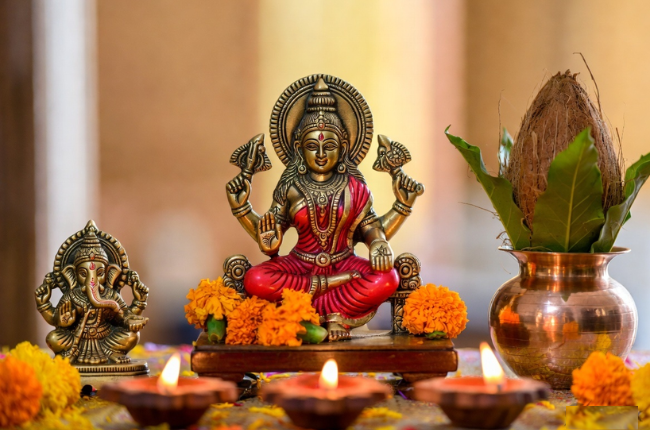
- Idol or image of Goddess Lakshmi — a brass, silver, or clay murti of Lakshmi seated on a lotus. For the Diwali Pooja specifically, a seated Lakshmi (not standing) is the classical preferred form — the seated posture represents Sthira Lakshmi, the stable, settled form of wealth that stays rather than passes through
- Idol of Lord Ganesha — placed to the left of Lakshmi during the Pooja. Ganesha is always invoked first in any Vedic ceremony — this sequence is non-negotiable and documented in the Grihyasutras
- Copper or brass Kalash — a water pot with a wide base and narrow neck; filled with clean water, topped with mango leaves arranged in a crown, and a coconut placed on top with its three eyes visible
- Red cloth (lal vastra) — to cover the chowki (the wooden platform on which the idols are placed)
- Mango leaves — minimum five, maximum eleven; used for the Kalash crown and as offering vessels
- Coconut — one whole coconut for the Kalash; one additional coconut for the Pooja offering
- Raw rice (akshat) — washed and dried; used for the asana (seat) of the deity and for offerings throughout the Vidhi
- Marigold flowers (genda) — the classical Diwali Pooja flower; both loose petals and garlands
- Lotus flowers — if available; the lotus is Lakshmi's primary classical symbol and its presence in the Pooja is specifically auspicious
- Rose petals — secondary flower offering; red or pink preferred
- Turmeric (haldi) — for the tilak and for purification of the Pooja space
- Kumkum (sindoor) — for the tilak applied to the idol and to the family members after Aarti
- Sandalwood paste (chandan) — applied to the idol as a cooling, purifying offering
- Panchamrit — the five-nectar mixture for abhishek (sacred bathing of the idol): raw milk, curd, honey, ghee, and sugar
- Clean water in a copper vessel — for the Achamana (ritual sipping) and for the idol bathing sequence
- Incense sticks (agarbatti) — sandalwood or jasmine fragrance; minimum two sticks, lit simultaneously
- Camphor (kapoor) — for the Aarti flame; camphor burns completely without residue — the classical symbol of the ego dissolving in devotion
- Panchadeepa (five-wick lamp) or standard diya — filled with pure cow's ghee for the primary Aarti lamp. A ghee lamp is strongly preferred over oil for the Aarti itself; the surrounding diyas may use sesame oil or mustard oil
- Betel leaves (paan ke patte) — minimum five; used as offering plates for the naivedya
- Betel nuts (supari) — minimum five; offered alongside the betel leaves
- Naivedya (food offering) — must include: kheel (puffed rice), batasha (sugar candy), seasonal fruits, and at least one home-made sweet. The Skanda Purana specifically mentions kheel and batasha as the classical Diwali Lakshmi Pooja food offerings — these are not decorative but prescribed
- Coins and currency notes — placed on the chowki during the Pooja for Lakshmi's blessing; both old and new currency is acceptable but must be clean
- Account books (bahi-khata) — the business ledger and household accounts book; placed on the chowki for Lakshmi's blessing; this practice is documented in the North Indian merchant community's Diwali Vidhi tradition
- Sapta Dhanya (seven grains) — wheat, rice, black sesame, moong, urad, chana, and barley; placed in small mounds on the chowki as symbols of agricultural abundance
- Panchopachar items — the five standard offering categories: gandha (fragrance/sandalwood), pushpa (flowers), dhoop (incense), deepa (lamp), and naivedya (food)
Items to Keep Ready but Not on the Chowki
- A small broom (jhadu) — Lakshmi's classical symbol of the sweeping away of poverty; placed to the side of the chowki, not on it
- A conch shell (shankha) — blown at the beginning and end of the Aarti
- A bell (ghanta) — rung during the Aarti
- Spare diyas and extra cotton wicks — at least ten extra; a diya that goes out during the Pooja must be relit immediately
📿 MICRO-REMEDY BOX 1 — Quick Samagri Check
The five most commonly forgotten Diwali Lakshmi Pooja items — confirmed from Quora, Reddit, and community feedback:
- Kheel and batasha — the prescribed Diwali naivedya; not substitutable with generic sweets alone
- Separate Ganesha idol — many families use only the Lakshmi idol; Ganesha must be present and invoked first
- Lotus flowers — not always available but worth seeking; a lotus image on paper is an acceptable alternative
- Account books (bahi-khata) — frequently forgotten by business owners who perform a beautiful home ceremony but leave their ledgers in the office
- Extra wicks and ghee — a diya that runs out of ghee during the Aarti is a common disruption; keep a full spare supply within reach
The Correct Muhurat for Diwali Lakshmi Pooja and Why It Matters
Of all the decisions in Diwali preparation, the Muhurat — the auspicious timing window — is the one most frequently treated as approximate rather than precise. The attitude of "we'll start sometime after sunset" is the single most common timing error in household Diwali Lakshmi Pooja.
Classical Vastu and Jyotish tradition is unequivocal: Diwali Lakshmi Pooja performed outside its correct Muhurat window still has devotional value — but it does not carry the same classical Vedic efficacy as a Pooja timed to the Pradosh Kaal window on Kartik Amavasya.
Understanding Pradosh Kaal — The Classical Diwali Window
Pradosh Kaal is the period spanning approximately one hour and thirty-six minutes after sunset. It is the transitional time between day and night — when the Sandhya (twilight) energy is active — and the Muhurta Chintamani by Ramadaivagna specifically identifies this window as the most auspicious period for Lakshmi invocation on Diwali night.
The classical reasoning is precise: Lakshmi moves through the world during Pradosh Kaal on Kartik Amavasya. A Pooja begun at the start of this window — when the first stars become visible and the Amavasya darkness deepens — meets Lakshmi in her movement rather than after she has passed.
Nishitha Kaal — The Midnight Alternative
For households that cannot complete their preparation within the Pradosh window, the Nishitha Kaal — the midnight period of approximately 11:30 PM to 12:30 AM on Diwali night — is the secondary classical Muhurat. This window is prescribed specifically in the Devi Bhagavata Purana for Tantric and Shakta traditions of Lakshmi worship and is considered particularly powerful for Dhana Lakshmi invocation.
Business owners and traders who follow the merchant community's Diwali Vidhi tradition often perform the Pooja at Nishitha Kaal — the midnight window — after the Pradosh-window family Pooja is complete.
How to Find the Exact Muhurat for Your City
The exact Pradosh Kaal window varies by geographic location — sunset times differ by city, and the Amavasya Tithi's start and end times must be confirmed from a reliable Panchang for the current year. Key points to verify:
- The Amavasya Tithi must be active during the Pradosh window for the Muhurat to be valid. If Amavasya begins after Pradosh ends, the Pooja is performed the following day's Pradosh — an uncommon but classically documented situation.
- The Vrishabha Lagna (Taurus ascendant) period within the Pradosh window is considered especially auspicious for Lakshmi Pooja — Taurus is Venus's sign, and Venus governs material beauty and wealth. A Jyotishi or Panchang reading confirms when Vrishabha Lagna is active on Diwali night for your city.
- Sthira Lagna (fixed ascendant signs — Taurus, Leo, Scorpio, Aquarius) during the Pradosh window is associated with Sthira Lakshmi — the stable form of wealth that stays. The Muhurta Chintamani specifically recommends performing the Diwali Pooja during a Sthira Lagna for families whose intention is long-term financial stability rather than short-term gain.
Step-by-Step Diwali Lakshmi Pooja Vidhi — The Complete Classical Sequence
This is the complete Vidhi for household Diwali Lakshmi Pooja as performed in the North and West Indian traditions. Each step is in the correct classical sequence. No step may be skipped or reordered without affecting the ceremony's Vedic completeness.
The Complete Vidhi in Sequence
- Prepare the space. Clean the Pooja room or the designated area thoroughly. Lay the red cloth on the chowki. Place the Ganesha idol on the left side of the chowki and the Lakshmi idol on the right. Arrange the Kalash in the north-east corner of the chowki. Place coins, account books, and Sapta Dhanya on the chowki. Light the diyas throughout the house before beginning — the house must be lit before the Pooja begins, not after.
- Purify yourself. Bathe and wear clean, preferably new clothes. Yellow, red, or white is the classical preferred colour for Diwali Pooja attire. Sit facing east or north — the family head conducting the Pooja must sit in the correct direction.
- Recite the Sankalpa. The Sankalpa is the formal statement of intent that opens every Vedic ceremony. State your name, your family lineage (gotra), the current Tithi and year, and your specific intention for the Pooja. The Sankalpa transforms the ceremony from a ritual performance into a personally directed Vedic act. This step is consistently skipped in casual household Poojas — and its absence is the single most significant reason Poojas feel hollow rather than complete.
- Invoke Ganesha first. Apply kumkum and sandalwood tilak to the Ganesha idol. Offer flowers and akshat. Recite the Ganesh Vandana or simply say: "Om Ganeshaya Namaha" — minimum eleven times. Request Ganesha's blessing to remove obstacles from the Pooja itself and from the household's path forward. No Vedic ceremony begins without this step — it is prescribed in the Grihyasutras as the foundational sequence of all household Pooja.
- Perform Kalash Sthapana. Fill the copper Kalash with clean water. Add a pinch of turmeric, a few drops of Ganga water if available, and a betel nut to the water. Arrange mango leaves in a crown at the mouth of the Kalash. Place the coconut on top. Invoke the presence of all sacred rivers and of Lord Varuna in the Kalash water by placing your right hand on the Kalash and reciting: "Om Varunaaya Namaha" — seven times.
- Invoke Goddess Lakshmi — the Avahana. This is the formal invitation to the Goddess to enter the Pooja space. Offer akshat, flowers, and incense to the Lakshmi idol. Recite the Shri Sukta — the classical Vedic hymn to Lakshmi from the Rigveda Khilani (supplementary Rigvedic texts). The Shri Sukta's sixteen verses directly invoke Lakshmi's eight forms and request her permanent residence in the household. If the full Shri Sukta cannot be recited, the Lakshmi Ashtakam or Mahalakshmi Ashtakam is an accessible alternative with classical standing.
- Perform Shodashopachara — the sixteen-step offering sequence. The classical Diwali Lakshmi Pooja follows the Shodashopachara Vidhi — sixteen offerings made to the Goddess in sequence:
- Avahana — invitation (already performed above)
- Asana — offering a seat (place fresh flowers or akshat beneath the idol)
- Padya — water for washing the feet (sprinkle clean water before the idol)
- Arghya — water for the hands (offer water in a copper spoon)
- Achamana — water for sipping (three drops of water offered)
- Snana — bathing with Panchamrit (pour Panchamrit over the idol gently, then wipe clean)
- Vastra — offering of cloth (place a small red or yellow cloth near the idol)
- Yajnopavita — sacred thread offering (a cotton thread or mauli offered)
- Gandha — sandalwood paste (applied to the idol's forehead)
- Pushpa — flowers (offer marigold, rose petals, and lotus if available)
- Dhupa — incense (wave incense sticks clockwise before the idol)
- Deepa — lamp offering (wave the ghee lamp clockwise before the idol)
- Naivedya — food offering (place kheel, batasha, fruits, and sweets before the idol; ring the bell during this offering)
- Achamana — second water sipping (three drops of water)
- Tambula — betel leaf and nut offering (place five betel leaves with supari before the idol)
- Pradakshina and Namaskara — circumambulation and prostration (walk clockwise around the chowki three times, then prostrate or bow deeply)
- Perform the Lakshmi Aarti. Light the camphor in the Panchadeepa or diya. Hold the lamp in the right hand. Wave it in a clockwise circular motion before the Lakshmi idol — seven complete circles. Ring the bell continuously during the Aarti. Blow the conch at the beginning and end. The entire family must be present and singing the Aarti together — Lakshmi's classical preference, as described in the Vishnu Purana, is for a household gathered in unified devotion.
- Distribute Prasad. After the Aarti, distribute the blessed kheel, batasha, and sweets to every family member. Apply kumkum tilak to every person's forehead. Offer Prasad to neighbours and guests. The Skanda Purana notes that sharing Prasad beyond the immediate family on Diwali night is itself an act that pleases Lakshmi — generosity on this night is a direct expression of the abundance she represents.
- Keep the lamp lit through the night. The classical instruction is unambiguous — the Pooja lamp must not be extinguished after the Aarti. It must burn through the night or for as long as possible. A lamp that is deliberately extinguished after the ceremony signals closure — the opposite of what the Pooja has just invoked. Keep extra ghee and wicks ready.
The Most Common Diwali Lakshmi Pooja Mistakes — And Their Classical Corrections
Many families perform the Diwali Pooja with great sincerity and find that the ceremony feels incomplete or that its effects are short-lived. In the overwhelming majority of such cases, the cause is one or more of the following structural mistakes — each of which has a direct classical correction.
Mistake 1 — Skipping the Sankalpa
The Sankalpa is the ceremony's directional force. Without it, the Pooja is a beautiful ritual with no personal address. The Goddess receives the flowers and the lamp — but there is no formal statement of who is offering, for what purpose, and with what intention. Classical Vedic tradition is explicit: a ceremony without Sankalpa is like a letter without an address. It is sent — but it arrives nowhere in particular.
Correction: Prepare the Sankalpa text in advance. State your name, gotra, the current year and Tithi, and your specific intention for wealth, health, family prosperity, or business growth. Say it aloud at the beginning of the Pooja before any other step.
Mistake 2 — Invoking Lakshmi Before Ganesha
In the excitement of Diwali preparation, many families go directly to the Lakshmi Pooja and add a brief Ganesha prayer as an afterthought. The Grihyasutras are categorical: Ganesha must be invoked first — fully, with tilak, flowers, and a complete Vandana — before any other deity is approached in a Vedic ceremony.
Correction: Give Ganesha's Avahana its own dedicated step — minimum five minutes — before approaching the Lakshmi idol. This is not a formality. In the classical system, an uninvoked Ganesha creates obstacles within the ceremony itself.
Mistake 3 — Performing the Pooja in a Cluttered or Partially Clean Space
Lakshmi does not enter where disorder lives. The Skanda Purana's description of Lakshmi's movement on Diwali night specifically notes that she bypasses homes where the threshold is unclean, the Pooja space is cluttered, or the family is not gathered. A beautifully decorated living room with a cluttered Pooja corner is, in the classical reading, an unclean Pooja space.
Correction: The cleaning must include the Pooja space itself — not just the visible rooms. Remove all old flowers, dried leaves, accumulated dust, and expired items from the Pooja area at least one day before Diwali. The Vastu of the Pooja space is as important as the Vastu of the home — for Diwali specifically, a Vastu guide for new home covers the elemental purification principles that apply to household sacred spaces.
Mistake 4 — Using Artificial Flowers or Stale Prasad
Artificial flowers are energetically inert in the classical Vedic offering system — they carry no Prana (life force) and cannot serve as genuine offerings. Similarly, Prasad that was prepared the previous day and left uncovered overnight is not considered fresh in the classical sense.
Correction: Use only fresh flowers — purchased on the morning of Diwali at the latest. Prepare Naivedya on the day of Diwali itself. The kheel and batasha, being dry items, are exempt from this rule and may be purchased in advance.
Mistake 5 — Performing the Pooja Alone When the Family Is Present
Classical Vedic household Pooja is a collective act. The Vishnu Purana describes Lakshmi as drawn to households where the family is gathered in unified devotion — not to a single person performing a ceremony while the rest of the family watches television in the next room.
Correction: Every family member present in the house must participate — seated around the chowki, singing the Aarti, and receiving Prasad together. Children must be included and should be given a small active role — holding a flower offering, ringing the bell — rather than observing passively.
Mistake 6 — Extinguishing the Diya After the Aarti
A Pooja diya extinguished immediately after the ceremony signals, in the classical symbolic language, that the invitation has been rescinded. The effort of the Pooja invites Lakshmi — the burning lamp sustains that invitation through the night.
Correction: Ensure enough ghee is prepared to keep the main Pooja lamp burning for at least four to five hours after the Aarti. Place it in a safe, fireproof location where it can burn without risk. If a ghee lamp through the night is not practically safe, keep the diya burning for a minimum of one complete hour after the Aarti concludes.
📿 MICRO-REMEDY BOX 2 — Community Voice
A question that appears repeatedly in Diwali preparation threads on Reddit and Quora: "We perform the Lakshmi Pooja every year with full sincerity but the financial situation in our house never really improves. What are we doing wrong?"
In classical Vedic tradition, the Diwali Pooja invites Lakshmi — but her continued presence requires ongoing conditions: a clean and ordered home throughout the year, absence of unnecessary debt that is not being actively addressed, respectful treatment of money itself (not leaving coins on the floor, not keeping torn currency), and sustained daily practice such as a Friday Lakshmi Pooja. The Diwali ceremony is the annual formal invitation. The daily practices are what make the home a place she stays. A single night of sincerity surrounded by eleven months of disorder creates an invitation that Lakshmi enters and leaves quickly. As classical tradition holds, outcomes depend on karma, sustained practice, and the sincerity of daily conduct — not on the ceremony alone.
What the Classical Texts Actually Prescribe — The Shri Sukta and Its Significance
Most Diwali Lakshmi Poojas performed in Indian homes today use a printed Aarti booklet — the Aarti Sangrah — that contains the popular Jai Lakshmi Mata devotional song and a brief prayer. This is a devotionally valid practice. It is not, however, the classical Vedic ceremony prescribed for Kartik Amavasya in the ancient textual tradition.
The classical prescription — documented in the Skanda Purana, the Padma Purana, and the Rigveda Khilani — is the recitation of the Shri Sukta as the core invocation of the Diwali Lakshmi Pooja.
What the Shri Sukta Is
The Shri Sukta is a sixteen-verse hymn found in the supplementary material of the Rigveda — the Khilani section — and is among the oldest Sanskrit texts dedicated to Goddess Lakshmi in the Vedic canon. Each of its sixteen verses invokes a specific aspect of Lakshmi's abundance and requests a specific form of her grace:
- Verses 1-4 invoke Lakshmi's golden radiance (Hiranyavarnam) and request her permanent residence
- Verses 5-8 invoke her abundance in cattle, food, and household prosperity
- Verses 9-12 invoke her grace for the removal of Alakshmi — the anti-Lakshmi force of poverty, misfortune, and inauspiciousness
- Verses 13-16 invoke her divine fragrance, her connection to the lotus, and her role as the Shakti of Vishnu — requesting that she remain in the household permanently
The Alakshmi verses (9-12) are the section most consistently absent from popular Diwali Pooja guides. The removal of Alakshmi — the force that drives prosperity away — is as important a classical element of the Diwali ceremony as the invitation of Lakshmi herself. The Padma Purana specifically notes that the Shri Sukta's Alakshmi Nashana (poverty-destroyer) section, recited with a burning camphor lamp, is among the most powerful ritual acts of the Diwali Vidhi.
The Difference This Makes in Practice
A Pandit familiar with your Kula tradition will tell you that the Shri Sukta, even when recited imperfectly by a household that is still learning, carries classical Vedic resonance that no devotional song — however sincerely sung — fully replicates. The Sanskrit sound patterns in the Shri Sukta are not decorative — they are the vibrational architecture of the invocation itself, structured to activate the specific quality of Lakshmi's presence that the Diwali ceremony is designed to invite.
For families new to the Shri Sukta, a recorded recitation by a qualified Pandit played during the Pooja — with the family listening and repeating each verse — is a classically acceptable practice documented in the regional Vaishnava household tradition.
What to Do After Diwali — Keeping Lakshmi's Presence Through the Year
One question that sits in hundreds of community threads with no complete published answer: the Diwali Pooja went beautifully — what do we do now to make sure the prosperity Lakshmi brings actually stays?
This is the dimension of Diwali Lakshmi Pooja that almost no article addresses — the post-Pooja practice that determines whether the ceremony produces lasting change or a brief elevation that fades within weeks.
The Classical Post-Diwali Practice Framework
The day after Diwali (Govardhan Puja day): Do not sweep the house immediately after Diwali night. The classical tradition holds that Lakshmi's footprints — symbolised by small lotus prints (charan paduka) traced in turmeric or rangoli from the entrance to the Pooja room — must remain visible for at least one full day after Diwali. Sweeping them away immediately is a symbolic act of ejecting the presence that was just invited.
The following Friday: Begin the weekly Shukrawar Lakshmi Pooja — a Friday Lakshmi worship practice that the classical tradition prescribes as the mechanism for sustaining what the Diwali ceremony initiates. The Friday Pooja need not be elaborate — a clean lamp, fresh flowers, and the recitation of the Lakshmi Ashtakam or Shri Sukta is sufficient. Consistency across Fridays is more valuable than occasional elaborate ceremonies.
Keep the Pooja space clean and active. A Pooja space that is cleaned only for Diwali and then left unattended for eleven months signals to the energetic principle of Lakshmi that the household's welcoming of her presence was seasonal rather than sincere. A lamp lit in the Pooja space every evening — even a small diya for five minutes — maintains the continuity of the invitation.
Financial discipline as a Lakshmi practice. The Vishnu Purana and the Padma Purana both note that Lakshmi resides where money is treated with respect — not hoarded, not wasted, but used with conscious intention. Specific practices from the classical tradition that sustain Lakshmi's presence:
- Never leave coins on the floor — pick up any fallen currency immediately
- Do not keep torn or defaced currency notes in the wallet or home — exchange them at a bank
- Maintain the household account book (bahi-khata) with regular entries — Lakshmi is said to reside where accounts are kept clearly and honestly
- Make a regular charitable donation — even a small fixed amount — every Friday or on every Amavasya. The Ashta Lakshmi framework holds that Dhana Lakshmi flows most freely through households that allow money to move — not those that only accumulate
The Alakshmi Nashana practice: If the family has experienced persistent financial difficulty despite sincere Diwali Poojas in previous years, the classical prescription is a dedicated Alakshmi Nashana ceremony — a specific ritual for the removal of the anti-prosperity force. This is distinct from the standard Lakshmi Pooja and requires a Pandit trained in the Shri Sukta tradition for proper Vidhi. A complete Pooja selection guide helps identify when a separate remedial Pooja is indicated alongside the annual Diwali ceremony.
As astrological tradition holds, individual outcomes from any Vedic ceremony depend on karma, sincerity of practice, and the completeness of what is offered — not on the ceremony alone. The Diwali Pooja opens a door. Daily practice keeps it open.
Regional Variations in Diwali Lakshmi Pooja — What Changes and What Never Does
One question that generates significant community confusion — particularly among families who have moved between regions or who are performing the Pooja after inheriting a tradition from a different state: does the Diwali Lakshmi Pooja Vidhi differ between North India, South India, Maharashtra, and Bengal — and if so, which version is correct?
The classical answer distinguishes clearly between what varies and what is universal.
What Never Changes Across Regions
- Ganesha is always invoked first — no regional tradition in the classical Vedic system begins a ceremony with Lakshmi before Ganesha has been formally invited
- The Pradosh Kaal Muhurat is universal — the timing principle applies across all regional traditions
- The Shodashopachara offering sequence is the foundational structure in all classical regional Vidhi traditions
- The Shri Sukta is the classical core invocation across all traditions — though regional Poojas add their own supplementary prayers and regional Sanskrit hymns
What Varies by Regional Tradition
North India (including UP, Bihar, Rajasthan, Punjab, Delhi): The merchant community tradition adds Chitragupta Pooja and Kalam-Dawat Pooja (worship of the pen and inkwell as symbols of business recording) alongside the standard Lakshmi-Ganesha Pooja. Account books (bahi-khata) are placed on the chowki and formally blessed. The Shri Sukta recitation is followed by the Kanakdhara Stotra in many North Indian households.
Maharashtra: The Maharashtrian tradition performs Lakshmi-Kuber Pooja on Diwali — Kuber (the deity of wealth) is formally invoked alongside Lakshmi as co-deity, making the ceremony explicitly about both attraction (Lakshmi) and retention (Kuber) of wealth. The Kuber Mantra and Yantra guide covers the Kuber invocation protocol that the Maharashtrian tradition integrates into the Diwali ceremony.
Bengal (Kali Puja): Bengal's Diwali equivalent is Kali Puja — Goddess Kali rather than Lakshmi is the primary deity worshipped on Kartik Amavasya in the Bengali tradition. This is not an error or a deviation — the Devi Bhagavata Purana acknowledges both forms as valid Kartik Amavasya worship for different regional and sectarian traditions. Bengali families outside Bengal who wish to honour their lineage tradition may perform Kali Puja at Nishitha Kaal and a separate Lakshmi Pooja at Pradosh Kaal.
South India (Tamil Nadu, Kerala, Karnataka, Andhra Pradesh): South Indian households celebrate Naraka Chaturdashi (the day before Diwali) as the primary Diwali observance, with the emphasis on the Abhyanga Snanam (ritual oil bath) in the early morning. Lakshmi Pooja in the South Indian tradition is associated more strongly with Vaibhava Lakshmi Vrata — a Friday-based worship cycle — than with a specific Diwali night ceremony. South Indian families following the North Indian Diwali Lakshmi Pooja form are practising an acceptable cross-regional extension of the classical Vidhi.
The principle that unifies all of these variations: the regional Vidhi is the family's inherited channel to Lakshmi's grace — its specific form reflects the Kula tradition of the lineage. What matters is that the channel is used with completeness, knowledge, and sincerity — not that one regional form is superior to another. A Pandit familiar with your Kula tradition will always recommend following your family's inherited Vidhi first.
FAQ
Q1. What is the correct Muhurat for Diwali Lakshmi Pooja? The correct Muhurat is the Pradosh Kaal — the period beginning approximately ninety-six minutes after sunset on Kartik Amavasya. Within this window, the Vrishabha Lagna (Taurus ascendant) period is specifically auspicious for Lakshmi Pooja. The exact Muhurat varies by city and must be confirmed from a reliable Panchang for the current year. The midnight Nishitha Kaal is the secondary auspicious window for households that cannot complete preparation within the Pradosh period.
Q2. Which idol of Lakshmi is used for Diwali Pooja — sitting or standing? The seated Lakshmi idol is the classical prescribed form for the Diwali Pooja. A seated posture represents Sthira Lakshmi — the stable, settled form of wealth that stays. A standing Lakshmi idol is associated with movement and transience. Families seeking lasting prosperity specifically request the seated form for the Diwali ceremony.
Q3. How do I do Lakshmi Pooja at home for Diwali step by step? Begin with space purification and correct Samagri arrangement on the chowki. Recite the Sankalpa. Invoke Ganesha first with tilak, flowers, and Vandana. Perform Kalash Sthapana. Invoke Lakshmi through the Shri Sukta or Lakshmi Ashtakam. Complete the Shodashopachara sixteen-offering sequence. Perform the Aarti with a ghee lamp, bell, and conch. Distribute Prasad to the full family. Keep the lamp burning through the night.
Q4. What is the most important item in the Diwali Lakshmi Pooja Samagri? The most frequently overlooked yet classically essential items are kheel and batasha — the specific Naivedya prescribed for Diwali Lakshmi Pooja in the Skanda Purana — and a separate Ganesha idol. Many families use only a Lakshmi idol and add Ganesha as an afterthought. In the classical Vidhi, Ganesha's formal invocation is not optional — it is the foundational step on which the entire ceremony's Vedic completeness rests.
Q5. Can Lakshmi Pooja be done alone without a Pandit at home? The household Diwali Lakshmi Pooja is specifically designed for family performance — a Pandit is not required for the standard ceremony. The Shodashopachara Vidhi can be performed by any sincere family member who follows the correct sequence. A Pandit is recommended when the family wishes to recite the complete Shri Sukta with correct pronunciation, or when an Alakshmi Nashana ceremony or special Havan is being added to the standard Pooja.
Q6. Why is my Diwali Lakshmi Pooja not giving results even after years? The most common structural reasons are: the Sankalpa is missing or vague; Ganesha is not properly invoked first; the Naivedya is incorrect or stale; the lamp is extinguished immediately after the Aarti; the post-Diwali Friday Lakshmi Pooja practice is not maintained; or the home has persistent clutter and disorder that creates a structurally unwelcoming environment through the year. As classical tradition holds, individual outcomes depend on karma, sustained daily practice, and the completeness of the ceremony — not on the single night alone.
Q7. What should I do after Diwali Lakshmi Pooja to keep wealth in the house? Do not sweep immediately after Diwali night — preserve the symbolic footprints for at least one day. Begin a weekly Friday Lakshmi Pooja the following week and maintain it consistently. Keep the Pooja space clean and lit daily. Treat money with respect — do not leave coins on the floor or keep torn currency. Make a regular charitable offering on Fridays or Amavasya. As astrological tradition holds, outcomes vary with karma, sincerity, and the quality of sustained daily practice.
Conclusion
Shri Sukta holds this principle at its core: Lakshmi does not arrive because she is summoned — she arrives because the household has created the conditions she is drawn to. Light in darkness, cleanliness at the threshold, the family gathered in unity, the Sankalpa spoken with clarity, and the lamp kept burning through the night. These are not ceremonial details. They are the specific conditions the classical texts describe as Lakshmi's arrival signal.
The most concrete step any family can take before this Diwali is to write down the Sankalpa — their name, their gotra, and their precise intention — and to keep the Samagri list complete so that nothing interrupts the Vidhi midway. That preparation alone separates a complete ceremony from an incomplete one.
Outcomes depend on karma, the sincerity of what is offered, and the daily conduct that either sustains or dissipates what the ceremony begins. Diwali Pooja opens the door. How the household lives through the year is what keeps it open.
Want this Diwali's Lakshmi Pooja performed with the complete classical Vidhi — correct Muhurat, full Shri Sukta recitation, and proper Shodashopachara sequence? AtoZPandit.com connects you with verified Pandits who perform the Diwali Lakshmi Pooja at your home or online with full classical authenticity — so the ceremony is complete in every sense that matters.
DISCLAIMER This article is published for educational and cultural awareness purposes only. The Vedic ritual descriptions, Muhurat principles, and Pooja Vidhi steps described here are part of India's classical tradition and do not substitute for qualified medical, legal, or financial advice. For personalised guidance, connect with AtoZPandit.com