Ganesh Chaturthi Home Pooja Guide Correct Vidhi Prasad and Decoration Tips
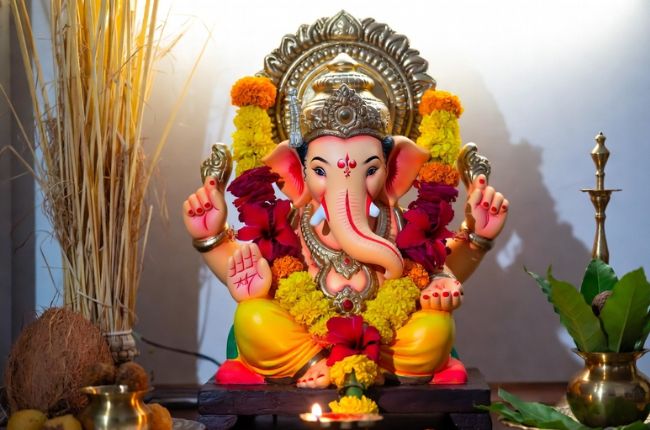
There is a particular kind of stillness that settles over a home the morning of Ganesh Chaturthi — before the streets fill, before the neighbourhood drums begin, before anyone outside the family is awake. The mother of the house has already risen, bathed, and begun arranging marigolds around the idol she has been preparing for days. The children know without being told that today is different. Something is about to arrive — not just a festival, but a presence. Ganesha's arrival in a home on Chaturthi morning is not a metaphor in the classical tradition. It is treated as the literal arrival of a divine guest who will live with the family for one day, five days, or eleven days and who must be welcomed, housed, worshipped, fed, and finally farewelled with the same care and attention one would give to the most honoured elder of the family.
Most families who observe Ganesh Chaturthi know the broad shape of the festival — bring the idol home, do the Pooja, offer modak, immerse on the final day. What almost no article explains clearly is why the Prana Pratishtha performed at the idol's arrival is the most critical moment of the entire festival, what the Mudgala Purana specifies about the sixteen-step Shodashopachara Pooja that must be performed on the first day, and what the consequence is of performing the Visarjan without the Uttarpuja — the farewell worship that classically reverses the Prana Pratishtha and returns Ganesha from the idol back to his cosmic form before immersion.
This guide covers the complete Ganesh Chaturthi home Pooja — from idol selection and Prana Pratishtha through the daily Pooja Vidhi, fasting rules, mantra practice, and the correct Visarjan procedure — drawn from the Mudgala Purana, the Ganapatya Agama tradition, and verified Pandit practice across Maharashtra, Karnataka, and Tamil Nadu.
What Ganesh Chaturthi Is and Why the Fourth Tithi Belongs to Ganesha
Ganesh Chaturthi — also called Vinayaka Chaturthi — falls on the fourth day (Chaturthi Tithi) of the bright fortnight (Shukla Paksha) of the month of Bhadrapada in the Vedic calendar, corresponding to August or September in the Gregorian calendar. The Chaturthi Tithi is considered Ganesha's own day in every month — the Sankashta Chaturthi observed on the fourth day of the dark fortnight (Krishna Paksha) every month is a smaller monthly observance of the same principle. But the Bhadrapada Shukla Chaturthi is considered the day of Ganesha's birth — Ganesh Jayanti — making it the most powerful of all Chaturthi Tithis in the year.
The Classical Source: Mudgala Purana and Ganesha Purana
The theological and ritual foundation of Ganesh Chaturthi is documented in two primary classical texts. The Mudgala Purana — the most comprehensive text dedicated exclusively to Ganesha — describes his eight primary forms (Ashtavinayaka), his twenty-one names, and the specific ritual procedures for his worship across different purposes. The Ganesha Purana — embedded in the Skanda Purana — narrates the circumstances of Ganesha's birth and establishes the Bhadrapada Chaturthi as the annual celebration of his manifestation. Both texts specify the Shodashopachara (sixteen-step) Pooja as the correct household worship format for Ganesh Chaturthi — a level of ritual detail that most popular guides reduce to a simplified five-step procedure.
Why Ganesha Is Worshipped First Among All Deities
The classical principle of Prathamam Vandanam — worshipping Ganesha before beginning any other ritual, any new venture, or any important life undertaking — is documented in the Mudgala Purana and reinforced across the Dharmashastra tradition. The Purana's explanation is both theological and practical: Ganesha governs Vighna (obstacles) in both directions — he creates obstacles for those who proceed without proper beginning, and he removes obstacles for those who honour the correct order of things. Every major Hindu ritual, every Vedic Puja, every Havan begins with Ganesha's invocation precisely because without his blessing, the ritual's energy may not flow smoothly to its intended destination.
Ganesh Chaturthi 2026 — Dates and Auspicious Timings
Ganesh Chaturthi 2026 falls on Wednesday, 19 August 2026. The Chaturthi Tithi begins on 18 August evening and extends through 19 August, making 19 August the primary day of home idol installation across most regional traditions.
Key 2026 Dates for Home Observance
- Ganesh Chaturthi (Idol Installation Day) — 19 August 2026
- Panch Diwsi (5-day Visarjan) — 23 August 2026
- Anant Chaturdashi (11-day Visarjan) — 29 August 2026
Auspicious Muhurta for Prana Pratishtha on 19 August 2026
The most auspicious window for performing the Prana Pratishtha (idol installation) on Ganesh Chaturthi is the Madhyahna Muhurta — the midday period when the Chaturthi Tithi is active. Classical Pandit tradition specifies that Ganesha's Prana Pratishtha should be performed during the midday window when the Sun is at its highest point, as Ganesha's energy is considered solar in nature in the Ganapatya tradition. The Abhijit Muhurta — approximately 24 minutes centered on solar noon — is the ideal window within the midday period. Families who cannot observe the midday Muhurta may perform the Prana Pratishtha in the morning hours of the Chaturthi Tithi, before noon. Evening installation is not recommended in classical practice.
Complete Ganesh Chaturthi Samagri List
Every item listed below must be gathered before the morning of Ganesh Chaturthi. Beginning the Prana Pratishtha with incomplete samagri requires interrupting the ritual — which breaks the continuity of the Sankalpa and reduces the ritual's efficacy.
For the Idol and Altar Setup
- Clay Ganesha idol — see idol selection rules in the next section
- Wooden platform or chowki — elevated seat for the idol, cleaned and decorated
- Red or yellow cloth — to cover the platform base
- Fresh flowers — marigold, red hibiscus (jaswand), red rose, white jasmine
- Marigold garlands — for draping over the idol and platform
- Red and yellow threads (mauli) — for tying the idol's wrist and the Kalash
- Brass Kalash — filled with Gangajal or clean water, mango leaves, and a coconut
- Coconut — with husk and tuft intact, wrapped in red cloth
- Mango leaves — seven or eleven, fresh
For Prana Pratishtha and Daily Pooja
- Panchamrit — milk, curd, honey, ghee, and sugar combined for Abhisheka
- Gangajal — for purification rituals
- Sandalwood paste (chandan) — for applying to the idol's forehead
- Kumkum and sindoor — for tilak application
- Turmeric (haldi) — for ritual marking
- Raw rice (akshat) — unbroken, unwashed grains for offering
- Durva grass — the most essential Ganesha-specific offering. Three-bladed durva grass (Cynodon dactylon) is Ganesha's most beloved offering according to the Mudgala Purana. No other offering is considered its equal in Ganesha worship
- Shami leaves — secondary sacred leaf offering for Ganesha
- Betel leaves and betel nuts (paan and supari) — for daily offering
- Incense sticks (agarbatti) — sandalwood or jasmine fragrance
- Camphor (kapoor) — for Aarti twice daily
- Ghee diyas — clay diyas, minimum two per Pooja session
- Fruits — banana, coconut, pomegranate for daily naivedya
- Modak — the primary prasad offering. See Section 8 for the classical modak significance and preparation
For Decoration
- Saffron or orange fabric — for draping behind the idol
- Banana leaves — for lining the altar and serving prasad
- Rangoli colours — for altar decoration and floor patterns
- Flower petals — loose petals for scattering around the idol base
- Gold or silver foil — optional but traditional for decorating the idol's backdrop
For Visarjan
- Large bucket or tub — for eco-friendly home Visarjan if no water body is accessible
- Additional marigold garlands — for the farewell offering
- Final coconut offering — for breaking at Visarjan
- Clean white cloth — for wrapping the idol respectfully before immersion
Idol Selection Rules — What the Classical Tradition Specifies
The selection of the Ganesha idol for home installation is governed by specific classical criteria that are almost entirely absent from popular festival guides. The Mudgala Purana and the Ganapatya Agama tradition specify the following:
The Trunk Direction Rule
The direction of Ganesha's trunk is among the most debated and most misunderstood aspects of idol selection. The classical position from the Mudgala Purana is as follows:
- Left-curving trunk (Vamamukhi) — the trunk curves to Ganesha's left, which appears to the devotee's right when facing the idol. This is considered the standard household form and is appropriate for all home worship. Left-curving trunk Ganesha is associated with ease of worship and accessibility of blessings.
- Right-curving trunk (Dakshinamukhi) — the trunk curves to Ganesha's right, appearing to the devotee's left. This form is considered highly powerful but significantly more demanding in terms of ritual precision. Classical Pandit tradition cautions that a right-trunk Ganesha installed in a household where the complete Shodashopachara Pooja cannot be maintained daily may become a source of Vighna rather than its removal. Right-trunk Ganesha is primarily appropriate for temple installation and for advanced Sadhaka households where the complete ritual can be guaranteed.
- Straight trunk — a middle position, considered neutral and equally appropriate for household worship as the left-trunk form.
For the overwhelming majority of Indian households, the left-curving trunk form is the correct and classically recommended choice.
Clay Idol Over Plaster of Paris
The Mudgala Purana specifies mrinmaya — made of earth — as the ideal material for the Chaturthi idol. A clay idol returns naturally to the earth at Visarjan, completing the cycle of manifestation and dissolution that Ganesha's festival symbolically enacts. Plaster of Paris (PoP) idols, which became commercially dominant from the mid-20th century onward, do not dissolve in water and release harmful chemicals into water bodies. Classical tradition, ecological responsibility, and practical Visarjan considerations all point in the same direction: an uncoloured or naturally coloured clay idol is the correct choice for both Prana Pratishtha sanctity and responsible Visarjan.
Size Considerations for Home Installation
The classical guideline from the Ganapatya Agama tradition is that the home idol should be of a size proportional to the household's capacity to worship it with full attention. A very large idol in a small home where the family cannot maintain daily Shodashopachara Pooja is, in classical terms, a mismatch between the deity's presence and the household's capacity to honour it. A modestly sized idol — between 30 cm and 60 cm for most urban households — worshipped with complete Vidhi and genuine attention is significantly more effective than a large idol worshipped perfunctorily.
Prana Pratishtha — The Most Critical Ritual of Ganesh Chaturthi
Prana Pratishtha — the establishment of life force — is the consecration ritual through which Ganesha is formally invited to leave his cosmic form and take up residence in the clay idol for the duration of the festival. This is not a symbolic act. In the Ganapatya tradition, Prana Pratishtha is the moment at which the idol transforms from a beautiful clay object into a living divine presence. Every ritual that follows — the daily Pooja, the modak offerings, the Aarti — is offered to this living presence, not to the idol as an object.
Step-by-Step Prana Pratishtha Vidhi
- Bathe and dress in clean, freshly washed clothing — yellow or saffron for Ganesha worship is most appropriate
- Purify the altar space — sprinkle Gangajal on the platform, the cloth, and the area surrounding the idol's designated position
- Place the idol on the platform facing the family — Ganesha should face west (devotees face east while worshipping) or face the main entrance of the home
- Perform Achaman — sip water three times from the right palm with the prescribed Mantra, purifying the ritual performer before the consecration begins
- Speak the Sankalpa — the formal declaration of intention naming the devotee, the date, the Tithi, the Nakshatra, the purpose of the worship, and the duration of the installation (1 day, 5 days, or 11 days). The Sankalpa is spoken aloud, not merely thought. It is the Prana Pratishtha's most essential element — without it, the ritual is a procedure without a purpose
- Perform Nyas — the ritual placement of Mantras on specific parts of the idol's body using the right hand's fingertips, beginning from the crown of the head and moving downward. This activates the deity's presence in each part of the idol's form
- Perform Avahana (invocation) — formally request Ganesha's presence to enter the idol. The classical Avahana Mantra is: Agachha Agachha Deva Vighnaharta Gajanana, Pratishtha Kuru Deva Poojam Grihana Namostute
- Offer Asana (seat) — scatter fresh flower petals beneath and around the idol, formally offering Ganesha a worthy seat
- Perform Abhisheka — pour Panchamrit over the idol in a slow, steady stream, followed by clean water. The Abhisheka is accompanied by the recitation of the Ganesha Atharvasirsha — the Upanishadic text dedicated to Ganesha that forms the scriptural foundation of the Ganapatya tradition
- Dress the idol — after Abhisheka and gentle drying with a clean cloth, apply fresh sandalwood paste to the forehead, kumkum at the crown, and drape fresh garlands around the neck and trunk
- Apply the sacred thread — tie the mauli (red thread) around the idol's wrist, the Kalash, and the wrist of the primary worshipper, connecting all three in the ritual's energetic circuit
- Light the diya — the lamp lit at Prana Pratishtha should remain continuously lit for the duration of the installation. For multi-day installations, many families now use a glass-enclosed lamp to maintain the flame safely
- Ring the bell and perform the opening Aarti — the Jai Ganesh Deva Aarti is recited, the conch (shankh) is blown if available, and the camphor flame is offered in the clockwise direction before the idol
As many families discover when they sit with their Pandit, the Prana Pratishtha is the moment that separates a Ganesh Chaturthi of genuine divine presence from one that is culturally rich but spiritually hollow. The Sankalpa spoken at this moment — the clarity and sincerity of what the family is asking for and what they are committing to in return — determines the quality of everything that follows across the installation period.
Daily Pooja Vidhi for the Complete Installation Period
Whether the idol is installed for one day, five days, or eleven days, the following Shodashopachara (sixteen-step) Pooja is performed twice daily — at sunrise and at sunset — for the duration of the installation.
The Sixteen Steps of Shodashopachara Pooja
The sixteen steps are performed in the following sequence. Each step involves both a physical action and the recitation of the corresponding Upachara Mantra:
- Dhyana — meditation on Ganesha's form, bringing his complete image to mind before beginning
- Avahana — renewed daily invocation requesting Ganesha's continued presence
- Asana — offering a fresh seat with flower petals
- Padya — offering water for Ganesha's feet
- Arghya — offering water for Ganesha's hands
- Achamana — offering water for sipping
- Snana (Abhisheka) — bathing the idol with Panchamrit on the first day; with clean water or milk on subsequent days
- Vastra — offering clothing symbolically through a piece of new red or yellow cloth placed beside the idol
- Yajnopavita — offering the sacred thread (a fresh mauli or a new sacred thread placed before the idol)
- Gandha — applying fresh sandalwood paste to the idol's forehead with the ring finger of the right hand
- Pushpa — offering flowers. Durva grass is the primary offering for Ganesha — presented in bundles of three, five, or twenty-one blades. The Mudgala Purana specifies that twenty-one blades of durva offered with the twenty-one names of Ganesha constitute the most complete flower offering possible in his worship
- Dhupa — offering incense by waving the burning stick before the idol in a clockwise direction
- Deepa — offering the lit diya by waving it clockwise before the idol
- Naivedya — offering food. Modak is the primary naivedya. See the next section for the complete modak offering protocol
- Tambula — offering betel leaves and betel nuts
- Pradakshina and Namaskara — circumambulating the idol (or turning clockwise in place if space is limited) and offering full prostration (Sashtanga Namaskara) — all eight parts of the body touching the ground in reverence
Mantras for Daily Pooja
The following mantras form the core of daily Ganesha worship during Chaturthi:
- Ganesha Atharvasirsha — the complete Upanishadic text dedicated to Ganesha, ideally recited once at the morning session
- Ganesha Mula Mantra — Om Gam Ganapataye Namah — recited 108 times with a Japamala during the daily session
- Twenty-One Names of Ganesha — recited while offering the twenty-one durva bundles: Sumukha, Ekadanta, Kapila, Gajakarna, Lambodara, Vikata, Vighna-Nashaka, Vinayaka, Dhumraketu, Ganadhyaksha, Bhalachandra, Gajanana, Vakratunda, Shurpakarna, Heramba, Skandapurva, Kapilasya, Mushikavahana, Kumaraswami, and Vighna-Raja, Siddhi-Ganapati
📦 Micro-Remedy Box — Did You Know
The Mudgala Purana devotes an entire chapter to the significance of durva grass as Ganesha's primary offering — and the reason given is neither arbitrary nor merely traditional. The text narrates that when the demon Analasura was terrorising the cosmos, Ganesha swallowed him whole — consuming fire in the process. His body became so heated that not even the Ganges water poured by the gods could cool him. It was only when twenty-one sages offered twenty-one bundles of durva grass that Ganesha's body cooled completely. The durva's natural cooling property — which Ayurveda confirms as a real botanical quality of Cynodon dactylon — is the reason it became Ganesha's most beloved offering. This is why no flower, no modak, no ornament carries the same ritual weight in Ganesha worship as a fresh bundle of three-bladed durva grass. Most families decorate elaborately and then offer a single wilted durva strand — precisely inverting the classical priority.
Modak — The Sacred Offering and Its Classical Significance
Modak — Ganesha's favourite food in the classical tradition — is not merely a sweet. The word Modak derives from the Sanskrit root moda — joy, delight, bliss — and the offering of Modak represents the offering of pure joy to the deity of auspicious beginnings. The Mudgala Purana specifies that Ganesha holds a Modak in his lower left hand in his primary iconographic form — meaning the Modak is not just an offering but an attribute of the deity himself.
The Classical Modak Varieties
Two primary forms of Modak are used in classical Ganesha worship:
- Ukadiche Modak (steamed Modak) — the form specified in Maharashtrian Ganapatya tradition as the most sacred. A rice flour shell (ukad) is filled with a sweetened coconut and jaggery mixture (saran) and steamed. The Mudgala Purana references a steamed offering in the context of Ganesha's naivedya. This form is prepared fresh on the day of worship and offered warm.
- Talniche Modak (fried Modak) — a wheat or rice flour shell fried in ghee with a similar sweet filling. Less formally specified in classical texts but widely used as an accessible alternative to the steamed form.
The Twenty-One Modak Offering
The Mudgala Purana specifies that twenty-one Modaks constitute the complete naivedya offering for Ganesh Chaturthi — paralleling the twenty-one durva bundles and the twenty-one names. This number is not arbitrary: twenty-one in classical numerology represents the seven notes of music multiplied by the three states of consciousness (waking, dreaming, deep sleep) — a totality of joyful expression offered to the lord of all beginnings.
Modak Offering Protocol
- Modaks must be prepared in a clean kitchen by a person who has bathed and is in a pure ritual state — not prepared commercially and brought home for the festival
- They are placed on a banana leaf before the idol — never on a plate that has been used for other food
- They are offered as naivedya with the Mantra: Naivedyam Samarpayami — "I offer this food"
- After the Pooja, they are distributed as prasad to every family member and guest — the prasad of a correctly performed Ganesh Chaturthi naivedya is considered one of the most powerful forms of Ganesha's blessing available to the household
Ganesh Chaturthi Fasting Rules — What to Eat, What to Avoid, and Why
The Ganesh Chaturthi vrat is observed primarily on the Chaturthi Tithi itself — the day of installation. Many families extend the fast through the complete installation period, though the classical specification is for the first day only, with reduced dietary simplicity (Sattvic eating without onion and garlic) maintained through the remaining days.
What Is Permitted on the Chaturthi Fast
- Fruits — all varieties without restriction
- Milk, curd, and paneer — all dairy products
- Sabudana (tapioca) — khichdi and vada
- Kuttu ka atta (buckwheat flour) — for roti and poori
- Sama ke chawal (barnyard millet) — for khichdi
- Sendha namak (rock salt) — the only permitted salt
- Potatoes and sweet potatoes — widely used in vrat cooking
- Dry fruits and nuts — all varieties
- Coconut — fresh coconut and coconut water
- Ghee — for cooking vrat preparations
What Is Prohibited
- Regular wheat flour, rice, and lentils — not permitted on the strict fast day
- Onion and garlic — prohibited for the complete installation period for all family members, not merely the person fasting
- Non-vegetarian food — completely prohibited for all household members during the installation period
- Table salt (iodised) — replaced by sendha namak
- Alcohol — completely prohibited
- Mustard oil — replaced by ghee for vrat cooking
The Moon Prohibition on Ganesh Chaturthi
One of the most widely known but least understood rules of Ganesh Chaturthi is the prohibition against looking at the Moon on the Chaturthi night. The Bhavishya Purana narrates that when Ganesha fell from his vehicle after over-eating Modaks one Chaturthi evening, the Moon laughed at him. Ganesha cursed the Moon, declaring that anyone who saw the Moon on Chaturthi night would be wrongly accused of theft or moral transgression. The practical implication: on the evening of Ganesh Chaturthi, the family avoids looking directly at the Moon from approximately dusk until midnight. If the Moon is accidentally seen, the remedy specified in the Bhavishya Purana is the recitation of the Syamantaka Mani story from the Bhagavata Purana — the narrative of a wrongful theft accusation resolved by Krishna's intervention.
Common Mistakes Families Make During Ganesh Chaturthi
Understanding what not to do is as important as knowing the correct Vidhi. The following errors are the most frequently observed — and most easily avoidable — mistakes in household Ganesh Chaturthi practice.
Mistakes in Idol Selection and Setup
- Selecting a right-trunk idol for household worship without the capacity to maintain the complete daily Shodashopachara ritual — creates Vighna rather than removing it
- Placing the idol facing south — Ganesha should face west (devotees face east) or face the home entrance. A south-facing idol is inauspicious in classical placement rules
- Placing the idol directly on the floor without an elevated platform — the deity's seat must always be elevated above the devotee's floor level
- Installing a PoP idol and attempting Visarjan in a natural water body — harmful to the environment and contrary to the mrinmaya (clay) specification of the Mudgala Purana
Mistakes in Pooja Performance
- Skipping the Sankalpa — performing the ritual actions without the formal declaration of purpose. This is the most common and most consequential omission
- Offering Tulsi to Ganesha — Tulsi is specifically prohibited in Ganesha worship in the Ganapatya tradition. The Mudgala Purana narrates the reason: Tulsi once rejected Ganesha's proposal of marriage, and Ganesha in turn declared that Tulsi would never be offered to him. Offering Tulsi to Ganesha is considered inauspicious regardless of how widely it is used in other Hindu worship contexts
- Using artificial or plastic flowers as the primary offering — the Shodashopachara Pooja specifies fresh, living flowers. Artificial flowers are decorative, not ritual
- Offering durva that is yellow, dry, or single-bladed — durva must be green, three-bladed, and fresh. Yellow durva has lost its cooling energy and is not accepted in classical practice
- Neglecting the twice-daily Pooja schedule and performing worship only once daily during a multi-day installation. Once Prana Pratishtha is performed, the daily ritual commitment is non-negotiable for the full installation period
Mistakes in Fasting and Food Offering
- Offering non-sattvic food as naivedya — the food offered to Ganesha must be freshly prepared, vegetarian, and free of onion and garlic
- Commercially purchased Modaks offered as naivedya without home preparation — the Mudgala Purana's emphasis is on the act of preparation as part of the offering. Modaks purchased from a sweet shop carry no such preparation energy
- The family eating before the naivedya is offered — the family eats only after the naivedya is offered to Ganesha and the prasad is distributed. Eating before the deity has been fed is considered deeply inauspicious in all Hindu ritual traditions
📦 Micro-Remedy Box — Pandit's Tip
Focus: Bhakti Honestly, this surprises most people when they first hear it: the single factor that determines the quality of Ganesh Chaturthi more than any other — more than the idol's size, more than the decoration, more than the number of Modaks offered — is the quality of attention given during the Prana Pratishtha Sankalpa. A Pandit familiar with your Kula tradition will tell you that Ganesha is called Buddhipriya — the one who loves intelligence and discrimination — and he responds most powerfully to worship done with full awareness of what is being asked and why. As many families discover when they sit with their Pandit, a Chaturthi celebrated with a small clay idol, a sincere Sankalpa, and fresh durva offered with full attention consistently produces more felt blessing than a festival with the largest idol in the neighbourhood and a Pooja performed on autopilot. Ganesha is not moved by spectacle. He is moved by the quality of the invitation.
Ganesh Chaturthi for Apartments and Small Homes
Urban families in apartments frequently express concern about whether the complete Chaturthi Vidhi is possible in a small space, without a dedicated Pooja room, and without access to a natural water body for Visarjan. The classical tradition accommodates all three realities with specific guidance.
Space Constraints
- A dedicated altar space of as little as 60 cm x 60 cm is sufficient for a complete Shodashopachara Pooja. The idol size should be proportional — a 20 cm to 30 cm idol is entirely appropriate for a small apartment altar
- If no separate Pooja room exists, a clean, elevated surface in the living room's northeast or east direction serves as the correct installation point
- The idol must not be placed in the bedroom, bathroom, or kitchen — if the home's layout provides no other option, the living room's northeast corner is always the correct default
Noise and Community Considerations
- Apartment-dwelling families are not required to maintain the conch-blowing and drum-playing aspects of the community Chaturthi celebration — these are community ritual elements that do not apply to household Pooja
- The bell ringing during Aarti is appropriate even in apartments — the sound duration is brief and the ritual purpose is genuine
- Neighbours of different faiths or in noise-sensitive buildings are best considered through timing the Aarti during daylight hours rather than late evening
Eco-Friendly Visarjan for Apartments
Apartment families without access to a river or lake for Visarjan have two classically acceptable alternatives:
- Bucket or tub Visarjan — fill a large bucket or bathtub with clean water. Perform the complete Uttarpuja (farewell Pooja) before the idol. Lower the clay idol into the water and allow it to dissolve naturally. The dissolved clay water is then poured into the roots of a plant or tree — not into the drain
- Community Visarjan tank — many Ganesh Chaturthi committees in urban areas now provide community Visarjan tanks with subsequent eco-processing of the clay. This is a fully acceptable alternative for apartment residents and is consistent with the environmental spirit of the mrinmaya (clay) specification
For broader guidance on how the Vastu of apartment homes interacts with religious ritual spaces, the Vastu Guide Without Demolition covers apartment-specific directional corrections that enhance the home's ritual energy.
Visarjan — The Complete Farewell Vidhi
Visarjan — Ganesha's farewell and immersion — is as ritually significant as the Prana Pratishtha that began the festival. In the Ganapatya tradition, Visarjan is not the disposal of an idol. It is the formal reversal of the Prana Pratishtha — the ritual through which the living divine presence that entered the clay form is respectfully returned to its cosmic origin before the physical form is dissolved back into the earth element from which it came.
Uttarpuja — The Essential Pre-Visarjan Worship
Uttarpuja — the concluding worship — is performed immediately before Visarjan and is the step most commonly omitted in popular Chaturthi celebration. Without Uttarpuja, the Prana Pratishtha remains open — Ganesha's presence has been invoked into the idol but not formally released. Immersing an idol without Uttarpuja is, in classical terms, sending an honoured guest away without saying goodbye.
Complete Visarjan Vidhi Step by Step
- Perform the final full Shodashopachara Pooja of the installation period — the complete sixteen-step sequence, with fresh flowers, durva, modak naivedya, and the Ganesha Atharvasirsha recitation
- Perform Uttarpuja — a simplified farewell sequence that includes: offering the final Arghya (water for hands), the final Tambula (betel), and the Dakshina (monetary offering placed before the idol)
- Recite the Visarjan Mantra — formally request Ganesha to return to his cosmic form: Yantodvosani Devesha Punaraaganaya Punah, Punaragamanaayeti Pratishthaapitasi Maya — "O Lord of gods, as you depart from this Yantra, please come again. I have installed you with this intention of your return."
- Perform the final Aarti — with the complete family present. The atmosphere of the final Aarti should be celebratory rather than sorrowful — Ganesha's departure is understood as a completion, not a loss
- Apply the final tilak to every family member's forehead from the Chaturthi kumkum
- Distribute the final prasad — the remaining Modaks and fruits are distributed to all present
- Carry the idol to the Visarjan point — the idol is carried respectfully, not dragged or hurriedly transported. In many families, the senior male member carries the idol at chest height as if carrying an honoured elder
- Perform the final immersion — lower the idol gently into the water (natural body or bucket) while reciting Om Gam Ganapataye Namah continuously
- Bring Visarjan mitti home — a small portion of the clay from the dissolved idol, once the water has settled, is traditionally brought home and placed in the home garden or in a pot of soil — the earth that held Ganesha's form for ten days is considered sacred for plant growth and household prosperity
Two Ganesh Chaturthi Questions That Almost No Article Answers
What Is the Correct Protocol When the Clay Idol Cracks or Breaks Before Visarjan
This question appears with genuine urgency in Ganesh Chaturthi forums on Reddit and Quora every year — from families whose idol has cracked during transport, during the festival, or after accidental impact — and receives almost no serious classical answer. The Ganapatya tradition, as preserved in Maharashtrian Pandit consultation practice, addresses this directly. A cracked or damaged clay idol is not an inauspicious omen in itself — the Mudgala Purana does not treat physical damage to a clay idol as a sign of divine displeasure. What it does affect is the completeness of the Prana Pratishtha's geometric form. If the crack is minor — a surface fracture that leaves the idol's overall form intact — the Pooja continues without interruption, with the crack area gently wrapped in clean red cloth to maintain the idol's ceremonial dignity. If the damage is significant — the idol has broken into multiple pieces or the head has separated from the body — the classical protocol is to perform an early Visarjan on that day, treating the breakage as the natural completion of the idol's form rather than a premature ending. A brief Uttarpuja is performed before immersion, and the Prana Pratishtha is considered respectfully closed. The family does not observe this as a negative event — the clay has returned to earth on Ganesha's own timing.
What Happens to the Spiritual Continuity of Ganesh Chaturthi When the Family Is Away From Home Mid-Festival
A second question absent from virtually every published Chaturthi guide — asked consistently in family WhatsApp groups and Quora threads: the family installed Ganesha for eleven days but must travel from Day 5 onward due to unavoidable circumstances. What is the correct protocol? Can another family member continue the Pooja? Can the festival be closed early? The classical Ganapatya tradition, from verified Pandit accounts across Maharashtra and Karnataka, provides three options in order of preference. First preference: a family member — even an elderly grandparent or a trusted neighbour of the same faith — maintains the twice-daily Pooja in the family's absence, with the primary devotee's Sankalpa specifically delegating the ritual responsibility to that person at the time of departure. Second preference: if no suitable person can maintain the Pooja, the festival is formally shortened — Uttarpuja is performed on the day before departure and Visarjan is conducted, treating this as a five-day or seven-day installation rather than the originally intended eleven. The shortened festival with a proper Visarjan is classically considered complete and auspicious. Third preference — the one most families resort to and the one least supported by classical tradition: leaving the installed idol unattended without daily Pooja for multiple days. The Ganapatya tradition is clear that an installed Ganesha — a consecrated living presence — cannot be left without daily worship. If daily worship cannot be maintained, early Visarjan is always preferable to abandonment.
FAQ
What time should Ganesh Chaturthi Pooja be done at home? The Prana Pratishtha on the first day should be performed during the Madhyahna (midday) Muhurta when the Chaturthi Tithi is active — ideally within the Abhijit Muhurta near solar noon. For the daily Pooja during the installation period, two sessions are performed: morning at sunrise after the family has bathed, and evening at dusk before the household eats. The evening session is considered the primary worship of each day in the Ganapatya tradition.
Can we do Ganesh Chaturthi Pooja without a Pandit at home? The household Ganesh Chaturthi Vidhi can be performed by the family without a Pandit provided the Sankalpa is spoken aloud with clarity of purpose, the Shodashopachara Pooja sequence is followed correctly, the Ganesha Atharvasirsha is recited during Abhisheka, and the Uttarpuja and Visarjan are completed correctly at the end of the installation period. For families unfamiliar with the Atharvasirsha or the complete Mantra sequence, AtoZPandit.com Pandits conduct Live E-Pooja services for Ganesh Chaturthi that the family can participate in from home with their own idol.
How many days should we keep Ganesha idol at home? Classical tradition offers three primary options: one and a half days (Dhed Diwsi), five days (Panch Diwsi), and eleven days (Ekadash Diwsi). The eleven-day installation is considered the most complete, as it covers the full period from Chaturthi through Anant Chaturdashi. The correct choice depends on the family's capacity to maintain the twice-daily Shodashopachara Pooja for the full duration — a shorter installation performed with complete attention is classically superior to a longer installation maintained incompletely.
Which flowers are best for Ganesh Chaturthi Pooja at home? Durva grass — three-bladed, fresh, and green — is Ganesha's primary and most sacred offering according to the Mudgala Purana. No flower carries equal weight in Ganesha worship. After durva, red hibiscus (jaswand), marigold, and red rose are the most appropriate flower offerings. Tulsi must never be offered to Ganesha under any circumstances — it is specifically prohibited in the Ganapatya tradition.
What should be done if we accidentally see the Moon on Ganesh Chaturthi night? The Bhavishya Purana's prescribed remedy for accidentally seeing the Moon on Chaturthi night is the recitation of the Syamantaka Mani story from the Bhagavata Purana — the narrative of a false theft accusation resolved by Krishna. If the full story is not accessible, the recitation of Om Namah Shivaya 108 times while applying tilak from Ganesha's altar is a widely accepted Prayaschitta (expiation) in current Pandit practice. The event is treated as a minor ritual irregularity requiring a simple remedy — not as a serious inauspicious event.
How to perform Ganesh Visarjan at home without a river or lake? Fill a large bucket or bathtub with clean water. Perform the complete Uttarpuja farewell sequence before the idol. Carry the idol to the water and lower it gently while reciting the Visarjan Mantra and Om Gam Ganapataye Namah continuously. Allow the clay to dissolve naturally — this may take several hours for larger idols. Pour the dissolved clay water into the roots of a tree or garden plant. Do not pour it into the drain or toilet. The clay returns to the earth through the plant's roots — completing the classical cycle of the earth-born idol returning to the earth.
What is the significance of offering 21 Modaks and 21 durva to Ganesha? The number twenty-one in the Ganapatya tradition represents completeness — the seven musical notes multiplied by the three states of consciousness. The twenty-one Modaks correspond to the twenty-one names of Ganesha recited in the Mudgala Purana. The twenty-one durva bundles correspond to the same twenty-one names, offered simultaneously with the name recitation. Together, the twenty-one Modaks and twenty-one durva constitute the most complete offering possible in classical Ganesha worship — covering both the nourishing (Modak) and the cooling (durva) aspects of the deity's nature simultaneously.
Conclusion
Ganesh Chaturthi is the Vedic tradition's most joyful teaching on the nature of beginning — the truth that every genuine undertaking requires a worthy invitation to the force that governs obstacles, and that this invitation, made with sincerity and correct procedure, changes the quality of what follows. The Prana Pratishtha opens a door. The nine or eleven days of worship are the family's sustained conversation with what walks through it. The Visarjan closes the door with gratitude and the knowledge that Ganesha does not truly leave — he returns to the cosmic form from which a sincere Sankalpa can always call him. Bring home a clay idol this Chaturthi. Speak the Sankalpa aloud. Offer fresh durva with both hands. Let the festival be smaller and more attentive than last year rather than larger and more distracted. Classical Vedic practice holds that Ganesha removes obstacles most powerfully for those who approach him with genuine clarity about what they are asking and genuine willingness to do the work that follows his blessing. Personal results, as always, depend on the sincerity of devotion, the consistency of practice, and divine grace.
Invite Ganesha into your home this Chaturthi with the complete classical Vidhi performed correctly from Prana Pratishtha through Visarjan. Book an in-home or Live E-Pooja Ganesh Chaturthi service with a verified AtoZPandit.com Pandit and receive Ganesha's blessings with every step performed as the tradition intends.
Disclaimer: This article is published for educational and cultural awareness purposes only. The information presented does not substitute for professional medical, psychological, or legal advice. For personalised Ganesh Chaturthi Pooja guidance rooted in your specific Kula tradition and regional practice, connect with a qualified Pandit at AtoZPandit.com.