
Navratri Pooja Vidhi Day by Day Fasting and Devi Worship Guide
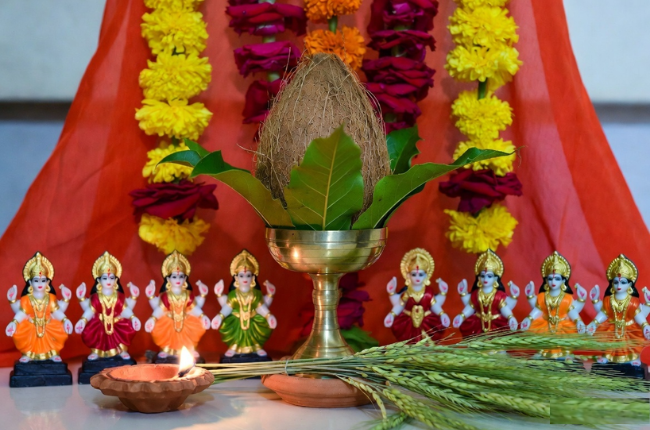
Every year, twice a year, something shifts in the atmosphere of Indian homes. The smell of camphor and roses fills rooms that have been ordinary all week. Diyas appear on windowsills before sunrise. Women who have been carrying the weight of the household all year tie a red chunri and sit before the Goddess with a quality of stillness that does not come from anywhere else. Navratri — nine nights of Devi worship — is not a festival that happens around families. It happens inside them, changing something that is difficult to name but immediately felt.
Most families who observe Navratri know the broad shape of it: fast for nine days, worship Maa Durga, do the Kanya Pujan on Ashtami or Navami. What almost no article explains clearly is why the sequence matters — why the Ghatasthapana must happen before any other ritual, why each of the nine days is assigned to a specific form of the Goddess and a specific colour, and what the classical Devi Mahatmya tradition says about the consequence of performing the Vidhi without the Sankalpa. The difference between Navratri as a cultural observation and Navratri as a living Shakta practice is precisely this knowledge of sequence and intention.
This guide covers the complete Navratri Pooja Vidhi — from Ghatasthapana on Day 1 through Kanya Pujan and Visarjan — with day-by-day Devi forms, mantras, colours, and fasting rules drawn from the Devi Mahatmya, the Shakta Agama tradition, and verified Pandit practice across regional traditions.
What Navratri Is and Why It Occurs Four Times a Year
Navratri means nine nights — nava (nine) and ratri (night) — and refers to the period dedicated to the worship of Adi Shakti, the primordial feminine power, in her many forms. The festival is celebrated four times annually in the Vedic calendar, though two of the four are lesser known:
- Chaitra Navratri — March or April, beginning on Chaitra Shukla Pratipada. The more widely observed Navratri in North India. Ends with Ram Navami.
- Sharad Navratri — September or October, beginning on Ashwin Shukla Pratipada. The most widely observed across all of India. Ends with Vijayadashami (Dussehra).
- Magha Gupta Navratri — January or February. Observed primarily by Shakta practitioners and Tantric traditions.
- Ashadha Gupta Navratri — June or July. Similarly observed in Shakta and Tantric lineages.
The two Gupta (hidden) Navratris are considered particularly powerful for advanced Shakta Sadhana but are less commonly observed in household practice. This guide covers the complete Vidhi applicable to both Chaitra and Sharad Navratri — the two most widely observed household traditions.
The Classical Source: Devi Mahatmya and Markandeya Purana
The theological and ritual foundation of Navratri worship is the Devi Mahatmya — also called the Durga Saptashati or Chandi Path — a 700-verse hymn embedded in the Markandeya Purana. The Devi Mahatmya narrates the three great battles of the Goddess against the demons Madhu-Kaitabha, Mahishasura, and Shumbha-Nishumbha — each representing a different quality of human ignorance that the Goddess destroys through her three primary forms: Mahakali, Mahalakshmi, and Mahasaraswati. The nine nights of Navratri correspond to the nine chapters of the Devi Mahatmya's central narrative, making the recitation of the complete text across the nine days the most classical form of Navratri observance. Many families who are not aware of this connection perform the rituals without understanding that the festival's structure and the text's structure are the same map.
Why Nine Nights Rather Than Nine Days
The emphasis on nights rather than days in the festival's name is deliberate. In the Shakta tradition, the Goddess's energy is considered most accessible after sunset — the period from dusk to midnight being the primary window of Devi Sadhana. The classical Navratri Pooja Vidhi prescribes the main ritual worship (Sandhya Pooja) at dusk, with the daytime dedicated to fasting, recitation, and preparation. Families who observe only daytime rituals and consider the nights ordinary are working with half the traditional structure.
Complete Navratri Pooja Samagri List Before You Begin
Every item listed here must be gathered before Ghatasthapana on Day 1. Beginning the ritual and then sourcing materials mid-way disrupts the continuity of the Sankalpa. The list covers the complete nine-day observance.
For Ghatasthapana (Day 1 Setup)
- Brass or clay Kalash — one, clean and unused or ritually purified
- Mango leaves — seven or eleven, fresh, to line the Kalash rim
- Coconut — one, with husk intact and tuft present
- Sacred soil (mitti) — from a riverbank, temple courtyard, or clean garden earth
- Barley seeds (jau) — for sowing in the earthen pot that accompanies the Kalash
- Earthen pot (mitti ka bartan) — for sowing the jau seeds
- Gangajal or clean water — to fill the Kalash
- Raw rice (akshat) — unwashed, unbroken grains
- Red cloth — to line the altar base
For Daily Pooja (All Nine Days)
- Devi idol or framed image — Durga, Lakshmi, and Saraswati forms, or a single Navadurga image
- Red chunri or red dupatta — for draping over the Devi image daily
- Fresh flowers — red hibiscus (jaswand) is the most classical Devi offering; marigold and rose are widely accepted
- Marigold garlands — for the altar and Kalash
- Incense sticks (agarbatti) — sandalwood or rose fragrance preferred
- Camphor (kapoor) — for Aarti twice daily
- Ghee lamp (diya) — clay diyas preferred; one for the altar, one for the Ghatasthapana Kalash
- Panchamrit — milk, curd, honey, ghee, and sugar for abhishek on key days
- Kumkum and sindoor — for applying to the Devi image daily
- Turmeric (haldi) — for ritual marking
- Betel leaves and betel nuts (paan and supari) — for daily offering
- Coconuts — additional ones for offering across the nine days
- Fruits — banana, apple, pomegranate for daily naivedya
- Mishri and sugar — for prasad preparation
- Cloves and cardamom — for Panchamrit and prasad
- Red and yellow threads (mauli) — for tying the Kalash and wrist of devotees
For Kanya Pujan (Day 8 or Day 9)
- Halwa, puri, and chana — the classical Navratri prasad triad
- New red or coloured dupattas — one per Kanya
- Coins or dakshina — for each Kanya
- Alta (red dye) — for applying to the Kanya's feet
- Bangles — red or coloured, one set per Kanya
For Visarjan (Day 10)
- Additional flowers and garlands
- Coconut for the final offering
- Clean white or red cloth for wrapping the idol if immersion is planned
Ghatasthapana — Why Day 1 Is the Most Critical Ritual of All Nine Days
Ghatasthapana — the establishment of the sacred pot — is the ritual that formally opens the nine-day Navratri observance. It is not a preliminary step before the real worship begins. It is the central act of invocation through which the Goddess is formally invited to reside in the home for the duration of the festival. Every subsequent day's Pooja derives its sanctity from the Sankalpa established in the Ghatasthapana. An incorrectly performed or omitted Ghatasthapana weakens the entire nine-day ritual at its foundation.
The Correct Time for Ghatasthapana
The Ghatasthapana must be performed during the Pratipada Tithi (the first day of the lunar fortnight) and ideally within the Abhijit Muhurta — the auspicious midday window of approximately 24 minutes that falls near solar noon on Day 1. The Muhurta Chintamani specifies that Ghatasthapana performed during Chitra or Vaidhriti Yoga is to be avoided — a detail absent from almost every popular Navratri guide. If the Abhijit Muhurta is missed, the morning hours of the Pratipada Tithi are acceptable. Ghatasthapana is never performed at night, even though the Navratri emphasis is on nocturnal worship.
Step-by-Step Ghatasthapana Vidhi
- Purify the altar space — clean the designated Pooja area, apply a fresh coat of red or saffron rangoli or paste to the altar surface, and lay a clean red cloth as the base.
- Prepare the earthen pot — fill the earthen pot (mitti ka bartan) with clean sacred soil mixed with raw rice. Sprinkle barley seeds (jau) across the surface of the soil evenly. This pot of growing barley is called jau ka khet — the Goddess's field — and will sprout over the nine days as a living indicator of the Goddess's presence and the family's sincerity.
- Prepare the Kalash — fill the brass or clay Kalash with Gangajal or clean water. Add a coin (copper preferred), raw rice, betel nut, a pinch of turmeric, and five types of precious items if available (gold, silver, copper, gemstone, and grain). These represent the five elements and Panchamahabhuta within the Kalash.
- Place mango leaves around the Kalash rim — arrange seven or eleven fresh mango leaves in a circle around the inner rim of the Kalash, tips pointing upward. Mango leaves are the classical Vedic symbol of prosperity and auspicious beginning.
- Place the coconut on the Kalash — wrap the coconut in a red cloth, apply kumkum to the tuft end, and place it firmly on top of the mango leaves. The coconut represents Devi herself — the three eyes of the coconut are the three eyes of the Goddess.
- Tie the red thread (mauli) — wrap the mauli around the Kalash three times and tie it firmly. This seals the Sankalpa within the Kalash.
- Place the Kalash on the earthen pot of barley — the Kalash rests on the sprouting field, symbolising the Goddess's energy grounding itself into the earth and producing abundance.
- Perform the Sankalpa — the most important step, and the one most commonly skipped in household practice. The Sankalpa is the formal declaration of intention spoken before the Kalash. It names the devotee, the Gotra, the location, the Tithi, the Nakshatra, and the specific purpose for which the nine-day worship is being undertaken — whether for family welfare, a specific prayer, or general Devi Aradhana. Without the Sankalpa, the ritual has form but not direction.
- Invoke the Goddess into the Kalash — recite the Devi Mahatmya's opening invocation or, at minimum, the Navadurga Dhyana Shloka, formally requesting Adi Shakti to take residence in the Kalash for the nine days.
- Light the diya — the lamp lit at the Ghatasthapana must remain continuously lit for all nine days and nights. This is the Akhand Jyoti — the unbroken flame. If the flame extinguishes, it is considered inauspicious and requires a Shanti ritual before relighting. Many families now use a glass-enclosed oil lamp to protect the flame from wind.
📦 Micro-Remedy Box — Did You Know
The barley shoots (jau) grown during Ghatasthapana are not merely decorative. The Markandeya Purana describes the Goddess as Shakambhari — she who nourishes through vegetation — and the growing jau is a living embodiment of her presence in the home. Classical Navratri tradition holds that the height and density of the sprouted barley on Navami (Day 9) is an indicator of the Goddess's blessings for the family's agricultural, financial, and health abundance in the coming season. In rural North India, the jau shoots are distributed as prasad after Visarjan — tucked behind ears or placed in turbans — because the plant that grew in the Goddess's presence during nine days of worship is considered to carry her energy directly. Most urban families grow the jau and discard it after Visarjan without knowing this.
Nine Days of Navratri — Devi Form, Colour, Mantra, and Significance
Each of the nine days of Navratri is dedicated to one of the nine forms of the Goddess collectively called Navadurga. Each form represents a specific aspect of Shakti's power, a specific colour whose wearing or offering concentrates that day's energy, and a specific Beeja mantra or Dhyana shloka drawn from the Devi Mahatmya tradition.
Day 1 — Shailputri
Form: Daughter of the Himalayas. Rides a bull (Nandi). Carries a trident and lotus. Represents the grounding of the divine feminine in earthly form. Colour: Yellow — stability, cheerfulness, intellectual clarity. Mantra: Om Devi Shailputryai Namah Significance: Ghatasthapana day. The worship of Shailputri establishes the foundational stability for the entire nine-day Sadhana. She governs the Moon in Jyotish — those with a troubled Moon in the birth chart benefit most from sincere Day 1 worship.
Day 2 — Brahmacharini
Form: The ascetic form of the Goddess. Walks barefoot, carries a Japamala and Kamandalu. Represents disciplined Sadhana and renunciation for a higher purpose. Colour: Green — growth, new beginnings, fertility. Mantra: Om Devi Brahmacharinyai Namah Significance: Governs Mars. Worship on this day is particularly beneficial for those experiencing Manglik Dosha difficulties or Mars-related anger and conflict.
Day 3 — Chandraghanta
Form: The warrior Goddess with a crescent Moon bell on her forehead. Rides a tiger. Ten-armed. Represents courage and the destruction of fear. Colour: Grey — strength, resilience, the capacity to stand firm. Mantra: Om Devi Chandraghantayai Namah Significance: Governs Venus. The ringing of bells during worship on this day carries specific significance — the sound of the Chandraghanta bell is said in the Devi Mahatmya tradition to terrify negative forces and purify the home's energy field.
Day 4 — Kushmanda
Form: The Goddess who created the universe with her smile. Eight-armed. Carries weapons and a Kamandalu of amrita (nectar). Represents the creative power at the origin of all things. Colour: Orange — warmth, abundance, solar energy. Mantra: Om Devi Kushmandayai Namah Significance: Governs the Sun. Offering pumpkin (kushmanda) as naivedya on this day is the classical practice — the Goddess's name itself means "one who holds the universe like a small pumpkin in her hands."
Day 5 — Skandamata
Form: Mother of Skanda (Kartikeya). Holds her infant son in her arms alongside weapons. Represents maternal protection and the fierce grace of the mother who fights for her child. Colour: White — purity, clarity, divine protection. Mantra: Om Devi Skandamatayai Namah Significance: Governs Mercury. Worship on this day is considered especially beneficial for children's health and education, and for mothers seeking protection for their families.
Day 6 — Katyayani
Form: The warrior Goddess born from the combined anger of the Trimurti to destroy Mahishasura. Three-eyed, eighteen-armed. Rides a lion. Represents righteous power and the destruction of injustice. Colour: Red — power, courage, passion, divine energy. Mantra: Om Devi Katyayanyai Namah Significance: Governs Jupiter. The Katyayani Vrat — fasting specifically for marriage — is one of the most widely observed sub-traditions of Navratri. Young unmarried women worship Katyayani on this day specifically seeking the removal of marriage obstacles. The Marriage Delay Solutions guide covers the complete Katyayani Vrat Vidhi and associated astrological remedies.
Day 7 — Kalaratri
Form: The darkest and most fierce form of the Goddess. Black-skinned, dishevelled hair, three eyes that burn like fire. Rides a donkey. Represents the destruction of darkness and the fearless confrontation of what is most feared. Colour: Royal blue — depth, protection, the infinite night sky. Mantra: Om Devi Kalaratryai Namah Significance: Governs Saturn. Worship on this day is considered particularly powerful for those experiencing Shani Sade Sati, Shani Mahadasha, or persistent obstacles that seem rooted in deep karmic patterns. Kalaratri is the destroyer of Adharma — she removes what has outstayed its time.
Day 8 — Mahagauri
Form: The radiant white Goddess — Parvati restored to her youthful beauty after severe Tapasya. Four-armed, rides a white bull or elephant. Represents purification, forgiveness, and the grace of renewal. Colour: Pink — compassion, love, the softening of rigidity. Mantra: Om Devi Mahagauryai Namah Significance: Governs Rahu. Ashtami — the eighth day — is considered the most powerful day of the entire Navratri for Devi worship. The Kanya Pujan is performed by many families on this day. Havan and Chandi Path completion are also traditionally placed on Ashtami.
Day 9 — Siddhidatri
Form: The Goddess who bestows all Siddhis (divine powers). Seated on a lotus, four-armed. Surrounded by Siddhas, Gandharvas, and devotees. Represents the completion of spiritual accomplishment. Colour: Purple or violet — spiritual mastery, wisdom, divine connection. Mantra: Om Devi Siddhidatryai Namah Significance: Governs Ketu. The ninth day completes the cycle. The Devi Mahatmya is recited in full one final time. Kanya Pujan is performed by families who kept it for Navami rather than Ashtami. Visarjan preparations begin after the evening Pooja.
A Pandit familiar with your Kula tradition will tell you that each day's colour is worn by the devotee, not merely placed on the altar — because the colour creates a vibrational alignment between the worshipper's own field and the specific form of the Goddess being invoked on that day.
Complete Navratri Fasting Rules — What to Eat, What to Avoid, and Why
The Navratri fast is among the most widely observed and most widely misunderstood fasting traditions in Indian practice. The purpose of fasting in the Shakta tradition is not primarily physical detoxification — it is the deliberate withdrawal of the body's digestive energy from ordinary food so that the same energy can be redirected toward Sadhana. A fast observed mechanically, with no corresponding increase in mantra recitation, worship time, or inner attention, produces far less than its potential.
What Is Permitted During Navratri Fasting
- Sendha namak (rock salt) — the only permitted salt. Table salt (iodised or processed) is specifically excluded in the classical fasting tradition because it is considered heavily processed and energetically impure for vrat observance.
- Kuttu ka atta (buckwheat flour) — for rotis or poori. The most widely used fasting grain.
- Singhara atta (water chestnut flour) — for rotis and halwa.
- Sama ke chawal (barnyard millet) — for khichdi and rice preparation.
- Rajgira (amaranth) — for laddoo and roti.
- Fresh fruits — all varieties permitted without restriction.
- Milk, curd, and paneer — all dairy products are permitted throughout the fast.
- Potatoes and sweet potatoes — permitted and widely used in vrat cooking.
- Dry fruits and nuts — almonds, cashews, raisins, and dates all permitted.
- Sabudana (tapioca) — khichdi and vada prepared with sabudana are among the most classical Navratri fasting foods.
- Coconut — fresh coconut and coconut water are both permitted.
- Ghee and honey — both permitted throughout.
What Is Strictly Prohibited During Navratri Fasting
- Regular wheat flour (maida or gehu ka atta) — not permitted on the vrat
- Rice (regular chawal) — not permitted; replaced by sama ke chawal
- Regular table salt — replaced entirely by sendha namak
- Onion and garlic — prohibited throughout all nine days, including in cooked food. This prohibition extends to the full household in many traditions — not merely to the person fasting
- Non-vegetarian food — meat, fish, and eggs are completely prohibited for all family members in the home during Navratri, regardless of whether every family member is observing the vrat
- Alcohol — completely prohibited
- Mustard oil — not used in vrat cooking; replaced by ghee or groundnut oil
- Lentils (all dals) — prohibited on strict fast days, though some regional traditions permit moong dal on certain days
- Processed and packaged foods — even those labelled "vrat-friendly" should be checked for regular salt and prohibited ingredients
Eating Timings During the Fast
Classical Navratri fasting prescribes one full meal per day, taken after the evening Pooja and Aarti — typically between 6 PM and 8 PM. Fruits and water may be consumed through the day. Many families observe Nirjala vrat (complete waterless fast) on Ashtami specifically — the most intense of the nine days in terms of Devi energy. For those with health conditions, Phalahar (fruit-only) fasting throughout the day with one cooked vrat meal in the evening is the widely accepted alternative.
What Happens If the Fast Is Broken Accidentally
This question — what if I accidentally ate something prohibited — appears in almost every Navratri community thread and receives either dismissive reassurance or harsh responses. The classical Shakta tradition's answer, drawn from verified Pandit consultation practice, is measured: an accidental consumption of a prohibited item during Navratri fasting does not invalidate the entire vrat. The Sankalpa is broken in that moment, but it can be renewed through the Prayaschitta (expiation) ritual — a simple act of self-purification involving a bath, a rededication prayer before the Devi, and the recitation of the Devi Kavach three times. What cannot be remedied by Prayaschitta is deliberate, repeated breaking of the fast combined with continued claim of observance — the classical tradition treats sincerity of intention as the determining factor in the vrat's efficacy.
The Daily Navratri Pooja Vidhi — Step by Step
The following sequence applies to each of the nine days of Navratri and is structured around two worship sessions — morning (Pratah Pooja) and evening (Sandhya Pooja). Both sessions follow the same core sequence; the evening session is considered the primary worship of each day.
Morning Pooja Sequence (Pratah Pooja)
- Bathe and wear clean, freshly washed clothing in the colour assigned to that day's Devi form
- Light the Akhand Jyoti if it requires topping up with oil or ghee — this is the priority of every morning before any other action
- Offer fresh flowers and garlands to the Devi image — remove yesterday's offerings first, always
- Apply fresh kumkum and sindoor to the Devi's forehead
- Offer fresh fruits and naivedya — the food prepared in the Devi's name for that day
- Recite the day's assigned Navadurga mantra — 108 times with a Japamala, or at minimum 11 times with full attention
- Ring the bell and perform Aarti with a camphor lamp — the Jai Ambe Gauri Aarti is the most widely used across North India; regional traditions have their own Aarti compositions
- Apply tikka (kumkum) from the Devi's feet to the devotee's own forehead as prasad of the morning worship
Evening Pooja Sequence (Sandhya Pooja)
- Bathe again if possible, or at minimum wash hands, feet, and face before the evening session
- Light fresh incense and a new camphor lamp
- Recite the Devi Mahatmya chapter or chapters assigned to that day's narrative — the classical assignment divides the 13 chapters across the nine days, beginning from Chapter 1 on Day 1 and concluding with Chapter 13 on Day 9
- Perform Shodashopachara Pooja (16-step worship) if the full Vidhi is being observed — this includes Avahana (invocation), Asana (offering a seat), Padya (water for feet), Arghya (water for hands), Achamana (water for sipping), Snana (bathing), Vastra (clothing), Abharana (ornaments), Gandha (sandalwood paste), Pushpa (flowers), Dhupa (incense), Deepa (lamp), Naivedya (food offering), Tambula (betel), and Pradakshina-Namaskara (circumambulation and prostration)
- Perform the evening Aarti with full family participation — the collective recitation of the Aarti during Navratri evenings is considered to multiply the individual devotee's accumulated merit
- Distribute prasad to all family members present
📦 Micro-Remedy Box — Community Voice
A question that appears across multiple Navratri forums and WhatsApp groups every year: "My mother-in-law says the Kanya Pujan must be done on Ashtami. My own mother insists it must be on Navami. Both are adamant. Which is correct?"
Both are classically correct — and the disagreement reflects a genuine regional difference, not an error in either tradition. The Devi Bhagavata Purana permits Kanya Pujan on either Ashtami or Navami, with some Shakta Acharyas specifying Ashtami as the more powerful day because it falls under Mahagauri's fierce grace, while others prefer Navami as the day of Siddhidatri's complete bestowal. The practical guidance from Pandit tradition is this: if the family has a consistent custom of performing it on one particular day that has been observed across generations, maintain that day — the continuity of Kula tradition carries its own sanctity. If there is no established family tradition, Ashtami is the more widely recommended date in North Indian practice. What matters most is that the Kanya Pujan is performed sincerely, on one of the two days, and never omitted.
Kanya Pujan — The Ritual Most Families Perform Without Knowing Its Full Meaning
Kanya Pujan — the worship of young girls as living forms of the Goddess — is the culminating ritual of Navratri and the one that most powerfully demonstrates the Shakta tradition's understanding of the divine feminine as physically present in the world, not merely symbolically represented on an altar.
Who Qualifies as a Kanya
The classical definition from the Devi Bhagavata Purana specifies:
- Age between 2 and 10 years — prepubescent girls only
- Minimum 5 Kanyas, ideally 9 to represent the nine Navadurga forms
- The girl called Kumari (age 2) represents Adi Shakti herself — her presence is considered the most potent
- A girl called Trimurtini (age 3) represents the Trimurti's Shakti
- Up to age 10, each year corresponds to a specific Devi form
A tenth girl, called the Langur or Batuk, is sometimes added in North Indian tradition to represent Bhairava — the male guardian of Shakti — bringing the number to 10.
Kanya Pujan Step-by-Step Vidhi
- Invite the Kanyas to the home — ideally on the morning of Ashtami or Navami, before the household has eaten
- Wash the feet of each Kanya with clean water, then with milk, then with Gangajal — the classic three-stage Padya
- Apply alta (red dye) to their feet — the red footprint of the Goddess entering the home
- Apply tilak to each Kanya's forehead with kumkum from the Devi's altar
- Dress each Kanya in new cloth — a dupatta or chunri in red or the auspicious colour of the day
- Offer bangles — one set per Kanya
- Seat them facing east or north before the altar
- Offer halwa, puri, and chana — the classical Navratri Kanya prasad triad. The halwa must be made with ghee. The chana must be the black variety (kala chana). The puri must be freshly made that morning
- Perform Aarti of the Kanyas with a camphor lamp — the same Aarti performed for the Devi idol, now performed for the living forms of the Goddess
- Offer dakshina — coins or a small monetary gift placed in each Kanya's hand with both hands, touching the feet first
- Seek the Kanyas' blessings before they leave — the devotee bows to the Kanya and receives her blessing, exactly as before the Devi idol
As many families discover when they sit with their Pandit, the Kanya Pujan is not merely symbolic worship. In the Shakta Agama tradition, the Goddess is genuinely present in the body of the Kanya during this ritual — which is why the Kanyas are worshipped before they eat, not after, and why they are never hurried or treated casually during the ritual.
Two Navratri Questions That Almost No Article Answers
What Is the Correct Way to Handle the Navratri Fast When a Death Occurs in the Family During the Nine Days
This question appears across Indian Navratri forums on Reddit and Quora — with genuine urgency from families who have faced this situation — and receives almost no serious published answer. Classical Dharmashastra tradition, as preserved in regional Pandit consultation practice across Rajasthan, Uttar Pradesh, and Maharashtra, addresses this specifically. When a death (mrityu) occurs in the family during an active Navratri vrat, the Ashaucha (ritual impurity from death) protocol takes precedence over the vrat continuation. The vrat is formally closed — not abandoned — through a brief Samapti (completion) prayer before the Devi, expressing the circumstance and requesting her understanding. The Akhand Jyoti, if running, is maintained by a family member outside the immediate Ashaucha — ideally a neighbour or extended family member not subject to the death impurity. The nine-day worship is resumed in the following Navratri. The classical tradition is clear that the Goddess does not penalise a family for honouring the dead — mrityu seva (service to the deceased) is itself a Dharmic act that the Goddess recognises.
What Happens to the Spiritual Merit of Navratri Worship If the Devotee Has an Active Family Dispute or Holds Grudges During the Nine Days
A second question found consistently in Quora threads and Reddit discussions on Navratri practice — and absent from every published guide — asks whether the internal state of the devotee affects the efficacy of the ritual. In plain terms: does it matter if I am doing the Pooja correctly but carrying anger toward my husband, or have not spoken to my sister in two years? The Devi Mahatmya tradition's answer, as articulated in the Shakta Agama commentarial tradition, is direct: the nine nights of Navratri are specifically designed as a window for internal purification — not merely external ritual. The Goddess in her Mahakali form destroys the Arishadvarga — the six internal enemies of desire, anger, greed, attachment, pride, and jealousy. A devotee who performs the complete external Vidhi while actively feeding these internal enemies is, in classical terms, offering the ritual with one hand and withdrawing its benefit with the other. The classical recommendation is to perform, as part of the Navratri Sankalpa, a specific internal resolution: to suspend active grudges, to seek forgiveness from those harmed, and to consciously offer the internal enemies to the Goddess's fire alongside the external offerings. This internal dimension of Navratri is the one most consistently absent from published guides — and the one most frequently mentioned by experienced Pandits as the determining factor in whether the nine days produce a felt change in the devotee's life.
Navratri Visarjan — How to Correctly Close the Nine-Day Worship
Visarjan — the formal farewell to the Goddess — is the ritual that closes the Navratri observance on Dashami (the tenth day, Vijayadashami). An incomplete or skipped Visarjan leaves the ritual energetically open — the Sankalpa established at Ghatasthapana remains unresolved.
Visarjan Vidhi Step by Step
- Perform the final full Pooja of the nine-day cycle on the morning of Dashami, following the complete daily sequence
- Recite the Devi Mahatmya's concluding chapter (Chapter 13, the Phalastuti) in full — the verses that enumerate the blessings of the complete recitation
- Perform the final Aarti with the full family present
- Distribute the jau (barley shoots) grown in the Ghatasthapana pot as prasad — one shoot per family member, tucked behind the ear or in the hair
- Formally request the Goddess's departure — recite the Visarjan shloka, which thanks the Goddess for her residence in the home and formally requests her to return to her abode while carrying the family's prayers with her
- Immerse the Kalash water — pour it into a flowing water source (river, lake) or into the roots of a plant if no water body is accessible. Do not pour it in the drain
- Immerse or respectfully store the idol — clay idols are traditionally immersed in water. Metal or stone idols are cleaned, wrapped in clean red cloth, and stored for the next Navratri
- Break the fast — the Navratri fast is formally broken after Visarjan with the eating of the Kanya prasad: halwa, puri, and chana
FAQ
What is the correct time to do Navratri Pooja at home each day? Navratri Pooja is performed twice daily — a morning session (Pratah Pooja) at sunrise after bathing, and an evening session (Sandhya Pooja) at dusk before the household eats. The evening session is considered the primary worship of each day in the Shakta tradition. The most auspicious window for the evening Aarti is between 6 PM and 8 PM, aligning with the twilight period when the Goddess's energy is considered most receptive to invocation.
How do I do Navratri Pooja Vidhi correctly at home without a Pandit? The household Navratri Vidhi can be performed without a Pandit by following the complete sequence: Ghatasthapana on Day 1 with a spoken Sankalpa, daily morning and evening Pooja with the correct day's Devi form and mantra, the Devi Mahatmya recitation or Durga Chalisa as an accessible alternative, Kanya Pujan on Ashtami or Navami, and Visarjan on Dashami. The Sankalpa is the most important step to include. For complex Havan requirements or Chandi Path, AtoZPandit.com Pandits conduct Live E-Pooja services that families can attend from home.
Can women observe Navratri fast during their monthly cycle? Classical Dharmashastra tradition varies significantly by regional lineage on this question. The majority of North Indian Pandit traditions permit women to continue Navratri fasting during their cycle but prescribe stepping back from direct physical contact with the idol and the Akhand Jyoti flame during those days — another family member maintains the physical ritual continuity while the woman continues the internal practice of mantra recitation and fasting. The Shakta Agama tradition of South India, by contrast, views the menstrual cycle as itself Shakti's expression and places no restriction. Families should follow their established Kula tradition on this point.
What are the nine colours of Navratri and why do they matter? The nine Navratri colours assigned to each day are: Day 1 Yellow, Day 2 Green, Day 3 Grey, Day 4 Orange, Day 5 White, Day 6 Red, Day 7 Royal Blue, Day 8 Pink, Day 9 Purple. The colour worn by the devotee creates a vibrational alignment with the specific Devi form being worshipped that day. As astrological tradition holds, the colour's effect works through the devotee's own energy field — wearing the correct colour while reciting the correct mantra compounds the day's worship significantly.
How do I observe Navratri fast if I have diabetes or health problems? Those with health conditions requiring regular food intake — diabetes, blood pressure medication, pregnancy — are advised by classical practice not to observe the complete one-meal fast but to observe Phalahar (fruit-based eating through the day) while maintaining all ritual, mantra, and worship elements of the Navratri observance. The spiritual merit of Navratri comes from the combination of worship quality and fasting sincerity — a health-adapted fast observed with full devotion carries full merit in the classical Shakta tradition.
What is the significance of Kanya Pujan and can boys be included? Kanya Pujan worships the nine Navadurga forms as present in young girls because the Shakta tradition understands the divine feminine as physically incarnated in the female body specifically. A young boy called Batuk or Langur is included in some regional North Indian traditions as the tenth figure representing Bhairava, Shakti's guardian — but the central worship is of the Kanyas. The inclusion of Batuk is traditional in some Kula practices and absent in others. Families should follow their established regional and Kula practice on this point.
What should I do if the Akhand Jyoti flame goes out during Navratri? If the Akhand Jyoti extinguishes accidentally, do not immediately relight it. First perform a brief Shanti ritual — bathe, sit before the altar, offer water and flowers, and recite the Devi Kavach or Durga Chalisa three times as Prayaschitta. Then relight the lamp with a fresh cotton wick, fresh ghee, and a renewed Sankalpa. The Manasara and Shakta Agama traditions are clear that an extinguished lamp is a signal to renew attention — not a sign of divine anger. Sincerity of response is the complete remedy.
Conclusion
Navratri is the Vedic tradition's most complete teaching on the nature of time — nine nights structured as a full journey from invocation through battle through grace through completion. The Ghatasthapana opens a door. The nine days of worship are the walk through it. The Visarjan closes the door with gratitude. What the family carries out from those nine days depends entirely on what they brought into them — the quality of attention, the sincerity of the fast, the willingness to offer not just flowers and fruits but the six internal enemies that the Goddess was born to consume. Begin this Navratri with the Sankalpa spoken aloud before the Kalash. Name what you are bringing, name what you are asking, and name who you are asking it for. Classical Vedic practice holds that the Goddess hears every Sankalpa spoken with genuine intention — and that her response, while not always immediate, is never absent. Personal results, as always, depend on the depth of devotion, the sincerity of practice, and divine grace.
Navratri's nine days carry the full power of Devi Aradhana — but only when the Vidhi is performed correctly and the Sankalpa is complete. Book a Live E-Pooja or in-home Navratri Pooja service with a verified AtoZPandit.com Pandit and receive Maa Durga's blessings with the complete classical Vidhi performed on your behalf.
Disclaimer: This article is published for educational and cultural awareness purposes only. The information presented does not substitute for professional medical, psychological, or legal advice. For personalised Navratri Pooja guidance rooted in your specific Kula tradition and regional practice, connect with a qualified Pandit at AtoZPandit.com.