Online Pooja for NRIs How Live E-Pooja Works and Stays Shastrically Valid
There is a particular kind of longing that Indians living abroad carry quietly — one that surfaces at certain times of year more than others. When Navratri arrives and the house does not smell of agarbatti. When a child is born abroad and the parents wonder how the Namakarana will happen. When a family member falls seriously ill back home and the only thing the person in London or New Jersey wants to do is perform a proper Puja — not light a candle, not play a recorded mantra, but sit before a properly consecrated fire with a trained Pandit who knows what he is doing and complete a Pooja the way their grandmother would have recognised.
For most of the last two decades, that longing had no practical answer. The distance was the answer — you are too far, you will do it when you visit, someone back home will perform it on your behalf and call you after. That arrangement worked, in the way that a photograph of a meal works when a person is genuinely hungry. The ritual happened. The family member attended it by proxy. And the gap between being present and being represented remained.
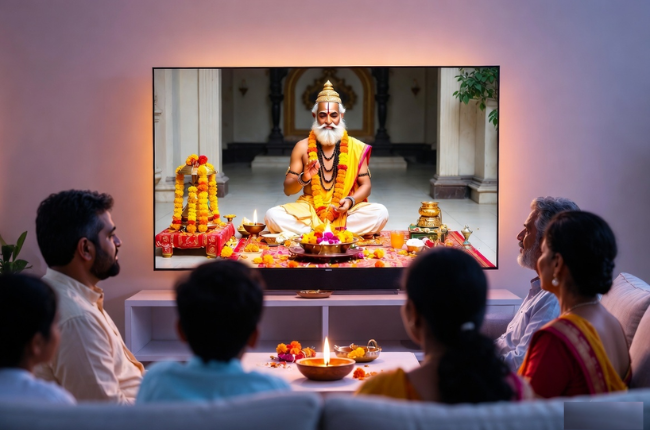
Online Pooja — live-streamed, real-time Vedic ritual conducted by trained Pandits — closes that gap in ways that earlier generations of NRI families simply did not have access to. What most guides on this subject miss is the precise classical reasoning for why a Pooja performed with the devotee attending live — even across a screen and twelve time zones — carries genuine Vedic validity, and what separates a properly conducted online Pooja from a recorded ritual or a WhatsApp video call with an under-prepared priest. This guide covers how online Pooja works, why it carries the same spiritual benefit as an in-person ceremony, what trained Pandits at AtoZPandit.com bring to every live session, the practical and financial advantages NRI families gain, and the questions that families ask before booking that no published content has answered directly.
What Online Pooja Is and How the Classical Framework Supports It
Before addressing how online Pooja works practically, the question that every sincere NRI family carries deserves a direct classical answer: does physical presence at a Pooja matter, and if so, what does attending by live video actually constitute in Vedic terms?
The Mantra Shastra and Karma Kanda traditions — the classical frameworks governing ritual efficacy — identify three components that determine whether a Pooja produces its intended effect for the Yajamana (the person on whose behalf the ritual is performed):
The Three Classical Requirements for Ritual Validity
- Sankalpa — the formal statement of intention, made at the opening of every Pooja, in which the Pandit names the Yajamana — their full name, Gotra (lineage), Nakshatra (birth star), and the specific purpose of the ritual. The Sankalpa is the mechanism by which the ritual's merit is directed to the specific individual. It does not require the person to be physically present — it requires their name, lineage, and intention to be accurately stated before the sacred fire.
- Shraddha — the devotion and sincerity of the Yajamana's engagement with the ritual. The classical tradition holds that the Yajamana's internal orientation toward the Pooja — their awareness of what is happening, their prayer, their emotional presence — is what channels the ritual's generated merit toward them. Live attendance via video — watching, praying, and participating in real time — satisfies this requirement in a way that a recorded Pooja or a proxy performance without the family's knowledge does not.
- Dravya Shuddhi — the purity and correctness of the ritual materials used. The sacred items — Samagri, ghee, flowers, fruits, sacred thread, and the specific items prescribed for the Pooja type — must be authentic, correctly sourced, and properly consecrated. This requirement is met entirely on the Pandit's side and is independent of the devotee's location.
When all three conditions are met — correct Sankalpa naming the NRI devotee, the devotee's live and sincere participation, and authentic ritual materials properly used — the classical framework holds that the Pooja's merit reaches its intended recipient with full efficacy. The geographical distance between the Yajamana and the ritual site is not a classical obstacle. Distance has never been a classical obstacle. The Pitru Paksha Tarpan performed on behalf of an ancestor requires no physical proximity to the deceased — it requires correct Sankalpa and sincere intent.
How to Book and Attend an Online Pooja on AtoZPandit.com — Step by Step
The practical process is straightforward. Here is the complete sequence from booking to completion.
- Visit AtoZPandit.com and select your Pooja type. The platform lists the complete range of available Poojas — from Satyanarayan Katha and Navgraha Shanti to Kaal Sarp Dosha Puja, Griha Pravesh, Rudrabhishek, and specific festival ceremonies. Each listing specifies what the Pooja covers, its duration, the ritual materials included, and the pricing.
- Submit your personal details for the Sankalpa. During booking, you will provide your full name, Gotra, Janma Nakshatra (birth star), and the specific intention or wish (Manokamna) for the Pooja. If you do not know your Gotra or Nakshatra, AtoZPandit.com's team assists in identifying these from your birth details before the ceremony.
- Select your date and time zone. AtoZPandit.com coordinates the Pooja timing to a Muhurta — an auspicious Vedic time window — appropriate for your Pooja type, while scheduling the live session at a time accessible within your time zone. A family in California, London, or Melbourne can attend a morning Pooja in India from their evening, their morning, or their midday — the scheduling team confirms the overlap before booking is finalised.
- Receive your joining link. A live video link — via a secure platform — is sent to your registered email and WhatsApp before the ceremony. No technical installation is required. The session runs on any smartphone, tablet, or computer with an internet connection.
- Attend the live Pooja in real time. Log in before the scheduled start. The Pandit will greet you, confirm your name and Sankalpa details, and proceed with the complete Pooja Vidhi in your presence. You can watch, listen, and pray along throughout the ceremony. For some Poojas, the Pandit will guide you through actions you can perform simultaneously at home — lighting a diya, holding flowers, or reciting a prayer — to deepen your participation.
- Receive Prasad and the Pooja recording. After the ceremony, AtoZPandit.com dispatches Prasad — the sacred offering items from the Pooja — to your international address. A recording of the full session is also provided so you can revisit the ceremony and share it with family members who could not attend live.
- Receive a post-Pooja consultation if needed. For Poojas addressing specific Dosha or life challenges, AtoZPandit.com offers a follow-up consultation with the Pandit or a Jyotishi to discuss the outcomes, any additional remedial steps, and the timeline within which the Pooja's effects are classically expected to manifest.
The Same Vedic Benefits — Why Online Pooja Is Not a Compromise
The most persistent concern NRI families carry before their first online Pooja is this: will it actually work the same way? Not just technically — but spiritually. Will the ritual carry the same weight as the ceremony their parents attended in person?
The answer the classical framework gives is unambiguous — and it is worth stating plainly rather than hedging.
The Agni Does Not Know Geography
The Agni consecrated for the Pooja — the sacred fire into which the Pandit offers ghee, Samagri, and the prescribed ritual substances — is lit and maintained according to the same classical Vidhi whether the Yajamana is sitting three feet from it or watching from Toronto. The fire's consecration is a matter of the Pandit's knowledge, preparation, and the correctness of the ritual sequence — not of who is in the room. The Rigveda describes Agni as Vishvavyacha — all-pervading — not as a local presence confined to a specific physical space.
The Sankalpa Reaches Its Recipient
The Sankalpa — which the Pandit recites at the opening of the Pooja — names the Yajamana specifically and directs the ritual's generated merit toward that named individual. This is the mechanism the classical tradition uses for Poojas performed on behalf of absent family members, deceased ancestors, and individuals in different cities or countries. The NRI devotee attending via live video is in a stronger position than a family member for whom a Pooja is performed entirely in absentia — because the live attendee brings their own Shraddha (sincere engagement) into the ritual field in real time.
What the Devotee's Live Presence Adds
The difference between a recorded Pooja and a live online Pooja is the difference between reading about a meal and eating it. During a live session:
- The devotee's prayers and intentions are active and present during the actual ritual — not added retrospectively to a recording
- The Pandit can address the devotee directly, confirm the Sankalpa, and respond to any specific concern the family raises before or during the ceremony
- The devotee's emotional and devotional engagement — their Bhakti — becomes part of the ritual field that the Agni witnesses
- The timing of the Pooja is coordinated to an auspicious Muhurta that includes the devotee's participation — not a Muhurta chosen independently of them
As is commonly observed among NRI families who attend their first online Pooja with genuine openness — the experience of watching a trained Pandit perform the complete ritual in real time, hearing their own name spoken in the Sankalpa, and being able to pray along from their home abroad carries a quality of connection that proxy rituals simply do not produce.
Why AtoZPandit.com Is the Right Choice for NRI Online Pooja
Not every online Pooja service delivers what the classical tradition requires. The difference between a genuinely effective online Pooja and a visually appealing but ritually incomplete video session comes down to the preparation, knowledge, and experience of the Pandit conducting it — and the platform's commitment to classical Vidhi rather than streamlined convenience alone.
Trained, Experienced, and Classically Grounded Pandits
Every Pandit on AtoZPandit.com is verified for classical training, regional tradition expertise, and practical experience before being listed on the platform. The verification process covers:
- Formal training in the relevant Kalpasutra or Grihyasutra tradition governing the Pooja type
- Demonstrated knowledge of correct Mantra Uccharana (pronunciation) — the single most important determinant of a mantra's vibrational efficacy
- Familiarity with the specific ritual materials, their substitution protocols where internationally sourced materials differ, and the correct sequence of each Pooja Vidhi
- Experience conducting live online sessions — including the specific adaptations required to maintain ritual integrity in a digital format without compromising classical completeness
A Pandit who knows the ritual deeply but has no experience with the live-streamed format will lose critical ritual momentum managing the technology. A platform that prioritises technical smoothness over Vedic knowledge produces a visually professional but spiritually thin session. AtoZPandit.com's Pandits are trained in both — classical completeness and live digital delivery.
Versed in NRI-Specific Needs
NRI families present specific requirements that a domestic Pooja service is not equipped to handle:
- Sankalpa accuracy for international devotees — The Sankalpa traditionally includes the Desh (country), Pradesh (region), and Nagar (city) of the Yajamana. AtoZPandit.com's Pandits are trained to incorporate the devotee's current country of residence into the Sankalpa accurately — a detail that many domestic services omit or generalise.
- Time zone coordination for auspicious Muhurta — Finding a Muhurta that is both astrologically auspicious and practically accessible across a twelve-hour time difference requires genuine Panchang knowledge, not just calendar scheduling. AtoZPandit.com's Jyotish team identifies Muhurta windows that serve both requirements.
- Explanation in English — Many NRI families — particularly second-generation participants — benefit from the Pandit explaining each ritual step in English alongside the Sanskrit recitation. AtoZPandit.com's Pandits are selected partly on their ability to bridge the classical and the accessible without sacrificing the depth of either.
- Prasad international shipping — The consecrated Prasad from your Pooja is dispatched to your international address after the ceremony. The packaging, preservation, and shipping protocol is managed by AtoZPandit.com's logistics team — ensuring the sacred items arrive intact and properly sealed.
Complete Ritual — No Shortcutting the Vidhi
The most common criticism levelled at online Pooja services — and it is a legitimate criticism where it applies — is that the ritual is shortened, the mantras are abbreviated, or the Samagri is simplified to reduce preparation time. AtoZPandit.com's service commitment is the opposite:
- Every Pooja is conducted according to its complete classical Vidhi — no mantra abbreviations, no ritual step omissions
- The Samagri used is sourced and verified for classical authenticity — not replaced with commercially convenient substitutes where authentic items are prescribed
- The Pooja duration matches what the classical tradition prescribes for that ceremony type — not a condensed version designed to fit a commercial session slot
Pandit's Tip — Focus: Shraddha As many NRI families discover after their first online Pooja with AtoZPandit.com — what they expected to feel like a workaround ends up feeling like a homecoming. Hearing a trained Pandit speak their Gotra and Nakshatra correctly in the Sankalpa, watching the Agni lit and tended with proper care, being able to fold their hands and pray from their living room in another country — these are not compromises. They are what the tradition looks like when someone has genuinely thought about how to bring it to you where you are. A Pandit familiar with this service will tell you: the devotee's sincerity travels faster than any aircraft. The Agni receives it regardless of the distance.
The Convenience and Practical Advantages — What NRIs Gain
Beyond the spiritual equivalence of the ceremony, online Pooja through AtoZPandit.com delivers practical advantages that in-person arrangements simply cannot match from abroad.
No Travel Required — No Planning the Trip Around the Ceremony
Travelling to India specifically to attend a Pooja — or timing a visit to coincide with a family ceremony — carries a cost in money, leave days, and logistical complexity that most NRI professionals know intimately. A return flight from the United States or United Kingdom to India for a week-long visit costs the equivalent of many months of online Pooja bookings. Online Pooja eliminates the travel requirement entirely — the ceremony comes to the devotee, on a schedule the devotee helps design.
Affordable Without Sacrificing Quality
Online Pooja pricing on AtoZPandit.com is structured to be genuinely accessible — not artificially inflated for an international market. The cost reflects the Pandit's preparation time, the ritual materials sourced and used, the Prasad shipping, and the platform's coordination — without the venue, travel, and accommodation costs that inflate in-person ceremony budgets. NRI families who previously managed ceremonies by wiring money to family back home and hoping the arrangements were handled correctly now have a transparent, end-to-end managed alternative at a comparable or lower total cost.
The Entire Family Can Attend — Across Multiple Countries
One of the most distinctive advantages of live online Pooja is that it dissolves the geography of the extended family simultaneously. A Satyanarayan Katha booked on AtoZPandit.com can be attended live by the primary family in New Jersey, the grandparents in Mumbai, the siblings in London, and cousins in Singapore — all watching the same ceremony in real time, all included in the Sankalpa, all sharing the experience of the ritual at the moment it happens. No physical gathering has ever achieved this across four continents simultaneously.
Bookings Available for All Major Poojas and Life Events
AtoZPandit.com's online Pooja catalogue covers the full range of Vedic ceremonies that NRI families need across a lifetime:
- Life milestone Poojas — Namakarana (naming ceremony), Annaprashana (first feeding), Upanayana (thread ceremony), Vivah (wedding rituals), Griha Pravesh (housewarming)
- Dosha remedial Poojas — Kaal Sarp Dosha Puja, Manglik Shanti, Navagraha Shanti, Pitra Dosha Shanti, Sade Sati remedial Pooja
- Festival and seasonal Poojas — Navratri Pooja, Diwali Lakshmi Pooja, Ganesh Chaturthi, Satyanarayan Katha, Rudrabhishek
- Ancestral and memorial Poojas — Pitru Paksha Tarpan, Shraddha, annual death anniversary Pooja (Varshik Shraddha)
- Protective and wellbeing Poojas — Maha Mrityunjaya Homa, Sudarshana Homa, Hanuman Pooja for protection
Live Access Means Real Participation — Not Proxy Attendance
The most meaningful practical advantage — and the one NRI families most consistently cite after their first session — is the quality of participation that live access provides. Watching the Pandit light the Agni in real time. Hearing your name spoken in the Sankalpa. Following the ritual sequence as it happens. Lighting your own diya at home at the moment the Pandit lights the primary flame. Folding your hands in prayer at the moment of Aarti. This is participation — not observation of a recording, not a WhatsApp notification that the Pooja is done.
Is Online Pooja Truly as Effective as Temple Pooja — The Question Every NRI Asks First
This question deserves a direct, honest, and classically grounded answer rather than reassurance.
A temple Pooja conducted by a trained, knowledgeable Pandit in a properly consecrated space carries the accumulated sanctity of that space — the years of ritual performed there, the prayers offered by thousands of devotees, the consistent divine presence that classical tradition holds builds over time in a genuinely maintained sacred space. That accumulated sanctity is a real quality that an online Pooja conducted from a private ritual space — however well prepared — does not replicate.
What online Pooja does carry — and what matters most for the NRI devotee's specific situation — is the complete Vidhi, the correct Sankalpa naming the specific devotee, the Pandit's trained knowledge and genuine preparation, the consecrated Agni, the authentic Samagri, and the devotee's own sincere live participation. These are the factors the classical tradition identifies as the primary determinants of a Pooja's efficacy for the individual. The temple's accumulated sanctity is a gift to the devotees who can access it. Online Pooja is the full ritual — for those who cannot.
The comparison the classical tradition actually makes is not between online Pooja and temple Pooja. It is between a correctly conducted Pooja with sincere devotee participation — wherever that participation happens — and an incorrectly conducted or proxy Pooja without the devotee's genuine engagement. By that measure, a live online Pooja with full Vidhi and sincere NRI participation outperforms a rushed, abbreviated in-person ceremony performed without the devotee's knowledge or care.
Myth vs. Fact
MYTH: Online Pooja is a modern convenience created for people who cannot be bothered to travel — it does not carry the same spiritual weight as a physical ceremony.
FACT: The classical validity of a Pooja rests on three foundations: correct Sankalpa naming the Yajamana, sincere live participation by the devotee, and authentic ritual materials correctly used. All three are fully present in a properly conducted online Pooja through AtoZPandit.com. The classical tradition has always accommodated geographic distance — Pitru Paksha Tarpan, for instance, has been performed for absent family members across centuries without questioning its validity.
What Almost No Article Covers: How Online Pooja Works When the Family Is in a Grief Emergency
This situation — which no published guide addresses — is one of the most emotionally urgent contexts in which NRI families contact online Pooja services. A parent has died in India. The son or daughter is in the United States and cannot get a flight home for five days. The Antim Sanskar (last rites) will proceed without them — that cannot be helped. But what about the Terahvi (thirteenth-day ceremony)? The Shraddha? The family is asking them to decide within twenty-four hours whether to book the priest back home or arrange something they can attend.
AtoZPandit.com handles grief emergency bookings with a specific protocol that its Pandits are trained for. The Sankalpa for grief ceremonies — particularly Shraddha and Tarpan — requires precise details: the deceased's full name, Gotra, the Tithi (lunar date) of death, and the Nakshatra of the deceased where known. These details must be captured accurately because the Sankalpa for an ancestral ceremony is the mechanism by which the ritual's benefit reaches the departed soul — and an incorrectly stated Sankalpa in this context is a classical error with real consequences.
What the family in grief needs to know is this: AtoZPandit.com's team handles the detail collection, Muhurta selection, and Pandit assignment within hours of the booking — not days. The live session allows the NRI family member to be present at the ceremony that matters, rather than receiving a phone call after it is done. The Prasad and sacred ash from the Homa can be shipped internationally. And for families where multiple members are scattered across countries, the live link allows the entire family — in India, abroad, and everywhere between — to attend the same ceremony simultaneously.
The grief emergency is the context in which online Pooja is not a convenience. It is the only option. And it is, in that moment, exactly enough.
FAQ
Can online Pooja give the same results as in-person Pooja for NRIs? Online Pooja conducted with complete classical Vidhi, correct Sankalpa naming the devotee, authentic ritual materials, and the devotee's sincere live participation satisfies the three classical requirements for ritual efficacy. The Mantra Shastra tradition holds that the Sankalpa directs the Pooja's merit to the named Yajamana regardless of geographic distance. A live online Pooja outperforms a proxy or abbreviated in-person ceremony in every classical measure that matters for the devotee.
How do I know the Pandit on AtoZPandit.com is properly trained? Every Pandit listed on AtoZPandit.com is verified for classical training in the relevant Kalpasutra or Grihyasutra tradition, correct mantra pronunciation, and experience conducting complete online Poojas. The platform does not list untrained or informally prepared priests. The Pandit's regional tradition expertise, years of experience, and specific Pooja competencies are verified by AtoZPandit.com's editorial and service team before any Pandit is made available for booking.
What details do I need to provide before booking an online Pooja? You will need your full name, Gotra (family lineage), Janma Nakshatra (birth star), current country of residence, and the specific intention or wish for the Pooja. If you do not know your Gotra or Nakshatra, AtoZPandit.com's team assists in identifying these from your birth details before the ceremony. Accurate Sankalpa details are the most important thing you can provide — they are the mechanism by which the ritual's benefit is directed specifically to you.
How much does online Pooja cost on AtoZPandit.com for NRIs? AtoZPandit.com's online Pooja pricing is structured to be genuinely accessible without compromising ritual completeness. The cost covers the Pandit's preparation and session time, all ritual Samagri, Prasad sourcing, and international shipping. Pricing varies by Pooja type and duration. As astrological tradition holds, individual outcomes vary with karma and sincerity — but the investment in a correctly conducted Pooja through AtoZPandit.com is consistently among the most cost-effective ritual options available to NRI families internationally.
Can the whole family attend an online Pooja from different countries? A live online Pooja link from AtoZPandit.com can be shared with any number of family members across any number of countries simultaneously. A single Pooja booking can include family members in India, the United States, the United Kingdom, Canada, Australia, and Singapore — all attending the same ceremony in real time. The Sankalpa can name multiple Yajamanas where the Pooja is being performed for the entire family unit.
What happens to the Pooja Prasad if I am living abroad? AtoZPandit.com dispatches the consecrated Prasad — the sacred offering items from your Pooja — to your international address after the ceremony. The packaging is designed for international shipping with appropriate preservation. A full recording of the Pooja is also provided so you can revisit the ceremony and share it with family members who were unable to attend the live session.
Is it right to do a Pooja online — does Vedic tradition allow it? The Vedic tradition's requirement for Pooja validity has never been physical proximity — it has been correct Sankalpa, sincere devotion, and authentic ritual conduct. Poojas have been performed on behalf of absent individuals for centuries within the classical framework. Online Pooja extends this principle: the devotee is not absent — they are present in real time, praying, watching, and participating. The classical tradition supports this fully. Personal outcomes depend on individual karma, the quality of the Pandit's preparation, and the sincerity of the devotee's engagement.
Conclusion
Vedic tradition has always found ways to reach its devotees across distance — through Sankalpa, through sincere prayer, through the understanding that the sacred fire's reach is not measured in metres. Online Pooja is not a modern workaround for an ancient system. It is the ancient system, meeting its devotees where they are.
Start today by visiting AtoZPandit.com, selecting the Pooja that matches your family's current need, and submitting your details for the Sankalpa. The coordination team handles everything from Muhurta selection to Prasad shipping — your part is to show up at the live session with the same sincerity you would bring to a temple.
As is commonly observed among NRI families who have made online Pooja a regular part of their household's Vedic life — the distance stops feeling like the defining fact of being Indian abroad. The ritual is present. The Pandit is trained and prepared. The Agni is lit. And the family — scattered across four continents — folds its hands at the same moment, before the same sacred fire, in the same prayer. That is what the classical tradition always promised, and what AtoZPandit.com delivers.
If your family is ready to experience a complete, classically conducted Pooja from wherever you are in the world — AtoZPandit.com connects you with trained, experienced Vedic Pandits who deliver the full ritual, the correct Sankalpa, authentic Samagri, and Prasad shipping to your international address. Book your online Pooja on AtoZPandit.com today and bring the tradition home — wherever home is.
Disclaimer This article is written for educational and cultural awareness purposes only. The Vedic ritual information provided here does not substitute professional medical, psychological, or legal advice. For a complete and authentic online Pooja experience, connect with a qualified Pandit at AtoZPandit.com.