Pitru Paksha Tarpan Guide Pind Daan Rituals to Invite Ancestor Blessings
There is a particular kind of grief that families carry without a name for it. A father passes. The rituals are performed in whatever way the family could manage — hurriedly, with some elements missing, because nobody in the current generation was taught the sequence in full. The months pass. And then quietly, one by one, things in the household begin to feel stuck. A son's career stalls at the point of breakthrough. A daughter's marriage is delayed without explanation. A property matter lingers in documentation for years. The family prays. The family works. Nothing fully resolves.
In Vedic tradition, this pattern has both a name and a cause. The Garuda Purana — the primary classical text governing the rituals of death, transition, and ancestral peace — establishes that the souls of ancestors who do not receive the correct Shraddha rituals remain in a state of incompletion between the world of the living and the world of the departed. They do not cause harm deliberately. But their unresolved state creates what the Brihat Parashara Hora Shastra identifies as Pitra Dosha — an ancestral karmic condition that expresses as persistent, otherwise-inexplicable obstacles in the lives of their descendants.
What most articles on this topic fail to address is the distinction between Tarpan, Shraddha, and Pind Daan — three different rituals that serve different purposes in the ancestral peace sequence, each with its own Vidhi, its own timing, and its own scope of effect. Performing only one and expecting the result of all three is the most common ritual gap across Indian families today.
This article covers the complete Pitru Paksha sequence from Mahalaya Amavasya to the final Shraddha, the correct Tarpan Vidhi for home practice, the Pind Daan procedure at the three primary sacred sites, the complete list of Pitra Dosha symptoms, and the answers to the questions that grieving and concerned families carry but rarely find answered in any published source.
What Pitru Paksha Actually Is — The Classical Framework From the Garuda Purana
Pitru Paksha — the fortnight of ancestors — falls in the Krishna Paksha (waning phase) of the lunar month of Bhadrapada, typically in September. It begins on the day after Bhadrapada Purnima and concludes on Mahalaya Amavasya — the new moon that closes the fortnight. The Garuda Purana identifies this period as the sixteen-day window during which the souls of ancestors are released from their current plane of existence and move closest to the realm of the living, making the rituals performed during this period exponentially more effective than the same rituals performed at any other time of year.
The classical framework rests on three distinct ritual acts:
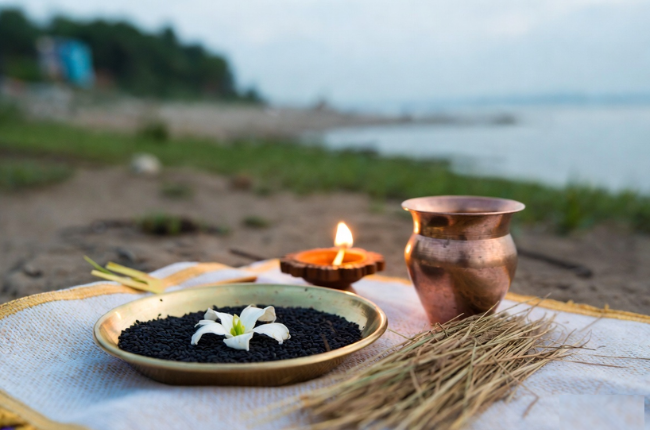
Tarpan — the offering of water mixed with black sesame, performed daily during Pitru Paksha, which provides sustenance and relief to the ancestral soul in transit. Tarpan is the foundational daily practice — it can be performed at home, at a river, or at any clean outdoor space with access to flowing water or a vessel of clean water. It does not require a Pandit for its basic form, though a Pandit ensures the correct Sankalpa and mantra sequence.
Shraddha — the full ritual ceremony performed on the specific Tithi of the ancestor's death, which includes the recitation of the Shraddha mantra, the offering of food (Pinda) to crows and other creatures as representatives of the ancestral realm, and the feeding of a Brahmin as the living representative of the departed soul. Shraddha is the complete ceremony. Tarpan is its daily preparatory element.
Pind Daan — the offering of rice balls (Pinda) at a sacred site (Kshetra), which is the most powerful single act in the ancestral peace sequence. The Garuda Purana establishes that Pind Daan performed at Gaya, Varanasi, or Nashik carries a liberation (Mukti) transfer to the ancestral soul that home-based rituals cannot fully replicate. Pind Daan at these sites is recommended at least once in a generation.
A complete Pitra Dosha assessment establishes which of these three ritual acts is most urgently needed based on the severity of the family's current situation and the gap in ancestral rituals.
Pitru Paksha 2025 — Dates, Tithis, and Which Ancestor Each Day Addresses
The Pitru Paksha 2025 calendar follows the Bhadrapada Krishna Paksha. Shraddha is performed on the Tithi matching the date of the ancestor's death in the lunar calendar. The mapping is as follows:
Purnima Shraddha — For ancestors who departed on Purnima (full moon) in any month. This is the first day of Pitru Paksha.
Pratipada Shraddha (Krishna Paksha 1) — For ancestors who departed on the first day of either Paksha.
Dwitiya Shraddha (Krishna Paksha 2) — For ancestors who departed on the second Tithi.
Tritiya Shraddha — For ancestors who departed on the third Tithi. Also used for ancestors whose death Tithi falls on Chaturthi when Chaturthi Shraddha coincides with Mahabharani.
Chaturthi Shraddha — For ancestors who departed on the fourth Tithi.
Panchami Shraddha — For ancestors who departed on the fifth Tithi. Also for unmarried girls and children who departed in infancy — the Dharmasindhu specifically prescribes Panchami for these cases.
Shashthi Shraddha — For ancestors who departed on the sixth Tithi.
Saptami Shraddha — For ancestors who departed on the seventh Tithi.
Ashtami Shraddha — For ancestors who departed on the eighth Tithi.
Navami Shraddha (Avidhava Navami) — For married women who predeceased their husbands. This Tithi carries specific significance for the female ancestral line and is the most important Shraddha Tithi for Saubhagya (married wellbeing) in the women of the family.
Dashami Shraddha — For ancestors who departed on the tenth Tithi.
Ekadashi Shraddha — For ancestors who departed on the eleventh Tithi. Also for sannyasis and those who renounced worldly life before death.
Dwadashi Shraddha (Magha Shraddha) — For ancestors who were saints, ascetics, or those devoted to Lord Vishnu.
Trayodashi Shraddha — For children and young people who departed before the age of adulthood.
Chaturdashi Shraddha — For ancestors who died an accidental death, died by weapons, or died suddenly and violently. This is a critical Tithi for families with such ancestral histories, as these souls require specific pacification beyond the standard Tarpan.
Mahalaya Amavasya (Sarva Pitru Amavasya) — The most important day of the entire Pitru Paksha. On this day, Shraddha is performed for all ancestors simultaneously — known and unknown, across all lineages. If a family can perform only one Shraddha in the entire year, the Garuda Purana specifies that Mahalaya Amavasya is the day on which it will be received by all ancestors regardless of their specific departure Tithi.
📿 Pandit's Tip — Focus: SankalpaAs many families discover when they sit with their Pandit before Tarpan, the single most important element of the entire ritual is the Sankalpa — the formal declaration of the performer's name, father's name, Gotra, the name of the ancestor being addressed, and their relationship to the performer. The Garuda Purana specifies that the soul of the ancestor receives Tarpan specifically because the Sankalpa creates a named channel between the offering and its recipient. Tarpan performed without a correctly recited Sankalpa is like a bank transfer sent without an account number — the funds leave the sender but have no confirmed destination. Families who have performed Tarpan for years without knowing their Gotra or their ancestor's lunar departure Tithi should make identifying these details their first priority before the next Pitru Paksha begins.
How to Perform Tarpan at Home — The Complete Step-by-Step Vidhi
Tarpan can be performed at home when travel to a sacred river is not possible. The following Vidhi follows the Grihyasutra tradition for householder Tarpan.
- Begin before sunrise. Tarpan must be performed in the morning, before the first meal of the day. The practitioner must have bathed and be in clean, preferably white or undyed clothing.
- Prepare the Tarpan vessel. Use a copper or brass water vessel. Fill it with clean water. Add black sesame (kala til) — a small handful. Add a few drops of Ganga Jal if available. Mix gently with the right hand.
- Lay kusha grass on the performing surface. Kusha grass (darbha) is the ritual conductor for ancestral offerings. The Garuda Purana specifies that offerings made on kusha grass are received directly by the Pitru realm. Place two or three strands of kusha on the right hand when performing the Tarpan itself.
- Face south during Pitru Tarpan. North is the direction of the gods. South is the direction of Yama and the ancestral realm. Tarpan for ancestors is always performed facing south. This directional alignment is non-negotiable in the Garuda Purana's Vidhi.
- Recite the Pitru Sankalpa. Name yourself, your father's name, your Gotra, today's Tithi, and the name and relationship of the ancestor for whom Tarpan is being offered. Example: "I, [your name], of [Gotra] Gotra, on this [Tithi] of Bhadrapada Krishna Paksha, offer this Tarpan to my [relationship], [ancestor's name], for their peace and liberation."
- Offer water three times for each ancestor. Pour water from the copper vessel through the right hand — palm cupped, fingers together, water flowing over the thumb — three times while naming the ancestor. Say "Truptim Yacchatu" (may they be satisfied) after each pouring.
- Offer Tarpan to the three ancestral levels. The Garuda Purana specifies three levels of offering: to the father's line (Pitru), to the grandfather's line (Pitamaha), and to the great-grandfather's line (Prapitamaha). Each level receives three separate offerings.
- Offer Tarpan to the maternal line as well. The maternal grandfather (Nanashraddha) is addressed in a separate round of offerings facing southwest. This offering is frequently omitted and represents one of the most common gaps in family Tarpan practice.
- Offer the remaining water to the tulsi plant or pour it at the base of a tree. Do not pour the used Tarpan water down a drain. Return it to the earth.
- Feed crows before eating anything. After Tarpan, place a small portion of cooked food — preferably rice with sesame — on a leaf outside the home for crows. Crows are the classical representatives of the ancestral realm in Vedic tradition. When a crow eats the offered food, the offering is considered received.
Pind Daan — The Most Complete Act of Ancestral Liberation
Pind Daan is the offering of rice balls (Pinda) that represents the physical, energetic, and karmic sustenance provided to the ancestral soul for its onward journey. The Garuda Purana's description of Pind Daan is among the most detailed in all of Vedic ritual literature — more pages are devoted to this single act than to any other ancestral practice.
Why Pind Daan at a Sacred Site Carries More Effect Than Home Practice
The Garuda Purana explicitly addresses this question. It establishes that Kshetra Shraddha — Shraddha performed at a sacred site — carries a liberation effect that householder Shraddha cannot fully replicate because the sacred site itself has accumulated centuries of ritual energy (shakti) that amplifies the offering's potency. Gaya, Varanasi, and Nashik are the three primary Kshetras named across all classical texts for this purpose.
The practical understanding is that the sacred site acts as a transmitter. The family's offering, made with sincerity and correct Vidhi, enters a field of amplified ritual energy and its effect on the ancestral soul's liberation is correspondingly greater.
Gaya — The Primary Pind Daan Site
Gaya in Bihar is the single most powerful Pind Daan Kshetra in classical Vedic tradition. The Garuda Purana, the Vayu Purana, and the Agni Purana all separately name Gaya as the site where Lord Vishnu placed His footprint — the Vishnupad — and declared that Pind Daan performed here confers liberation to the ancestor across twenty-one generations of their lineage. This is the most expansive liberation claim in any classical text for a single ritual act.
Pind Daan at Gaya is performed across three days at the primary sites: Vishnupad Temple, Falgu River bank, and Akshayavat (the undying banyan tree within the Vishnupad complex). Each site receives a separate set of Pinda offerings with a separate Sankalpa. The three-day sequence is the complete Gaya Shraddha — one-day versions are available but do not cover all three Kshetra points.
Varanasi — Pind Daan for Souls Who Departed Without Final Rites
Varanasi carries a specific classical mandate for souls who departed without the correct final rites — those who died suddenly, far from home, without family present, or whose death rites were performed incorrectly. The Kashi Khand of the Skanda Purana establishes that Pind Daan at Manikarnika Ghat and Pishachmochana Tirtha in Varanasi liberates souls who are in a state of incompletion due to incorrect or absent final rites. For families with such ancestral situations, Varanasi is the more specific prescription than Gaya.
Nashik — Pind Daan for the Maternal Line
Nashik on the banks of the Godavari river is the classical Kshetra for Pind Daan specifically for the maternal lineage. Families who have performed Gaya Shraddha but continue to observe Pitra Dosha symptoms often discover, on consultation with a qualified Pandit, that the maternal line's Shraddha has been consistently neglected. Nashik's Ramkund Ghat is the primary site. Pind Daan here addresses maternal grandfather, maternal grandmother, and the maternal great-grandparents in their respective Tithi sequence.
Complete Pitra Dosha Symptoms — What the Chart and the Household Tell You
Pitra Dosha manifests across three domains simultaneously: in the birth chart, in the physical household, and in the pattern of family events across generations. All three must be checked.
In the Birth Chart
The Brihat Parashara Hora Shastra identifies Pitra Dosha through several specific configurations. Sun in the ninth house afflicted by Saturn, Rahu, or Ketu indicates ancestral disruption in the paternal line. Rahu in the ninth house — the house of father and dharma — is the most classically cited Pitra Dosha indicator. When the ninth lord is weak, debilitated, or placed in a Dusthana, the ancestral connection to the paternal line is structurally compromised in the chart.
For the maternal line, affliction to the fourth house or its lord — the house of mother and family roots — along with Ketu in the fourth, indicates Matru Dosha, the maternal equivalent of Pitra Dosha.
A complete Kundali reading that specifically examines the ninth house, ninth lord, fourth house, and the placement of Sun, Moon, and Rahu gives the complete Pitra Dosha picture from the chart.
In the Household Pattern
Classical Vedic tradition identifies these recurring household patterns as consistent with active Pitra Dosha:
- Persistent and unexplained delays in the marriage of children, particularly the eldest child
- Repeated pregnancy losses or difficulty in conceiving children, particularly male heirs in families where the paternal lineage is incomplete
- Property disputes and legal matters that remain unresolved across years without logical explanation
- Financial progress that reaches a certain ceiling and stops, regardless of effort and qualification
- Recurring health patterns — particularly affecting the liver, eyes, or nervous system — across generations of the same family
- The presence of snakes in or around the home property in unusual frequency (the classical texts associate serpents with Pitru presence)
- Dreams of deceased ancestors appearing distressed, asking for food or water, or standing in water up to the waist — a specific classical indicator documented in the Garuda Purana
In the Generational Pattern
When two or more generations of the same family show the same pattern of obstacle — late marriage across both parents and children, or business failure at the same threshold across father and son — the classical framework identifies this as a lineage-level Pitra Dosha rather than an individual karmic condition. The remedy in this case is lineage-level: a Pind Daan at Gaya with Sankalpa naming all three generations, combined with the Narayan Bali ritual if any ancestor died an abnormal death.
📖 Did You KnowThe Mahalaya Amavasya — the concluding day of Pitru Paksha — holds a specific classical status that is often not explained to families. The Garuda Purana establishes that on Mahalaya Amavasya, the gates of the Pitru realm are fully open, and every ancestral soul — regardless of their current plane of existence, their departure Tithi, or the completeness of their previous Shraddha — moves into proximity with the living world and receives any sincere offering made in their name. This means that a family which has missed Pitru Paksha Tarpan for decades can, by performing a complete and sincere Shraddha on Mahalaya Amavasya with a correct Sankalpa naming all known and unknown ancestors, reach every soul in their lineage simultaneously. The Garuda Purana specifically calls this the day of universal ancestral reception — no other single day in the Hindu calendar carries this scope.
The Most Common Pitru Paksha Mistakes That Invalidate the Ritual
Understanding the mistakes is as important as understanding the Vidhi. These are the gaps most commonly found in family Tarpan and Shraddha practice.
Performing Tarpan Without Knowing the Gotra
The Gotra — the ancestral sage lineage — is the identifier that makes the Sankalpa specific to a particular family line. Tarpan performed without naming the correct Gotra reaches the general pool of ancestral souls but does not specifically reach the named ancestor's soul. Many families in urban environments have lost knowledge of their Gotra across two or three generations. Recovering the Gotra — through elder relatives, family records, or a consultation with the family's traditional Pandit — is the single most important preparatory act before Pitru Paksha.
Using the Wrong Sesame — White Instead of Black
Black sesame (kala til) is the specific offering grain for Pitru Tarpan across all classical texts. The Garuda Purana, the Dharmasindhu, and the Grihyasutras all specify black sesame as the Pitru grain. White sesame is used for Deva Tarpan — the offering to the gods. Families who substitute white sesame for black sesame in Tarpan are unintentionally performing the Deva offering rather than the Pitru offering. This is one of the most widespread and least-known ritual substitution errors.
Performing Tarpan Facing North Instead of South
North is the direction of the living realm and the Devas. South is the direction of Yama's realm and the Pitrus. Tarpan performed facing north, east, or any direction other than south does not reach the ancestral realm with full potency. Many families set up their Tarpan space facing east because their home puja room faces east — and inadvertently perform their entire Pitru Paksha practice in the wrong direction.
Skipping the Maternal Line
The maternal grandfather — Nanashraddha — and the maternal grandmother receive separate Tarpan offerings in the classical Vidhi. These are performed facing southwest rather than south. Families who perform Tarpan only for the paternal lineage — father, grandfather, great-grandfather — leave the maternal ancestral souls unaddressed. Pitra Dosha symptoms that trace to the maternal line (fourth house affliction in the chart, mother's health difficulties, property issues) will not resolve through paternal Tarpan alone.
Performing Shraddha on the Wrong Tithi
Each ancestor must be addressed on the Tithi matching their lunar death date — not their solar calendar death date. A grandfather who died on the 15th of September in the solar calendar may have departed on Navami, Dashami, or any other Tithi in the lunar calendar that year. Using the solar date to determine the Shraddha Tithi is incorrect and results in the offering arriving on the wrong day of the ancestral calendar.
What Happens When Pitru Paksha Is Not Observed — The Classical Account
The Garuda Purana addresses this question directly and at length. It does not frame the consequences as divine punishment — it frames them as the natural result of an incomplete energetic transaction.
The ancestral soul, according to the Garuda Purana's account, requires the Tarpan water offering to sustain itself during its transit period between death and its next destination. When Tarpan is not offered for a complete Pitru Paksha, the soul remains in a state of thirst (trishna) that prevents it from completing its transit cleanly. This incomplete transit is what creates the Pitra Dosha condition in the descendants' charts — not a curse, but a residual energetic incompletion that expresses as blockage in the living family's life areas.
The Garuda Purana also addresses what happens when Shraddha has not been performed for multiple generations. It states that the accumulated trishna of multiple ancestral souls in incomplete transit creates a compounded Dosha that manifests across multiple simultaneous life areas in the family — explaining why some families seem to face obstacles in career, marriage, and health all at once rather than in one area at a time.
The remedy in this case is not panic — it is the performance of Narayan Bali in addition to the regular Shraddha sequence. Narayan Bali is the specific ritual prescribed in the Garuda Purana for resolving the accumulated Dosha of multiple generations of missed Shraddha. It is performed at Trimbakeshwar, Varanasi, or by a qualified Pandit specialising in this ritual.
The Question No Article Answers: What About Ancestors Whose Death Date Is Unknown?
This question appears consistently in discussions of Pitru Paksha and receives no complete answer in any published article. What does a family do when an ancestor's death date — in either the solar or lunar calendar — is completely unknown? This is an increasingly common situation as families lose intergenerational documentation across urban migrations.
The classical answer from the Garuda Purana and the Dharmasindhu is clear: Mahalaya Amavasya is specifically designed for this situation. The concluding day of Pitru Paksha receives all ancestral souls regardless of their departure Tithi. A Sankalpa performed on Mahalaya Amavasya that names the family Gotra, names whatever ancestors are known by name, and then extends to "all known and unknown ancestors of our lineage across all generations" — using the Sanskrit phrase "Sarve Pitarah Truptim Yachchantu" (may all ancestors be satisfied) — reaches every soul in the family line.
Additionally, the Chaturdashi Shraddha — the fourteenth day of Pitru Paksha — is prescribed for ancestors who died under unclear or exceptional circumstances. When the exact departure condition of an ancestor is unknown, the Chaturdashi Tarpan covers them within its scope.
Families who have completely lost ancestral records should work with a Pandit who specialises in Shraddha Karma to construct a Sankalpa that uses the family Gotra and the names of the three most recent known ancestors as the anchor, then extends by formula to all ancestral souls connected to that Gotra.
The Question Families Carry But Never Ask: Can Women Perform Tarpan?
This is among the most asked questions in online Pitru Paksha discussions and receives a direct classical answer that is almost never presented in published articles.
The Garuda Purana specifies that widows — vidhwa — are explicitly permitted to perform Tarpan for their departed husbands. The Dharmasindhu, which is one of the most authoritative texts on ritual procedure in the Dharmashastra tradition, extends this to daughters whose parents have no surviving son — a daughter (putrika) may perform the complete Shraddha sequence including Pind Daan on behalf of her parents when no male heir is available.
In contemporary practice, the question has extended to whether any woman may perform Tarpan regardless of widowhood or the absence of a male heir. This is an area where different regional traditions hold different positions. The South Indian tradition — particularly the Smartha and Vaishnava traditions of Tamil Nadu and Karnataka — has historically been more inclusive of women's participation in Shraddha. The North Indian Brahminical tradition has been more restrictive.
The practical guidance for families where no male heir is available, or where the only available performer is a daughter or daughter-in-law who wishes to honour the ancestors: a Pandit can perform the Sankalpa on behalf of the family, with the woman as the named recipient of the benefit and the family as the offering party. This is a classical workaround documented in the Dharmasindhu for precisely this situation.
FAQ
How do I perform Tarpan at home without a river nearby? Tarpan can be performed at home using a clean copper or brass vessel filled with water, black sesame, and Ganga Jal if available. Face south. Recite the Sankalpa with your name, Gotra, and the ancestor's name. Pour water three times through the right hand — palm cupped, flowing over the thumb — for each ancestor across three generations of paternal and maternal lines. Pour the used Tarpan water at the base of a tree or tulsi plant. As classical Vedic practice holds, sincerity of Sankalpa determines the offering's potency more than the physical setting.
What is the difference between Tarpan and Shraddha? Tarpan is the daily water offering made during Pitru Paksha for the general sustenance of ancestral souls. Shraddha is the complete ceremony performed on the specific Tithi of the ancestor's departure, which includes Tarpan, Pinda offering, feeding of crows, and the feeding of a Brahmin as the living representative of the departed. Tarpan is the daily practice. Shraddha is the complete ceremony. Pind Daan at a sacred site adds the liberation dimension that householder Shraddha cannot fully provide.
What is Mahalaya Amavasya and why is it the most important day of Pitru Paksha? Mahalaya Amavasya is the final day of Pitru Paksha — the new moon that closes the ancestral fortnight. The Garuda Purana establishes it as the day when all ancestral souls, regardless of their departure Tithi, are simultaneously accessible. Shraddha performed on this day reaches all known and unknown ancestors across the family lineage. If a family can perform only one Shraddha in the entire year, the classical texts prescribe Mahalaya Amavasya.
Can Pind Daan be done at home or must it be at Gaya? The Garuda Purana establishes that Pind Daan at Gaya carries a liberation effect that householder Pind Daan cannot fully replicate, because the sacred site amplifies the ritual's potency through centuries of accumulated ritual energy. Home-based Pind Daan — offering rice balls to crows as part of the Shraddha ceremony — is valid and beneficial for the ancestral soul's sustenance. But the liberation (Mukti) transfer specifically attributed to Gaya requires the physical offering at Vishnupad and Akshayavat. Classical tradition recommends Gaya Pind Daan at least once in a generation.
What are the most important Pitru Paksha dates in 2025? Pitru Paksha 2025 begins on the day after Bhadrapada Purnima and concludes on Mahalaya Amavasya. Avidhava Navami — the ninth Tithi, for married women who predeceased their husbands — and Chaturdashi — for ancestors who died accidental or violent deaths — are among the most critical Tithis beyond the closing Amavasya. For accurate 2025 dates by Tithi, verify with the current year's Panchanga as Tithi dates shift annually with the lunar calendar.
How do I know if my family has Pitra Dosha? Pitra Dosha is indicated by Rahu or Sun affliction in the ninth house of the birth chart, persistent unexplained delays in marriage or children across generations, recurring property disputes, health patterns affecting the same organ across multiple generations, and dreams of distressed ancestors. A complete Kundali analysis examining the ninth house, ninth lord, and fourth house gives the chart-based diagnosis. A Pitra Dosha assessment with a qualified Jyotishi combines the chart analysis with the family's generational history for the most complete picture.
Is it necessary to fast during Pitru Paksha? Fasting during Pitru Paksha is recommended in the Dharmasindhu as a mark of respect and energetic alignment with the ancestral realm during the fortnight. The fast is typically partial — one meal per day, without meat, alcohol, or pungent food. Complete fasting on the day of the individual ancestor's Shraddha Tithi is the classical prescription, with the fast broken only after the ritual is complete. The Garuda Purana does not prescribe complete fasting as mandatory for Tarpan — sincerity of offering and correct Sankalpa carry more weight than fasting severity.
Conclusion
Pitru Paksha is not a ritual of grief or fear. The Garuda Purana's framing is consistently one of relationship — the relationship between the living and those who came before them, sustained across the boundary of death by the continuity of intention, offering, and love expressed in correct ritual form.
The most important step a family can take today is to identify three things before the next Pitru Paksha arrives: the family Gotra, the lunar departure Tithi of the primary ancestors they wish to address, and whether any ancestor in the lineage died without correct final rites. These three pieces of information determine the complete Shraddha sequence that will be most effective for that family.
Classical Vedic practice holds that no offering made with sincerity is ever lost. An ancestor addressed even once with a correctly named Sankalpa, offered water with black sesame facing south, and followed by the feeding of crows, receives that offering across whatever plane they currently inhabit. Begin the practice, maintain it across Pitru Paksha each year, and trust that the relationship between the living and the departed sustains across the boundary of death with the same fidelity that any sincere relationship carries in life.
If your family is preparing for Pitru Paksha Tarpan, Shraddha, or Pind Daan at Gaya, Varanasi, or Nashik and needs a qualified Pandit who performs the complete classical Vidhi with accurate Sankalpa, connect with AtoZPandit.com. Book your Pitru Paksha Tarpan and Pind Daan at AtoZPandit.com — where every ancestral ritual is performed with the completeness and care your lineage deserves.
Disclaimer: This article is published for educational and cultural awareness purposes only. The ritual guidance provided reflects classical Vedic textual tradition and is not a substitute for personalised advice from a qualified Pandit or Jyotishi. For health concerns or grief support, please consult a certified healthcare professional or counsellor. For personalised Pitru Paksha guidance, connect with AtoZPandit.com.