
Satyanarayan Pooja Vidhi Benefits Common Mistakes Samagri Katha and Complete Guide
Some months, families feel that things are simply not moving. A promotion stays pending. A property deal keeps getting delayed. A marriage negotiation goes quiet without explanation. The family prays regularly — and yet the relief they expect after performing Satyanarayan Pooja does not come. The confusion that follows is heavier than the original problem: "We did the Pooja. Why is nothing changing?"
That weight has a name in Vedic tradition. When the Pooja Vidhi — the prescribed ritual procedure — is followed incompletely, the Sankalpa, which is the formal intention-setting that activates the ritual's connection to Lord Vishnu, loses its coherence. The Skanda Purana, which contains the Satyanarayan Katha in its Reva Khanda section, does not merely tell the story of the Pooja — it documents the exact consequences faced by devotees who performed the ritual without sincerity, with missing elements, or with incorrect Prasad distribution. These are not folk warnings. They are classical records.
What most articles on this topic miss entirely is the role of the Sankalpa and the Panchamrit preparation in determining whether the Pooja's full benefit transfers to the family. A list of "dos and don'ts" is not sufficient. What a family actually needs is the complete picture: what the Pooja is designed to do at each stage, what breaks that mechanism, and what restores it.
This article covers the correct Satyanarayan Pooja Vidhi from Sankalpa to Prasad distribution, the specific mistakes that interrupt the ritual's transfer of blessing, the complete benefits the Pooja confers when done correctly, and the answers to the questions most families carry but rarely find addressed anywhere.
What Satyanarayan Pooja Actually Does — and Why Sequence Matters
Satyanarayan Pooja is a Vaishnava householder ritual described in the Skanda Purana's Reva Khanda, addressed by Rishi Suta to the assembled sages at Naimisharanya. Lord Vishnu, in His form as Satyanarayan — the Lord of Truth — grants this Pooja's blessings specifically to householders who perform it with the correct intention, the correct Samagri, and the correct sequence.
The ritual is not a general-purpose prayer. Its mechanics rest on three pillars:
- The Sankalpa — the formal declaration of the performer's name, Gotra, location, and purpose, which binds the ritual to a specific family and a specific intention
- The Panchamrit Abhishek — the ritual bathing of the Lord's image or Shaligram with five sacred substances, which activates the transfer of shakti from the deity to the household
- The Katha Shravan — the listening to all five chapters of the Satyanarayan Katha without interruption, which completes the ritual's narrative cycle as prescribed in the Skanda Purana
When any one of these three pillars is weakened — through distraction, incorrect materials, or incomplete recitation — the Pooja's mechanism is disrupted at that specific point. The ritual does not "fail" in a catastrophic sense, but its transfer of blessing becomes partial. As is commonly observed among families who follow this tradition carefully, a Pooja performed with full attention to all three pillars produces a noticeably different outcome over the following months compared to one performed with shortcuts.
Internal links on complete Pooja selection guidance and authentic Vedic Pooja services can help families understand which ritual best fits their specific situation before scheduling the Pooja.
How to Perform Satyanarayan Pooja Correctly at Home — Step by Step
Performing Satyanarayan Pooja at home is entirely possible when the sequence and materials are correct. Follow these steps on the chosen auspicious day — Purnima (full moon), Ekadashi, or any Thursday — preferably in the morning or early evening hours.
- Set the Puja space the evening before. Clean the area completely. Place a wooden chowki or clean platform facing East. Cover it with a fresh yellow or red cloth.
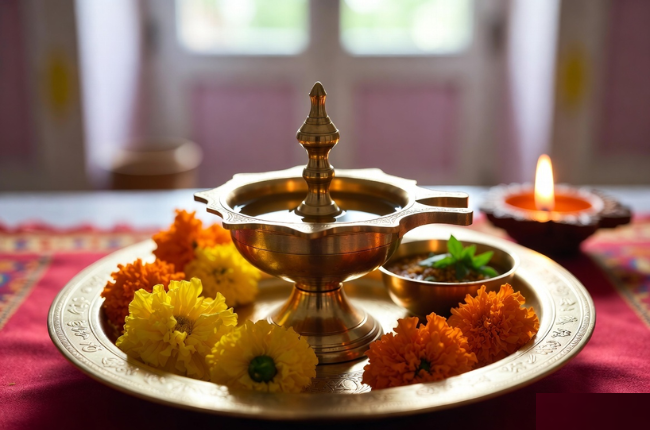
- Gather all Samagri the morning of the Pooja. Required items: Panchamrit ingredients (milk, curd, honey, ghee, sugar), tulsi leaves, yellow flowers (marigold preferred), roli, akshat (unbroken raw rice), a brass or copper Kalash, coconut, banana leaves, a Shaligram or Lord Vishnu idol, incense sticks, camphor, a diya with ghee or sesame oil, and wheat flour for the Prasad (Sheera).
- Prepare the Kalash correctly. Fill the brass Kalash with clean water. Place mango leaves around the rim in a fan arrangement. Set a coconut on top. Mark the Kalash with roli. This Kalash represents Lord Vishnu's presence as witness to the Sankalpa.
- Recite the Sankalpa before anything else. The Sankalpa must name: your own name, your father's name, your Gotra, today's Tithi and Nakshatra, the place of performance, and the specific intention of the Pooja (prosperity, a new home, a child's wellbeing, or gratitude). Without the Sankalpa, the Pooja has no named recipient.
- Perform the Panchamrit Abhishek. Pour milk, curd, honey, ghee, and sugar over the Shaligram or idol in sequence. Wipe gently with a soft cloth after each pouring. Do not use plastic spoons — use a copper or silver one.
- Listen to all five chapters of the Satyanarayan Katha without leaving the room. Every family member present must remain seated through the complete recitation. Phones and outside conversations must stop.
- Prepare the Sheera Prasad during the Katha. The wheat flour Prasad is cooked with ghee, sugar, and banana, and must not be tasted before offering it to the Lord. Offer the Prasad formally as part of the concluding Aarti.
- Perform the Aarti with all family members present. Pass the camphor flame clockwise in front of the deity. Every person present must hold the aarti plate at least once.
- Distribute the Prasad to every person present before anyone leaves. No one may leave the Pooja space before receiving Prasad. This is the most commonly violated rule in the entire ritual.
The Most Common Satyanarayan Pooja Mistakes That Break the Ritual
Most Satyanarayan Pooja mistakes do not happen out of carelessness. They happen because nobody explained the reason behind each rule. When a family understands why a rule exists, they follow it naturally.
Skipping or Rushing the Sankalpa
The Sankalpa is not a formality. The Skanda Purana's treatment of the Satyanarayan Vrat makes clear that the ritual's benediction is directed at the named performer and their family. Without a properly recited Sankalpa — one that names the Gotra, the Tithi, and the specific intention — the Pooja becomes an unnamed offering with no directed recipient. Many families rush through this step or skip it entirely when a Pandit is not present, believing the Katha alone is sufficient.
Leaving the Katha Incomplete or Interrupted
The five chapters of the Satyanarayan Katha narrate specific devotees who received blessings and others who faced difficulties when they left before the Katha was complete or ignored the Prasad. The Skanda Purana uses these narratives not as moral fables but as ritual instructions embedded in story form. Leaving the room during the Katha, answering phone calls, or allowing children to run in and out during recitation breaks the shravan — the dedicated listening that is itself a ritual act.
Using Incorrect or Substitute Panchamrit Ingredients
Panchamrit must be prepared with five specific substances: cow's milk, cow's curd, pure honey, pure cow ghee, and sugar — in that sequence. Substituting buffalo milk for cow's milk, using processed honey, or skipping ghee and replacing it with refined oil changes the ritual's offering entirely. As many practitioners note, the Panchamrit is not simply a cleansing liquid — each ingredient corresponds to a classical element whose presence in the offering is part of the ritual's designed structure.
Tasting the Prasad Before Offering
The Sheera — wheat flour Prasad cooked in ghee with sugar and banana — must reach the Lord as the first recipient. Tasting the Prasad during cooking to check sweetness is the single most commonly committed mistake in home Satyanarayan Poojas. The Prasad, once tasted by the cook, is technically no longer an unbroken offering. Experienced families assign one person to cooking who does not taste, and a separate person confirms the readiness by smell alone.
Distributing Prasad After Guests Have Left
The Skanda Purana's Katha directly narrates the story of Sadhu the merchant whose family faced difficulty because Prasad was refused or not distributed while all guests were still present. Prasad must be placed in the hands of every person present before anyone leaves the Pooja space. Wrapping Prasad in a leaf or packet for people to "take home later" does not fulfil this requirement.
📿 Pandit's Tip — Focus: ShraddhaAs many families discover when they sit with their Pandit before the Pooja, the mental state of the household during the Katha is itself part of the ritual. The Skanda Purana's instruction to listen with full attention — manasa, vacha, karmana — means with the mind, the voice, and action together. When family members are present in body but distracted in mind, the shravan is incomplete even if everyone is physically seated. A few minutes of quiet before the Katha begins, with phones placed outside the room, changes the quality of the entire Pooja. This is not a custom — it is a classical instruction.
Full Benefits of Satyanarayan Pooja When Performed Correctly
Satyanarayan Pooja, when performed with full Vidhi, confers benefits across four dimensions of household life. These are documented across multiple chapters of the Skanda Purana's Reva Khanda and are consistently reported across families who maintain the Vrat regularly.
Financial and Material Blessings
The Katha directly narrates the stories of Sadhu the merchant and the poor Brahmin — both of whom performed the Pooja in times of material difficulty and received specific relief. The mechanism here is not magical wish-granting. The Pooja activates a state of dharmic alignment in the household — a clarity of intention and a settlement of karmic accounts that allows material progress to flow more freely. As astrological and ritual tradition holds, individual outcomes vary with karma and sincerity.
Relief from Prolonged Delays and Obstacles
Families traditionally perform Satyanarayan Pooja when a specific goal has been pending too long — a job search, a property registration, a business launch, or a marriage negotiation. The Pooja is prescribed specifically for sankat mochana — the removal of obstacles — in Vaishnava householder tradition.
Strengthening of Family Harmony
The Pooja is performed with all family members present by design. The collective Sankalpa, the shared Katha listening, and the simultaneous Prasad receiving are structured to reinforce family bonds at the ritual level. Families who perform this Pooja annually, particularly on Purnima, consistently note improvement in household communication and reduced conflict in the months following.
Fulfilment of a Specific Vow or Mannat
When a family has taken a Mannat — a vow to perform Satyanarayan Pooja if a specific wish is granted — the performance of that Pooja is not optional once the wish is fulfilled. The Skanda Purana narrates a king who delayed his promised Pooja and faced reversal of his blessings. The fulfilment Pooja must be performed within the agreed time and with greater care than the original request Pooja.
What the Skanda Purana Actually Says — The Classical Authority on This Ritual
The Satyanarayan Katha is housed in the Reva Khanda of the Skanda Purana, one of the eighteen Mahapuranas. The Reva Khanda addresses a wide range of householder rituals specific to the banks of the Narmada river tradition, but the Satyanarayan Vrat is presented as universally applicable — it does not require a specific location, season, or caste classification for its performance.
The Skanda Purana's framing of this Pooja is notable for what it does not say. It does not prescribe an elaborate priestly performance that a household cannot manage independently. The Katha itself narrates a poor Brahmin who performed the ritual with minimal materials and received the same blessing as a merchant who arranged a full ceremony. The classical text's emphasis is on sincerity of bhav — the heartfelt feeling behind the offering — not on the scale of expenditure.
The five chapters of the Katha each carry a distinct message:
- Chapter One — The Pooja's origin and Lord Vishnu's description of its method to Narada
- Chapter Two — The poor Brahmin who performed it and his family's relief
- Chapter Three — Sadhu the merchant's Pooja, his departure without fulfilling his Mannat, and the consequences
- Chapter Four — The merchant's daughter's wedding and the reversal of blessings when Prasad was refused
- Chapter Five — The wood-cutter who performed the Pooja sincerely and received complete liberation of debt
Each chapter functions as both a story and a ritual instruction. A Pandit familiar with the Reva Khanda tradition will read each chapter with awareness of its embedded ritual direction — not merely as a narrative to recite aloud.
📖 Did You KnowThe Satyanarayan Katha is one of the very few Puranic rituals where the Lord's blessing is described as being available to any householder regardless of their family's ritual status or accumulated karma. The Skanda Purana explicitly frames this Vrat as a democratised form of Vishnu worship — Lord Vishnu tells Narada that He grants this Pooja's blessing to any sincere performer because the world in the current age (Kaliyuga) needs a ritual that does not require the elaborate resources demanded by older Yajnas. This is a significant classical statement about the Pooja's design — it was intended from the beginning to be accessible to ordinary families.
What Happens When Satyanarayan Pooja Is Done Incorrectly — The Failure Case
Many families carry a quiet anxiety after a Pooja that felt incomplete — they are not sure what went wrong, or whether to repeat it. This is worth addressing plainly.
The Skanda Purana's Katha narratives describe two types of consequence when the Pooja is not completed correctly:
- Reversal of a granted wish — this occurs specifically when a Mannat Pooja is delayed or the Prasad is refused. The Katha is explicit that the Lord's granted blessing can be temporarily withdrawn until the unfulfilled promise is honoured.
- Absence of expected benefit — this occurs when the Pooja is performed without the Sankalpa, without the complete Katha, or with incorrect Samagri. The ritual was performed, but its mechanism was not fully engaged. This is different from a divine punishment — it is more like a machine that was assembled with a missing part.
The correct response in both cases is the same: perform the Pooja again, this time with all elements in place and a Pandit present to ensure the Sankalpa is correctly recited. Families who have performed the Pooja multiple times without the expected result will almost always find, on careful review, that one of the three pillars — Sankalpa, Panchamrit, or Katha Shravan — was compromised.
As astrological tradition holds, some karma runs deeper than a single remedy cycle. When a Pooja is performed correctly and the desired outcome still does not arrive in the expected timeframe, the next step is a Kundali review to assess whether a planetary period is creating a structural delay — and whether a different Dosha remedy is required alongside the Pooja.
A career astrology reading or a Vimshottari Dasha analysis can help identify whether a planetary blockage is compounding the situation that the Satyanarayan Pooja alone cannot address.
The Question No Article Answers: Can Satyanarayan Pooja Be Performed Without a Pandit?
One question that appears repeatedly in Quora threads and Reddit's r/hinduism community is whether a family can perform Satyanarayan Pooja entirely without a Pandit — and whether the results differ. No published article addresses this plainly.
The Skanda Purana does not require a Pandit's presence. The Katha itself narrates multiple instances of householders performing the ritual independently — the poor Brahmin in Chapter Two performs it without any mention of a priest. The classical text's framework is clear: what is required is the correct sequence, the correct Samagri, and the correct Sankalpa.
However, the Sankalpa is where most families encounter difficulty without guidance. The Sankalpa must correctly name the Gotra (ancestral lineage), the current Tithi (lunar date from the Panchanga), the current Nakshatra, and the specific intention. A Sankalpa with incorrect details does not invalidate the Pooja — but it weakens the directed nature of the ritual. The Lord receives the offering, but the named family's connection to it is less precise.
For families performing the Pooja independently, the practical recommendation from classical tradition is this: prepare the Sankalpa text in advance with accurate Panchanga details, recite it three times at the start of the ritual, and perform the complete five-chapter Katha without abbreviation. The Pooja performed this way, with care and full sequence, carries classical validity.
The Question Families Carry but Never Find Answered: What If the Same Pooja Needs to Be Done Twice?
Another question that appears in community discussions but has no published answer: what happens when a family performs Satyanarayan Pooja correctly, receives the benefit, and then faces the same problem again some months later? Do they perform the Pooja again, or does a repeated performance carry less weight?
The Skanda Purana does not set a limit on the number of times the Pooja may be performed. Several of the Katha's narratives involve families who perform the Pooja repeatedly — on every Purnima, every Ekadashi, or every time a significant family event occurs. The Pooja was designed by the classical tradition as a recurring Vrat, not a one-time remedy.
Families who maintain a regular Satyanarayan Pooja cycle — typically monthly on Purnima — consistently report that each performance feels cumulatively effective. This is consistent with the Vrat framework in classical Vedic practice, where the regularity of the ritual builds a sustained relationship of bhakti (devotion) with the Lord. A single Pooja addresses a specific problem. A regular Pooja builds the household's overall dharmic resilience. Both are valid — they serve different purposes.
FAQ
What is the right time to perform Satyanarayan Pooja at home? Satyanarayan Pooja is traditionally performed on Purnima, Ekadashi, or any Thursday. Morning hours after sunrise are most auspicious, though early evening before sunset is also permitted. The Panchanga Tithi and Nakshatra of the chosen day should be checked before fixing the date for best alignment.
How do I reduce the effects of a wrong Pooja on my family? Perform the Satyanarayan Pooja again with a correctly recited Sankalpa, complete five-chapter Katha, and proper Prasad distribution. Classical Vedic practice holds that a sincere second performance with corrected elements restores the ritual's full benefit for those who approach it with genuine intention and preparation.
Can Satyanarayan Pooja be done without a Pandit? Satyanarayan Pooja can be performed without a Pandit if the family correctly prepares the Sankalpa with accurate Panchanga details — Tithi, Nakshatra, and Gotra — recites the complete five-chapter Katha without interruption, and distributes Prasad to all present before anyone leaves. As classical tradition holds, individual outcomes vary with the sincerity of the preparation.
What happens if Prasad is not distributed to everyone at the Pooja? The Skanda Purana's Katha specifically narrates families who faced reversal of their blessings when Prasad was not distributed while all guests were still present. Prasad must be placed physically in the hands of every person in the Pooja space before the gathering ends. Sending Prasad home with departing guests does not fulfil this classical requirement.
What Samagri is most commonly forgotten in Satyanarayan Pooja? The most frequently forgotten items are unbroken raw rice (akshat), pure cow ghee for Panchamrit, mango leaves for the Kalash rim, banana for the Sheera Prasad, and a copper or silver spoon for the Abhishek. Preparing a full Samagri list three days before the Pooja prevents last-minute shortages that force substitutions.
What is the full meaning of Satyanarayan Vrat for household life? Satyanarayan Vrat is a Vaishnava householder ritual from the Skanda Purana that honours Lord Vishnu as the Lord of Truth. Its purpose is the resolution of karmic obstacles in material, professional, and family life through sincere collective worship, correct ritual sequence, and the shared receiving of Prasad by the entire household.
Which planetary period makes Satyanarayan Pooja most recommended? Satyanarayan Pooja is especially recommended during periods of Jupiter and Moon Mahadasha or Antardasha, when Vishnu's connection to the chart is most receptive. It is also traditionally performed during Venus Dasha for matters of marriage and family. As astrological tradition holds, individual outcomes vary with karma and sincerity, and a Kundali reading alongside the Pooja gives the most complete picture.
Conclusion
Satyanarayan Pooja embodies one of the deepest principles of the Vaishnava householder path: that the Lord of Truth receives the offering not by its scale, but by the truth of the intention behind it. The Skanda Purana's Katha does not celebrate elaborate ceremonies — it celebrates ordinary families who performed the ritual correctly and with full heart.
The most useful thing a family can do today is check three things before their next Satyanarayan Pooja: whether their Sankalpa text is prepared with accurate Panchanga details, whether all five Panchamrit ingredients are sourced correctly, and whether everyone who will attend has committed to remain through the complete Katha and Prasad distribution.
Classical Vedic practice holds that the ritual's full benefit reaches the household when karma and sincerity align — not on ritual scale alone. Begin with correctness, sustain with regularity, and the Lord of Truth responds in His own time and way.
If your family is planning a Satyanarayan Pooja and wants the Sankalpa, Katha, and Prasad performed with complete classical accuracy, connect with AtoZPandit.com for an experienced Vaishnava Pandit who follows the full Skanda Purana Vidhi. Book your Satyanarayan Pooja at AtoZPandit.com — where every ritual is performed with the precision and care your family deserves.
Disclaimer: This article is published for educational and cultural awareness purposes only. The ritual guidance provided reflects classical Vedic textual tradition and is not a substitute for personalised advice from a qualified Pandit. For medical concerns, please consult a certified healthcare professional. For personalised Pooja guidance, connect with AtoZPandit.com.