Mantra Power and Sound Frequencies Vedic Science of Mind Body Healing
There are people who have chanted the same mantra every morning for years and felt something shift — not dramatically, not overnight, but steadily, the way a river reshapes stone. The anxiety that used to arrive with the alarm began arriving a little later, then less loudly, then sometimes not at all. The mind that used to scatter across a hundred thoughts before breakfast started finding a centre. And when they tried to explain what had changed to someone who had not experienced it, the words did not quite arrive. It felt too quiet to describe and too real to dismiss.
What the Vedic tradition calls Mantra Shakti — the power inherent in sacred sound — is among the most precisely documented and least casually understood subjects in classical Indian knowledge. The Rigveda, the oldest surviving text of human civilisation, opens with a mantra. The Mandukya Upanishad devotes its entire teaching to the analysis of a single syllable — Om. The Mantra Shastra tradition, preserved across the Agama texts and the Tantra lineages of both Shaiva and Vaishnava schools, treats mantra not as a spiritual affirmation or a relaxation technique but as a precise technology of sound — one in which specific phonetic sequences produce specific effects on the practitioner's body, nervous system, and field of awareness.
What most guides on this subject miss entirely is the distinction between mantra as a linguistic meaning-carrier and mantra as a sound-body — and why that distinction changes everything about how the practice works and what it requires. This guide covers the classical science of sound in the Vedic framework, what each major mantra does in the body and mind, how to chant correctly for maximum benefit, the specific physiological effects documented by Ayurveda and the Nada Brahma tradition, and two questions that real practitioners ask that published content has never answered with genuine classical grounding. By the end, you will understand mantra power not as belief but as a systematic practice with a precise internal logic.
What Mantra Actually Is — The Classical Definition Most People Never Hear
The word mantra is itself a compound: manas (mind) and trana (liberation or protection). The literal meaning is that which liberates the mind — or that which protects the mind from its own tendencies toward agitation and distraction. This etymology, preserved in the Mantra Shastra tradition, immediately establishes that mantra is not primarily about the meaning of the words being chanted. It is about what the sound does to the mind that produces it.
Mantra as Shabda — Sacred Sound Beyond Meaning
Classical Sanskrit philosophy distinguishes four levels of Shabda — sacred sound — through which a mantra operates:
- Para — the unmanifest level of sound, beyond human hearing, existing as pure vibration in the field of consciousness. This is the level at which the Vedic seers (Rishis) are said to have heard the mantras — not composed them.
- Pashyanti — the level at which sound becomes vision — the point where the vibration acquires form and direction in the practitioner's awareness. Experienced meditators describe this as the moment a mantra begins to feel like it is chanting itself.
- Madhyama — the intermediate level, where sound becomes organised thought and internal speech. Most mantra practice operates at this level — the mantra is heard internally even when the lips are still.
- Vaikhari — the manifest level of audible, spoken sound. Beginners and most daily practitioners work primarily at this level — the sound is produced by the vocal apparatus and received by the ears.
The Mantra Shastra tradition teaches that effective practice moves inward through these four levels over time — beginning at Vaikhari (audible chanting), settling into Madhyama (internal repetition), and eventually touching the deeper Pashyanti and Para levels where the sound's full transformative power operates. Understanding this framework explains why experienced practitioners chant differently from beginners — and why simply mouthing the words without internal engagement produces far less than the practice's full capacity.
How to Chant Mantras Correctly — Step-by-Step for Full Benefit
Most people who begin mantra practice receive the mantra but not the method. The method is where the practice either works or stays decorative. Here is the classical sequence prescribed across the Agama and Mantra Shastra traditions.
- Choose one mantra and hold it for a minimum of forty days. The classical prescription for mantra Anushthana (sustained practice) is a minimum of forty consecutive days without interruption. Switching mantras before a cycle is complete disperses the accumulated vibrational effect. Choose one mantra aligned to your intention — healing, clarity, devotion, or protection — and commit to it fully before evaluating results.
- Fix the time and the seat. Chant at the same time each day, in the same physical location if possible. The Mantra Shastra tradition holds that a consecrated seat (Asana) accumulates vibrational memory over repeated sessions — the practitioner enters a more receptive state faster because the place itself carries the practice's imprint. Use a wool or cotton mat. Avoid plastic seating.
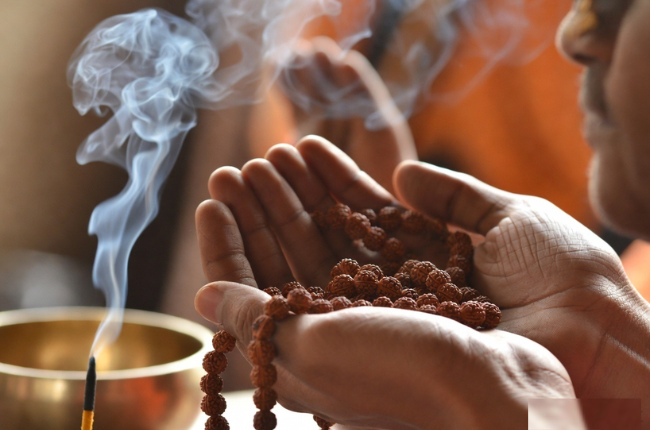
- Set the count with a Rudraksha or Tulsi mala. A standard mala carries 108 beads — one full rotation equals 108 repetitions. Classical prescription for daily Japa (repetition) is a minimum of one mala (108 repetitions). For healing intentions, three malas daily is the standard prescription in the Tantra traditions. Use the thumb and middle finger to move the beads — the index finger is not used in traditional Japa because it is associated with the ego principle.
- Begin with three deep breaths and one minute of silence. Do not begin chanting immediately after sitting down. Allow the nervous system to settle from whatever activity preceded the practice. Three slow, complete breaths — inhaling fully, exhaling completely — shift the body out of sympathetic activation and into the parasympathetic state where mantra practice produces its deepest effects.
- Chant aloud for the first mala, in a whisper for the second, silently for the third. This progression — from Vaikhari to Madhyama — is the classical method for moving the practice inward. Audible chanting establishes the sound in the body. Whispered chanting internalises it. Silent repetition consolidates it in the field of awareness.
- Maintain consistent rhythm and pronunciation. Rhythm (Laya) and correct pronunciation (Shuddha Uccharana) are non-negotiable in classical Mantra Shastra. A mantra chanted with incorrect stress patterns or elongated syllables in the wrong place produces a different vibrational pattern from the one prescribed. Ask a qualified teacher for the correct pronunciation before beginning a new mantra practice.
- Close with three minutes of silence after the final repetition. Do not stand up immediately after completing the mala. Sit in stillness and allow the vibrational field established by the chanting to settle into the body and mind. This post-chanting silence is described in the Agama tradition as the period in which the mantra's effect is most deeply absorbed.
The Science of Nada Brahma — Sound as the Foundation of Reality
The classical Vedic framework for understanding mantra power begins with Nada Brahma — the principle that the universe itself is sound, and that all manifest reality is a particular condensation of vibration. This is not a metaphor in the classical texts — it is the cosmological foundation from which mantra science draws its logic.
The Mandukya Upanishad and the Primacy of Om
The Mandukya Upanishad — one of the most concentrated philosophical texts in the Upanishadic tradition — opens with a direct statement: Om iti etat sarvam — Om is all of this. The text proceeds to analyse the syllable Om as containing within its three component sounds — A, U, M — the three states of consciousness (waking, dreaming, deep sleep) and the fourth state (Turiya) that underlies and witnesses all three.
The classical analysis of Om's physiological effect is precise: the A sound resonates primarily in the chest cavity, activating the cardiac and pulmonary region. The U sound moves the resonance upward through the throat and into the cranial cavity. The M sound — the closing nasal resonance — produces a sustained vibration in the skull and sinuses that the Nada Shastra tradition describes as stimulating the Ajna Chakra (the centre of intuition and higher cognitive function located between the eyebrows).
How Sound Becomes Medicine — The Nada Chikitsa Tradition
Nada Chikitsa — sound healing — is a recognised branch of classical Ayurveda documented in the Charaka Samhita and elaborated in the Sangita Ratnakara by Sharngadeva, the thirteenth-century treatise on Indian classical music and its medicinal applications. The Sangita Ratnakara documents specific Ragas (melodic frameworks) and their effects on the body's Dosha balance — a framework that directly parallels the Mantra Shastra tradition's mapping of specific mantras to specific physiological and psychological conditions.
The foundational principle is consistent across both traditions: sustained, correctly produced vocal sound creates sympathetic resonance in the body's tissues, fluids, and nervous system. The body is approximately sixty percent water by composition. Sound waves propagate through water with particular efficiency — and sustained mantra chanting creates a vibrational field within the body's fluid systems that the classical texts describe as Shodhana — purification or clearing of the channels.
The Major Mantras and What Each One Does
Different mantras produce different effects — not arbitrarily, but because their specific phonetic structure creates specific vibrational patterns. Here is what the classical Mantra Shastra tradition documents for the most widely practised mantras.
Om — The Primordial Sound
Om is the Pranava — the original vibration from which all other mantras are said to derive. It is prescribed across virtually every Hindu, Buddhist, and Jain tradition as the foundational mantra. Its primary effects, as documented across the Mandukya Upanishad and the Yoga Sutras of Patanjali, include the settling of scattered mental activity, the reduction of what Patanjali calls Vikshepa (mental disturbance), and the gradual deepening of the meditator's access to silence between thoughts.
Gayatri Mantra — The Solar Invocation
The Gayatri Mantra — drawn from the Rigveda's third Mandala — is addressed to Savitri, the solar deity, and specifically invokes the illuminating power of the sun to activate and clarify the practitioner's own intelligence (dhi). The mantra's twenty-four syllables are mapped in the Mantra Shastra tradition to the twenty-four vertebrae of the human spine — a structural correspondence that the tradition holds produces a full-body vibrational activation when the mantra is chanted with correct metre. Prescribed benefits include clarity of intellect, protection from negative influence, and the gradual purification of the Antahkarana — the inner instrument of mind, ego, and discriminative intelligence.
Maha Mrityunjaya Mantra — The Conqueror of Death
The Maha Mrityunjaya Mantra from the Rigveda and Yajurveda — addressed to Tryambaka, the three-eyed aspect of Shiva — is the classical mantra prescribed for health restoration, protection from untimely death, and recovery from serious illness. The Shiva Purana documents its prescription specifically for conditions where the body's vital force (Prana) is depleted. Its thirty-three syllables are said to activate all thirty-three classical nerve points (Marma) of the body when chanted with correct resonance — a claim that the Shalya Tantra (surgical) branch of Ayurveda supports in its documentation of Marma points as energy convergence locations.
Om Namah Shivaya — The Panchakshara
Om Namah Shivaya — the five-syllable (Panchakshara) mantra of Shiva — is among the most widely chanted mantras in the Indian subcontinent. The Shiva Purana and the Namah Shivaya Stava tradition map its five core syllables (Na, Ma, Shi, Va, Ya) to the five classical elements (Pancha Bhuta): earth, water, fire, air, and space. Chanting this mantra is described as bringing the practitioner's elemental composition into balance — with documented effects on grounding, emotional stability, and the reduction of Vata-driven anxiety.
Om Namo Narayanaya — The Ashtakshara
The eight-syllable (Ashtakshara) Vaishnava mantra is the foundational mantra of the Sri Vaishnava tradition, documented in the Pancharatra Agama texts. Its primary documented effect is the cultivation of Bhakti — devotional love — alongside the progressive dissolution of Ahankara (ego-identification). The tradition prescribes it specifically for practitioners whose primary challenge is pride, rigidity, or difficulty surrendering personal control — conditions mapped in Ayurveda to excess Pitta in the Manovaha Srotas (mental channels).
Pandit's Tip — Focus: BhaktiAs many practitioners discover after six months of consistent Japa — the mantra begins doing something they did not expect. It starts appearing in the mind without being called. While washing dishes, while waiting for a train, while lying half-awake before sleep. This is what the Mantra Shastra tradition calls Ajapa Japa — the mantra that chants itself. It is not a sign that the practice has become mechanical. It is the sign that the mantra has moved from the Vaikhari level into the Madhyama level — from deliberate production into natural presence. A Pandit familiar with the tradition will tell you: when the mantra finds you without effort, the real practice has begun.
What the Classical Texts Say About Incorrect Mantra Practice
One of the most genuinely important — and most consistently avoided — topics in mantra literature is what happens when the practice is done incorrectly. The classical Mantra Shastra tradition is not cautious about naming this.
The Three Classical Errors
The Mantra Shastra tradition identifies three categories of error that reduce or distort the mantra's effect:
- Bija mispronunciation — The seed syllables (Bija Aksharas) embedded in many mantras — Hreem, Shreem, Kleem, Aim, Kreem — carry specific vibrational properties that depend on precise pronunciation. A mispronounced Bija is described in the Tantra Shastra tradition as producing a distorted vibrational pattern — not harmful in the acute sense, but ineffective in its intended direction. This is why the classical tradition requires initiation (Diksha) from a qualified teacher for Bija mantra practice — the teacher transmits not just the syllables but the correct sonic form.
- Irregular practice — The Mantra Shastra tradition is explicit that a practice held for forty consecutive days and then abandoned produces less benefit than one held modestly but without interruption. The Sanskrit term is Nishtha — steadiness of practice. Erratic chanting — three days of intense practice followed by a week of nothing — does not accumulate the sustained vibrational imprint that the tradition documents as the mechanism of mantra's deeper effects.
- Chanting without Bhavana — Bhavana is the inner feeling-state or intention held during chanting. The Tantra tradition distinguishes sharply between Shabda (the sound) and Artha (the meaning and intention behind the sound). Chanting the syllables without any internal orientation toward the mantra's purpose — healing, devotion, clarity, protection — produces the Vaikhari level effect only. The deeper levels require that the practitioner holds the mantra's Artha alongside its Shabda.
The Failure Case — What Happens When Mantra Practice Stops Working
Many sincere practitioners reach a point where the mantra that once produced a clear calming effect seems to have lost its power. The mind wanders just as much. The sitting feels mechanical. Nothing shifts. This experience — which the classical tradition anticipated and named — is called Mantra Shunyata in some Tantric lineages: the apparent emptiness or flatness of a practice that has reached a plateau.
The classical diagnosis distinguishes between two causes. The first is accumulation fatigue — the practitioner has been working at the Vaikhari level for so long that the audible chanting has become purely habitual, without internal engagement. The remedy is to drop to silence — to shift the entire practice to internal Japa for a period of seven to fourteen days. The second cause is Dosha accumulation blocking the Manovaha Srotas — the classical Ayurvedic understanding that excess Ama (metabolic waste) in the body's channels reduces the nervous system's receptivity to subtle vibrational input. The remedy here is Ayurvedic — a dietary simplification and, where appropriate, a Panchakarma consultation — before resuming the mantra practice.
What Almost No Article Covers: How Mantra Practice Interacts With Your Kundli's Planetary Configuration
This question surfaces consistently in Jyotish communities on Reddit and Quora — and receives no structured answer anywhere in published content. If a person has a weak or afflicted Mercury in their natal chart, does Gayatri Mantra practice — which invokes the solar intelligence — help or conflict? If Saturn is placed in the fifth house of mantra and spiritual practice, does that indicate a person for whom mantra practice will always feel difficult?
Classical Jyotish addresses the relationship between planetary configurations and mantra receptivity through the concept of Ishta Devata — the personal deity most aligned with the individual's soul's evolutionary direction in this lifetime. The Brihat Parashara Hora Shastra prescribes a method for identifying the Ishta Devata from the natal chart — specifically through the twelfth lord from the Atmakaraka planet (the planet at the highest degree in the chart). The Ishta Devata's associated mantra is the one the classical tradition considers most powerfully aligned with the individual's specific karmic field.
The practical implication is significant: not every mantra works equally for every person. A mantra powerfully effective for one practitioner may feel inert for another — not because of lack of sincerity, but because the planetary configuration creates a natural resonance with specific divine frequencies and a natural distance from others. A person with a strong Jupiter and a Sagittarius Lagna typically responds deeply to Guru mantras and Vishnu mantras. A person with a prominent Mars and an Aries Lagna often finds Hanuman mantras and protective Shiva mantras produce the fastest results.
The Graha-specific mantra prescriptions documented in the Navagraha Stotra tradition provide a starting framework — each planet has its associated deity, seed syllable, and mantra sequence that the classical tradition considers most effective for strengthening or pacifying that planetary influence in the natal chart. A Jyotishi reading the full chart can identify not just which mantra to practise but the correct number of repetitions, the ideal day and time for the practice, and the specific Bhavana (intention) to hold during chanting — all calibrated to the individual's planetary configuration.
One Question Real Practitioners Ask That No Article Answers: Can Mantra Practice Override a Difficult Planetary Period?
This question — phrased in dozens of ways across community platforms — carries the deepest emotional weight of any mantra-related topic. A person in Saturn Mahadasha or Rahu Antardasha, facing genuine professional or personal difficulty, wants to know: if I chant consistently and sincerely, will the mantra change what the planets are producing?
The classical answer requires holding two things simultaneously — and most content collapses one to elevate the other.
The Brihat Parashara Hora Shastra is direct: planetary periods (Dasha and Antardasha) produce effects according to the karma carried in the natal chart. A Saturn Mahadasha for a person whose natal Saturn is debilitated and afflicting the seventh house will produce the kinds of relational and professional challenge that the chart indicates — regardless of any remedial practice. This is the Vedic doctrine of Karma Phala — the fruit of past action ripens in its time, and no practice prevents the ripening.
What mantra practice does during a difficult planetary period, the classical tradition holds, operates on a different mechanism entirely. The Mantra Shastra texts describe it as building Chitta Shuddhi — the purification of the mental and emotional field — which determines the quality of experience within the period's events, even when it cannot alter the events themselves. A person in Saturn Mahadasha who holds a consistent Shani mantra practice and a Maha Mrityunjaya Japa does not escape Saturn's testing. What changes is their internal relationship to the test — the steadiness with which they carry it, the quality of the decisions they make within it, and the degree to which the difficulty produces genuine growth rather than mere suffering.
The second mechanism is Karma Laghu — the lightening of karmic intensity. Several classical sources, including the Skanda Purana and the commentary traditions on the Navagraha Stotra, hold that sustained, sincere mantra practice directed at the afflicting planet can reduce the intensity of the period's effects — not eliminate them, but shift them from acute to manageable. Personal results, as always, depend on individual karma, the quality of practice, and divine grace.
FAQ
What is mantra power and how does it work on the mind and body? Mantra power operates through sustained vocal and mental vibration that creates sympathetic resonance in the body's tissues, nervous system, and fluid systems. The Mantra Shastra tradition documents specific phonetic sequences producing specific physiological effects — from nervous system regulation to cognitive clarity. The Nada Brahma framework treats sound as the foundational substance of reality, making mantra a direct engagement with that substrate.
Which mantra is most powerful for healing the body? The Maha Mrityunjaya Mantra from the Rigveda and Yajurveda is the classical prescription for health restoration and recovery from serious illness. The Shiva Purana documents its specific application for depleted vital force. For daily maintenance of health and stress reduction, Om Namah Shivaya is prescribed across Shaiva traditions for its elemental-balancing effect on the body's Pancha Bhuta composition.
How long does it take for mantra chanting to show results? Classical Mantra Shastra prescribes a minimum forty-day Anushthana — uninterrupted daily practice — before evaluating results. Most sincere practitioners report a shift in the quality of morning mental clarity within the first two weeks. Deeper physiological and emotional effects typically emerge between thirty and ninety days of consistent practice. As astrological tradition holds, individual outcomes vary with karma and sincerity.
How do I reduce anxiety and stress using mantra chanting at home? Begin with Om chanting — three to five minutes of slow, sustained Om repetition immediately after waking. The nasal resonance of the closing M sound directly activates the parasympathetic nervous system through vagal stimulation. Follow with twenty-one repetitions of Om Namah Shivaya, focusing the awareness on the sound rather than the meaning. Hold this practice for fourteen consecutive days before assessing its effect on your anxiety baseline.
What is the difference between mantra Japa and mantra meditation? Mantra Japa is the repetitive recitation of a mantra — counted on a mala — with the primary purpose of accumulating the mantra's vibrational imprint in the practitioner's field. Mantra meditation uses a single mantra as the object of sustained attention, without counting repetitions, allowing the mind to settle around the sound. The classical tradition prescribes Japa for building Mantra Shakti and meditation for deepening its absorption. Both are necessary for the full practice.
Can children and elderly people chant mantras safely? Classical Ayurveda and Mantra Shastra prescribe mantra practice as universally safe across all ages — with one qualification for the elderly and those with respiratory conditions: the audible chanting level should be adjusted to the person's breath capacity. Internal Japa (silent repetition) carries no respiratory demand and is prescribed specifically for those for whom audible chanting is physically taxing. Children benefit particularly from Gayatri Mantra, which the Dharmashastra tradition prescribes as the foundational practice for students.
What does the Veda say about the source of mantra power? The Vedic tradition holds that mantras were not composed by human authors — they were heard (shruti) by the Rishis in states of deep meditation and transmitted as received. The Rigveda's opening Mandala attributes the mantras to the Drishta — the seer — rather than the Karta — the maker. This distinction is foundational: mantra power does not originate in human creativity. It exists as a property of the sound itself, which the Rishi accessed and transmitted. The practitioner who chants enters the same vibrational stream the Rishi first heard.
Conclusion
Mantra practice is the oldest technology of inner transformation that Indian civilisation preserved — and it has survived not because it is beautiful to listen to, but because it works in the body and mind in ways that sincere practitioners across three thousand years have consistently documented.
Start today with one mantra, one mala, and one consistent time. Choose the mantra that aligns with your immediate need — Om for stillness, Gayatri for clarity, Maha Mrityunjaya for healing, Om Namah Shivaya for grounding. Hold it for forty days without evaluation, without switching, without expecting a dramatic transformation. The transformation the classical tradition promises is not dramatic — it is the steady, quiet reshaping of the mind's default relationship to itself.
As is commonly observed among families where even one member holds a consistent mantra practice — the quality of the household's inner atmosphere shifts before anyone has language to describe it. Classical Vedic tradition holds that the outcomes depend on karma, sincerity, and the willingness to stay with the sound long enough for it to become something more than a practice. That depth is available to every person who approaches it with genuine intention and proper guidance.
If you want personalised guidance on which mantra aligns with your Kundli's planetary configuration — including the correct pronunciation, daily count, and timing for your specific chart — AtoZPandit.com connects you with verified Jyotish and Mantra Shastra experts who provide a complete, classically grounded mantra prescription. Book your Mantra consultation on AtoZPandit.com and begin the practice with the full support of the classical tradition behind it.
Disclaimer This article is written for educational and cultural awareness purposes only. The Vedic and Mantra Shastra information provided here does not substitute professional medical or psychological advice. For a complete and personalised mantra or Kundli consultation, connect with a qualified expert at AtoZPandit.com.