
Number 108 in Vedic Science Why This Sacred Number Holds Cosmic Power
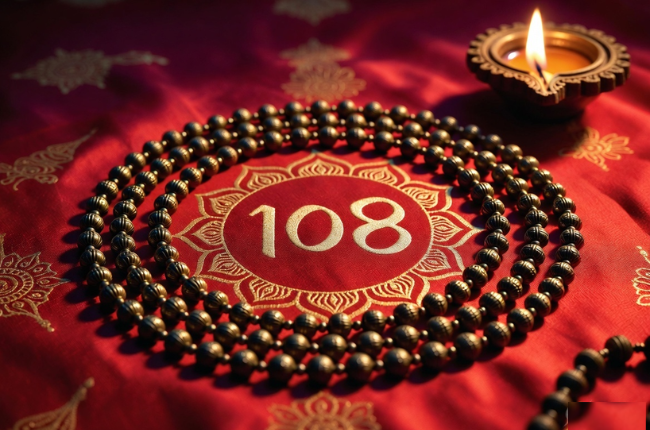
There is a number that appears everywhere in Indian sacred life and almost nobody has been told why. It is on the mala around the Pandit's wrist — 108 beads, always exactly 108. It is in the Upanishads — 108 of them, not 107 or 109. It is in the distance between the Earth and the Sun, between the Earth and the Moon, and in the diameter of the Sun itself — numbers that ancient Indian astronomers calculated with a precision that still holds when checked against modern measurements. It appears in temple architecture, in the names of Vishnu, in the steps of classical dance, and in the firing sequence of a Havan. The number is 108, and its presence across every domain of Vedic knowledge is not coincidence and not aesthetics. It is the fingerprint of a precise and unified cosmological understanding.
Most people who use a mala, chant a Mantra 108 times, or touch 108 diyas at a temple cannot explain why the number is 108 rather than 100 or 125. The explanation exists — it is precise, multi-layered, and deeply embedded in classical Vedic science — but it has never been assembled in one place for a general reader. That gap is what this article fills.
What no other article on this topic has brought together is the complete convergence proof — the demonstration that 108 is not sacred because a tradition declared it sacred, but because the same number emerges independently from Vedic mathematics, classical astronomy, Jyotish, Mantra Shastra, Yoga philosophy, Sanskrit linguistics, and temple architecture all at once. When the same number is produced by that many independent classical systems simultaneously, the convergence itself is the evidence. This guide presents every layer of that convergence in full — the mathematical, the astronomical, the astrological, the ritual, the architectural, and the philosophical — so that every reader who finishes it understands not just that 108 is sacred, but precisely why it could not have been any other number.
The Mathematical Foundation — Why 108 Is Not an Arbitrary Sacred Number
The sacredness of 108 in Vedic tradition begins not with ritual declaration but with mathematics. The number 108 carries a specific mathematical structure that the ancient Vedic tradition recognised as cosmologically significant — and that modern mathematics confirms as genuinely extraordinary.
Understanding this mathematical foundation is the essential first step, because it establishes that 108 is not a number chosen by priests for convenience. It is a number that the structure of mathematics itself produces when the right questions are asked.
The 1, 2, 3 Construction — The Most Elegant Mathematical Property of 108
The single most cited classical mathematical property of 108 is its construction from the first three counting numbers in a specific exponential arrangement:
108 = 1¹ × 2² × 3³ = 1 × 4 × 27 = 108
In the Vedic mathematical and philosophical tradition, this construction is not merely a numerical curiosity. The numbers 1, 2, and 3 carry specific cosmological meanings that run through the entire Vedic knowledge system:
- 1 represents Brahman — the undivided, absolute, singular source of all existence
- 2 represents Dvaita — duality, the primary creative division of the singular into the manifest world of pairs (light and dark, Purusha and Prakriti, Shiva and Shakti)
- 3 represents Trimurti — the three-fold cosmic function of creation (Brahma), preservation (Vishnu), and dissolution (Shiva); also the three Gunas (Sattva, Rajas, Tamas); also the three states of consciousness (waking, dreaming, deep sleep)
When these three cosmological principles — Singularity, Duality, and Trinity — are combined in the exponential form 1¹ × 2² × 3³, the result is 108. The Vedic tradition reads this as the mathematical proof that 108 is the number in which the three foundational principles of existence are encoded simultaneously. It is the number that holds the entire structure of the cosmos in its arithmetic.
Additional Mathematical Properties That Classical Texts Note
- 108 is a Harshad number — divisible by the sum of its own digits (1 + 0 + 8 = 9; and 108 ÷ 9 = 12 exactly). In the Vedic mathematical tradition, a number divisible by the sum of its digits was considered self-referential — a number that contains its own key.
- The digits of 108 sum to 9 — and 9 is the number of completion in the Vedic numerical system. The nine planets (Navagraha), the nine qualities (Nava Rasa), the nine geometrical forms of the Sri Yantra — 9 is the cosmic completion number, and 108 reduces to it.
- 108 divided by 2 is 54 — the number of letters in the Sanskrit alphabet (27 consonants and 27 vowels in the classical Devanagari counting, or 54 total phonemes in the broader Varna count used in different Sanskrit grammatical traditions). The Sanskrit alphabet is itself considered a sacred cosmological structure in the Tantra Shastra — each letter is a Bija (seed syllable) corresponding to a deity and a cosmic principle.
- 108 multiplied by 2 is 216 — and 216 is 6³, the cube of 6. In the Vedic architectural tradition, 216 appears as a significant measure in temple proportions. The relationship between 108 and 216 — one being the double of the other — is used in classical Vastu Shastra calculation systems.
As is commonly observed among scholars trained in both classical Sanskrit mathematics (Vedic Ganita) and Western number theory — the mathematical properties of 108 are not retrospectively assigned by tradition. They are intrinsic to the number's arithmetic structure. The Vedic tradition did not make 108 sacred. It recognised that 108 already was.
The Astronomical Convergence — How the Sun, Moon, and Earth Encode 108
The most striking single piece of evidence for the Vedic tradition's astronomical sophistication is the relationship between the number 108 and the three bodies at the centre of Vedic cosmology — the Sun, the Moon, and the Earth. This relationship was not discovered by modern astronomy first and then attributed to ancient tradition retroactively. The astronomical relationship of 108 is documented in classical Indian astronomical texts — the Surya Siddhanta being the primary reference — with a precision that reflects systematic observation and mathematical calculation over centuries.
The Sun-Earth-Moon Distance Relationship
Three astronomical facts — each independently verifiable with modern instruments — converge on the number 108:
Fact 1 — The Sun's diameter is approximately 108 times the Earth's diameter. The Sun's mean diameter is approximately 1,391,400 kilometres. The Earth's mean diameter is approximately 12,742 kilometres. The ratio: 1,391,400 ÷ 12,742 ≈ 109.2 — close to 108, with the small variation attributable to the fact that both bodies are not perfect spheres and their diameters vary slightly depending on the measurement axis used.
Fact 2 — The average distance from the Earth to the Sun is approximately 108 times the Sun's diameter. The mean Earth-Sun distance (one Astronomical Unit) is approximately 149,597,870 kilometres. The Sun's mean diameter is approximately 1,391,400 kilometres. The ratio: 149,597,870 ÷ 1,391,400 ≈ 107.5 — again, close to 108, with the variation explained by the elliptical nature of the Earth's orbit (the distance varies between perihelion and aphelion).
Fact 3 — The average distance from the Earth to the Moon is approximately 108 times the Moon's diameter. The mean Earth-Moon distance is approximately 384,400 kilometres. The Moon's mean diameter is approximately 3,474 kilometres. The ratio: 384,400 ÷ 3,474 ≈ 110.6 — again in the vicinity of 108, with variation attributable to the Moon's elliptical orbit.
What This Convergence Means
These three ratios — all independently close to 108 — are not engineered or forced. They are physical facts of the solar system's geometry. The Surya Siddhanta, the classical Sanskrit astronomical text whose current form is dated to approximately the fourth or fifth century CE but whose content tradition is considerably older, contains calculations of planetary distances and diameters that reflect this 108-ratio knowledge.
The classical Vedic interpretation of this astronomical convergence is precise: 108 is the number that connects the three primary cosmic bodies — the Sun (Surya, the source of light and life), the Moon (Chandra, the governor of mind and time), and the Earth (Bhumi, the field of experience) — in a single numerical relationship. A number that encodes the geometry of these three bodies is, in the Vedic cosmological framework, inherently sacred — it is the arithmetic of the observable cosmos itself.
This is why the Panchang — the Vedic almanac that tracks the Sun and Moon's movements — and the Vimshottari Dasha system that maps planetary periods across a life both draw from the same numerical framework that 108 anchors. The number is not decorative in Jyotish — it is structural.
108 in Jyotish — How the Sacred Number Structures Vedic Astrology
In Vedic astrology (Jyotish), 108 is not an incidental reference — it is a foundational structural number that appears in the architecture of the system itself. Understanding where and how 108 appears in the Jyotish framework reveals why the number is inseparable from the classical astrological tradition.
The 27 Nakshatras × 4 Padas = 108
The most direct appearance of 108 in Jyotish is the multiplication of the twenty-seven Nakshatras (lunar mansions) by the four Padas (quarters) within each Nakshatra:
27 Nakshatras × 4 Padas each = 108 Padas total
The 108 Padas are the finest division of the zodiac in the classical Vedic astrological system. Each Pada spans exactly three degrees and twenty minutes of arc. Together, the 108 Padas divide the complete 360-degree zodiac into equal units — creating a grid of 108 positions through which the Moon moves in its monthly cycle and through which every planet moves in its longer cycles.
This is the direct astronomical-astrological source of the 108-bead Japa Mala (prayer rosary). The mala's 108 beads represent the 108 Padas of the Nakshatra system — and a complete circuit of the mala in Mantra recitation symbolically traverses all 108 positions of the cosmic grid that the Moon's movement maps. A Mantra chanted 108 times is a Mantra addressed to every position of the lunar grid simultaneously — a complete cosmic address rather than a partial one.
The Navagraha Connection — 9 Planets × 12 Houses = 108
A second Jyotish derivation of 108:
9 Navagraha (planets) × 12 Bhavas (houses) = 108
The nine planets of the Vedic astrological system — Sun, Moon, Mars, Mercury, Jupiter, Venus, Saturn, Rahu, and Ketu — each move through all twelve houses of the birth chart. The total number of planet-house relationships in a complete Kundali reading: 9 × 12 = 108. Each of these 108 relationships has a specific classical interpretation in the Brihat Parashara Hora Shastra — the foundational text of Vedic Jyotish.
This means that a complete birth chart reading, in the classical framework, addresses 108 distinct planetary-house combinations. The number is again not arbitrary — it is the exact count of the complete astrological relationship matrix.
The Rashi-Nakshatra Grid — 12 × 9 = 108
A third derivation:
12 Rashis (zodiac signs) × 9 Navamshas (ninth divisions within each sign) = 108
Each of the twelve zodiac signs is divided into nine Navamshas of three degrees and twenty minutes each — and the total number of Navamshas across the complete zodiac is exactly 108. The Navamsha chart (D-9) is considered the most important divisional chart in Vedic Jyotish after the primary birth chart — it governs marriage, spiritual depth, and the soul's deeper purpose. Its 108-unit structure is another direct expression of the sacred number in the system's architecture.
For families working with a Jyotishi to understand their complete Kundali, the Nakshatra birth star guide, or their Vimshottari Dasha periods — the number 108 is quietly present in the structural foundation of every calculation being made.
📿 MICRO-REMEDY BOX 1 — Did You Know
The Vimshottari Dasha system — the primary planetary period system of Vedic astrology — has a total cycle of 120 years. This 120-year cycle divides among nine planets in specific year allocations: Sun 6, Moon 10, Mars 7, Rahu 18, Jupiter 16, Saturn 19, Mercury 17, Ketu 7, Venus 20. The sum: 6 + 10 + 7 + 18 + 16 + 19 + 17 + 7 + 20 = 120. But the Antardasha (sub-period) calculation within the system uses 108 as a key divisor in the classical mathematical formula for determining the precise duration of each sub-period. The Brihat Parashara Hora Shastra encodes 108 into the Antardasha calculation as the normalising constant — another structural appearance of the sacred number in the most widely used Vedic timing system. The number is, quite literally, built into the mathematics of how Vedic astrology measures time.
The Japa Mala — Why Every Mala Has Exactly 108 Beads
The Japa Mala — the prayer rosary used across Hindu, Buddhist, Jain, and Sikh traditions — has exactly 108 beads in its classical form. This is the most visible everyday expression of the number 108 in Indian spiritual practice, and it is the one that generates the most questions from families who use a mala without knowing its structural logic.
The 108 beads of the mala are not a convention that spread from one tradition to another by cultural contact. They are independently arrived at by the same astronomical and mathematical logic in each tradition — because the 108-Nakshatra-Pada structure and the 27 × 4 derivation are facts of the Vedic cosmos that every tradition drawing from Vedic astronomical knowledge encounters independently.
The Classical Logic of 108 Japa Recitations
When a Mantra is chanted once for each bead of the mala — completing one full circuit of 108 repetitions — the classical teaching holds that the following complete correspondence is achieved:
- All 27 Nakshatras are addressed — one full lunar grid traversed
- All 4 Padas of each Nakshatra are represented — the finest level of the zodiacal grid included
- The Mantra's vibration has reached every position of the cosmic grid simultaneously
- The chanter's Prana (life force) has completed one full breath-mantra cycle — because the classical Pranayama tradition holds that a human being takes approximately 21,600 breaths per day (15 breaths per minute × 60 minutes × 24 hours = 21,600) and 21,600 ÷ 200 = 108
The last point is significant: 21,600 daily breaths — a number documented in classical Hatha Yoga texts including the Hatha Yoga Pradipika — divide by 200 to give 108. The mala thus represents a compressed version of the complete daily breath cycle, making one circuit of the mala a microcosmic completion of the full day's life force movement.
The 109th Bead — the Meru
Every classical Japa Mala has a 109th bead — the Meru (also called Sumeru) — which is larger than the other 108 beads and sits at the joining point of the mala's loop. The Meru is never counted in the Japa. It serves three classical functions:
- It is the turning point — when the chanter reaches the Meru, they do not cross it but reverse direction for the next round of 108. Crossing the Meru is considered a break in the sacred count.
- It represents Mount Meru — the cosmic mountain at the centre of the universe in Vedic cosmology, around which all planetary bodies revolve. The 108 beads revolve around the Meru as the planets revolve around the cosmic axis.
- It is the guru bead — representing the teacher's presence in the practice. Some traditions hold that touching the Meru is touching the guru's feet — a moment of reverence between rounds of Mantra.
Which Mala Material for Which Purpose — Classical Guidance
The classical Mantra Shastra prescribes different bead materials for different purposes — each material carries a specific elemental and planetary resonance:
- Rudraksha beads: The most universally prescribed mala material for Mantra Japa — associated with Shiva's third eye tears and with Saturn's protective energy. Suitable for all purposes but particularly powerful for Shani Sade Sati remedies and general protective practice. The Rudraksha selection guide covers the full Mukhi-by-Mukhi prescription.
- Tulsi beads: Prescribed specifically for Vishnu and Krishna Mantra Japa — the Vaishnava tradition's primary mala material.
- Sphatik (crystal quartz) beads: Prescribed for Devi Mantra Japa, for cooling planetary influences (particularly the Sun and Mars), and for meditation practices.
- Coral (Moonga) beads: Prescribed for Mars-related Mantras and for practices aimed at courage, protection, and vitality.
- Pearl beads: Prescribed for Moon-related Mantras and for practices aimed at emotional peace, mental clarity, and relationship harmony.
- Sandalwood beads: Prescribed for general Japa and for cooling, sattvic spiritual practices — particularly suited for beginners.
108 in Sanskrit, the Upanishads, and Classical Texts
The number 108 appears not only in the numerical and astronomical dimensions of Vedic knowledge — it structures the classical literary and philosophical tradition with equal precision. The appearance of 108 in the organisation of the Sanskrit textual canon is among the most compelling pieces of evidence that the number is genuinely embedded in the foundational architecture of Vedic knowledge, not applied decoratively after the fact.
The 108 Upanishads
The classical Vedic philosophical tradition recognises 108 Upanishads — the foundational texts of Vedanta, the philosophical culmination of Vedic knowledge. The Muktika Upanishad — itself one of the 108 — provides the definitive classical list of all 108 Upanishads and explains the significance of the number explicitly: the 108 Upanishads represent the complete philosophical knowledge of the Vedic tradition, covering every dimension of the relationship between the individual soul (Jivatman) and the universal consciousness (Brahman).
The ten principal Upanishads — Isha, Kena, Katha, Prashna, Mundaka, Mandukya, Taittiriya, Aitareya, Chandogya, and Brihadaranyaka — are the most studied and most cited. But the classical tradition holds that complete Vedantic knowledge requires all 108, because each Upanishad addresses a specific angle of the single question that Vedanta is built around: what is the nature of consciousness, and what is the relationship between the individual and the absolute?
The 108 Names of Sacred Deities
Every major deity in the Vedic tradition has a classical Ashtottara Shatanama — a hymn of 108 names (Ashta = eight, Uttara = beyond, Shata = hundred, Nama = names; literally "the hundred and eight names"). These are not arbitrary collections of epithets. Each Ashtottara Shatanama is a structured theological document — 108 names that together map the complete nature of the deity addressed:
- Vishnu Ashtottara Shatanama — the 108 names of Vishnu, covering his cosmic roles, his Avatars, his qualities, and his relationships with the other dimensions of the Vedic cosmos
- Lakshmi Ashtottara Shatanama — the 108 names of Lakshmi, covering all eight forms of the Ashta Lakshmi and their specific expressions of abundance
- Shiva Ashtottara Shatanama — the 108 names of Shiva, covering his roles as destroyer, yogi, cosmic dancer, and absolute consciousness
- Ganesha Ashtottara Shatanama — the 108 names of Ganesha, covering his role as obstacle-remover, wisdom-giver, and first among the divine
Reciting the Ashtottara Shatanama of a deity is considered a complete act of worship in the classical tradition — equivalent to addressing the deity across every dimension of their divine identity simultaneously. The 108 names achieve completeness precisely because of the structural significance of the number: 108 positions cover the entire Nakshatra grid, and a deity addressed through 108 names is addressed across every point of the cosmic map simultaneously.
The 108 in Sanskrit Phonology
The Sanskrit alphabet in its classical Tantra Shastra formulation consists of 54 letters — 16 vowels and 38 consonants in the standard count used in the Shiva Sutras and Matrika tradition. Each of the 54 letters has both a Shiva form (masculine, conscious aspect) and a Shakti form (feminine, energy aspect) — giving 54 × 2 = 108 total letter-aspects. The Sanskrit alphabet, in this Tantric reading, contains 108 fundamental sound-units, each carrying a specific vibrational identity that corresponds to a specific point in the body, in the cosmos, and in the structure of consciousness.
This is why Sanskrit Mantra recitation — particularly recitation on a 108-bead mala — is understood in the classical tradition as a vibrational correspondence with the complete phonological structure of the cosmos. Each Mantra repetition activates one letter-aspect combination. One hundred and eight repetitions activate the complete alphabet of existence.
108 in Temple Architecture, Yoga, and Classical Dance
The appearance of 108 extends beyond texts and rituals into the physical built environment and the classical performing arts — demonstrating that the number's significance in Vedic tradition is not confined to one domain but pervades every form of organised sacred expression.
108 in Temple Architecture — Vastu and Agama Shastra
Classical Hindu temple architecture is governed by two intersecting textual traditions: Vastu Shastra (the science of built space and elemental alignment) and Agama Shastra (the temple-specific ritual and architectural texts). Both traditions encode 108 into the physical structure of temples with a consistency that spans every regional temple style — from the North Indian Nagara style to the South Indian Dravidian style.
The 108-point temple grid: The foundational planning grid of a classical Hindu temple is the Vastu Purusha Mandala — a square grid divided into 64 or 81 smaller squares depending on the temple type. The peripheral squares of the 81-square grid, which carry the positions of the 45 directional deities (Pada Devatas), number exactly 32 — and the internal Mandala's ritual positions, combined with the deity positions of the standard Agama Vastu grid, generate multiples and structural relationships that resolve to 108 at the level of the complete temple precinct layout.
108 lamps in classical temple ritual: The Deepa Aradhana (lamp offering ceremony) performed in classical South Indian temples — particularly in the Shaiva and Vaishnava Agamic traditions of Tamil Nadu and Karnataka — specifies exactly 108 lamps for the most complete and auspicious form of the ceremony. A temple festival with 108 lamps simultaneously lit is considered a complete offering — one lamp for each Nakshatra Pada, addressing the deity across the complete cosmic grid.
108 steps in pilgrimage sites: Several of the most significant Hindu pilgrimage sites — including the famous 18 steps of Sabarimala (Pathinettam Padi) and the 108-step configurations at various hill temples — are structured around multiples and divisions of 108. The 18 steps of Sabarimala are 108 ÷ 6, and each step is associated with one of the 18 Puranas, 18 weapons of the divine, and 18 chapters of the Bhagavad Gita — all expressing the same underlying 18-factor that makes 108 (18 × 6) what it is.
108 in Yoga — Surya Namaskar and Pranayama
The classical Hatha Yoga Pradipika and the Shiva Samhita both reference 108 in the context of breath, energy, and practice cycles:
108 Surya Namaskars: The complete practice of Surya Namaskar (Sun Salutation) performed as a dedicated daily or festival practice specifies 108 repetitions as the complete cycle — corresponding to the 108 Nakshatra Padas and to the Sun's position across the complete Nakshatra grid through the year. Performing 108 Surya Namaskars on Makar Sankranti (the Sun's entry into Capricorn) is among the most widely practised classical Yoga observances in India.
21,600 breaths and 108: As noted in the Japa Mala section above, the Hatha Yoga Pradipika documents the classical count of approximately 21,600 daily breaths — a number that divides by 200 to give 108. Pranayama practice in the classical tradition often uses 108 breath cycles as the marker of a complete sitting — one full passage through the compressed equivalent of the daily breath total.
108 energy channels (Nadis) converging at the heart: The classical Yoga anatomy of the subtle body (Sukshma Sharira) identifies 108 primary Nadis (energy channels) — out of the 72,000 total Nadis — as the channels that converge at the Anahata Chakra (heart centre). The heart centre's 108 primary channels are the structural reason that devotion (Bhakti) — which the classical tradition locates in the heart — is expressed through 108-count practices. A Mantra chanted 108 times is a Mantra that passes through all 108 Nadis of the heart simultaneously.
108 in Bharatanatyam and Classical Dance
The classical Indian dance tradition — particularly Bharatanatyam, the oldest documented classical dance form of South India — recognises 108 Karanas (fundamental movement units) as the complete vocabulary of classical dance. The Natya Shastra of Bharata Muni — the foundational text of classical Indian performing arts — documents 108 Karanas as the complete set of body-position combinations from which all dance sequences are built.
Interestingly, the Natya Shastra's 108 Karanas are not confined to dance — they are simultaneously the movement vocabulary of Agamic temple sculpture. The 108 Karana positions are carved on the outer walls and gateway towers of major South Indian temples — most famously at the Chidambaram Nataraja temple in Tamil Nadu, where all 108 Karanas are depicted in stone as a permanent record of the dance tradition's complete movement grammar.
📿 MICRO-REMEDY BOX 2 — Classical Warning
The Mantra Shastra tradition holds a specific warning regarding the incorrect use of the 108-count: a Japa practice in which the counter loses track of the count — either stopping before 108 or continuing past 108 without restarting — is considered an incomplete Japa in the classical framework. The Japa Mala was specifically designed to solve this problem: the 108 beads eliminate the need for mental counting, freeing the practitioner's attention for the Mantra itself. Classical texts including the Mantra Mahodadhi (a Tantra Shastra text on Mantra practice) note that a Japa practice performed without a physical count aid — relying on mental counting alone — is at risk of count error that creates an incomplete ritual. This is why the Japa Mala is not a decorative accessory but a functional ritual instrument — the physical counter that makes accurate 108-Japa possible for the ordinary practitioner.
Two Questions No Article on 108 Has Answered — The Missing Layers
Two questions appear repeatedly in Reddit threads on Hinduism and Vedic science, in Quora discussions on sacred numbers, and in YouTube comment sections on 108 — with no complete published answer in any existing English-language article or video. Both deserve a full classical response.
Why Is 108 Used and Not 100 or 1000 — What Is Wrong With Round Numbers?
This question — if the tradition just wanted a large, complete number for ritual use, why not 100 or 1000, which are simpler? — is asked regularly and answered only superficially elsewhere. The classical answer is both mathematical and cosmological, and it makes the question itself reveal the depth of the tradition.
Round numbers like 100 and 1000 are human conveniences — they are products of the base-10 counting system that human fingers make intuitive. They carry no structural relationship to the Nakshatra grid (27 × 4 = 108, not 100), to the planetary-house matrix (9 × 12 = 108, not 100 or 1000), to the solar geometry (the Sun's diameter relative to the Earth-Sun distance ≈ 108, not 100), or to the Sanskrit phonological structure (54 × 2 = 108, not 100).
The classical Vedic tradition was not designing a ritual convenience — it was encoding a cosmological reality. And the cosmological reality produces 108. A tradition that used 100 instead of 108 would be using a number that is convenient but structurally disconnected from the cosmos it is attempting to address. The precision of 108 is precisely what makes it sacred — it is the number the universe produces, not the number human finger-counting prefers.
The deeper classical teaching on this point comes from the Muktika Upanishad: the number of Upanishads is 108 because the complete philosophical knowledge of the Vedic tradition — covering every angle of the Brahman-Atman relationship — requires exactly that many texts. Not one fewer and not one more. 100 would be incomplete. 109 would be redundant. The completeness criterion is cosmological, not aesthetic — and 108 is the number that satisfies it.
Does Chanting a Mantra 108 Times Actually Do Anything — or Is It Symbolic?
This is the question that most genuinely troubles modern Indian families who are caught between inherited practice and contemporary scepticism. The classical tradition has a precise answer — one that is neither dismissive of the question nor evasive about the mechanism.
The Mantra Mahodadhi and the Tantra Shastra tradition hold that Mantra repetition operates through three simultaneous mechanisms:
Vibrational: Sound is a physical phenomenon — it produces measurable vibrations in the air and in the body. Sanskrit Mantra syllables are structured phonological patterns whose vibrational qualities are not arbitrary but correspond to the Bija (seed sound) architecture of the classical Sanskrit phonological system. Chanting a Mantra 108 times produces a sustained, precisely structured sound environment that the classical tradition holds as genuinely affecting the chanter's neurological and energetic state. This is not mystical assertion — the physical reality of sound vibration is beyond dispute. What the tradition adds is that the specific syllable structures of Sanskrit Mantras are optimised for specific effects in ways that ordinary speech is not.
Intentional: The Sankalpa (formal intention) held through 108 repetitions creates a sustained mental focus of a quality that brief or uncounted repetition cannot produce. The classical teaching on this point is consistent with what modern psychology understands about focused repetitive practice: sustained, counted, intentional repetition of a focused thought-sound pattern produces measurable changes in mental state and cognitive orientation. The 108-count is not the mechanism — the mechanism is sustained intentional focus. The 108-count is the classical framework that makes sustained focus achievable for an ordinary practitioner.
Ritual-Cosmological: In the classical framework, a Mantra chanted 108 times is a Mantra that has traversed the complete Nakshatra grid, addressed all 108 Navagraha-house relationships, and activated all 108 Nadi channels of the heart. Whether or not a contemporary practitioner holds this cosmological framework consciously, the classical tradition holds that the structural completeness of 108 repetitions creates a ritual completeness that partial counts do not achieve.
As classical Vedic tradition holds — and as any sincere practitioner who has maintained a consistent 108-Japa practice over time will affirm — individual outcomes from Mantra practice depend on the correctness of the Mantra, the sincerity of the practitioner, the consistency of the practice, and the karmic context of the person's life. The 108-count is the structural container. What fills it is the practitioner's own intention and devotion.
Practical Guide — How to Use 108 in Daily Vedic Practice
Understanding 108 is one thing. Knowing how to bring it into daily practice — in a way that is classically grounded, practically accessible, and genuinely beneficial — is what most families actually need. This section covers the complete practical application framework.
Japa Practice — The Most Direct Application
The daily Japa Mala practice is the most accessible and most universally recommended application of the 108-count in the Vedic tradition. The classical prescription for beginning a Japa practice:
- Select the Mantra based on the specific planet, deity, or life area being addressed. For Saturn-related challenges, the Shani Beej Mantra is prescribed. For career growth, the Surya Gayatri is prescribed. For general wellbeing and protection, the Maha Mrityunjaya Mantra is the most widely recommended across all regional and sectarian traditions. For a complete Mantra-to-problem matching framework, the complete Pooja selection guide covers the deity and planetary correspondence system.
- Select the Mala material based on the Mantra's planetary correspondence — as detailed in H2-4 above.
- Begin on an auspicious day — Monday for Moon and Shiva Mantras, Sunday for Sun Mantras, Saturday for Saturn Mantras, Thursday for Jupiter and Vishnu Mantras. The Panchang Guide confirms the auspicious starting day for the specific Mantra being undertaken.
- Maintain a 40-day cycle — the classical prescription for Mantra Japa is a minimum of 40 consecutive days of 108 repetitions per sitting. This 40-day cycle — called a Purashcharana in the classical Mantra Shastra — is the standard unit of Mantra practice. One Purashcharana = 40 days × 108 repetitions = 4,320 total Mantra repetitions per Purashcharana.
- Sit facing east or north — the same directional alignment prescribed for all Vedic ritual practice.
- Hold the Mala in the right hand — the right hand carries the solar, active energy in the Vedic directional system. The Mala rests on the ring finger and is moved with the thumb. The index finger never touches the Mala during Japa — the index finger carries the ego energy (Ahamkara) in the classical hand anatomy, and ego contact is considered a disruption of the Japa's devotional quality.
108 Surya Namaskars — The Physical Practice
For families seeking a physically embodied 108-count practice, the 108 Surya Namaskar cycle is the classical prescription. Performed ideally at sunrise — facing east, as the Sun rises — the 108-cycle Surya Namaskar combines breath, movement, and Mantra in a single practice that addresses the Sun's complete Nakshatra-grid movement symbolically in one sitting.
The 12 Surya Namaskar positions, performed 9 times = 108 repetitions total (12 × 9 = 108 — another appearance of the 9 × 12 derivation that the Navagraha-Bhava matrix also produces).
Reciting the 108 Names of a Deity
The Ashtottara Shatanama of the family's Kula Devata (lineage deity) — recited daily or on the deity's specific day of the week — is among the most powerful classical practices available without requiring a Pandit's involvement. The names are widely available in classical Sanskrit with transliteration, and their recitation requires only a clean space, a lit lamp, and the sincere intention of the practitioner.
For families working on specific life areas, the corresponding deity's Ashtottara is the classical prescription:
- Financial challenges: Lakshmi Ashtottara — recited on Fridays
- Career and authority: Surya Ashtottara — recited on Sundays
- Marriage and relationship: Uma Ashtottara or Shiva-Parvati Ashtottara — recited on Mondays
- Obstacle removal: Ganesha Ashtottara — recited on Wednesdays
- Protection and courage: Hanuman Ashtottara — recited on Tuesdays and Saturdays
108 in the Context of Dosha Remedies
Several of the most significant classical dosha remedies in the Vedic system use 108 as their count benchmark. The Kaal Sarp Dosha removal guide, the Shani Sade Sati remedies guide, and the Rahu Ketu effects guide all reference 108-count Mantra practices as components of their respective remedy protocols — because the 108-count's structural completeness makes it the classical benchmark for Mantra-based remedial work regardless of the specific Dosha being addressed.
As classical tradition consistently holds — individual outcomes from any practice depend on karma, the correctness of the Mantra selected, the sincerity and consistency of the practice, and the active Dasha period in the practitioner's birth chart. The 108-count is the structural framework. Personal results vary with the quality of what is brought to it.
FAQ
Q1. Why is 108 considered a sacred number in Hinduism? The number 108 is sacred in Vedic tradition because it emerges simultaneously from multiple independent classical systems — mathematics (1¹ × 2² × 3³ = 108), astronomy (the Sun's diameter is approximately 108 times the Earth's diameter; the Earth-Sun distance is approximately 108 times the Sun's diameter), Jyotish (27 Nakshatras × 4 Padas = 108; 9 planets × 12 houses = 108), and Sanskrit phonology (54 letters × 2 aspects = 108). A number produced by all these independent systems simultaneously is cosmologically foundational, not ceremonially convenient.
Q2. Why does a Japa Mala have exactly 108 beads? The 108 beads of a Japa Mala correspond to the 108 Padas of the Vedic Nakshatra system — the twenty-seven Nakshatras each divided into four Padas. A complete circuit of the mala in Mantra recitation symbolically traverses all 108 positions of the cosmic grid, making the Mantra a complete cosmic address rather than a partial one. The mala also serves as a physical counting instrument that frees the practitioner's attention from counting and directs it fully to the Mantra.
Q3. How many Upanishads are there and why is the number 108? The classical Vedic tradition recognises 108 Upanishads — documented in the Muktika Upanishad, which itself provides the definitive list. The number 108 is used because the Upanishads are structured to provide complete philosophical coverage of the Brahman-Atman relationship across every angle of the question. The Muktika Upanishad explicitly states that knowledge of all 108 Upanishads constitutes complete Vedantic understanding — making 108 the criterion of completeness in the philosophical tradition as in the ritual tradition.
Q4. What is the significance of chanting a Mantra 108 times? Chanting a Mantra 108 times achieves three simultaneous classical completions: the vibrational pattern of the Mantra traverses the complete 108-Nakshatra-Pada grid; the practitioner's sustained intentional focus reaches a depth not achievable with brief or uncounted practice; and the 108 Nadi channels of the heart centre are all activated. The classical tradition holds that 108 repetitions produce a ritual and energetic completeness that partial counts do not — making 108 the standard count for all serious Mantra practice.
Q5. What does the number 108 mean in Vedic astrology? In Vedic Jyotish, 108 is structural rather than symbolic. The 27 Nakshatras × 4 Padas = 108 total Padas — the finest division of the zodiac. The 9 Navagraha × 12 Bhavas = 108 total planetary-house relationships in a birth chart reading. The 12 Rashis × 9 Navamshas = 108 total Navamsha divisions of the zodiac. These three independent derivations make 108 the numerical foundation of the Vedic astrological system's complete analytical framework.
Q6. How is 108 connected to the Sun, Moon, and Earth? Three astronomical ratios independently approximate 108: the Sun's diameter is approximately 108 times the Earth's diameter; the Earth-Sun mean distance is approximately 108 times the Sun's diameter; and the Earth-Moon mean distance is approximately 108 times the Moon's diameter. These are physical facts of the solar system's geometry, documented in the classical Indian astronomical text Surya Siddhanta. Their convergence on 108 is the astronomical evidence that the number encodes the geometry of the three primary cosmic bodies.
Q7. How many times should I chant a Mantra for it to be effective? The classical minimum for a Japa practice to produce its full intended effect is one complete Purashcharana — 40 consecutive days of 108 repetitions per sitting, totalling 4,320 repetitions. For more serious remedial work — planetary Dosha correction, specific karmic patterns — the classical prescription is typically three or more Purashcharanas (120+ days of daily 108-count Japa). As astrological tradition holds, individual outcomes vary with karma, the correctness of the Mantra selected, and the sincerity of the practice.
Conclusion
Vedic tradition holds that the cosmos is not random — it is structured, and its structure is mathematical. The number 108 is not a cultural preference that spread from one tradition to another through historical contact. It is the number that the structure of the cosmos itself produces when the right questions are asked of mathematics, astronomy, linguistics, and philosophy simultaneously. That convergence — independent systems arriving at the same number without being designed to — is the deepest classical argument for 108's significance, and it is one that requires no faith to appreciate. It requires only attention.
The most practical step any person reading this can take today is to hold their Japa Mala — or to obtain one if they do not have one — and to begin a 40-day, 108-repetition daily Mantra practice with a Mantra appropriate to their current life area of focus. The structural completeness of 108 is available to anyone willing to use it consistently and sincerely.
Outcomes from Mantra practice — as classical tradition holds across every text that addresses this question — depend on karma, the quality and correctness of the practice, and the active planetary period in the practitioner's life. The number 108 is the container. What the practitioner brings to it, consistently and sincerely, determines what the container holds.
Want to begin a 108-Mantra Japa practice with the correct Mantra for your birth chart, the right Mala material for your planetary configuration, and a personalised Purashcharana plan? AtoZPandit.com connects you with Vedic scholars and Jyotishis who identify the exact Mantra, Mala, and practice structure matched to your specific Kundali — so your daily practice is built on classical precision from the first bead.
DISCLAIMER This article is published for educational and cultural awareness purposes only. The Vedic mathematical, astronomical, and ritual traditions described here are part of India's classical knowledge heritage and do not substitute for qualified scientific, medical, or professional advice. For personalised guidance, connect with AtoZPandit.com.