Indian Festivals Sacred Rituals Guide What Every Family Must Do for Prosperity
There is a moment every Indian family knows — standing in the kitchen at five in the morning, the smell of ghee warming in a pan, the sound of a stotra playing softly from somewhere in the house, the particular quality of stillness that exists only on festival days before the rest of the world wakes up. That feeling is not nostalgia. It is the lived experience of a ritual structure that has been working on the family's behalf for generations — aligning the household's energy with the planetary, seasonal, and divine cycles that Vedic tradition mapped with extraordinary precision. Indian festivals are not celebrations layered on top of ordinary life. They are the framework within which ordinary life receives its direction, protection, and renewal. The Skanda Purana, one of the largest of the eighteen Mahapuranas, dedicates entire sections to the proper observance of major festivals — not as cultural events but as prescribed interactions between the family and specific divine forces that are most accessible at particular astronomical moments. Diwali is not merely the festival of lights — it is the prescribed window for invoking Lakshmi when her energy is most receptive to household worship. Navratri is not merely nine nights of dance — it is the biannual period when the Shakti of the universe is most available for transformation.
What most festival guides — online and in print — miss entirely is the Vidhi layer: the specific sequence of ritual actions, the correct timing within the festival day, the samagri (ritual materials) whose presence or absence changes the quality of the puja, and the crucial distinction between the outer celebration and the inner ritual that determines whether the festival actually delivers its classical benefit for the family. A puja performed at the wrong time with incomplete samagri on an otherwise celebrated day is a beautiful gesture — but it is not the same as the ritual the classical texts prescribed and the one that carries genuine energetic consequence. This article covers every major Indian festival's correct Vidhi, the precise timing rules, the samagri list, and the specific family prosperity outcomes that classical tradition associates with each festival's proper observance.
Why Indian Festivals Work — The Classical Framework
Indian festivals are not arbitrary cultural celebrations. Each major festival is positioned at a specific astronomical moment — a Tithi, Nakshatra, and planetary configuration that occurs annually — when the divine energy associated with that festival is at its most accessible, most concentrated, and most responsive to human worship. The Surya Siddhanta and the Muhurta Chintamani together establish the mathematical foundation for this positioning: the universe moves in cycles, and certain moments within those cycles create windows of amplified connectivity between the worshipper and the worshipped.
The Three Layers of Every Indian Festival
Every major Indian festival operates simultaneously on three levels, and a complete festival observance engages all three:
The Astronomical Layer — The festival is timed to a specific Tithi, Nakshatra, or planetary transit. Diwali falls on Amavasya (new moon) of Kartik month — the darkest night of the month and the moment when Lakshmi's light is most visible against the darkness. Holi falls on Purnima (full moon) of Phalgun — the moment of maximum lunar energy before the shift into spring. These are not coincidences — they are deliberate alignments documented in the classical Panchanga tradition.
The Ritual Layer — The specific sequence of puja, mantra, dana (charity), and fasting that the classical texts prescribe for each festival. This layer is the most commonly incomplete in modern observances — families celebrate the cultural surface while missing the ritual depth that produces the festival's classical benefits.
The Community Layer — The social and familial activities — the shared meal, the exchange of gifts, the community worship — that bind the family to its extended network and to its cultural identity. This layer is the most visible and the most consistently maintained even in modernised households.
Classical tradition holds that a festival observed at all three levels simultaneously produces outcomes that no single layer alone can generate — the astronomical window opens the possibility, the ritual activates it, and the community layer sustains it across the family's social field.
Why Timing Within the Festival Day Matters
Most families know the festival date — very few know the precise window within the festival day when the puja must be performed to access the astronomical alignment. The Muhurta Chintamani is explicit: Lakshmi Puja on Diwali must be performed during Pradosh Kaal (the 1.5-hour window after sunset) — not at any point during the day, not after 10 PM. The Saraswati Puja of Navratri's Ashtami must occur during the specific Ashtami Tithi — if the Ashtami ends at 2 PM, a puja begun at 3 PM carries the Navami Tithi's energy rather than the Ashtami's, producing a fundamentally different result. This precision is not pedantry — it is the difference between the correct key and a nearby key. Both fit in the lock. Only one opens the door.
For families wanting to confirm the precise Tithi and timing for each festival in 2026, the Panchang Complete Guide provides the complete framework for reading daily Tithi, Nakshatra, and auspicious timing windows throughout the year.
Navratri — Nine Nights of Shakti and the Ritual That Most Families Perform Incompletely
Navratri occurs twice annually in its major forms — Chaitra Navratri in spring (March-April) and Sharad Navratri in autumn (September-October). The Devi Bhagavata Purana, the primary classical authority on Navratri observance, establishes that both occurrences mark the biannual peak of Shakti energy — the divine feminine force that governs transformation, protection, and the dissolution of obstacles. The spring Navratri aligns with the solar new year and governs new beginnings. The autumn Navratri — Sharad Navratri — is the more powerful of the two for family prosperity rituals because it falls immediately before Dussehra and Diwali, at the season's most energetically concentrated window.
The Nine Forms and Their Daily Correspondence
Each of the nine nights is dedicated to a specific form of Devi — and the classical Vidhi for each night differs based on which form is being invoked:
- Day 1 — Shailputri: Wearing white, offering white flowers and cow's ghee. Governs the Moon and stability.
- Day 2 — Brahmacharini: Wearing red, offering sugar and panchamrit. Governs Mars and discipline.
- Day 3 — Chandraghanta: Wearing royal blue, offering milk sweets. Governs Jupiter and courage.
- Day 4 — Kushmanda: Wearing yellow, offering malpua (sweet pancake). Governs the Sun and creative energy.
- Day 5 — Skandamata: Wearing green, offering banana. Governs Mercury and family wellbeing.
- Day 6 — Katyayani: Wearing grey, offering honey. Governs Jupiter and marriage blessings — the most important day for unmarried girls and women seeking marriage.
- Day 7 — Kalaratri: Wearing orange, offering jaggery. Governs Saturn and protection from negative forces.
- Day 8 — Mahagauri: Wearing peacock green, offering coconut. Governs Rahu and purity.
- Day 9 — Siddhidatri: Wearing pink, offering sesame (til) sweets. Governs Ketu and spiritual completion.
The Akhand Jyoti — The Ritual Most Families Miss
The Devi Bhagavata Purana specifies that the most powerful Navratri ritual for family protection and prosperity is the Akhand Jyoti — an unbroken lamp flame maintained throughout all nine nights without extinction. The lamp must be ghee-based, placed in the northeast corner of the home or in the puja room, and must not be extinguished even for cleaning purposes during the nine nights. Classical tradition holds that the unbroken flame represents the continuous presence of Devi in the household — and that a flame extinguished during the nine nights breaks the protective field the ritual was creating.
Most modern families light a diya on specific evenings but do not maintain the Akhand Jyoti. The Devi Bhagavata Purana treats this as a partial rather than complete observance — the partial observance carries partial benefit rather than none, but families seeking the full classical benefit of Navratri for family protection should maintain the Akhand Jyoti.
Kanya Puja — The Ritual With the Most Direct Prosperity Connection
On Ashtami (eighth night) or Navami (ninth night) — the specific day depending on regional tradition — the Kanya Puja is performed: nine young girls (representing the nine forms of Devi) are invited, their feet are washed, they are offered a meal of puri, chana, and halwa, and each is given a small gift of clothing, money, or sweets before departing with the family's Sankalpa (prayer) for the year. The Skanda Purana identifies Kanya Puja as the most directly prosperity-linked ritual of the entire Navratri — the family that performs Kanya Puja with genuine respect and complete offering receives the Devi's blessing on their household's financial and relational wellbeing for the coming year.
Navratri Fasting Rules
Classical Navratri fasting involves the avoidance of grains (anna), non-vegetarian food, onion, garlic, and alcohol for the full nine days. The intention behind the fast is as important as the physical abstention — the Devi Bhagavata Purana specifies that fasting accompanied by negative speech, anger, or family conflict carries no spiritual benefit regardless of dietary completeness. The quality of conduct during Navratri — speech, thought, and action — is treated as inseparable from the fast's efficacy.
For families combining Navratri worship with Vastu-aligned puja room placement, the Vastu Guide for New Home explains the correct northeast placement for the Akhand Jyoti and the puja room that maximises Navratri's classical benefit.
Dussehra (Vijayadashami) — The Festival of Victory That Requires a Specific Sankalpa
Dussehra falls on the tenth day of Sharad Navratri — Vijayadashami, the most auspicious Tithi in the entire Vedic calendar for new beginnings. The Muhurta Chintamani identifies Vijayadashami as one of the Saade Teen Muhurat — the three-and-a-half most auspicious Muhurats of the Hindu calendar year that require no additional Panchang verification. Any auspicious beginning made on this Tithi carries intrinsic classical endorsement regardless of the day's other Panchang factors.
The Three Vidhi Elements Most Families Skip
Shastra Puja — The classical Dussehra observance includes the worship of the tools of one's own profession alongside the worship of weapons (Shastra). A teacher worships books. A carpenter worships tools. A farmer worships the plough. A business owner worships the accounts ledger and the cash box. The Skanda Purana establishes that Shastra Puja on Vijayadashami formally initiates the year's most productive professional cycle — the tools blessed on this day carry an auspicious charge into all work performed with them in the coming year.
Aparajita Puja — The worship of Aparajita Devi — a form of Durga specifically associated with victory and invincibility — is the most classically specific Dussehra puja and the one most commonly absent from modern observances. The puja is performed in the afternoon, ideally near a tree (Shami tree is the classical specification, but any large tree serves in urban contexts), with white flowers, white sandalwood paste, and a Sankalpa specifically naming the victory being sought — in career, health, legal matters, or family conflict.
Shami Puja and Leaf Exchange — The classical tradition, documented in the Skanda Purana's account of the Pandavas retrieving their weapons from the Shami tree after their period of concealment, involves worshipping the Shami tree and exchanging its leaves with family and neighbours as a symbol of mutual blessing and victory. The leaf is called Sona (gold) in the folk tradition of Maharashtra and parts of North India — and giving it is the family's way of offering gold symbolically to everyone they love.
📖 Did You Know The Muhurta Chintamani by Ramadaivagna identifies only three-and-a-half moments in the entire Hindu calendar year that are so intrinsically auspicious they require no Panchang verification before use. These are called Saade Teen Muhurat: Chaitra Shukla Pratipada (Hindu New Year), Akshaya Tritiya (third day of Vaishakh Shukla Paksha), Vijayadashami (Dussehra), and the first half of Kartik Shukla Pratipada (the day after Diwali). Most families know these dates as festivals — very few know that the classical texts treat them as universal Muhurat windows that effectively override any inauspicious Panchang factor present on the same day.
Diwali — The Festival With Five Separate Rituals That Most Families Compress Into One
Diwali is the most widely celebrated Indian festival — and the most ritually misunderstood. What most families treat as a single festival is actually a five-day ritual sequence, each day with its own Vidhi, its own presiding deity, and its own specific family prosperity outcome. Compressing all five days into a single Lakshmi Puja evening is the most common and most consequential Diwali ritual error.
The Five Days and Their Correct Vidhi
Day 1 — Dhanteras (Dhanatrayodashi): The Trayodashi Tithi of Krishna Paksha in Kartik month. The presiding deity is Dhanvantari — the physician of the gods — and this is the correct day for health-related prayers, for purchasing items of lasting material value (gold, silver, utensils, Lakshmi-Ganesh idols for Diwali worship), and for performing a specific lamp offering (diya) to Yamraj (the god of death) facing south at dusk, as documented in the Skanda Purana. The south-facing Yamraj diya on Dhanteras is one of the most consistently observed classical rituals for family longevity — yet it is rarely explained in popular Diwali content.
Day 2 — Naraka Chaturdashi (Chhoti Diwali): The Chaturdashi Tithi. The presiding deity is Krishna in his Narakasura-vanquishing form. The classical Vidhi involves bathing before sunrise with a specific oil application — sesame oil or Apamarga herb paste rubbed on the body before the bath — as the Skanda Purana specifies this pre-dawn oil bath as the ritual that removes the equivalent of the sins of Narakasura from the family's karmic field. The fourteen-lamp (Chaturdashi diya) offering is performed on this evening.
Day 3 — Diwali (Lakshmi Puja — Amavasya): The Amavasya Tithi of Kartik month. This is the main Diwali night. The Lakshmi Puja must be performed during Pradosh Kaal — the 1.5-hour window immediately after sunset. This timing is non-negotiable in classical Vidhi. The Vishnu Purana explains that Lakshmi's receptivity to household worship is maximum during Pradosh Kaal on Kartik Amavasya — worshipping at any other time on the same day does not access the same window.
The Lakshmi Puja Samagri — Complete List
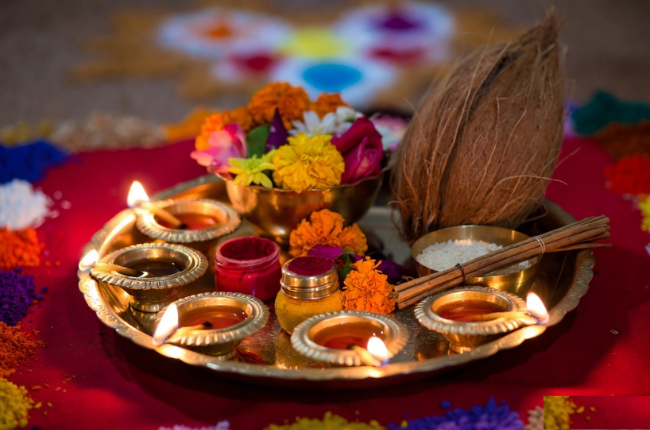
A Diwali Lakshmi Puja performed with incomplete samagri carries a correspondingly incomplete classical benefit. The full classical samagri list from the Skanda Purana's Diwali section:
- A new or freshly cleaned Lakshmi-Ganesh idol or image (never use a broken or chipped idol)
- Red cloth for the asana (seating)
- Fresh lotus flowers or marigolds (red and yellow)
- Panchamrit (milk, curd, honey, ghee, sugar water) for abhishek
- Kumkum, turmeric, chandan (sandalwood paste)
- Five varieties of fruits
- Five varieties of sweets (panchameva)
- Coins, silver items, and the family's account books or cash box (these are placed before Lakshmi for her blessing — the accounts ledger specifically represents the family's financial life seeking her benediction)
- Dhoop, agarbatti, and a ghee diya
- Gangajal for sprinkling
- A new broom — purchased on Dhanteras and first used on Diwali morning to sweep the home before the puja
Day 4 — Govardhan Puja (Annakut): The Pratipada Tithi after Diwali. This is the day of Krishna's victory over Indra's pride — the classical Vidhi involves creating a mound of food offerings (Anna) representing Govardhan Hill and offering it to Krishna before consuming any food. This is one of the Saade Teen Muhurat days — Kartik Shukla Pratipada — and any auspicious beginning made on this day carries intrinsic classical endorsement.
Day 5 — Bhai Dooj (Yama Dwitiya): The Dwitiya Tithi. Sisters perform tilak on their brothers' foreheads and pray for their longevity and prosperity. The presiding deity is Yamraj, and the classical tradition holds that a brother who receives his sister's tilak on this day is protected from untimely death for the year — a classical statement of the power of familial love and ritual as intertwined forces.
Makar Sankranti — The Solar Festival That Governs the Entire Year's Agricultural and Financial Cycle
Makar Sankranti falls on January 14th or 15th each year — the precise moment when the Sun enters the sign of Capricorn (Makar Rashi), marking the solar Uttarayana (northward journey). Unlike lunar festivals whose dates shift annually with the lunar calendar, Makar Sankranti follows the solar calendar and falls on virtually the same date every year. The Surya Siddhanta establishes Uttarayana as the period when the sun's energy is most supportive of material progress, agricultural fertility, and the repayment of ancestral debts.
The Classical Vidhi for Makar Sankranti
Sunrise bath: The Makar Sankranti bath must be taken at or before sunrise — ideally in a river or, where a river is not accessible, with Gangajal added to the home bath water. The Skanda Purana specifies this dawn bath as the act that formally receives the Uttarayana's solar blessing into the individual's body and life force for the coming year.
Til-Gur Dana: The donation of sesame (til) and jaggery (gur) on Makar Sankranti is among the most consistently prescribed Daan acts in all of classical Indian festival tradition. Sesame represents Saturn's domain (longevity, karma) and jaggery represents sweetness and nourishment — the combined donation on this day is treated as a karmic clearing of the previous year's unresolved Saturn debts. The Makar Sankranti sesame donation is specifically mentioned in the Dharmashastra tradition as one of the most meritorious acts available.
Kite flying — the overlooked ritual dimension: What most urban families experience as recreation carries a classical dimension in the Makar Sankranti observance — flying kites in the morning sun is the traditional way of receiving Uttarayana solar energy through the body, particularly on the skin. The Ayurvedic tradition associated with Makar Sankranti specifies early morning sun exposure on this day as therapeutically significant for Vitamin D, skin health, and the activation of prana (life force) for the new solar year.
Holi — The Festival of Purification Before the Spring Cycle
Holi is observed on the Purnima (full moon) of the Phalgun month — the last full moon before the Vedic new year begins in Chaitra. The Bhagavata Purana's account of Holika and Prahlada establishes the classical understanding: Holi is not primarily a festival of colour (that is Rang Panchami, five days later in some traditions) but a festival of fire purification — the burning of Holika represents the burning of the previous year's accumulated negative energy, jealousy, pride, and all that has stood between the family and its dharmic path.
Holika Dahan — The Night Before Holi
The Holika Dahan — the ritual bonfire — must be lit during Pradosh Kaal on Purnima evening, in the Bhadra-free window. The Muhurta Chintamani specifically warns against lighting the Holika fire during Bhadra Karana — a classical prohibition that is documented in virtually every regional Panchang but rarely explained to families. The correct timing each year requires a Panchang check for Bhadra's presence and end time on the Holi Purnima.
The Holika Parikrama: The family circumambulates the Holika fire three or seven times after lighting, carrying a mixture of raw coconut, wheat stalks, and new grain — the first fruits of the season's crop offered to the purifying fire before consumption. This Parikrama is the ritual's most practically significant component — it formally surrenders the previous year's agricultural and financial cycle to the fire and receives the new cycle's energy.
What to throw in the Holika fire: Classical tradition specifies specific items for the family to offer to the Holika bonfire as symbolic releases — dried coconut, sesame, sugar cane pieces, dried cow dung cakes, and a handful of grain from the previous year's harvest. Each family member places these items in the fire with a silent Sankalpa naming one thing they are releasing from the previous year.
⚠️ Myth vs. Fact
MYTH: Holi is the same festival as Rang Panchami, and the colour-playing is the main ritual of Holi.
FACT: The Bhagavata Purana establishes Holika Dahan — the purification bonfire — as the primary ritual of Holi. The playing of colours (Rang) is a celebratory addition that follows the ritual, not the ritual itself. In many classical traditions, particularly in Maharashtra and Madhya Pradesh, Rang Panchami — five days after Holi — is treated as the actual colour-playing festival, separate from Holi's purification ritual. Families who celebrate only the colour-playing and skip Holika Dahan have inverted the festival's classical priority.
Raksha Bandhan — The Ritual of Protection That Extends Beyond Siblings
Raksha Bandhan falls on the Purnima of Shravan month — the full moon of the monsoon season, when the Rig Veda's Shravana Nakshatra (the listening star, associated with Vishnu) is at its most powerful. The Bhavishya Purana documents the original Raksha Bandhan as a protective thread (Raksha sutra) tied by the goddess Indrani to her husband Indra's wrist before battle — establishing that the Raksha thread's classical function is protection, not merely sibling affection.
The Correct Vidhi for Raksha Bandhan
The Raksha thread must be tied during the Aparahna (afternoon) period — not in the morning, despite the popular practice of early morning Rakhi ceremonies. The Muhurta Chintamani specifies Aparahna Kaal (the 4th of the 5 daily time divisions, roughly 3-6 PM) as the most auspicious window for Raksha Bandhan. The Bhadra Karana prohibition applies here as strongly as it does for Holika Dahan — the Rakhi must not be tied during Bhadra, and on some years the morning Purnima carries Bhadra through midday, making afternoon the only classically valid window.
The complete Rakhi Vidhi sequence: The sister places a small puja thali before her brother with kumkum, rice grains, a diya, sweets, and the Rakhi thread. She applies tilak on his forehead, waves the diya in aarti, ties the Rakhi on his right wrist, feeds him a sweet, and receives her gift. Each step carries specific classical meaning — the tilak activates his Ajna chakra (protective intelligence), the aarti represents the sister's prayer as a living flame, and the Rakhi itself is the formal transfer of protective intention.
Extending Raksha Bandhan to the community: The Bhavishya Purana documents a broader Raksha Bandhan tradition in which the protective thread is tied not only between siblings but also between a Pandit and a householder, between a devotee and their deity's image, and between family members of all relationships seeking mutual protection. The thread's classical function is the Sankalpa it carries — any protective intention formally set at the time of tying carries the Purnima's amplified energy.
Ganesh Chaturthi — The Festival With the Most Precisely Timed Puja Window
Ganesh Chaturthi falls on the Chaturthi Tithi (fourth day) of Shukla Paksha in the Bhadrapada month. The Ganesha Purana — the primary classical text on Ganesha worship — establishes that the Chaturthi Tithi of Bhadrapada Shukla Paksha is the most potent Ganesha Tithi in the entire year, occurring at the precise astronomical moment when Ganesha's energy is most receptive to installation and worship.
The Pranapratishtha — Why It Cannot Be Skipped
The most critical element of Ganesh Chaturthi that most families omit is the Pranapratishtha — the formal installation ceremony that invites Ganesha's consciousness into the idol before worship begins. An idol worshipped without Pranapratishtha is, in the classical understanding, an artwork — beautiful and culturally meaningful but not the living presence the festival is designed to invoke. The Pranapratishtha involves specific mantras, a Netra Unmilana (opening of the eyes) ceremony, and a formal Avahana (invitation) — all three components are required for a complete installation.
The Modak Offering — Classical Significance
The twenty-one Modaks (ekavimshati modaka) offered to Ganesha on Chaturthi are documented in the Ganesha Purana as his most beloved offering — and the specific number twenty-one is not decorative but ritual. The Ganesha Purana specifies that twenty-one represents the completion of the material world's seven layers (each experienced in three modes of consciousness), and offering twenty-one Modaks symbolises the surrender of the entire material experience to Ganesha's wisdom and guidance.
Homemade versus purchased Modaks: Classical tradition consistently specifies that puja offerings prepared with the worshipper's own hands — with intention and mantra during preparation — carry significantly greater ritual potency than purchased sweets. The physical effort of preparation is itself an offering. Families who prepare Modaks at home on Chaturthi morning, while reciting Om Gam Ganapataye Namah, are following the complete classical Vidhi.
The Moon-Sighting Prohibition
The Ganesha Purana contains one of the most specific festival prohibitions in all classical literature: on Ganesh Chaturthi, sighting the moon after sunset is to be strictly avoided. The text narrates that the moon laughed at Ganesha's rotund form after he fell from his vehicle — and Ganesha cursed the moon, declaring that anyone who sees it on his festival day will face false accusations and undeserved scandal. Classical tradition treats this prohibition with complete seriousness — if the moon is accidentally sighted, the remedy is to recite the Syamantaka gem story from the Bhagavata Purana, which documents how Krishna himself was cleared of a false accusation.
As many families discover when they sit with their Pandit for Ganesh Chaturthi preparations, the moon prohibition is one of the most practically relevant festival rules in everyday life — particularly in urban environments where the moon is visible through windows without intention.
🪔 Pandit's Tip — Focus: Bhakti A Pandit familiar with your Kula tradition will tell you something that most festival guides never mention: the same festival carries different emphasis depending on the family's Kula Devata (family deity) and Gotra tradition. A family whose Kula Devata is Ganesha observes Ganesh Chaturthi with the full Shodasopachara (sixteen-step) Puja. A family whose Kula Devata is Devi observes Navratri's Ashtami with the full Kumari Puja. And a family that has lost knowledge of their Kula Devata — through migration, urbanisation, or generational discontinuity — is observing every festival without the specific divine resonance that makes it most effective for that bloodline. Reconnecting with your Kula Devata is the single most significant festival-related action a modern Indian family can take for long-term prosperity. A Pandit who knows your Gotra can identify your Kula Devata and its associated festival traditions within a single consultation.
Karva Chauth — The Complete Ritual Framework Beyond the Popular Narrative
Karva Chauth falls on the Chaturthi Tithi of Krishna Paksha in the Kartik month — four days before Diwali. The Skanda Purana documents Karva Chauth as a Vrata (sacred vow) observed by married women for the longevity and protection of their husbands — and its ritual Vidhi is significantly more detailed than the popular narrative of fasting until moonrise.
The Complete Karva Chauth Vidhi
The Sargi ritual: Before sunrise, the mother-in-law provides the daughter-in-law with Sargi — a tray of food, sweets, and fruits consumed before the day's fast begins. This must be completed before sunrise. The Sargi is not merely a gift — it is the formal transfer of the older generation's protective blessing into the younger woman's body before she undertakes the day's sacred discipline.
The Puja sequence: In the afternoon, married women gather with their Karva (a small clay or metal pot filled with water) for the collective puja. The Karva Chauth story (Katha) — the narrative of Veeravati and the moon's deception — is recited by all women together before any individual offering is made. The Skanda Purana specifies that the Katha recitation is non-negotiable — the puja without the Katha is ritually incomplete.
The moonrise offering: At moonrise, the woman views the moon through a sieve, then views her husband's face through the same sieve, then directly. Water from the Karva is offered to the moon. The husband then offers water to his wife and gives her the first food she eats after the day's fast. The sieve's use is not theatrical — it is the classical symbol of filtering the moon's light through the protective net of the Vrata's accumulated power before it enters the worshipper's vision.
One Question No Festival Guide Answers: What Happens When a Family Member Dies Within 30 Days of a Major Festival
This question appears consistently across r/hinduism and Quora discussions on festival observance — and receives no complete classical answer in any published article. The concern is real and practically urgent: when a close family member passes away within 30 days of Diwali, Navratri, or another major festival, does the family observe the festival or observe the mourning period? And if the festival is skipped, what are the ritual consequences?
Classical Dharmashastra tradition — specifically the Ashaucha (mourning impurity) rules documented in the Gautama Dharmasutra and the Paraskara Grihyasutra — provides a specific and nuanced answer that almost no popular festival guide addresses.
The Ashaucha period in classical tradition lasts ten days for the immediate family (spouse, children, parents) and progressively shorter periods for more distant relatives. During Ashaucha, the classical instruction is clear: the family in mourning does not perform festival puja, does not participate in community celebrations, and does not light Diwali lamps in the outer home. However, the classical texts make one critical exception: the Nitya Karma — the daily puja to the household deity — is never suspended, even during Ashaucha. The lamp in the puja room continues to burn. The morning offering continues. What is suspended is the festival's celebratory and social dimension, not the household's continuous divine connection.
For families where the Ashaucha period has ended before the festival but the mourning is still fresh — within the same year as the death — regional traditions vary. The North Indian tradition generally permits full festival observance after Ashaucha ends. The South Indian tradition, particularly in Brahmin households, observes a partial festival restriction through the full year of mourning, with specific exceptions documented in the regional Nibandha literature. A Pandit who knows the family's Gotra and regional tradition will provide the precise guidance for the specific situation — there is no single universal answer, and a general festival article cannot substitute for that lineage-specific knowledge.
The deeper classical principle, documented in the Garuda Purana, is that a departed soul's peace is not disrupted by the living family's festival celebrations after the Ashaucha period ends. In fact, the text notes that ancestors in Pitru Loka receive a portion of every auspicious puja and festival offering made by their descendants — meaning a family's full and correct festival observance is an ongoing gift to both the living and the departed.
For families dealing with ancestral karma alongside festival observance, the Pitra Dosha Symptoms and Complete Home Remedies Guide and the Pitru Paksha Tarpan Complete Guide together provide the complete framework for honouring both the living family's festival needs and the departed ancestors' continued wellbeing.
Akshaya Tritiya — The Festival Most Underused for Its Classical Purpose
Akshaya Tritiya falls on the Tritiya Tithi of Vaishakh Shukla Paksha — the third day of the waxing moon in the second month of the Hindu calendar. It is one of the Saade Teen Muhurat — intrinsically auspicious without any additional Panchang verification required. The word Akshaya means inexhaustible or imperishable — and the Bhavishya Purana documents this day as the moment when any auspicious beginning carries the quality of inexhaustibility: whatever is started will not diminish, whatever is given will return multiplied, and whatever is prayed for carries the amplified energy of the day into its eventual fruition.
What Classical Tradition Actually Recommends for Akshaya Tritiya
Popular culture has reduced Akshaya Tritiya almost entirely to gold purchasing — which is a valid classical practice (the Bhavishya Purana does associate material purchases on this day with lasting prosperity) but is far from the day's most important classical use.
The most classically significant Akshaya Tritiya practices, in order of ritual importance:
Dana (Charity) — The Day's Highest Act: The Bhavishya Purana specifies that Daan performed on Akshaya Tritiya returns to the giver in inexhaustible measure across future lives. The classical Daan items for this day are: water pots (ghada) offered to the thirsty as summer approaches, food offered to Brahmins and the poor, footwear offered to those who walk without protection, and the settling of any outstanding debts owed to others. The Satyanarayan Katha performed on Akshaya Tritiya — a full Satyanarayan Puja with the complete narrative — is among the most potent uses of the day's energy for family prosperity. For the complete Satyanarayan Puja Vidhi and its most commonly made mistakes, the Common Satyanarayan Pooja Mistakes and Full Benefits Guide provides the authoritative reference.
Beginning New Ventures: Akshaya Tritiya is the strongest single day in the year for beginning any new enterprise, starting construction, signing business agreements, beginning a new educational course, or making any commitment intended to last. The day's intrinsic Muhurat quality means no additional Panchang verification is required — the Tritiya itself is the endorsement.
Barley Offerings to Ancestors: The Bhavishya Purana specifically mentions the offering of barley (yava) to ancestors on Akshaya Tritiya as one of the most powerful acts of ancestral honouring outside of Pitru Paksha — particularly relevant for families carrying Pitra Dosha or families where a recent death has created unresolved ancestral obligations.
The Universal Festival Prosperity Framework — Five Practices That Apply to Every Indian Festival
Across all major Indian festivals, regardless of the specific deity, season, or regional tradition, five classical practices appear in virtually every festival's Vidhi as non-negotiable components of a complete observance.
Practice 1 — Puja Room Preparation the Night Before
Every major festival's Vidhi begins not on the festival day itself but on the evening before — with the thorough cleaning and preparation of the puja space. The Grihyasutra tradition specifies that the divine presence invited during festival worship requires a clean, orderly, and aesthetically prepared space. A puja performed in a disorganised or unclean space is not rejected by the deity — but the deity's presence is diminished, as the space's energetic quality limits the quality of the connection established.
Practice 2 — The Sankalpa — The Most Underused Festival Practice
Every puja begins with a Sankalpa — a formal statement of identity and intention recited before the first offering is made. The Sankalpa includes: the current year, month, Paksha, Tithi, and day; the worshipper's name, Gotra, and Rashi; and the specific purpose for which the puja is being performed. Most families skip the Sankalpa entirely or recite it without understanding it. Classical tradition treats the Sankalpa as the energetic contract between the worshipper and the divine — without it, the offerings are received but the specific intention behind them has not been formally communicated. For families wanting to understand how to construct a proper Sankalpa for any festival, a Pandit consultation through AtoZPandit.com takes less than fifteen minutes and establishes the correct Sankalpa for the family's specific Gotra and situation.
Practice 3 — Prasad Preparation With Intention
The food offered to the deity (Naivedya) and subsequently distributed as Prasad must be prepared by the worshipper or family members — not purchased in its final form. The preparation itself is an act of worship. The cook should bathe before preparing Naivedya, maintain silence or chant during preparation, and avoid tasting the food before it has been offered. Classical tradition holds that Prasad prepared with these conditions carries the deity's blessing into the body of every person who receives it — Prasad prepared commercially and offered perfunctorily carries the offering's form without its substance.
Practice 4 — Dana on Every Festival Day
Every major Indian festival prescribes a specific form of Dana — charity — as an integral component of the observance, not an optional addition. The Skanda Purana's festival sections consistently specify that a puja performed without its associated Dana is structurally incomplete — the deity has been worshipped but the karmic circuit has not been completed. The Dana for each festival is specific: sesame on Makar Sankranti, food and water on Akshaya Tritiya, clothing on Dussehra, sweets and diyas on Diwali. The family that performs both the puja and its associated Dana on every festival day builds a consistent karmic credit that compounds across years.
Practice 5 — Family Participation — The Ritual That No Single Member Can Perform Alone
Classical festival Vidhi specifies that major household festivals require the participation of the entire family — not delegation to one member while others sleep or watch television. The Grihyasutra tradition is explicit: the householder (Grihastha) performs the puja, but the household's women, children, and elders must be present, even as observers, for the ritual's protective and prosperity benefits to extend to the entire family. A puja performed for the family by one family member in an otherwise empty house delivers individual benefit — not the household blessing that the festival's Vidhi is designed to produce.
For families wanting to align their festival practices with the correct auspicious timing for each ceremony in 2026, the Shubh Vivah Muhurat Complete Dates Guide and the complete AtoZPandit.com festival calendar provide the verified timing for every major festival's most auspicious puja window throughout the year.
FAQ: Indian Festivals Sacred Rituals and Family Prosperity
Q1. Which Indian festival is most important for family wealth and financial prosperity? Diwali's Lakshmi Puja — performed during Pradosh Kaal on Kartik Amavasya — is the most classically endorsed festival ritual for household financial prosperity. Akshaya Tritiya follows closely, with the Bhavishya Purana documenting its inexhaustible quality for any material or spiritual beginning. Both festivals require precise timing and complete samagri for their full classical benefit to reach the family.
Q2. What is the correct time to perform Lakshmi Puja on Diwali night? Lakshmi Puja on Diwali must be performed during Pradosh Kaal — the 1.5-hour window immediately after sunset on Kartik Amavasya. The Vishnu Purana establishes this timing as the precise window of Lakshmi's maximum receptivity to household worship. Performing the puja significantly before sunset or after 10 PM does not access the same energetic window. The exact Pradosh Kaal timing varies by city and year — check the current year's Panchang for your location.
Q3. Can festival rituals be performed if a family member is unwell or hospitalised? Classical Dharmashastra distinguishes between the householder's ritual inability (illness severe enough to prevent physical participation) and the household's ritual continuity. When the primary householder is hospitalised, another adult family member — spouse, eldest child, or sibling — may perform the festival puja on behalf of the household with a modified Sankalpa naming the hospitalised member. The ritual's benefit extends to the entire household regardless of who physically performs it, provided the Sankalpa includes all family members by name.
Q4. What is Panchamrit and why is it used in every major Indian festival puja? Panchamrit — the five sacred substances — consists of raw milk, curd, honey, ghee, and sugar water mixed together and used for abhishek (ritual bathing) of the deity's idol. The Skanda Purana documents Panchamrit's five components as corresponding to the five elements: milk to Earth, curd to Water, honey to Fire, ghee to Air, and sugar water to Space. Bathing the deity in all five simultaneously invites divine presence across all five elemental dimensions — making Panchamrit the most complete ritual cleansing medium available in classical Puja Vidhi.
Q5. Why is Dana (charity) required on every major festival day according to Vedic tradition? The Skanda Purana establishes that festival worship creates an energetic circuit between the worshipper and the divine — the puja is the offering, and the Dana is the completion of the circuit. A circuit opened but not closed produces accumulated energy with no release point, which classical tradition associates with spiritual congestion rather than prosperity. Dana releases the accumulated merit into the world, which creates the space for renewed abundance to enter the family. Personal results depend on karma, the quality of giving, and divine grace.
Q6. How do regional differences affect festival Vidhi across India? Festival Vidhi varies significantly across regional traditions — the North Indian Navratri emphasises Kanya Puja on Ashtami or Navami, while the Bengali tradition's Durga Puja has an entirely different five-day Vidhi structure. The Tamil tradition observes Navratri primarily as Golu (the display of sacred dolls). These are not contradictions — they are regional lineages of the same festival rooted in different Shastra traditions. A family's correct Vidhi is the one matching their Gotra's regional Panchang tradition, not a blended average of all regional practices.
Q7. What is the most important thing to do before starting any Indian festival puja at home? What should every family do before beginning a festival puja at home? The most important preparatory act is the Sankalpa — the formal statement of identity and intention recited before the first offering. Without a Sankalpa, the puja's benefit reaches the deity but the specific intention behind it has not been formally communicated in the ritual framework. Bathe, dress in clean clothes, prepare the puja space, light the diya, and then recite the Sankalpa before touching any offering. This single practice, consistently applied, transforms a cultural gesture into a complete classical ritual.
Conclusion
Indian festivals carry a principle that the classical texts state plainly and that living tradition confirms through generations of family experience — the universe responds to correct invitation at the correct moment. The families who approach each festival with its complete Vidhi, its precise timing, its required samagri, and its accompanying Dana are not following rules for their own sake. They are using the tools that classical Vedic tradition spent millennia refining — tools designed to align the family's intention with the divine energy that each festival makes available. Choose one festival from this guide and resolve to observe it completely this year — the correct timing, the full samagri, the Sankalpa, and the Dana. Experience the difference between a cultural celebration and a classical ritual, and let that difference guide every festival that follows. Classical Vedic practice holds that the prosperity, health, and harmony that India's festivals promise are fully available to every family willing to receive them correctly — and the reminder always holds that outcomes rest with karma, sincerity, and the grace of the divine forces each festival brings into the home.
Book a verified Pandit for any major Indian festival puja through AtoZPandit.com — conducted onsite at your home or as a Live E-Pooja with complete Vidhi, correct Muhurat, and full samagri guidance. For Navratri Akhand Jyoti, Diwali Lakshmi Puja, Ganesh Chaturthi Pranapratishtha, and all major festival ceremonies, connect with AtoZPandit.com today.
Disclaimer: This article is intended for educational and cultural awareness purposes only. The festival Vidhi and Vedic information provided is rooted in classical Shastra tradition and does not substitute for professional medical, legal, or financial advice. Regional and lineage-specific traditions may differ from the general classical framework presented here. For personalised festival Vidhi aligned with your family's Kula tradition, connect with AtoZPandit.com.