
Vastu Remedies Without Demolition Fix Home Energy Without Breaking Walls
Most families do not discover their home has a Vastu problem from a consultant. They discover it from life. Money that used to stretch now disappears before the month ends. Sleep in a particular room stays light no matter how tired the person is. Disagreements between family members repeat the same pattern year after year without resolution. A child who was doing well in school begins to struggle after the family moves. These are the signs most people bring to a Pandit or Vastu consultant — not a blueprint, not a floor plan. Just a feeling that something in the home is working against the family rather than with it.
What almost no Vastu article addresses directly is the question every family actually wants answered: can this be fixed without breaking walls, relocating the kitchen, or spending money the family does not currently have. The answer, grounded in the Manasara Vastu Shastra and the Mayamata — two of the oldest surviving classical texts on Vastu — is yes, with precision and consistency. Not every defect can be fully neutralised without structural change. But the majority of common Vastu problems affecting financial flow, sleep quality, relationship harmony, and household health can be corrected using placement, colour, element balancing, and energetic remedies that require no demolition whatsoever.
This guide covers the complete non-demolition Vastu correction system — the five element framework, room-by-room defect identification and correction, the most common directional problems and their practical remedies, what to place where for financial energy, and what specifically to avoid in each zone of the home.
What Vastu Shastra Actually Is and Why Direction Governs Everything
Vastu Shastra — literally "the science of dwelling" — is the classical Indian system of architecture and spatial arrangement documented in texts including the Manasara, the Mayamata, the Vishwakarma Prakash, and portions of the Matsya Purana and Agni Purana. The system is built on a single foundational principle: a home is not a static structure. It is a living energetic field that interacts continuously with the five cosmic elements — Panchamahabhuta — and with the directional forces that govern how those elements flow through physical space.
The Five Elements and Their Directional Homes
Every room and every corner of a home is governed by one of the five elements:
- Earth (Prithvi) — Southwest. Stability, weight, grounding. The heaviest structures and the master bedroom belong here.
- Water (Jala) — Northeast. Flow, purification, clarity. The prayer room, water storage, and open space belong here.
- Fire (Agni) — Southeast. Energy, transformation, digestion. The kitchen belongs here.
- Air (Vayu) — Northwest. Movement, communication, social connection. Guest rooms and storage for perishables belong here.
- Space (Akasha) — Centre (Brahmasthana). The central space of a home must remain open and uncluttered — this is the home's energetic heart.
Why the Northeast Is the Most Sacred Direction
The northeast — called Ishan in classical Vastu — is the confluence point of the North (governed by Kubera, the lord of wealth) and the East (governed by Indra, the lord of abundance and rainfall). The Manasara Vastu Shastra identifies the northeast as the direction from which positive cosmic energy enters a home. When the northeast is blocked, cluttered, heavy, or occupied by a toilet, kitchen, or staircase, the primary energy channel of the home is compromised — and financial, health, and relational difficulties follow as predictable consequences.
The Vastu Purusha Mandala
The foundational diagram of Vastu Shastra is the Vastu Purusha Mandala — a 9x9 or 8x8 grid that maps a cosmic being (Vastu Purusha) lying face-down across the floor plan of any structure. Each square of the mandala is assigned to a specific deity, a specific element, and a specific life domain. When a room's function conflicts with the deity and element of the zone it occupies, the Vastu Purusha is, in classical terms, uncomfortable — and that discomfort is expressed through the life difficulties of the family occupying the space. For a complete understanding of how directional energies interact with planetary influences, the Vastu Guide for New Home covers the foundational principles in full.
How to Identify Vastu Defects in Your Home Without a Consultant
Before applying any remedy, the defect must be identified accurately. The most common Vastu defects in Indian homes can be assessed through a straightforward room-by-room directional audit using a compass — or a compass app on a smartphone calibrated to magnetic north. Stand at the exact centre of your home and identify the direction each room faces. Then match each room's function against the directional assignment below.
Step-by-Step Home Vastu Audit
- Stand at the geometric centre of your home — not the entrance, but the actual centre point of the floor plan. If your home is rectangular, this is the intersection of the two diagonal lines from corner to corner.
- Open your compass app and identify true north — note which direction each room and each major corner of the home falls in relative to the centre.
- Map your rooms against the correct directional assignments:
- Northeast — Prayer room, water storage, open space. Any other use is a defect.
- East — Living room, study, open windows. Blocked east walls reduce health and social flow.
- Southeast — Kitchen, electrical equipment, generator. Any other use is a defect.
- South — Master bedroom, heavy storage. Open or empty south creates instability.
- Southwest — Master bedroom (owner of the home), heavy furniture, almirahs. Toilet or kitchen here is a severe defect.
- West — Children's room, dining area. Generally flexible.
- Northwest — Guest bedroom, storage, garage. Movement-related spaces belong here.
- North — Study, home office, open space. Kubera's direction — keeping north open and uncluttered directly supports financial flow.
- Centre (Brahmasthana) — Must remain open, uncluttered, and free of heavy furniture, pillars, or staircases.
- Note every room whose function conflicts with its directional zone — these are your active Vastu defects.
- Prioritise by severity — toilet in northeast, kitchen in northeast or southwest, master bedroom in northeast, and staircase in the Brahmasthana are the four most severe defects. Address these first.
Room-by-Room Vastu Corrections Without Breaking a Single Wall
This is the section most families need most urgently. What follows are the specific, actionable, non-demolition corrections for each major room and each common defect — drawn from classical Vastu texts and verified practitioner traditions.
Main Door — The Home's Primary Energy Gate
The main door is the first point through which Vastu energy enters the home. Its direction, condition, and threshold treatment are among the most impactful factors in the home's overall energetic quality.
Correct Directions for the Main Door
East-facing and north-facing main doors are considered most auspicious in the Manasara tradition — they receive morning light and Kubera's northern energy respectively. South-facing main doors require specific remedies. West-facing doors are neutral with correct balancing.
Non-Demolition Corrections for the Main Door
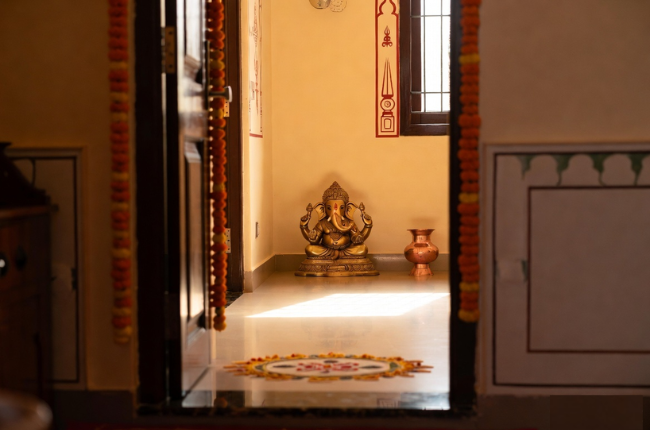
- Place a Ganesha idol or image above the main door on the outside — facing outward, not inward. This is the classical first correction for any entrance regardless of direction.
- Hang fresh or artificial marigold torans (door garlands) — renewed on every Friday or at every new and full Moon. The act of renewal is as important as the placement.
- Paint the main door in its directionally correct colour — green or wood tones for east, blue or grey for north, red or orange for south, white or cream for west.
- Ensure the threshold (dehleez) is clean, uncracked, and marked with a daily rangoli or kolam — even a simple geometric pattern drawn with rice flour activates the threshold's protective energy according to the Grihyasutra domestic tradition.
- Place a copper strip along the door threshold — copper is the metal of the Sun and activates purifying solar energy at the home's entry point.
- Ensure the main door opens fully and without obstruction — a door that only opens partway restricts the flow of opportunity into the home proportionally.
Living Room Vastu Corrections
The living room governs social reputation, family relationships, and the home's energetic welcome to the outside world.
- Heavy furniture — sofas, almirahs, large cabinets — belongs against the south and west walls. North and east walls must remain lighter and more open.
- Place a crystal bowl filled with water and floating marigolds in the northeast corner of the living room — renewed every Friday. This activates the water element in its correct directional zone.
- Television and electronic equipment belong on the southeast wall — fire element zone. A TV placed on the north or northeast wall creates elemental conflict.
- Hang a Kubera Yantra on the north wall of the living room — the north being Kubera's direction, the Yantra activates the financial energy of this wall. For the complete Yantra selection and placement framework, the Yantra Benefits and Selection Guide covers the classical placement rules in depth.
- Keep the northeast corner of the living room completely free of clutter, heavy furniture, shoes, brooms, or electrical equipment at all times.
- Ensure adequate natural light enters from the east — keep east-facing windows unobstructed during morning hours.
Kitchen Vastu Corrections
The kitchen governs health, digestion, and the nourishment energy of the entire family. A kitchen in the wrong zone — particularly the northeast or southwest — is among the most common sources of persistent health and financial problems in Indian homes.
If the Kitchen Is in the Northeast (Severe Defect)
This is the most common and most serious kitchen Vastu defect. Full correction requires relocating the kitchen — but until that is possible:
- Place a large red pyramid Vastu correction tile under the cooking stove to suppress the fire element's conflict with the northeast's water energy
- Cook always facing east — even in a misplaced kitchen, the cook's direction carries significant energetic weight
- Place a bowl of sea salt in the northeast corner of the kitchen and replace it every month — salt absorbs negative elemental conflict
- Hang a green curtain between the cooking area and the northeast corner to create a symbolic elemental separation
- Light a camphor lamp in the kitchen every evening to purify the accumulated fire-water elemental conflict
If the Kitchen Is Correctly in the Southeast
- The stove must be placed so the cook faces east while cooking — this is the single most important kitchen Vastu rule and requires no structural change
- Water sources (sink, water filter, drinking water storage) must be on the north or northeast side of the kitchen — never adjacent to or directly opposite the stove
- Keep the southeast corner of the kitchen — directly under or beside the stove — free of water storage, wet items, or damp cloths
Bedroom Vastu Corrections
The bedroom governs sleep quality, relationship harmony, physical health, and the restoration of personal energy. It is the room where Vastu defects produce the most immediately felt effects.
Sleeping Direction
- The head must point South or East while sleeping — never North. Sleeping with the head pointing north aligns the body's magnetic field against the Earth's north-south magnetic current, disrupting sleep, increasing stress hormones, and reducing the quality of cellular restoration during rest.
- South is the ideal sleeping direction — the head points toward Yama's direction, which in classical Vastu means the body is aligned with the flow of completion and rest rather than against it.
Furniture and Mirror Placement
- No mirror should directly face the bed — mirrors facing the sleeping body are considered to double the restless energy of the sleeper, disrupting sleep and creating relational tension. Cover mirrors in the bedroom with a cloth at night if repositioning is not possible.
- The bed must not be placed under a beam — sleeping under an exposed overhead beam creates a constant downward pressure in Vastu terms, associated with headaches, relationship strain, and financial anxiety. If the beam cannot be removed, paint it the same colour as the ceiling to visually dissolve its presence, and hang two bamboo flutes diagonally across it.
- Heavy almirahs and wardrobes belong on the south or west wall of the bedroom — never on the north or east.
- Keep the northeast corner of every bedroom completely free — no shoes, no almirahs, no dustbins.
For the Master Bedroom in the Wrong Zone
- If the master bedroom occupies the northeast (a significant defect), place a heavy brass or iron object — a large brass pot, a cast-iron bookend — in the southwest corner of that room to import southwest's stabilising earth energy into the space
- Sleep with the head pointing south to correct the body's directional alignment independent of the room's zone
Bathroom and Toilet Vastu Corrections
Toilet in the Northeast (Most Severe Common Defect)
- Place a sea salt bowl inside the toilet — replenished monthly. Salt is the primary Vastu absorber of elemental conflict.
- Paint the northeast toilet walls yellow or light green — colours that reduce the elemental heaviness of fire and earth in a water zone.
- Keep the toilet lid closed at all times and the toilet door closed — both practices prevent the downward-draining energy of the toilet from affecting the home's northeast energy field.
- Place a small Vastu pyramid on the toilet cistern — a widely used non-demolition correction for this defect specifically.
- Hang a wind chime with 6 or 8 rods outside the toilet door — the sound vibration partially counteracts the energetic disruption. For guidance on using protective tools for home energy, the Evil Eye Protection guide covers the full range of classical household protective remedies.
Study Room and Home Office Vastu Corrections
The study governs education, career decisions, concentration, and the quality of intellectual output. The north and east are the most favourable zones for study and work.
- Face north or east while studying or working — this is the single most impactful non-structural correction for study and career energy
- Place the study table away from the wall — working with the back to a solid wall and the face toward an open room creates the energetic configuration of support-behind, opportunity-ahead
- Keep a small green plant (money plant or tulsi in a separate pot) on the east side of the study desk — living plants activate air element in the correct zone
- Place a Saraswati idol or image on the east wall of the study room — facing west, so the student faces east and looks toward the deity
- Keep north and east walls of the study lighter in colour — white, pale yellow, or light green. Dark colours on north or east walls suppress the energy channels most supportive of mental clarity
The North Wall — The Single Most Impactful Change for Financial Energy
Of all the directional zones in a home, the north wall and the north zone carry the most direct relationship to financial energy in classical Vastu. The north is governed by Kubera — the Vedic deity of wealth — and by the planet Mercury, which governs commerce, trade, and the circulation of money. Keeping the north zone of every primary room open, light, clean, and correctly activated is the most impactful single-zone intervention available without demolition.
What the North Zone Must Have
- Open space — the north zone should be the least cluttered area of any room. If a choice must be made about where to place a heavy piece of furniture, it always goes south or west — never north.
- A flowing water element — a small indoor water fountain, an aquarium with an odd number of fish (seven or nine), or even a copper vessel filled with fresh water placed against the north wall activates Kubera's water energy in its correct zone. The water must be kept clean and moving — stagnant water in the north zone suppresses financial flow rather than supporting it.
- A Kubera Yantra or Kubera idol — facing south, placed on the north wall of the home's main living or work area. For the complete Yantra and mantra system for wealth activation, the Kuber Mantra and Yantra Complete Guide covers the classical activation protocol in full.
- Green colour elements — green is Mercury's colour and supports the commercial energy of the north zone. A green plant, a green cushion on the north side of the living room, or a green painting on the north wall all activate this zone's financial resonance.
What the North Zone Must Never Have
- Toilets — a toilet on the north wall is among the most financially damaging Vastu defects in the home. Until structural correction is possible, apply the toilet defect remedies described above with specific attention to keeping the toilet door permanently closed.
- Shoes and footwear storage — placing shoes in the north zone symbolically treads on Kubera's energy. Shoe racks belong in the south or west.
- Dustbins or waste storage — waste in the north zone is the spatial equivalent of discarding money. All waste storage belongs in the northwest.
- Heavy, dark-coloured furniture — suppress north wall energy. Replace with lighter furniture or cover with light-coloured fabric.
What Classical Vastu Texts Say That Most Articles Never Mention
The Manasara Vastu Shastra — one of the most comprehensive surviving classical texts on Vastu — dedicates specific chapters to the concept of Vastu Dosha Parihara (Vastu defect remedy). This is the classical basis for non-demolition correction. The text acknowledges explicitly that not every household has the resources to reconstruct rooms or relocate structural elements — and it provides a framework of compensatory interventions (Pratikara) that work through elemental balancing rather than structural change.
The Pratikara Framework
The Pratikara system in the Manasara identifies three levels of correction:
- Sthana Pratikara — correction through placement. Repositioning furniture, objects, idols, and functional items to redirect elemental flow within the existing structure.
- Rupa Pratikara — correction through form. Using colour, shape, and symbol to activate or suppress elemental energy in specific zones. Pyramids, Yantras, and colour corrections belong in this category.
- Shabda Pratikara — correction through sound. Using bells, wind chimes, conch shells, and mantra recitation to break up stagnant energy fields and reactivate dormant directional energies.
All three levels of Pratikara are available without demolition. A complete non-demolition correction programme applies all three in sequence — placement first, then form, then sound — rather than applying one in isolation. Most commercially available Vastu advice applies only one level, which is why results are often partial.
What the Mayamata Adds
The Mayamata — another foundational Vastu text — introduces the concept of Marma points in a home: specific structural intersections that carry concentrated energy and must never be drilled into, hammered, or obstructed. Marma points include the junctions between walls at the eight directional corners, the centre of the ceiling in each room, and the threshold of the main door. Understanding which areas of the home are energetically sensitive but structurally untouchable is as important as knowing where to place corrective objects — because an incorrectly placed correction item on a Marma point can amplify the defect rather than reduce it.
Two Vastu Questions That Almost No Article Answers
What Happens When a Rented Home Has Severe Vastu Defects That Cannot Be Corrected
This question appears consistently across Indian Vastu forums on Reddit and in Quora threads from urban professionals — and receives almost no serious published answer. The assumption in most Vastu literature is that the family owns the home and can make decisions about placement, colour, and objects freely. Renters face a different reality: they cannot paint walls, cannot install permanent fixtures, and may not be permitted to place large objects near structural elements. The classical Vastu response, drawn from verified Pandit consultation traditions across South India and Maharashtra, is as follows. The renter's Vastu authority extends to everything portable and everything impermanent. Portable corrections — salt bowls, water features, Yantras, plants, directional sleeping position, and fragrance — apply equally in a rented home and produce the same elemental effect. The permanent structural defect remains, but its impact is significantly softened when all portable corrections are applied consistently. The additional remedy specifically recommended for renters in difficult Vastu homes is a monthly Vastu Shanti Havan — even a simple one performed by the family with camphor, ghee, and the recitation of the Vastu Purusha mantra — which periodically resets the home's energy field independently of its structural condition.
Does Vastu Apply Differently When Multiple Families Share One Building
A second question with almost no published answer: in apartment buildings where many families share common walls, floors, and a single main gate, does the Vastu of the building override the Vastu of the individual flat? The answer, from the classical Vastu tradition and verified regional practitioner accounts from Vastu consultants in Mumbai and Chennai, distinguishes between two levels of Vastu. The building's Vastu (Bhavan Vastu) governs the collective energy of all residents — the direction of the main gate, the placement of the building's water tank and generator, and the building's orientation on the plot. This level affects all residents proportionally but not equally, because each flat's internal Vastu modifies how the building's energy is received within that specific unit. A flat with a well-corrected internal Vastu in a poorly oriented building will experience less of the building's negative energy than a flat with multiple internal defects in the same building. The practical conclusion is that internal flat corrections are genuinely worthwhile even in buildings with structural-level Vastu problems — because the flat's internal energy field is the one the family lives inside moment to moment.
📦 Micro-Remedy Box — Pandit's Tip
Focus: Shraddha A Pandit familiar with your Kula tradition will tell you this plainly: the most powerful Vastu correction is the one performed with full attention and then maintained. As many families discover when they sit with their Pandit, they spend considerable effort on the initial placement — the Yantra on the north wall, the salt bowl in the toilet, the wind chime at the northwest — and then forget about it entirely for months. The salt bowl becomes a permanent fixture rather than a monthly renewal. The water feature in the north runs dry. The marigold toran dries out and is not replaced. Vastu remedies are living corrections, not installation projects. The energy of renewal — the act of consciously refreshing each correction on its designated day — is itself a Vastu practice. A home that is freshened and re-attended monthly holds its corrected energy far more consistently than one where corrections were made once and abandoned.
Practical Steps to Begin Your Vastu Correction This Week
- Stand at the centre of your home with a compass — identify the direction of every room. Do not rely on your assumption of which direction is north. Verify it physically. This single step changes everything that follows.
- Identify your three most severe defects — toilet in northeast, kitchen in northeast or southwest, and master bedroom in northeast are the three priorities. Apply the specific corrections listed in the room-by-room section above for each defect present.
- Clear the Brahmasthana — remove every object from the geometric centre of your home. If a pillar or staircase occupies this space structurally, paint it yellow and wrap copper wire around its base. If furniture occupies it, relocate the furniture to the south or west walls.
- Activate the north wall this week — place a copper vessel with fresh water, a green plant, or a small indoor water fountain against the north wall of your living room or main working area. Clean and refresh it every Monday.
- Correct every bedroom's sleeping direction — ensure every family member sleeps with the head pointing south or east. This requires no purchases and no structural change. It is the most accessible and most immediately felt Vastu correction available.
- Place sea salt bowls in every active defect zone — use rock salt in small open bowls. Place them in toilet corners, in conflict-zone rooms, and under the stove if the kitchen is misplaced. Replace the salt on the first day of every new month.
- Paint or add colour to correct elemental zones — if repainting is possible, follow the directional colour map: yellow or earthy tones for southwest, blue or grey for north, green for east, white or cream for northeast. If repainting is not possible, add coloured cushions, curtains, or wall hangings that bring the correct colour into the zone.
- Perform a Vastu Shanti Puja for the home — ideally conducted by a qualified Pandit who performs the Vastu Purusha invocation with the correct Sankalpa for your specific home's directional layout. This resets the home's overall energy field and significantly amplifies the effect of every physical correction applied. AtoZPandit.com Pandits conduct both in-person and Live E-Puja Vastu Shanti services for homes across India and for NRI families abroad.
FAQ
Can Vastu really be fixed without breaking walls or spending a lot of money? Most common Vastu defects — including directional sleeping errors, clutter in the northeast, and elemental imbalances in living and work areas — can be corrected through placement, colour, and object-based remedies that require no structural change. Severe defects like a toilet permanently built in the northeast or a staircase in the Brahmasthana cannot be fully corrected without structural intervention, but their effects can be significantly reduced through the non-demolition remedies described in the Manasara's Pratikara framework.
Which direction should the main door face for maximum wealth and good luck? The east-facing and north-facing main doors are considered most auspicious in classical Vastu — east receives solar energy and north receives Kubera's wealth energy. A south-facing main door requires specific compensatory corrections including a bright light above the door, a red or copper threshold strip, and a Ganesha idol placed facing outward above the frame. As astrological tradition holds, the main door's direction interacts with the home's overall layout — no single direction produces results without the full Vastu context being assessed.
What is the fastest Vastu remedy to improve financial flow at home? The three fastest non-demolition financial corrections are: clearing and activating the north wall of the living room with a flowing water element, removing all clutter and heavy objects from the northeast corner of every room, and ensuring the main earning member of the family sleeps with the head pointing south. These three changes address the three primary zones most directly connected to financial energy in the classical Vastu system and can be implemented within one day.
How do I use Vastu to fix sleep problems without moving to another room? Sleep problems caused by Vastu are most commonly produced by three factors: head pointing north while sleeping, a mirror directly facing the bed, and sleeping under an exposed beam. Correct the sleeping direction to south or east, cover or reposition mirrors so they do not face the bed directly, and if a beam is overhead, hang two bamboo flutes diagonally across it and paint it the same colour as the ceiling. These corrections alone resolve the majority of Vastu-related sleep disturbances.
Is Vastu only for Hindus or does it apply to all families? Vastu Shastra is a spatial science based on directional energetics, elemental balance, and magnetic orientation — not on religious practice. Its principles apply to any structure regardless of the faith of its occupants, because the directional and elemental forces it addresses are physical and architectural rather than devotional. The remedies include classical Hindu ritual elements, but the underlying spatial corrections — sleeping direction, room function placement, north wall activation — produce effects that are independent of religious observance.
What should never be kept in the northeast corner of a home? The northeast corner must never contain: a toilet or bathroom, a kitchen stove or fire source, shoes or footwear, heavy almirahs or storage furniture, dustbins or waste storage, electrical equipment generating heat, or a staircase. The northeast is the home's primary energy entry point and Kubera's directional zone. Any heavy, dirty, fiery, or waste-associated object in this corner directly suppresses the financial and health energy of the entire home. For bedroom-specific Vastu, the Bedroom Vastu Complete Guide covers the northeast bedroom defect remedies in detail.
How long does it take to feel the effects of Vastu corrections at home? Sleep-related corrections produce the most immediate results — often within one to two weeks of consistently sleeping in the corrected direction. Financial energy shifts are typically felt within three to six months of sustained north-zone activation and northeast clearing. Relationship harmony improvements from bedroom corrections generally become noticeable within one to three months. Personal results, as always, depend on the severity of the original defects, the consistency with which corrections are maintained, and the individual karma of the family members involved.
Conclusion
Vastu Shastra's deepest teaching is that a home is a participant in the family's life — not a passive backdrop. Every direction, every corner, every wall is in an ongoing relationship with the people who live within it. The classical texts were not written for families with unlimited renovation budgets. The Pratikara framework exists precisely because the ancient Vastu masters understood that most families must work with what they have. Begin today with the compass, the sleeping direction, and the north wall. Those three corrections alone shift the energetic relationship between the family and the home in ways that compound quietly over months. Classical Vedic practice holds that a home corrected with sincerity and maintained with attention becomes a genuine ally in the family's material and spiritual life. Personal results, as always, depend on the consistency of practice, the karma of those within the home, and divine grace.
Your home's Vastu is either working with your family or quietly working against it. Connect with a verified AtoZPandit.com Vastu consultant for a complete room-by-room directional assessment and a personalised non-demolition correction plan for your specific home layout.
Disclaimer: This article is published for educational and cultural awareness purposes only. The information presented does not substitute for professional medical, psychological, or legal advice. For personalised Vastu guidance based on your specific home layout and family chart, connect with a qualified consultant at AtoZPandit.com.