
Kundli Reading Guide for Understanding Houses Planets and Predictions
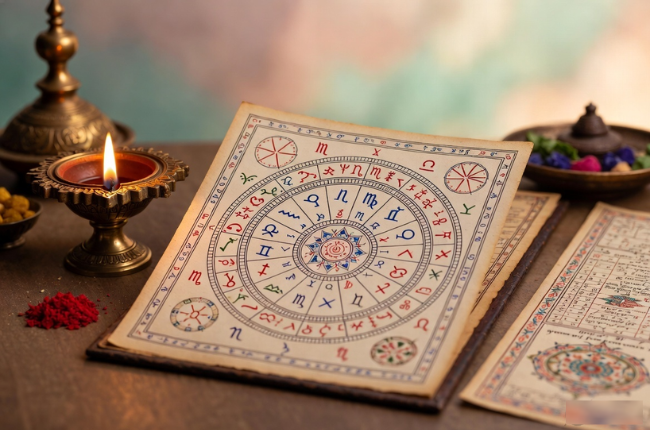
There is a moment most Indian families know — someone pulls out a folded paper with a grid of squares and Sanskrit letters, hands it across the table to a Pandit, and waits. The Pandit looks at it for a minute and begins talking about the person's life with a specificity that surprises everyone in the room. How a career stalled at a certain age. Why a particular relationship has been hard. What the next two years are likely to bring. The paper is a Janam Kundli — the Vedic birth chart — and for the person sitting across the table, it feels almost impossible that so much could be held inside a simple grid.
What the Pandit is doing is reading a precise, layered map. Every square in that grid is a Bhava — a house — and each house governs a specific domain of life: wealth, siblings, marriage, children, career, longevity. The planets placed inside those houses — and the houses they aspect from a distance — shape how each domain unfolds. The framework comes from the Brihat Parashara Hora Shastra, the foundational classical text of Vedic astrology, which established the twelve-house system, the nine-planet framework, and the interpretation principles that Jyotishis have used for over fifteen centuries.
What most introductory articles miss is the reading sequence — the order in which a trained Jyotishi moves through a chart, and why that sequence matters. This guide covers the complete structure of the Kundli, what each house and planet governs, how to identify the Lagna and why it changes everything, and the two charts — the Rashi and the Navamsa — that must be read together for any meaningful life assessment. By the end, you will know how to look at a Kundli and understand what you are seeing.
What a Kundli Is and How It Is Built
A Kundli is a snapshot of the sky at the exact moment and place of a person's birth. The nine planets — Navagraha — were positioned at specific points across the twelve Rashis (zodiac signs) at that moment. The Kundli captures those positions in a structured grid and maps them against the twelve houses of life.
The Two Formats You Will See
Indian Kundlis appear in two visual formats depending on the regional tradition:
- North Indian format — a diamond-shaped outer square divided into twelve sections, with the Lagna (ascendant) always in the top centre box. The Rashi numbers shift depending on the person's chart.
- South Indian format — a fixed 4x3 grid where the Rashis always occupy the same squares. Aries (Mesh) is always top-left second square. The Lagna is marked with a diagonal line inside the relevant Rashi box.
Both formats carry identical information — the visual arrangement differs, not the astrological content. A Jyotishi trained in one format reads both with equal accuracy.
The Three Layers Every Kundli Contains
- Rashi chart (D-1) — the primary birth chart. Houses and planets in their natal positions.
- Navamsa chart (D-9) — the divisional chart for marriage and the deeper quality of life. The Phaladeepika describes the Navamsa as the chart that reveals what the Rashi chart promises.
- Vimshottari Dasha timeline — the planetary period sequence active at birth and unfolding through life. This is the timing layer — it tells a Jyotishi when the chart's promises and challenges are likely to activate.
No Kundli reading is complete without all three layers. The Rashi chart shows the map. The Navamsa shows the terrain. The Dasha shows the current position on the road.
How to Identify Your Lagna — The Most Important Step in Kundli Reading
The Lagna — also called the Ascendant — is the Rashi that was rising on the eastern horizon at the exact moment of birth. It is the most important single point in the entire Kundli. Every house in the chart is counted from the Lagna. The Lagna sign becomes the first house. The next Rashi becomes the second house, and so on through all twelve.
Why the Lagna Matters More Than the Moon Sign
Most Indians know their Moon sign — Janma Rashi — because it is widely used for daily horoscope readings and Kundali matching. The Moon sign reflects emotional temperament and instinctive responses. The Lagna, by contrast, governs the physical constitution, the outward personality, the core life direction, and the overall strength of the chart. A Jyotishi always reads the chart from the Lagna first.
How to Find Your Lagna
The Lagna changes roughly every two hours as the Earth rotates. This is why the exact birth time is essential. With date, place, and time of birth confirmed, any reliable Kundli generation tool will calculate the Lagna accurately. In the North Indian chart, the Lagna is always in the top centre box, marked with the number of the Rashi or the abbreviation. In the South Indian chart, it is marked with a diagonal cross inside the relevant Rashi square.
The Lagna Lord and Its Importance
The planet that rules the Lagna Rashi is called the Lagna Lord or Ascendant Lord. Its position in the chart — which house it occupies, which planets it is with, and whether it is strong or weak — governs the overall quality of the person's life more than almost any other single factor. A strong Lagna Lord in a good house is the foundation of a strong chart regardless of other afflictions.
The Twelve Houses — What Each Bhava Governs
Each of the twelve Bhavas in the Kundli governs a specific domain of life. Understanding what each house rules is the foundation of chart reading. The descriptions below apply from the Lagna as the first house.
First to Fourth Houses — Self, Wealth, Siblings, Home
- First House (Lagna Bhava) — Physical body and constitution, personality, general life direction, self-expression, and vitality. The strongest house in the chart. Its condition sets the baseline for everything that follows.
- Second House (Dhana Bhava) — Accumulated wealth, family of origin, speech, food habits, and the right eye. The second lord's strength indicates the person's capacity to build and hold wealth.
- Third House (Sahaja Bhava) — Younger siblings, courage, short-distance travel, communication skills, hands, and written expression. A strong third house produces initiative and practical courage.
- Fourth House (Sukha Bhava) — Mother, home, land and property, domestic happiness, the heart, and formal education. The fourth house reveals the quality of the inner life — how settled or unsettled a person feels at their core.
Fifth to Eighth Houses — Intelligence, Enemies, Marriage, Longevity
- Fifth House (Putra Bhava) — Children, intelligence, creative ability, past-life merit (purva punya), and speculative ventures. Jupiter is the natural significator of this house.
- Sixth House (Ari Bhava) — Enemies, debts, disease, litigation, and daily work. A strong sixth house gives the ability to overcome obstacles and competition. Planets here often indicate health issues related to their natural signification.
- Seventh House (Kalatra Bhava) — Spouse, marriage, partnerships, and business agreements. Venus is the natural significator. The seventh lord's strength and placement determine the quality and timing of marriage.
- Eighth House (Ayur Bhava) — Longevity, transformation, sudden events, inheritance, occult knowledge, and chronic illness. The eighth is the most complex house in the chart — it governs both the deepest challenges and the deepest wisdom.
Ninth to Twelfth Houses — Dharma, Career, Income, Liberation
- Ninth House (Dharma Bhava) — Father, higher education, long-distance travel, dharma, fortune, and spiritual inclination. The ninth is considered the house of bhagya — luck and divine grace. Jupiter is the natural significator.
- Tenth House (Karma Bhava) — Career, profession, public standing, authority, and the father's status. The most visible house in the chart. The tenth lord's strength and the planets placed here directly govern professional success.
- Eleventh House (Labha Bhava) — Income, gains, elder siblings, social networks, and the fulfilment of desires. The eleventh lord placed well is one of the clearest indicators of financial prosperity.
- Twelfth House (Vyaya Bhava) — Expenses, foreign residence, sleep quality, spiritual liberation (moksha), and losses. The twelfth is not purely negative — a well-managed twelfth house supports spiritual progress, meditation, and meaningful charitable giving.
The Nine Planets — What Each Graha Signifies
The Navagraha — the nine planets used in Vedic astrology — are the Sun, Moon, Mars, Mercury, Jupiter, Venus, Saturn, Rahu, and Ketu. Each planet is a specific energy with its own domains of life, its own temperament, and its own set of houses it rules across the twelve Rashis.
The Seven Classical Planets
- Sun (Surya) — Soul, father, authority, government, self-confidence, the right eye, and bone health. Exalted in Aries. Debilitated in Libra.
- Moon (Chandra) — Mind, mother, emotions, fluids in the body, the left eye, and domestic life. Exalted in Taurus. Debilitated in Scorpio. Rules Cancer.
- Mars (Mangal) — Energy, courage, younger siblings, land, surgery, the blood, and the muscular system. Exalted in Capricorn. Debilitated in Cancer. Rules Aries and Scorpio.
- Mercury (Budha) — Intelligence, communication, trade, skin, the nervous system, and analytical ability. Exalted in Virgo. Debilitated in Pisces. Rules Gemini and Virgo.
- Jupiter (Guru/Brihaspati) — Wisdom, children, husband (in female charts), wealth, spiritual knowledge, the liver, and fat tissue. Exalted in Cancer. Debilitated in Capricorn. Rules Sagittarius and Pisces.
- Venus (Shukra) — Marriage, wife (in male charts), luxury, artistic ability, reproductive system, and material pleasures. Exalted in Pisces. Debilitated in Virgo. Rules Taurus and Libra.
- Saturn (Shani) — Discipline, karma, longevity, servants, chronic illness, bones, the nervous system at old age, and delays. Exalted in Libra. Debilitated in Aries. Rules Capricorn and Aquarius.
Rahu and Ketu — The Shadow Planets
Rahu and Ketu are the lunar nodes — the points where the Moon's orbit intersects the ecliptic. They are always placed exactly opposite each other in the chart and always move in retrograde motion.
Rahu amplifies and obsesses — wherever it sits, it creates intense desire and unconventional results. Ketu detaches and spiritualises — wherever it sits, it brings past-life mastery, a sense of completion, and sometimes sudden loss. Neither rules a Rashi independently, though classical texts associate Rahu with Aquarius and Ketu with Scorpio in some traditions.
How Planets Gain Strength and Weakness in a Kundli
A planet's position in the Kundli does not tell the full story. Its strength — or Bala — determines how effectively it delivers its results. A weak planet placed in a good house delivers far less than its potential. A strong planet placed in a difficult house often manages the difficulty better than expected.
The Five Conditions That Determine Planetary Strength
- Exaltation (Uccha) — When a planet is in its highest-strength Rashi, it delivers exceptional results for the houses it governs.
- Own sign (Swakshetra) — When a planet occupies a Rashi it rules, it is comfortable and effective.
- Friendly sign — When a planet sits in a sign ruled by a natural friend, it performs with moderate strength.
- Debilitation (Neecha) — When a planet is in its lowest-strength Rashi, its results are diminished — though Neecha Bhanga (cancellation of debility) conditions can restore strength significantly.
- Combustion (Asta) — When a planet is too close to the Sun (within specific degree limits), it loses its ability to deliver results independently. A combust planet is present in the chart but operates as if muted.
A Pandit familiar with your Kula tradition will tell you that a debilitated planet with Neecha Bhanga is often more dynamically productive than a planet merely in a neutral sign — the struggle the planet overcomes becomes the engine of the person's achievement in that domain.
What Most Articles Miss: How to Read House Lords, Not Just House Contents
Every article covering Kundli reading explains what planets and houses mean individually. Almost none explains the single most important reading technique in classical Jyotish — the Bhavesh method, reading the house lord's journey through the chart.
Why the Lord Matters as Much as the Occupant
A house in the Kundli is governed by two factors simultaneously: the planets physically placed inside it (occupants) and the planet that rules it by Rashi ownership (the lord). The lord carries the house's energy to wherever it sits in the chart, creating a connection between the two houses.
The Lord's Journey — Reading the Connection
When the lord of one house sits in another house, it connects the themes of both houses. This connection — called Bhava Sambandha — is one of the primary tools a Jyotishi uses to read a chart's specific life story:
- The second lord in the tenth house connects wealth-building to career — the person typically earns through professional achievement.
- The seventh lord in the fifth house connects marriage to intelligence and children — the spouse often comes through a romance or a shared intellectual pursuit.
- The tenth lord in the eighth house creates a complex career pattern — often a career involving research, transformation, or working behind the scenes, with significant career disruptions that ultimately lead to a different professional identity.
Honestly, this is what surprises most people when they sit with a Jyotishi for the first time — the reading does not come primarily from what is inside each house. It comes from where each house's lord has gone, what it has connected, and how strong it is in that new position.
When the Kundli Shows Difficulty — The Failure Case and What Comes Next
A Kundli reading sometimes surfaces configurations that are genuinely difficult — a debilitated seventh lord with no cancellation, a severely afflicted Lagna lord, or multiple malefics in the eighth house. Families often ask what to do when the chart shows more shadow than light.
The classical answer begins with distinguishing between a difficult chart and a broken chart. Vedic astrology does not produce broken charts. Every chart carries both challenge and capacity — the configuration that makes one domain difficult often concentrates the person's energy into another domain where genuine achievement becomes possible.
The Brihat Parashara Hora Shastra is explicit: a planet may be debilitated, but its lord may be strong. A house may be afflicted, but its lord may be exalted elsewhere. The remedial system of Vedic astrology — upaya — exists precisely because the classical tradition holds that karma can be worked with, not just endured. Specific Graha Shanti rituals, mantra practice for the afflicted planet, dana (charitable giving) aligned to the planet's nature, and gemstone prescriptions from the classical Ratna Pariksha tradition are all tools that a qualified Jyotishi prescribes after reading the full chart.
What does not work is applying generic remedies to a chart that has not been properly read. A Saturn remedy prescribed without confirming Saturn's house lordship in the specific Lagna can strengthen a planet that is already causing difficulty. This is why the reading must precede the remedy — always.
Pandit's Tip — Focus: KarmaAs many families discover when they sit with a Pandit for a complete reading — the chart does not predict a fixed life. It maps the karmic tendencies a person carries into this birth. A Jyotishi's role is not to read fate but to identify where the person's effort will produce the greatest result and where patience — not force — is the correct response. The chart is a compass. The life is still the person's to walk.
One Question Real Families Ask That No Article Answers: What If Two Family Members Have Contradicting Kundlis?
This question appears consistently in Reddit threads and Quora discussions but receives no structured answer anywhere in published content — what happens when a husband's chart shows a strongly favourable period for career and wealth, but the wife's chart simultaneously shows a difficult Saturn or Rahu transit? Do the charts interact, or do they run independently?
Classical Jyotish addresses this through the principle of Graha Drishti (planetary aspects) operating at the family level — the concept that individuals living in close proximity share karmic fields that interact. The Brihat Parashara Hora Shastra and several Nadi text traditions acknowledge that one partner's strong Jupiter transit can provide a degree of protective buffer for the household even when the other partner's chart shows difficulty.
The practical guidance from classical tradition is this: when two family members are simultaneously in difficult periods, the remedial approach is prescribed for the household — not for the individuals separately. A Navagraha Homa performed for the family unit addresses the collective karma of the household rather than the individual Graha positions. The dana prescribed is calibrated to the planets causing difficulty in both charts simultaneously. A Jyotishi reading both charts together can identify which of the two charts carries the stronger Lagna lord — and that partner's chart often serves as the stabilising anchor for the household during a difficult shared period.
FAQ
How do I read a Kundli for the first time on my own? Begin by identifying the Lagna — the rising sign — from the top-centre box in a North Indian chart or the marked square in a South Indian chart. Then note which planets sit in which houses. Read the Lagna lord's position next — the house it occupies connects your core life energy to that house's domain. This three-step sequence is how classical Jyotish begins every reading.
Which house in Kundli is most important for career and job? The tenth house governs career, profession, and public standing. The tenth lord's strength and placement determine professional success. The sixth house governs daily work and employment. Saturn, the Sun, and Mercury are the natural significators for career. All three must be read in both the Rashi chart and the Navamsa for a complete career assessment.
What does a weak planet in Kundli mean for my life? A weak planet — debilitated, combust, or placed in an enemy sign — delivers diminished results for the houses it governs and rules. It does not produce zero results. Neecha Bhanga conditions can cancel debility and restore strength. As astrological tradition holds, individual outcomes vary with karma and sincerity — a weak planet with strong remedial support often produces better results than a strong planet left unworked.
How do I reduce the bad effects of planets in my Kundli at home? Identify the planet causing difficulty from your chart. Offer water to the Sun at sunrise daily — this strengthens the solar principle regardless of chart configuration. Light a sesame oil lamp on Saturdays for Saturn-related difficulties. Recite the Navagraha Stotra on Wednesdays. These are starting practices — consult a qualified Jyotishi at AtoZPandit.com for remedies specific to your chart's configuration.
Is the Moon sign or the Lagna more important in Kundli reading? The Lagna is more important for overall life reading — it governs physical constitution, personality, and the structure of the entire chart. The Moon sign governs emotional temperament, mental responses, and instinctive behaviour. A complete Kundli reading uses both — the Lagna for life direction and the Moon for psychological depth. Daily horoscopes use the Moon sign because it is easier to calculate without a precise birth time.
What if I do not know my exact birth time for Kundli reading? Without an exact birth time, the Lagna cannot be calculated accurately — it changes every two hours. The Moon sign can still be determined from date and place alone in most cases. A Jyotishi can use rectification techniques — asking about major life events and working backwards through the Dasha system — to narrow down the probable Lagna. This is called birth time rectification and is a recognised classical practice.
What is the Navamsa chart and why does it matter in Kundli reading? The Navamsa is the D-9 divisional chart produced by dividing each Rashi into nine equal parts. The Phaladeepika describes it as the chart that reveals the deeper quality of the life the Rashi chart promises. For marriage, career longevity, and spiritual inclination, the Navamsa often gives the more accurate picture. A planet strong in both the Rashi chart and the Navamsa delivers its full results with consistency.
Conclusion
Kundli reading is the classical Vedic practice of treating a human life as a map worth reading carefully before important decisions are made — not to replace effort, but to direct it. The twelve houses, the nine planets, and the Lagna together form the most detailed life-mapping framework that any ancient civilisation produced.
Start today by pulling your Janam Kundli with your exact birth date, time, and place, and identify your Lagna and Lagna lord first. Note the house your Lagna lord occupies — that connection is the first sentence of your chart's story.
Classical Vedic tradition holds that a chart is not a destiny — it is a field of karma that a person navigates with knowledge, effort, and grace. As is commonly observed among families who approach their charts with genuine inquiry and proper guidance, the reading itself becomes a tool for making wiser decisions — not a reason to fear what the squares contain.
If you want a complete Janam Kundli reading — covering your Lagna, all twelve houses, planetary strengths, Dasha timeline, and Navamsa — AtoZPandit.com connects you with verified Jyotish experts who provide a full classical reading, not a software summary. Book your personalised Kundli reading on AtoZPandit.com and understand your chart the way a trained Jyotishi reads it.
Disclaimer This article is written for educational and cultural awareness purposes only. The Vedic astrological information provided does not substitute professional medical, psychological, or legal advice. For a complete and personalised Kundli reading, consult a qualified Jyotishi at AtoZPandit.com.