
Brahma Muhurta Vedic Science of Waking Early for Health and Spiritual Growth
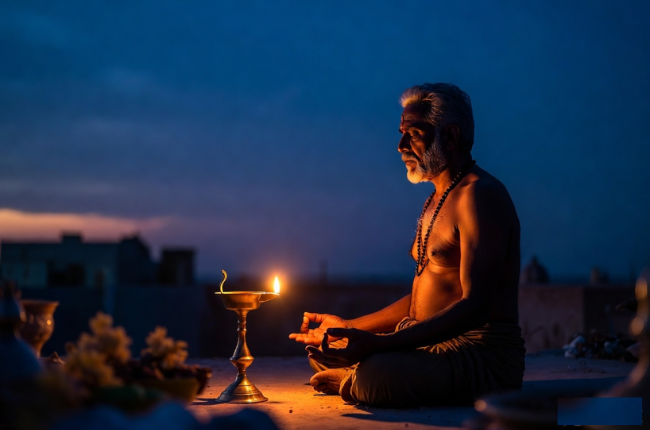
Most people who struggle to wake up early are not lazy. They are exhausted — and they know it. The alarm goes off, the mind calculates how much sleep is left, and the body makes a decision before the person is even fully conscious. By the time the sun is fully up, the day already feels like it started without them. A quiet sense of lost time trails through the morning, and no amount of coffee entirely removes it.
What the Vedic tradition calls Brahma Muhurta — the pre-dawn window roughly one and a half hours before sunrise — is not simply an ancient recommendation to wake up early. The classical texts treat this period as a qualitatively different kind of time. The Ashtanga Hridayam, the foundational text of Ayurveda authored by Vagbhata, opens its chapter on Dinacharya (daily routine) with a direct prescription: wake during Brahma Muhurta, for this period carries qualities of clarity, sattva (purity of mind), and prana (vital force) that no other hour of the day holds. The air is different. The mind is different. The classical texts do not say this metaphorically — they say it as a matter of Vedic physiology.
What most articles on this topic miss is the distinction between simply waking up early and waking up during Brahma Muhurta — and what that specific window does to the quality of the mind, the breath, and the body's rhythm when the practice is held consistently. This guide covers the exact time of Brahma Muhurta, what the classical texts say about it across Ayurveda and Jyotish traditions, the practical steps to establish the practice from today, the benefits documented across the classical framework, and two questions that no published content has answered with genuine Vedic grounding. By the end, you will know not just what Brahma Muhurta is but exactly what to do during it and why consistency matters more than perfection.
What Brahma Muhurta Is and When It Begins
A Muhurta in classical Vedic timekeeping is a unit of approximately 48 minutes — one thirtieth of a full day-night cycle of 24 hours. The day in Vedic reckoning is divided into thirty Muhurtas, each carrying a specific quality of time governed by planetary and elemental principles.
Brahma Muhurta is the fourteenth Muhurta of the night cycle — the second-to-last period before sunrise. It begins one hour and thirty-six minutes before sunrise and ends approximately forty-eight minutes before sunrise. In practical terms, this places Brahma Muhurta between roughly 3:40 AM and 5:20 AM during winter months, and between approximately 4:20 AM and 5:50 AM during summer months in most parts of India. The exact window shifts daily with the sunrise time at a person's specific location.
Why the Name Brahma
The word Brahma carries two simultaneous meanings in this context — both are intentional. Brahma refers to Brahman, the universal consciousness, the underlying reality that Vedic philosophy identifies as the ground of all existence. It also refers to Brahma, the creator deity of the Hindu trinity, who in classical narrative is said to begin the act of creation during this precise pre-dawn window each day. Waking during Brahma Muhurta is therefore described in classical texts not as rising early for personal benefit alone, but as aligning one's consciousness with the creative pulse of the universe at the moment it is most active.
The Sattvic Window
Classical Ayurveda divides the twenty-four hour cycle into three segments governed by the three Doshas — Kapha, Pitta, and Vata. Brahma Muhurta falls within the Vata-dominant pre-dawn period, when the mind is lightest, the nervous system is most receptive, and the quality of sattva — clarity, purity, and luminous awareness — is at its daily peak. The Charaka Samhita, the classical Ayurvedic text on internal medicine, describes this period as carrying sattvika qualities that are absent from all other hours of the day. A mind that receives impressions during this window, the text holds, retains them with a depth and clarity that the afternoon or evening mind cannot match.
How to Begin Brahma Muhurta Practice — Step by Step Starting Today
Most people who want to establish this practice fail not because they lack intention but because they attempt too sharp a shift. The classical Dinacharya tradition prescribes a graduated approach — the body's sleep rhythm is a physiological reality, not a moral failing, and the classical texts acknowledge this.
- Calculate your local Brahma Muhurta time. Find today's sunrise time for your city. Subtract one hour and thirty-six minutes — that is the start of Brahma Muhurta. Subtract forty-eight minutes from sunrise — that is when Brahma Muhurta ends. Set your alarm for the midpoint of this window as your target.
- Move your wake time backward by fifteen minutes every three days. If you currently wake at 7:00 AM, do not attempt a 4:30 AM alarm on day one. Move to 6:45 AM for three days, then 6:30 AM, and continue. The body's circadian rhythm adjusts in approximately three-day cycles. Forcing a ninety-minute shift overnight produces fatigue, not clarity.
- Adjust sleep time simultaneously. Brahma Muhurta practice is physiologically impossible if the person sleeps at midnight. The classical texts prescribe sleeping by 10:00 PM — the beginning of the Pitta night phase — to allow six to seven hours of sleep before the Brahma Muhurta alarm. Adjust the sleep time alongside the wake time, not separately.
- Keep water beside the bed the previous night. Drink one glass of room-temperature water within two minutes of waking. This activates the digestive fire (Agni), signals the body that the day has begun, and counteracts the Kapha heaviness that makes the first minutes after waking the hardest.
- Do not look at a phone screen for the first twenty minutes. The classical Dinacharya has no concept of a phone, but its logic is precise: the first impressions the mind receives after waking during Brahma Muhurta set the quality of the mental field for the entire day. News, social media, and notifications introduce rajasic (agitated) impressions into a sattvic window. Protect the first twenty minutes.
- Begin with three minutes of silent sitting. Before any mantra, prayer, or exercise — sit in stillness. Face east if possible. Allow the mind to settle into the quality of the hour before filling it with content. This three-minute pause is where most practitioners report the deepest shift in the practice's effect.
- Add your chosen Brahma Muhurta practice progressively. Start with one practice — mantra recitation, pranayama, or quiet reading of a classical or devotional text. Add a second practice only after the first has become automatic. The classical texts warn against overloading the early morning with ambition — simplicity held consistently outperforms a complex routine abandoned by the third week.
The Spiritual Benefits — What the Classical Texts Prescribe
The Vishnu Purana describes Brahma Muhurta as the period most favourable for Dharana (concentration), Dhyana (meditation), and Svadhyaya (self-study through sacred texts). The Manusmriti prescribes waking during this period for the twice-born student as a foundational daily obligation — not a recommended enhancement. The Skanda Purana names Brahma Muhurta as the hour when the Devatas — divine forces — are closest to the plane of human awareness, making prayer, mantra, and invocation during this window carry a potency that later-hour practice does not match.
What Happens to the Mind at This Hour
The mind during Brahma Muhurta has not yet accumulated the day's impressions — the conversations, the news, the decisions, the frustrations. It is closest to its own natural state. Classical Yoga texts, including the Hatha Yoga Pradipika, prescribe pranayama (breath regulation) specifically during this window because the breath at pre-dawn is at its most balanced — neither predominantly solar (Pingala) nor lunar (Ida) in character, but moving through Sushumna, the central channel. This balanced breath state is considered ideal for meditation, mantra work, and deep concentration.
Mantra Practice During Brahma Muhurta
The most widely prescribed mantra for Brahma Muhurta practice across classical traditions is the Gayatri Mantra — the solar invocation from the Rigveda's third Mandala, which is specifically addressed to the rising sun and its life-giving light. The Gayatri is traditionally recited 108 times during Brahma Muhurta, facing east, with pranayama between each set of 27 repetitions.
The Guru Granth Sahib — the central sacred text of the Sikh tradition — calls this pre-dawn period Amrit Vela, the ambrosial hours, and prescribes Nitnem (daily prayer) during this time with language that mirrors the Vedic description of Brahma Muhurta's qualities almost precisely — a point of cross-traditional convergence that carries its own quiet significance.
The Health and Ayurvedic Benefits — What the Body Gains
Brahma Muhurta benefits the body through mechanisms that classical Ayurveda documents with physiological specificity — not as vague wellness claims, but as observations about how the body's systems respond to the pre-dawn environment.
The Vata Window and Nervous System Receptivity
Vata governs movement, the nervous system, and the breath. During the pre-dawn Vata period, the nervous system is at its most receptive and least resistant state. Movement practices — Yoga asanas, Surya Namaskar, and simple walking — undertaken during Brahma Muhurta are absorbed more deeply by the musculoskeletal system than the same practices performed at other hours. The Ashtanga Hridayam prescribes Vyayama (physical exercise) during this period specifically because the body's capacity to integrate movement without stress is highest before the sun rises and the Pitta phase begins.
Respiratory Benefits of Pre-Dawn Air
The pre-dawn air carries a specific atmospheric quality that modern environmental science partially confirms: particulate matter is typically at its lowest concentration before vehicular and industrial activity begins, and the air's oxygen content relative to carbon dioxide is at its daily high point due to nighttime plant respiration. Classical Ayurveda describes this air as Prana-rich — carrying elevated vital force. The Charaka Samhita prescribes Pranayama specifically during Brahma Muhurta for respiratory health, and long-term practitioners across India's classical Yoga lineages consistently report improvements in lung capacity, sleep quality, and stress response over sustained practice.
Digestion and the Morning Agni
Waking during Brahma Muhurta — and drinking water immediately upon rising — activates the digestive fire (Jatharagni) before the first meal. Classical Ayurveda holds that a person who wakes during Brahma Muhurta and follows the prescribed morning routine arrives at their first meal with a fully activated digestive system, producing better nutrient absorption, more stable energy across the day, and reduced accumulation of Ama (undigested metabolic waste) in the body's channels.
Pandit's Tip — Focus: Shraddha As many families discover when they establish Brahma Muhurta as a household practice — the benefits do not arrive in the first week. The classical texts prescribe this practice as a daily discipline held across seasons, not a thirty-day experiment. What changes first is not productivity or health markers — it is the quality of the first thought of the day. That shift, subtle and consistent, is where the deeper transformation begins. A Pandit familiar with your household's practice will tell you: Brahma Muhurta is less a morning routine and more a daily act of choosing clarity before the world chooses noise for you.
Benefits for Students and Memory — What No Article Has Said Clearly
The connection between Brahma Muhurta and academic performance is one of the most consistently searched topics in Indian educational communities — and one of the most superficially treated in published content. Every article says "good for memory." None explains the classical mechanism.
The Charaka Samhita uses the term Medhya — intellect-supporting — as a category of practices and substances that strengthen the mind's capacity for retention, recall, and deep understanding. Brahma Muhurta practice is classified as a Medhya Dinacharya — a daily routine element that supports intellectual function specifically. The classical mechanism described is this: during sleep, the mind processes and consolidates the day's experiences. The final phase of sleep — the pre-dawn period — is when this consolidation is deepest. Waking during Brahma Muhurta, after this consolidation is complete but before the new day's impressions begin, creates what the Charaka Samhita describes as a clear field — a mental state in which new learning is absorbed at maximum depth.
What This Means for Students in Practice
- Material studied during Brahma Muhurta is absorbed into long-term memory more effectively than material studied during afternoon or evening hours — because the mental field is clear and unconsolidated new content has no competing impressions to displace it.
- Mathematical reasoning and analytical work performed during this window benefit from the Vata-governed precision of the pre-dawn mind — Vata's qualities of movement, clarity, and discrimination are at their daily peak.
- Creative work — writing, composition, and artistic problem-solving — benefits from the sattvic quality of the hour, which the classical texts associate with original insight rather than recombinative thinking.
As is commonly observed among families where students hold a consistent Brahma Muhurta study practice — the improvement in retention and examination performance becomes visible within one academic term, not one day.
What Brahma Muhurta Does to Career and Productivity — The Overlooked Dimension
Most productivity content in the modern world has rediscovered what the Vedic tradition formalised three thousand years ago — that the early morning hours carry a quality of uninterrupted focus unavailable at any other point in the day. The Vedic framing, however, goes further than productivity science in one specific way: it identifies why the pre-dawn hours produce a different quality of thought, not merely that they do.
The tenth house of career and professional success in Vedic astrology is governed by the Sun — and the Sun's power is at its most accessible at the precise moment of its rising. A person who is awake, settled, and engaged in conscious practice at the moment of sunrise has made a daily alignment with the solar principle that governs ambition, authority, and professional direction. The Brihat Parashara Hora Shastra describes the Sun's rising moment as carrying the energy of new karma — the potential for a day's worth of action to be set in its best direction.
Practically, the career benefit of Brahma Muhurta practice operates through three compounding mechanisms. The mind that begins the day in clarity makes better decisions than the mind that begins in reactive confusion. The person who has already completed a meaningful personal practice before work begins carries a different quality of presence into professional interactions. And the daily discipline of Brahma Muhurta — held across months and years — builds the quality the classical texts call Dhairya (steadiness of purpose) that no single productivity technique produces on its own.
Myth vs. Fact
MYTH: Brahma Muhurta only benefits people who are spiritual or religious — it has no practical value for working professionals or students.
FACT: The classical texts prescribe Brahma Muhurta as a universal Dinacharya obligation — not a spiritual optional. The Ashtanga Hridayam addresses it in the chapter on health and daily routine, not in the chapter on ritual. The benefits documented — nervous system receptivity, cognitive clarity, respiratory health, and digestive activation — apply to every person regardless of religious practice.
One Question Almost No Article Answers: What If You Cannot Wake During Brahma Muhurta Due to Night Shifts or Illness?
This question appears in nearly every Brahma Muhurta discussion thread on Reddit and Quora — nurses, factory workers, new parents, people recovering from illness — all of whom genuinely cannot access the pre-dawn window consistently. Every article prescribes the practice. None addresses what happens when it is structurally inaccessible.
Classical Ayurveda's answer to this is rooted in the principle of Satmya — the concept of individual adaptation. The Charaka Samhita acknowledges that Dinacharya prescriptions are ideals calibrated to the healthy, regularly sleeping individual in stable circumstances. For those whose life circumstances make the ideal inaccessible, the classical tradition offers a graduated application principle: access the closest available approximation of the sattvic window, and hold the practice's intention even when its exact form is unavailable.
For night-shift workers, the classical equivalent is the first waking moment after their sleep cycle ends — whatever hour that falls. The mind's quality immediately after deep sleep and before the day's impressions accumulate is structurally similar to Brahma Muhurta regardless of the clock time. A night-shift nurse waking at 1:00 PM after sleeping from 7:00 AM should treat the first twenty minutes after waking with the same protective approach prescribed for Brahma Muhurta — no phone, water first, three minutes of stillness, one mantra or breath practice.
For those recovering from illness — where waking before sunrise is physically depleting rather than energising — the Ashtanga Hridayam is explicit: the sick person's first obligation is to the body's healing, not to the ritual schedule. The Brahma Muhurta practice is resumed as the body's strength returns. Forcing the pre-dawn discipline during genuine illness is described in classical Ayurveda as a Vata aggravation — it depletes the very prana the practice is intended to build.
FAQ
What time exactly does Brahma Muhurta start and end each day? Brahma Muhurta begins one hour and thirty-six minutes before sunrise and ends forty-eight minutes before sunrise at your specific location. The window is approximately forty-eight minutes long and shifts daily with the sunrise time. For most Indian cities, this places Brahma Muhurta between 4:00 AM and 5:30 AM depending on the season and geography.
What should I do during Brahma Muhurta for the best results? Classical Dinacharya prescribes this sequence: drink water immediately upon waking, sit in stillness facing east for three minutes, perform pranayama or Gayatri Mantra recitation for fifteen to twenty minutes, then engage in Yoga, walking, or sacred text study. Begin with one practice and add progressively — a simple routine held daily outperforms a complex one abandoned within weeks. As astrological tradition holds, individual outcomes vary with karma and sincerity.
How does waking up in Brahma Muhurta benefit the mind and memory? The Charaka Samhita classifies Brahma Muhurta as a Medhya Dinacharya — a daily practice that supports intellectual function. The mind immediately after deep sleep consolidation is at its most receptive state. Material studied, problems considered, and decisions made during this window are processed with a depth and clarity unavailable at other hours, because the mental field carries no accumulated impressions from the day.
Can Brahma Muhurta practice help with stress and anxiety? Classical Ayurveda attributes stress and anxiety primarily to Vata imbalance — aggravated movement in the nervous system. Brahma Muhurta practice, particularly pranayama and silent meditation during this window, directly addresses Vata through the sattvic quality of the pre-dawn hour. Consistent practice over three to four weeks produces measurable reduction in morning anxiety for most practitioners. Personal results depend on individual constitution, karma, and the consistency of practice.
Is it harmful to sleep through Brahma Muhurta regularly? The Ashtanga Hridayam describes sleeping through Brahma Muhurta as one of the causes of Kapha accumulation — producing heaviness, mental dullness, and reduced digestive fire over time. The classical text does not use the language of harm in an acute sense — it describes a gradual diminishment of the body's sattvic capacity when the pre-dawn window is consistently missed. The effect accumulates over months, not days.
What is the difference between Brahma Muhurta and Amrit Vela? Brahma Muhurta is the Vedic Sanskrit term for the pre-dawn auspicious window — prescribed in Ayurvedic and Dharmashastra texts as the ideal time for daily practice. Amrit Vela is the term used in the Sikh tradition, drawn from the Guru Granth Sahib, for the same pre-dawn period of spiritual practice. Both traditions describe this window in nearly identical terms — heightened clarity, receptivity, and proximity to the divine — from within their respective classical frameworks.
Does Brahma Muhurta practice change anything about planetary effects in my Kundli? Vedic Jyotish holds that consistent Brahma Muhurta practice — particularly Surya Namaskar and Gayatri Mantra recitation at sunrise — strengthens the Sun's influence in the natal chart regardless of its natal placement. A weak Sun in the Kundli, which may manifest as low confidence or career inconsistency, responds over time to disciplined solar-hour practice. This is not a substitute for a proper Graha Shanti ritual prescribed by a Jyotishi — it is a complementary daily practice that works alongside the prescribed remedy.
Conclusion
Brahma Muhurta is the oldest productivity prescription in Indian civilisation — and it predates the language of productivity entirely. The classical texts that prescribe it are not talking about getting more done. They are talking about becoming a person who meets the day from a place of clarity rather than being overtaken by it.
Start tonight: calculate tomorrow's Brahma Muhurta window for your city, set the alarm for fifteen minutes earlier than usual, and keep a glass of water beside the bed. That single shift — water first, stillness before the phone, three minutes of quiet — is where the practice begins. Everything else is built from there, one morning at a time.
As is commonly observed among families where even one member holds the Brahma Muhurta practice with genuine consistency — the quality of the household's mornings changes before anyone can fully explain why. The classical tradition holds that outcomes depend on karma, sincerity, and the willingness to be present at the moment the day offers its best quality of light. That moment arrives every morning, without exception, for everyone who is awake to receive it.
If you want personalised guidance on integrating Brahma Muhurta practice with your Kundli's planetary configuration — including which mantras, which practices, and which timing suits your specific chart — AtoZPandit.com connects you with verified Jyotish and Ayurveda experts who provide a complete daily practice prescription. Book your Vedic Dinacharya consultation on AtoZPandit.com and begin your mornings with the full clarity the classical tradition promises.
Disclaimer This article is written for educational and cultural awareness purposes only. The Vedic and Ayurvedic information provided here does not substitute professional medical or psychological advice. For a complete and personalised Dinacharya or Kundli consultation, connect with a qualified expert at AtoZPandit.com.