Tarot Card Reading Guide What Career and Hidden Potential Questions Reveal
There is a kind of stuck feeling that does not respond to practical advice. The resume is strong. The interviews go well. The skills are genuine. But something about the direction feels unclear — like standing at a crossroads where every path looks reasonable and none feels right. Or a person has been in the same role for four years, knows they are capable of more, but cannot name what that more actually looks like. The problem is not information. The problem is clarity about something that practical analysis cannot fully reach.
This is where tarot card reading has found its most consistent and most honest use — not as a system for predicting fixed outcomes, but as a structured mirror that reflects patterns, tendencies, and hidden dimensions of a situation back to the person sitting with the question. A tarot reading does not tell you what will happen. It shows you what is currently shaping what happens — the energies, the blocks, the unexplored strengths, and the directions that deserve attention. For career decisions and the discovery of hidden potential in particular, this distinction matters enormously.
What almost no popular guide to tarot explains clearly is that tarot is not a Vedic system and does not claim to be one. It emerged from a European tradition — its imagery draws from Kabbalistic, Hermetic, and Christian mystical sources — and functions through a completely different mechanism than Jyotish, Numerology, or Vastu. Understanding what tarot actually is, how it operates, what it can genuinely reveal, and where its limitations lie is the foundation that makes a reading genuinely useful rather than merely entertaining. This article covers the complete framework — the deck structure, the major career-relevant cards, the spreads that work best for professional questions, how to approach a reading with the right questions, and how to distinguish between what a tarot reading can honestly deliver and what it cannot.
What Tarot Card Reading Actually Is — And What It Is Not
Tarot is a card-based divination and reflective system using a deck of 78 cards, each carrying a specific image, symbol, and interpretive framework. The standard tarot deck — established in its modern form through the Rider-Waite-Smith deck published in 1909 — divides into two sections: the Major Arcana of 22 cards representing archetypal life forces and major life themes, and the Minor Arcana of 56 cards divided into four suits representing the everyday dimensions of human experience.
The word arcana means secrets or mysteries — the hidden knowledge that the cards are understood to reflect when placed in specific patterns called spreads. A spread is a structured layout where each position carries a specific meaning — past influence, present situation, hidden factor, near future, and so on — and the card that falls in each position is interpreted in relation to both the position's meaning and the question being asked.
How a Tarot Reading Actually Works
A tarot reading works through the mechanism of synchronicity — the meaningful coincidence that the Swiss psychologist Carl Jung documented and that the tarot tradition had operated through for centuries before Jung named it. The reader shuffles the deck with the querent's question held in mind — either by the reader alone in a remote reading, or by the querent physically in a face-to-face reading — and the cards that emerge are understood to reflect the current energetic and psychological landscape of the querent's situation with meaningful rather than random accuracy.
This is not a claim of supernatural causation. The tarot tradition makes no claim that the cards possess independent knowledge. What it claims is that the human mind, when presented with rich symbolic imagery in the context of a specific question, accesses information and makes connections that rational, linear analysis does not reach. The cards serve as the symbolic surface against which this deeper processing occurs.
What Tarot Is Not
Tarot is not Vedic astrology. It does not use birth chart calculations, planetary positions, Nakshatra analysis, Dasha periods, or any of the technical framework of Jyotish. A tarot reading and a Jyotish reading may arrive at complementary insights about the same situation — but they do so through completely different mechanisms, and neither substitutes for the other.
Tarot is not prophecy in the classical sense. A tarot reading describes what is likely given current energies and trajectories — it does not describe fixed, inevitable outcomes. This is the distinction that makes tarot genuinely useful: if the reading reveals a block or a misdirection, the reader can address it. If the outcome were fixed, addressing it would be meaningless.
Tarot is not a Vedic or Indian system in its origin. It is a Western esoteric tradition that has been widely adopted in India and across the world. AtoZPandit.com offers tarot readings as a standalone guidance system — distinct from and complementary to the Vedic services on the platform, not a replacement or equivalent of them.
How to Perform Basic Tarot Card Reading Steps at Home
These steps are consistent with how professional tarot practitioners approach a reading and provide a structured framework for anyone beginning to explore tarot for personal guidance, particularly around career and purpose questions.
- Choose a quiet space and a clear timeframe. Tarot reading requires a quality of focused attention that a noisy or interrupted environment does not support. Choose a time when you will not be disturbed for at least thirty minutes. Early morning or late evening — when the mind is naturally quieter — produce the clearest readings for most people.
- Formulate your question precisely before touching the deck. This is the step most beginners skip — and it is the most important. A vague question produces a vague reading. Instead of "Will my career improve?" ask: "What is the primary block preventing my professional growth right now?" or "What hidden strength am I not fully using in my current career?" The more specific and honest the question, the more specific and useful the reading.
- Hold the deck in both hands and focus on your question. Breathe slowly. Allow the question to settle in the mind clearly — not as an anxious demand for an answer but as a genuine, open inquiry. Some practitioners recite a brief intention aloud: "I ask for clarity about [specific question]. May this reading reflect what is most true and most useful."
- Shuffle the deck thoroughly — at least seven complete shuffles — while maintaining the question in mind. The shuffling is not a mechanical process; it is the moment of engagement between the querent's energy and the deck. Cards that fall out during shuffling are noted as significant — they have, in the traditional view, insisted on being seen.
- Cut the deck once with the left hand and reassemble it. The left hand is traditionally associated with the intuitive, receptive dimension — the hand that receives rather than directs.
- Draw cards for your chosen spread — placing each card face-down in its designated position first, then turning them face-up together or one at a time depending on preference. The three-card spread (Past — Present — Future, or Situation — Action — Outcome) is the most accessible starting point for beginners. The Celtic Cross spread of ten cards is the standard for more complex career and life-direction questions.
- Read each card in relation to its position and the question — not in isolation. A Tower card in the "hidden obstacle" position carries a different message than the same Tower card in the "near future" position. Context is everything in tarot interpretation. Spend time with each card before moving to the next — resist the urge to move through them quickly.
- Record the reading in a dedicated journal. Date it, write the question, note the spread used, record which cards fell in which positions, and write your interpretation and any strong impressions the reading produced. Return to the journal entry after four to six weeks and assess which elements proved accurate or useful.
The Major Arcana Cards Most Relevant to Career and Potential
The 22 Major Arcana cards represent the large, archetypal forces that shape human experience — the themes and energies that operate beneath the surface of daily events. In a career reading, Major Arcana cards carry the most weight: their appearance signals that the career question being asked is connected to deeper life forces, not just immediate practical circumstances.
The Magician — Card I
The Magician is the card of directed will, skill, and the capacity to translate intention into action. In a career reading, the Magician's appearance in a present or near-future position signals that all the resources needed for the desired professional outcome are already available — the question is whether the querent is using them with focus and intention. It is the card of the entrepreneur, the skilled specialist, and the person whose career breakthrough comes from trusting their existing capabilities rather than waiting for new ones.
For hidden potential readings, the Magician in the "what you are not seeing" position is particularly significant: it suggests that the querent already possesses skills and resources that they are underestimating or directing toward the wrong goals.
The High Priestess — Card II
The High Priestess is the card of intuition, hidden knowledge, and the wisdom that does not arrive through rational analysis. In a career reading, her appearance suggests that the answer to the professional question lies below the surface — in the querent's instinctive sense of what is right, rather than in practical calculation. She appears frequently in readings for people who are intellectually committed to one career direction while their deeper knowing is pulling them elsewhere.
For creative professionals, researchers, counsellors, and anyone whose work requires accessing non-linear intelligence, the High Priestess is among the most auspicious career cards.
The Emperor — Card IV
The Emperor represents structure, authority, discipline, and the capacity to build lasting systems. In a career context, his appearance signals the importance of establishing clear professional boundaries, hierarchies, and systematic approaches to work. He is the card of the senior manager, the institutional builder, and the person whose professional strength lies in creating order from complexity. In a "hidden potential" position, the Emperor suggests that the querent's capacity for disciplined structure and leadership is underused in their current role.
The Wheel of Fortune — Card X
The Wheel of Fortune signals a turning point — a moment when external circumstances are shifting in ways that create opportunity or require adaptation. In a career reading, this card in a near-future position signals an approaching change that the querent has not fully anticipated. It is not a card of personal agency — it represents forces larger than individual will. The key interpretive question is whether the querent is positioned to ride the turn or likely to be caught unprepared by it.
The Star — Card XVII
The Star is the card of hope, clarity of direction, and the alignment between personal purpose and external opportunity. In a career reading — particularly one focused on hidden potential — the Star's appearance signals that a genuine path exists that connects the querent's deepest aspirations with practical professional expression. It is one of the most genuinely encouraging cards in the Major Arcana for career questions, appearing most powerfully after a period of professional difficulty as a signal that the turning point has arrived.
The Moon — Card XVIII
The Moon is the card of confusion, hidden fears, and the distortion that anxiety produces in perception. In a career reading, it most commonly signals that the querent's professional situation is not as clear as it appears — something is hidden, either from the querent by others or from themselves by their own fears. It is the card most associated with imposter syndrome, the fear of visibility, and the self-sabotage that keeps genuinely capable people from pursuing opportunities that are genuinely available to them.
The Sun — Card XIX
The Sun is among the most unambiguously positive cards in the Major Arcana for career readings. It signals clarity, confidence, success, and the coming into visibility of work that has been building in the background. In a near-future position, the Sun suggests that a period of professional recognition and reward is approaching. In a "hidden potential" position, it signals a natural capacity for leadership, visibility, and joyful self-expression in professional life that the querent has not yet fully claimed.
Myth vs. Fact
MYTH: The Death card in a tarot reading means a career will end badly or something terrible is about to happen professionally.
FACT: The Death card — Card XIII of the Major Arcana — almost never refers to literal death in tarot interpretation and never refers to failure in professional readings. It is the card of transformation, ending, and necessary completion — the professional phase, relationship, or identity that must conclude so that the next one can begin. In a career reading, the Death card most commonly signals that a current role, project, or professional identity has run its full course and is ready to be released. The transformation it heralds may feel uncomfortable — endings usually do — but the card's consistent meaning across the tarot tradition is renewal through completion, not destruction.
The Four Suits of the Minor Arcana and What They Reveal About Career
The 56 Minor Arcana cards are divided into four suits — Wands, Cups, Swords, and Pentacles — each governing a distinct dimension of human experience. In career readings, the suit that appears most frequently across a spread provides crucial information about where the primary energies and primary challenges of the professional situation lie.
Wands — Fire, Ambition, and Creative Drive
Wands are associated with the fire element — ambition, passion, creative energy, entrepreneurship, and the drive to initiate. A career reading dominated by Wands signals a situation full of energy, opportunity, and momentum — but potentially also one where the querent is spreading themselves too thin or pursuing multiple directions without sufficient focus. The Ace of Wands in a career reading is among the most positive signals of a new professional beginning with genuine creative potential. The Ten of Wands signals professional overload — taking on more than can be sustainably managed.
Cups — Water, Relationships, and Emotional Intelligence
Cups are associated with the water element — emotional life, relationships, creativity, intuition, and the quality of meaning in work. A career reading dominated by Cups signals that the emotional and relational dimensions of the professional situation are the primary factors — job satisfaction, team relationships, the sense of purpose in the work, and the alignment between professional life and personal values. For careers in counselling, teaching, healthcare, the arts, and any service-oriented profession, Cups cards carry particular relevance. The Ace of Cups in a career reading signals a new professional beginning that carries deep emotional resonance and meaning.
Swords — Air, Clarity, Conflict, and Decision
Swords are associated with the air element — thought, communication, conflict, decision-making, and the clarity that comes from honest analysis. A career reading dominated by Swords signals a situation where the primary challenges are mental and communicative — difficult decisions that must be made, conflicts that require resolution, or communication patterns that are creating professional obstacles. The Ace of Swords in a career reading signals the arrival of mental clarity and the capacity to cut through confusion to a clear decision. The Ten of Swords signals a situation that has reached its painful conclusion — and, crucially, that the worst is now behind rather than ahead.
Pentacles — Earth, Resources, and Material Manifestation
Pentacles are associated with the earth element — material resources, financial security, practical skills, career advancement, and the physical manifestation of effort. A career reading dominated by Pentacles is almost always directly about the practical, material dimension of professional life — salary, financial stability, skill development, and the slow, patient building of lasting professional value. The Ace of Pentacles in a career reading is among the clearest signals of a new professional opportunity with solid material foundations. The Ten of Pentacles signals lasting material security and the completion of a long-term professional building process.
The Best Tarot Spreads for Career and Hidden Potential Readings
The spread — the specific pattern in which cards are laid and the meaning assigned to each position — determines the kind of information a tarot reading produces. Different spreads are suited to different types of questions. For career and hidden potential questions, three spreads are consistently the most useful.
The Three-Card Spread — Situation, Action, Outcome
The simplest and most accessible career spread. Three cards are drawn and placed left to right. The first card represents the current career situation — where things actually stand, stripped of the story the querent is telling themselves. The second card represents the action most aligned with the querent's highest interest — not what they want to do, but what would most effectively serve their stated professional goal. The third card represents the likely outcome if the action of card two is taken.
This spread is best used for a single, specific career question — a decision between two opportunities, a question about a specific professional relationship, or a short-term direction check.
The Celtic Cross — The Standard for Complex Career Questions
The Celtic Cross is the most comprehensive and most widely used tarot spread — a ten-card layout that examines a career situation from multiple simultaneous angles. The ten positions cover: the present situation, the immediate challenge or cross-energy, the foundational past, the recent past, the potential future, the near future, the querent's internal perspective, external influences, hopes and fears, and the final outcome.
For career questions that involve multiple factors — a job change decision, a long-term direction question, a question about hidden blocks to professional growth — the Celtic Cross provides the most complete picture of any single spread. It is the spread that most repays careful, unhurried interpretation.
The Hidden Potential Spread — A Five-Card Layout
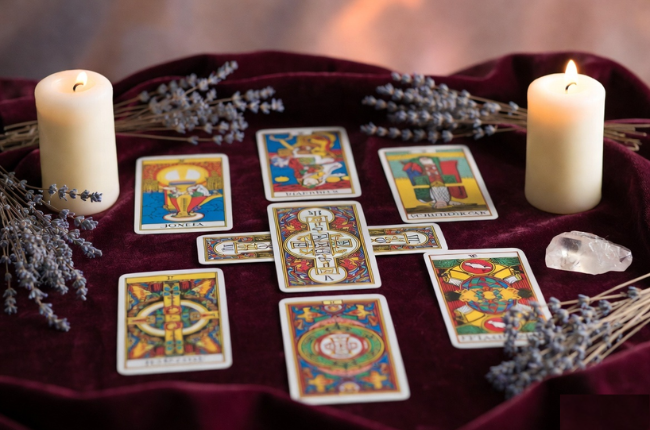
This spread is specifically designed for the question: what strengths, talents, or directions am I not fully seeing in myself? Five cards are drawn and placed in a cross pattern. The centre card represents the querent's known professional identity — how they currently understand their career self. The card above represents what is emerging — the potential developing toward expression. The card below represents what is foundational — the deep strength or value the career is built on, whether the querent recognises it or not. The card to the left represents what is being held back — the skill, direction, or quality that fear, habit, or circumstance is preventing from full expression. The card to the right represents the next step — the specific action most aligned with the hidden potential the reading has revealed.
Internal link: For how Vedic astrology's approach to career through planetary houses and Mahadasha periods compares with tarot's perspective on professional potential, see the Career Astrology Complete Guide Which Planet Blocks Job Success.
Pandit's Tip — Focus: Manasa
Honestly, this surprises most people approaching tarot for the first time: the quality of the question matters more than the quality of the deck. A practitioner who has worked with tarot for years consistently observes that querents who arrive with a precise, honest, and genuinely open question receive readings that are specific and useful — while those who arrive with a vague hope for reassurance receive readings that feel equally vague. The tarot responds to the quality of attention brought to it. Before formulating your career question, spend five minutes writing honestly about what you actually want to know — not what you wish were true, not what would feel most comfortable to hear, but what you genuinely need clarity about. That written honesty, translated into a precise question, is the single most reliable way to improve the usefulness of a tarot reading.
What the Tarot Tradition Says About the Nature of Readings
The tarot tradition — drawing from its Hermetic and Kabbalistic roots — understands the deck as a map of human experience rather than a predictive instrument. The Hermetic principle that underlies the tarot system is expressed in the phrase as above, so below — the idea that the patterns operating at the cosmic level are mirrored in the patterns of individual human experience, and that symbolic systems like the tarot provide a language for reading those correspondences.
The Kabbalistic Tree of Life — the ten Sefirot connected by 22 paths — provides the structural foundation for the Major Arcana's 22 cards, with each card corresponding to one of the 22 paths. This correspondence means that the Major Arcana is not an arbitrary collection of images but a systematic map of the forces that operate between the human and the divine — between the material and the spiritual — in the Kabbalistic understanding.
Arthur Edward Waite, whose collaboration with illustrator Pamela Colman Smith produced the Rider-Waite-Smith deck in 1909, brought these Hermetic and Kabbalistic correspondences into a visual system accessible to non-initiates — arguably the single most significant contribution to popular tarot practice, as it made the symbolic language of the cards visible and interpretable without specialist training.
Vedic Essence: The underlying principle of tarot — that the universe operates through patterns that can be read symbolically if the right kind of attention is brought to the right kind of symbol at the right kind of moment — is consistent with the broader Vedic understanding of Nimitta — the science of omens and signs through which the subtle world communicates with those attentive enough to receive its signals.
Tarot vs. Vedic Astrology — What Each Does That the Other Cannot
This is the content gap that is absent from virtually every article on tarot in the Indian context — and it is the most practically important piece of information for someone trying to decide which system to consult for a specific question.
The two systems operate through entirely different mechanisms and produce different kinds of insight. Understanding the genuine strength of each — rather than treating them as competitors — allows a person to choose the right tool for the specific question they are carrying.
Vedic astrology (Jyotish) works from the birth chart — a precise mathematical calculation based on the exact date, time, and place of birth. It provides a map of the individual's karmic potential across the entire life: which periods (Dashas) are active, which planets govern career and wealth, what the timing of major life events is likely to be, and what the deepest structural patterns of the individual's destiny look like. Jyotish is strongest for questions of timing, long-arc life patterns, and structural karmic analysis. It requires accurate birth data and a qualified practitioner who can read the chart correctly.
Tarot works from the present moment — the specific question, the current energetic landscape, and the symbolic information that emerges from the spread at the moment of the reading. It does not require birth data. It is strongest for questions about current blocks, immediate decisions, psychological patterns, and the hidden dimensions of a present situation. It works best for exploratory, open questions — "what is shaping this situation" — rather than predictive, timeline-specific questions — "when will I get the promotion."
The most useful combination — increasingly recognised by practitioners of both systems — is to use Jyotish for the structural, timing, and karmic analysis of a career situation and tarot for the current energetic and psychological dimension of the same situation. A Jyotish reading might reveal that a person is in a Jupiter Mahadasha particularly favourable for intellectual and teaching-oriented work. A tarot reading of the same person's career question might reveal that the Moon card in the hidden obstacle position is signalling a specific fear of visibility that is preventing them from pursuing the very opportunities the Jupiter Dasha is opening.
The two readings do not compete — they illuminate different layers of the same situation.
Internal link: For the Vedic astrology framework for career and professional timing, see the Vimshottari Dasha Complete Guide How Planetary Periods Affect Life Career.
One Question No Article Answers: What Happens When Two Different Tarot Readers Give Contradictory Readings on the Same Career Question
This is the question that appears most consistently in tarot community forums — Reddit's r/tarot, Quora's tarot threads, and YouTube comment sections of career tarot reading videos — and receives the least satisfying published answer. The situation is genuinely confusing: a person asks the same career question of two different qualified readers and receives readings that appear to point in opposite directions. One reader sees the Queen of Pentacles as the outcome — stability, practical achievement, and grounded success. The other reader draws the Tower as the outcome — disruption, collapse of the existing structure, and forced change. How can both be true?
The tarot tradition addresses this through the concept of multiple probability streams — the understanding that a reading reflects the most likely energetic trajectory given current conditions, and that conditions change. A reading from two different readers on the same question on two different days is not reading a fixed future from two different angles — it is reading two different moments in the same evolving energetic situation, filtered through two different readers' interpretive frameworks and intuitive lenses.
The practical guidance that experienced practitioners consistently give is this: when two readings contradict each other, the contradiction itself is information. It signals that the situation is genuinely in flux — that multiple outcomes are actively possible and that the querent's choices and actions in the near term will be the determining factor. A Tower-vs.-Queen-of-Pentacles contradiction on a career question says, most honestly: the situation you are in right now could resolve through either transformation and disruption or through stable, patient building — and which of these paths you take depends on decisions you have not yet made.
The second practical guidance: look at where the readings agree, not where they disagree. If both readers, despite different outcome cards, drew Swords-dominated present positions — both seeing a situation characterised by mental conflict, difficult decisions, and communication challenges — that convergence is the most reliable information the two readings together produce.
What to Do When a Tarot Reading Reveals Something Difficult
This is the second piece of Uncovered Territory that real users of tarot carry and that published content almost never addresses with the specificity and honesty the question deserves. The situation: a career-focused tarot reading produces cards that, taken together, suggest stagnation, blocked energy, or a difficult period ahead. The querent is distressed. The question is: what does one actually do with difficult information from a tarot reading?
The tarot tradition's foundational position on this — stated across virtually every classical tarot text from Waite's Pictorial Key to the Tarot through the contemporary scholarship of practitioners like Rachel Pollack — is that no card combination represents a fixed, unavoidable outcome. The reading reflects current energies and trajectories. Trajectories can be altered.
When a reading reveals a block — the Five of Pentacles suggesting financial insecurity, the Eight of Swords suggesting a self-imposed mental prison, the reversed Ace of Wands suggesting stalled creative energy — the correct response is not distress but specific, targeted action directed at the energy the card is identifying.
A Five of Pentacles in a career reading calls for an honest inventory of current financial management and a specific plan to reduce professional vulnerability. An Eight of Swords calls for an honest examination of the beliefs and stories the querent is telling themselves about their professional capacity — specifically, which of those stories are self-limiting rather than accurate. A reversed Ace of Wands calls for identifying what is draining creative energy and removing it, rather than pushing harder with less.
Difficult cards are not warnings to be feared — they are diagnostic tools. The most experienced tarot practitioners consistently describe their most personally useful readings as the ones that showed them something uncomfortable and true — because those readings pointed to the exact place where intentional change was most needed and most available.
Personal results, as always, depend on individual karma, the quality of practice, and the willingness to act on what the reading has genuinely revealed.
FAQ
Q1: How does tarot card reading work for career guidance? Tarot card reading works by placing specific cards in a structured spread where each position carries a designated meaning — present situation, hidden obstacle, likely outcome, and so on. The cards that emerge reflect the current energetic and psychological landscape of the career situation. A skilled reader interprets the cards in relation to the specific career question asked, identifying patterns, blocks, and directions that the querent may not have consciously recognised. The reading does not predict fixed outcomes — it reveals what is currently shaping the professional situation.
Q2: Can tarot card reading accurately predict career success? Tarot reading reflects current energetic trajectories and psychological patterns — it does not predict fixed career outcomes. A reading can identify the most likely professional direction given current conditions, reveal hidden blocks that are preventing progress, and signal approaching changes or opportunities. As the tarot tradition consistently holds, outcomes depend on the individual's choices and actions following the reading — a reading that reveals an obstacle is most useful when the querent takes targeted action to address that obstacle rather than waiting passively for events to unfold.
Q3: What is the difference between tarot and Vedic astrology for career questions? Vedic astrology works from the birth chart — providing structural, timing-based, and karmic analysis of the career across the full life arc. It is strongest for long-arc career pattern analysis and Dasha timing questions. Tarot works from the present moment — providing insight into current blocks, immediate decisions, and psychological dimensions of the professional situation. Tarot does not require birth data. The two systems complement rather than substitute for each other — Jyotish maps the terrain, tarot identifies what is happening in the current moment on that terrain.
Q4: Which tarot spread is best for finding hidden career potential? The five-card Hidden Potential spread — centre card for current professional identity, card above for emerging potential, card below for foundational strength, card to the left for what is being held back, and card to the right for the next step — is specifically designed for this question. The Celtic Cross provides a more comprehensive analysis when the career situation involves multiple simultaneous factors. The three-card Situation-Action-Outcome spread is the most accessible starting point for a single, specific career decision question.
Q5: Is tarot reading a part of Vedic tradition or a separate system? Tarot is a Western esoteric tradition — it draws from Hermetic, Kabbalistic, and later European mystical sources and is not a Vedic or Indian system in its origin. It has been widely adopted in India as a standalone guidance system, valued for the specific kind of insight it provides about current psychological and energetic patterns. AtoZPandit.com offers tarot readings as a distinct service — separate from and complementary to the Vedic Jyotish, Numerology, and ritual services on the platform, not a replacement or equivalent of them.
Q6: How often should one get a tarot reading for career guidance? The tarot tradition consistently advises against asking the same question in a new reading within less than four to six weeks of the previous reading. A reading reflects the energetic state of a situation at a specific moment — asking again too soon does not produce more information, it produces noise. A useful rhythm for career-focused tarot is one reading per major decision point or at the beginning of each new professional quarter, with a minimum of six weeks between readings on the same specific question.
Q7: Can a person with no experience read tarot cards for themselves accurately? A beginner can use tarot productively for self-reflection and exploratory inquiry — the three-card spread with a clear question, a good reference guide to card meanings, and an honest willingness to sit with what the cards reveal produces genuinely useful self-inquiry for most people who approach it sincerely. For complex career decisions, relationship dynamics, or situations with high stakes, a professional reader's interpretive experience — particularly their capacity to read cards in combination and in the context of the full spread — produces more complete and more reliable guidance than most beginners can access independently.
Conclusion
Tarot card reading, used honestly and with appropriate expectations, is one of the most accessible and genuinely useful tools for career reflection and the discovery of hidden potential available today. It does not replace the structural analysis that Vedic astrology provides, the precision of a numerological assessment, or the transformative power of a well-performed puja — but it serves a function that none of these other systems serves quite as directly: it holds up a mirror to the present moment, in all its complexity, and asks the querent to look honestly at what they see.
The most practical step for anyone approaching tarot for career guidance today is to formulate one honest, specific question — not "will I succeed" but "what is standing between me and the professional expression I am capable of" — and to bring that question to either a structured self-reading or a professional reader whose approach is grounded, honest, and free of performance.
As the tarot tradition consistently holds, the reading is most useful to those who approach it not as an oracle to be appeased but as a conversation with their own deeper knowing — one that the cards facilitate but that the querent must ultimately take responsibility for acting on.
If you want a professional tarot card reading focused on your career direction, hidden potential, or a specific professional decision, connect with an experienced reader at AtoZPandit.com. Our practitioners provide structured, honest career-focused readings — not generic card pulls, but a complete spread interpretation built around your specific question.
Disclaimer: This article is written for educational and cultural awareness purposes only. Tarot card reading is a reflective and guidance-based practice and does not constitute professional career, financial, medical, or legal advice. For personalised Vedic guidance on your specific situation, connect with a qualified Pandit at AtoZPandit.com.