
Vedic Gemstone Guide: Selection, Trial, Metal-Pairing & Activation
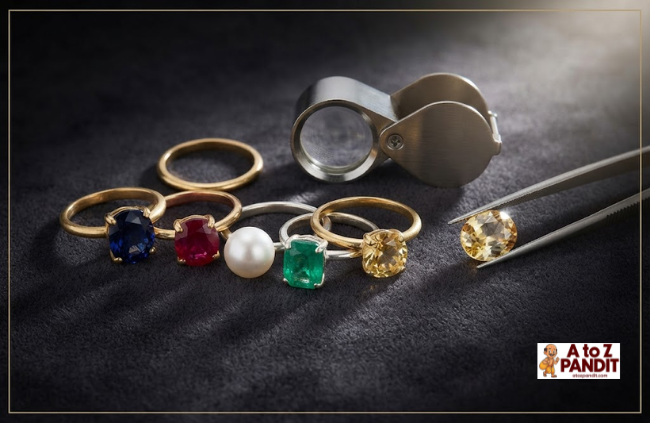
Every family that has ever bought a Blue Sapphire has, at some point, sat with the box unopened for an extra day — turning it over, wondering if the man at the counter was honest, and if the finger the neighbour swore by is even correct. That hesitation is not superstition; it is the sensible response to an industry where one dealer says test it yourself with acetone and the next says no home test is ever reliable. We have spent seasons untangling exactly this — sitting across from Mumbai and Thane families holding a stone they're afraid to wear, and afraid not to. This piece walks through selection, authentication, the safety trial, metal-pairing, finger placement, and activation as one sequence, not scattered rules. Where regional practice differs, we say so plainly. This is educational and cultural guidance, not a substitute for a personal chart reading.
While the questions here can feel heavy — a wrong stone, a wasted trial, money spent on glass dressed as sapphire — Vedic science teaches that the remedy is always stronger than the malady. We are here to move you from Bhaya, fear, to Abhaya, fearlessness, before we explain anything else.
The Navaratna and Uparatna Map
Nine planets, nine Navaratna gems: Ruby for Surya, Pearl for Chandra, Red Coral for Mangal, Emerald for Budh, Yellow Sapphire for Guru, Diamond for Shukra, Blue Sapphire for Shani, Hessonite for Rahu, Cat's Eye for Ketu. Each Uparatna — the secondary or substitute stone — exists because the primary gem is rare, costly, or unavailable at the required clarity. Iolite steps in for Blue Sapphire under Kaka Nili. White Sapphire stands behind Diamond. Amethyst is called on for a working Saturn remedy when Neelam's intensity feels excessive for a first-time wearer.
What most listicle guides skip: the Navagraha set is a hierarchy, not a shopping list. A chart typically calls for one primary stone, occasionally a second for a genuinely weak but friendly planet, and almost never all nine together — despite how often families buy a Navaratna ring on the strength of "it covers everything." And between us, this is what most families never hear from the shop counter: covering everything with weak-grade stones in one crowded ring usually means feeling nothing from any of them.
Diagnostic Framework: Do You Actually Need This Stone?
In consultation after consultation, the same pattern repeats: someone arrives already holding a stone, asking us to confirm what a jeweller already told them, rather than asking what their chart needs. Before any Ratna is chosen, three questions decide everything: is the planet weak, is it friendly, and is this the right period to strengthen it?
A gemstone amplifies a planet's existing signal — it does not create strength from nothing. This is why the same Yellow Sapphire that helps one Sagittarius-ascendant client can unsettle another: functional benefic status depends on house lordship, not sign alone. A malefic planet's stone, worn without checking Dasha timing, tends to intensify the very difficulty it was meant to soften. We have watched this happen with Mangal stones bought during an already-active Mars Antardasha — the coral did not fail; it was simply given at the wrong Vara for that chart. The honest sequence: confirm the planet is functionally benefic for your Lagna, confirm it is genuinely weak rather than merely "could be stronger," and confirm your Dasha won't over-amplify it. Skip one step and the stone turns decorative — worn, but doing nothing.
The Fake-Stone Reality: Testing Honestly
Two claims circulate with equal confidence: that a handful of home tests can expose a fake gemstone, and that no home test is ever reliable enough to trust. Both are partly right. Home checks can rule stones out; only a lab report can rule one in with certainty.
This is the gap almost every gemstone article on the first page misses — each presents one side as the full truth. Density, clarity under a loupe, and behaviour under UV light reliably flag glass, plastic, and many dyed substitutes; a genuine Neelam should feel distinctly heavier in the palm than its size suggests, and a scratch test against ordinary glass confirms hardness in stones like sapphire and ruby. What these checks cannot catch is a well-executed synthetic, a glass-filled fracture, or a treated stone sold as untreated — that needs spectroscopic equipment a home kitchen doesn't have. Our working rule: treat DIY checks as a first filter to reject obvious fakes, never as final proof of authenticity. For anything above a modest budget — and certainly for Neelam, Gomed, or Pukhraj bought for a real chart weakness — a certificate from a government-recognised laboratory such as the IIGJ Lab, run under India's Gem & Jewellery Export Promotion Council, is the step that actually closes the question.
The 3-Day Trial: Neelam and Lehsuniya
Blue Sapphire is the one Navaratna gem classical practice insists be trial-worn before it's trusted permanently. For three nights, the unmounted stone rests under the pillow or close to the body, and the wearer simply observes sleep, mood, and the small events of ordinary days.
Restful sleep, small good news, or a sense of ease are read as green signals; nightmares, an unexplained argument, a minor injury, or a string of bad luck mean the stone should be returned, not pushed through. Lehsuniya — Cat's Eye, the stone of Ketu — deserves the same caution, and most guides mention this only in passing. Ketu's energy is withdrawing and isolating rather than sudden like Saturn's, so the signs look different: watch for unusual detachment, confusion in decisions, or a spell of accidents with sharp or hot objects during the window, rather than Neelam's dramatic swings. Keep both stones wrapped in cloth through the trial — blue for Neelam, dark for Lehsuniya — and don't let anyone else handle either stone; the observation belongs to the wearer's own aura alone. If day three ends without a clear negative sign, that's generally read as permission to proceed to mounting, not as absolute certainty — which is why we still recommend a chart check alongside the trial, not instead of it.
Metal Pairing: Gold, Silver, Copper, and the Panchdhatu Debate
Classical prescription pairs gold with Surya, Mangal, and Guru stones; silver with Chandra and Shukra stones; and either panchdhatu or plain silver with Shani and Rahu stones, since Shani is traditionally read as uncomfortable in the Sun's own metal. The metal is the carrier; the stone is the message.
Panchdhatu — five metals, usually gold, silver, copper, iron, and zinc in roughly equal parts — is where sources genuinely disagree, and we'd rather say so than pretend otherwise. Some practitioners treat it as mandatory for Neelam, Gomed, and Lehsuniya. Others point out, correctly, that panchdhatu carries no single standardised prescription in the older Ratna Shastra texts, and that plain silver performs the same Saturn-appropriate role without the variability of alloy quality from one goldsmith to the next. Our practical stance: panchdhatu is a respected regional tradition, not a universal rule, and a well-made silver setting is a legitimate alternative if a trustworthy panchdhatu piece isn't available locally. What's not optional, regardless of metal: an open-back setting. If the stone's underside is sealed, skin contact is broken and the ring becomes jewellery rather than a Jyotish tool — a mistake we see in roughly one of every four rings a family brings in for a second opinion.
Finger and Meridian Alignment
We have watched a hundred rings go onto the wrong finger with total confidence, because two competing systems — classical Jyotish finger rules and Western palmistry mounts — get blended online until nobody can tell which rule they're actually following. The Jyotish rule, underneath the noise, is simpler than it looks.
Ring finger (Anamika) carries Surya and Guru stones — Ruby and Yellow Sapphire. Middle finger (Madhyama) is Shani's own seat, where Neelam is placed. Index finger takes Mangal and Rahu stones — Coral and Hessonite. Little finger holds Budh's Emerald. Pearl and Diamond, for Chandra and Shukra, are conventionally worn on whichever hand's ring finger feels more natural, since classical texts differ on left versus right for these two. The pavilion must touch the skin — non-negotiable across every text we've checked — which is why an open, prong-style setting matters more than the metal debate ever will. One caution rarely mentioned: energising stones like Ruby, Coral, and Yellow Sapphire can disturb sleep for sensitive wearers if kept on overnight; Blue Sapphire is traditionally removed before bed for the same reason, trial period included.
Misconceptions That Cost Families Money
Three beliefs travel through Indian families faster than any correction can catch them: that a Navaratna ring protects everyone regardless of chart, that any astrologer's word suffices without a birth-time-accurate chart, and that a costlier stone always works harder. None of the three hold up.
A Navaratna ring is a general-wellbeing piece, not a substitute for a targeted single-stone prescription — weak-grade stones crowded into one setting rarely carry enough of any one planet's signal to move a genuinely difficult Dasha. A chart without an accurate birth time can misplace the Lagna by an entire sign, changing which planet is even functionally benefic; a consultation built on a guessed time is a coin flip dressed as certainty. And carat weight, not price tag, actually governs strength — a smaller, clean, correctly certified stone consistently outperforms a larger, included, undisclosed-treatment stone that simply cost more at the counter. What we've consistently observed across seasons of consultations: families who ask for the certificate before the astrology get better outcomes than families who ask for the astrology before the certificate.
Prana Pratishtha: Activating the Stone at Home
A gemstone bought, tested, and correctly mounted is still, in classical understanding, only a mineral until Prana Pratishtha — the breath-installation ritual — brings it into active service. This is the step most online guides rush through in three lines, and it's exactly where the science of energy exchange actually happens.
On the correct Vara for the stone's planet, ideally during the waxing Shukla Paksha fortnight, bathe and wear clean clothes, then wash the mounted stone in raw milk followed by clean water or Gangajal. Hold the ring in your right hand with a rudraksha mala in your left, and chant the planet's Beej Mantra 108 times — the syllables matter less than most families fear, and the Sankalpa behind them matters more. Before the japa begins, state your intention plainly, in your own words: what you're asking this stone to strengthen, and why. This is the Dakshina principle at work even inside a home ritual — the intention is the address, the mantra is the message, and a vague Sankalpa reaches nowhere, however correctly the syllables are pronounced. Offer a few grains of rice and a flower, let the diya burn beside it a few minutes longer, and only then wear it. A priest-led version exists for families who prefer it, but the home version, done sincerely, carries the same result.
When a Gemstone Cracks or Goes Missing
A cracked or lost gemstone is read in classical practice as the stone having absorbed an impact meant for the wearer, not as a fresh misfortune arriving on its own. The correct response is calm assessment, not panic-driven replacement the same week.
A hairline crack in a hard stone like Ruby or Blue Sapphire means immediate removal — a cracked gem's vibrational flow is considered broken regardless of how intact it looks, and continued wear offers no benefit and some risk. Emerald and other included stones crack more easily under temperature change or a hard knock, which is a gemstone-quality issue as much as an astrological one; either way, stop wearing it the same day. For a lost stone, resist replacing it within the same week — several traditions read a sudden loss as the stone having completed its remedial work, and rushing a replacement before checking with an astrologer can mean choosing the wrong next stone for a chart that has since moved into a different Dasha. Consult before you re-mount, re-trial before you re-wear, and treat both events as information about timing, not as a verdict on your luck.
FAQ
How do I know if my gemstone is real?
Home checks rule out obvious fakes; only a lab certificate (IIGJ or similar) confirms authenticity for certain.
What is the 3-day trial for Blue Sapphire?
Keep it under your pillow for three nights and watch sleep and mood before wearing it permanently.
Which metal should I wear my gemstone in?
Gold for Surya, Mangal, Guru; silver for Chandra, Shukra; silver or panchdhatu for Shani, Rahu.
Which finger does each gemstone go on?
Ring finger for Ruby, Pukhraj; middle finger for Neelam; index for Coral, Gomed; little finger for Panna.
What if my gemstone cracks or is lost?
Remove a cracked stone at once; for a lost stone, consult before replacing.
Can I wear all nine Navaratna stones together?
It supports general wellbeing but rarely replaces one correctly prescribed stone.
Conclusion
Selecting, testing, and activating a Vedic gemstone is not one decision but a sequence of smaller, checkable ones — chart first, certificate second, trial third, correct metal and finger fourth, sincere activation last. Skip a step and even a genuine, expensive stone can sit on a finger doing nothing more than catching light. Families who treat this as one connected protocol, rather than a single purchase, are the ones who come back months later describing steady, unforced change rather than disappointment. Regional practice will always vary — a Thane goldsmith's panchdhatu formula won't match a Jaipur one exactly, and that's fine as long as the open-back setting and skin contact stay non-negotiable.
So what should you actually do right now, before you buy anything? Confirm your Lagna and current Dasha with a birth-time-accurate reading, ask any seller for a government-recognised lab certificate before price negotiation begins, and if the stone is Neelam or Lehsuniya, commit to the full three-day trial without skipping it out of impatience. That single sequence prevents almost every regret we've seen families carry.
Ready to find out which Ratna your chart actually calls for — certified, correctly metal-paired, and safely trial-tested?
Book a personalised Gemstone Consultation with a verified Jyotish expert on AtoZPandit.com today.