
Bija Mantra Science: Sacred Sound & Chanting Rules Explained
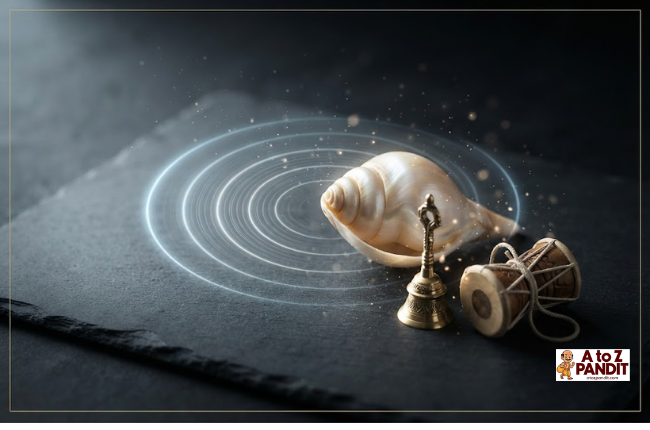
Stand in any temple courtyard at dawn and you'll hear it before you see it — the conch's long call, the bell's bright strike, a Pandit's low, even chant rolling under both. What we have consistently observed across thousands of consultations is that families treat this as pure faith and nothing else, unaware that a serious body of acoustic and neurological research now examines the same phenomenon from the opposite direction. This piece sits in that overlap deliberately — not to reduce mantra to biology, and not to dismiss the biology in favour of belief, but to show both frameworks side by side with equal honesty. We'll cover the physical mechanics of sound, the specific bija syllables SHREEM, KREEM, and HREEM, the four classical levels of speech, why phonetic precision genuinely matters, and the science behind the shankh, ghanti, and damru. None of this replaces a qualified teacher for serious mantra initiation.
What Actually Happens in Your Body When You Chant
Ask whether mantra chanting is "just psychological" or does something measurably physical, and the honest answer is that credible research points to a real, specific mechanism, not a vague placebo effect. When you chant aloud, the vibration generated in your throat and sinuses travels along the auricular branch of the vagus nerve — the same nerve targeted directly by clinical vagus nerve stimulation devices used for depression and epilepsy. A widely cited AIIMS Delhi fMRI study found that audible "Om" chanting produced measurable deactivation in the brain's limbic regions — the amygdala, hippocampus, and related structures involved in fear and stress response — a pattern similar to what's seen in clinical vagal stimulation, and distinct from simply making a neutral sound like "sss." Prana, the breath that carries the sound, is doing real mechanical work here: slow, extended exhalation during chanting raises heart-rate variability, a genuine marker of a well-regulated nervous system. Sit close to anyone doing serious Japa before sunrise — the cool stone floor underfoot, the low hum settling into the chest before it ever reaches the lips — and you're watching this mechanism in motion, not metaphor. This is one point where modern science is catching up to ancient observation rather than contradicting it — the Rishis prescribed daily Japa; the lab now shows why a regulated nervous system responds to it. One popular claim we'd push back on: that any repeated humming sound produces an identical effect. The AIIMS study specifically found the "sss" control sound produced no comparable limbic deactivation — the specific vowel-consonant shape of a mantra appears to matter, not just the act of vibrating the vocal cords.
SHREEM, KREEM, HREEM: The Physics and the Purpose of a Single-Syllable Mantra
Most bija mantra guides list SHREEM, KREEM, and HREEM as spiritual flavours to pick based on desired outcome, without explaining why a single syllable carries this much weight, and that gap is worth closing properly. A bija — literally "seed" — is a mantra reduced to its most concentrated acoustic unit, carrying no dictionary translation because its function is vibrational, not semantic; you are not asking a question in Sanskrit, you are generating a specific frequency pattern with the vocal tract as instrument. SHREEM, associated with Lakshmi and the quality of Shree — abundance, radiance, receptivity — uses a sustained "ee" vowel that produces a longer, rounder resonance in the mouth and chest. HREEM carries the Shakti bija's function of activation and captivation, its aspirated "H" beginning demanding a stronger initial breath push, a physically different gesture from SHREEM's softer onset. KREEM, associated with Kali's dissolving, ego-stripping energy, opens with a harder consonant strike that produces a shorter, sharper acoustic transient — the mouth's physical shape when forming KREEM is measurably more closed and forceful than when forming SHREEM. One claim we'd challenge here: some guides suggest any bija can substitute for any other if chanted with feeling. Classical Tantra disagrees specifically because the acoustic shape itself, not just the intention behind it, is understood to be part of the mechanism. And between us, this is the detail most bija workshops skip entirely: the Tejas, the inner radiance a practitioner is said to build through correct repetition, is described as accumulating differently depending on which bija is used — SHREEM building it slowly and steadily, KREEM releasing it in short intense bursts. Different tool, different curve, same underlying current.
The Four Levels of Speech: From Silent Intention to Spoken Sound
People ask what "Para to Vaikhari" actually means in practice, beyond a philosophy lesson, and the honest answer is that it maps directly onto how a mantra is actually built inside you before it leaves your mouth. Vaikhari is the spoken, audible level — the syllables you can record on a phone. Madhyama sits one layer beneath it: the mental murmur, the mantra rehearsed silently in the mind, verbalised but unheard. Pashyanti goes deeper still — a single-pointed, wordless intention where the meaning is fully present without yet being broken into syllables at all; this is Sankalpa in its purest form. Para is the source level, the potential from which sound itself first stirs, described in the Rig Veda's own doctrine of Vak as speech identical with the ground of consciousness. And between us, this is what most mantra teachers never explain clearly: a mantra chanted only at Vaikhari, mechanically, with no Madhyama or Pashyanti behind it, is a body doing exercise, not a mind doing Sadhana. Traditional practice asks you to let the same syllable move through all four levels at once — spoken, felt mentally, held as pure intention, and finally surrendered to its source.
Why Phonetic Precision Isn't Superstition: The Risks of Incorrect Pronunciation
Ask why traditional teachers insist on exact pronunciation when a slightly casual accent seems harmless, and classical grammatical texts actually document a specific case where this went wrong, not as folklore but as recorded linguistic history. The Taittiriya Samhita preserves the account of a Vedic sacrifice intended to produce "Indra-shatru" — one who defeats Indra — where a single misplaced tonal accent (svara) shifted the compound's grammatical reading to its opposite meaning, "one defeated by Indra," and the ritual's outcome followed the mispronounced version rather than the intended one. This is the classical basis for the principle that Vedic mantras carry six precise elements — the syllable, the tone, the duration, the stress, the rhythm, and the continuity — and an error in any of them can genuinely redirect the mantra's effect. It's worth being precise here rather than alarmist: this strict standard applies most seriously to formal Vedic Samhita mantras chanted in ritual context. Personal Bhakti chanting of names and Stotras is traditionally held to a gentler standard — devotion carries more weight than perfect phonetics for a householder's daily Japa. Accent variation across regions is not the same as genuine mispronunciation, and a beginner learning from a competent audio source or teacher closes this gap within weeks, not years.
Shankh, Ghanti, and Damru: The Acoustic Instruments of Ritual Sound
The question every curious visitor to a temple eventually asks a Pandit is some version of "why do you ring that bell right when the mantra starts," and the honest answer connects directly to acoustic engineering, not just ritual habit. The shankh — a sea-conch, not a manufactured instrument — has a natural internal spiral that functions as an acoustic resonating chamber, and different research teams have measured genuinely different peak frequencies for it, which is worth stating plainly rather than repeating one number as settled fact; what's consistent across studies is that a blown conch produces a complex, sustained harmonic tone with a long, tapering decay, distinct from a simple whistle. The ghanti, cast in a specific bronze-copper alloy, is engineered for exactly the opposite acoustic profile — a sharp, bright onset with rapid decay, designed to mark a precise moment (deity awakening, mantra start) rather than sustain a drone. The damru, Shiva's small hourglass drum, produces frequency modulation as the player's hand tension changes the skin's pitch mid-strike, traditionally linked to the primal rhythmic pulse of creation rather than melody. Together, the three form a deliberate sonic sequence in most temple ritual — sharp bell, sustained conch, rhythmic drum, then the human voice — moving the listener's attention from ordinary alertness toward focused stillness before a single mantra syllable is spoken. Anyone who has stood in a crowded Mandir at aarti time knows the specific feeling of that bell rope, worn smooth and dark by decades of hands, and the way camphor smoke curls upward exactly as the conch's note begins to fade — the whole sequence is engineered, not accidental. Fewer syllables. Sharper focus.
Building a Daily Bija Practice: Repetition, Timing, and the Number 108
Most guides stop at explaining what a bija means and never address the practical question every beginner actually has: how many times, at what time, and how do I know it's working. Classical Japa tradition uses a 108-bead mala specifically because repeated cycles at a steady rhythm entrain breath and attention together — a mechanism modern habit-formation research would recognise as a fixed-ratio behavioural loop, minus the reward uncertainty. Chant your chosen bija at a consistent Vara (weekday) and hour if possible; consistency of timing matters more than the exact count for a beginner. Ten to twenty minutes daily, seated with the spine upright so the chest cavity resonates freely, produces more measurable change over weeks than an occasional hour-long session. The tapering decay of your own voice after each repetition — that brief silence before the next syllable — is where Pashyanti-level attention actually has room to arise; rushing straight into the next repetition skips it entirely. Ten minutes, spine straight, full silence after.
Common Mistakes That Quietly Undo a Bija Practice
A bija practice that fails to produce any felt shift after weeks is rarely failing because the wrong syllable was chosen — it's usually undone by three specific habits nobody warns beginners about. The first is rushing the repetition cycle: chanting the next syllable before the tapering decay of the previous one has fully settled, which skips the exact silence-gap where Pashyanti-level attention has room to arise, turning devotional Japa into fast, meaningless syllable production. The second is mixing bijas within a single sitting based on mood — SHREEM one minute, KREEM the next — without letting either complete its Sankalpa; classical tradition holds this scatters rather than concentrates the vibrational build. The third, and most common among beginners anxious about the pronunciation warnings above, is over-correcting into a tense, self-conscious mouth position that flattens the natural resonance the vowel is supposed to produce — anxiety about getting it wrong often does more acoustic damage than a soft regional accent ever would. The fix for all three is the same: pick one bija, one sitting length, and let the breath — not the anxious mind — set the pace.
FAQ
What is a bija mantra? A single-syllable "seed" sound like SHREEM, KREEM, or HREEM that carries meaning through vibration rather than semantic translation.
Can mantra chanting really affect the nervous system? Yes — peer-reviewed fMRI research links audible Om chanting to vagus-nerve-linked limbic deactivation, comparable in pattern to clinical vagal stimulation.
What happens if I mispronounce a mantra? For formal Vedic Samhita ritual, tone errors can redirect meaning; for personal Bhakti chanting, sincerity matters more than phonetic perfection.
How many times should I chant a mantra daily? A 108-count mala is classical; ten to twenty minutes of consistent daily practice matters more than the exact number for beginners.
Do I need to understand Sanskrit to benefit? No — a bija's function is vibrational rather than semantic, so sincere, phonetically careful repetition works without a translation.
Conclusion
Sacred sound doesn't need to choose between being spiritual and being scientific — the honest picture is that both frameworks are describing real layers of the same event, from different vantage points. A bija syllable is a specific vocal-tract shape producing a specific acoustic signature; it is also, in classical understanding, a concentrated vibrational address to a specific form of divine energy, and neither description cancels the other out. What should you actually do right now? Pick one bija — SHREEM if what you're seeking is abundance and receptivity, HREEM for activation, KREEM for release — and give it ten focused minutes tomorrow morning, spine upright, chanting it aloud at least once before letting it settle into Madhyama's silent murmur. Pay attention to phonetic precision without turning it into anxiety; a sincere beginner correcting gently over weeks is doing this correctly. If you're preparing for formal Vedic ritual chanting specifically, that precision matters enough to learn directly from a qualified teacher rather than an app.
Want a mantra matched precisely to your birth chart and life goal? Book a personalised mantra consultation with a verified Jyotishi on AtoZPandit.com today.