Lal Kitab Remedies: Household Fixes, Palmistry & Blind Planets
A family walks out of a Lal Kitab consultation holding instructions to bury a coconut, wear an iron ring on the middle finger, and float raw radish in a canal — and somewhere between the parking lot and home, the doubt sets in. Is this astrology, or is it folk superstition wearing astrology's clothes? We have sat with enough families asking exactly this to know the honest answer: Lal Kitab remedies follow a consistent internal logic, house by house, even when the instructions sound strange to modern ears. This piece explains that logic — houses over signs, blind and sacrificial planets, the annual Varshphal shift, the palmistry cross-check, and the household items themselves — as one connected system, plus how to dispose of remedy items responsibly in a city where the nearest river may be an hour away. This is educational and cultural guidance, not a substitute for a personal chart reading.
Some of what follows involves charts read as afflicted, blind, or under strain — language that can sound alarming before it's explained. Vedic science teaches that the remedy is always stronger than the malady, and Lal Kitab in particular exists to move a person from Bhaya to Abhaya using nothing more than what is already in the kitchen.
What Lal Kitab Actually Is — and Isn't
Lal Kitab, compiled by Pandit Roop Chand Joshi between 1939 and 1952 in pre-Partition Punjab, is not a shortened version of classical Jyotish — it is a different reading system built on its own rules. Where Parashari astrology weighs sign, nakshatra, dasha, and dozens of yogas together, Lal Kitab asks one dominant question first: which house is the planet actually sitting in?
That single shift changes everything downstream. A planet's house — its Pakka Ghar, or permanent seat — matters more here than the sign it occupies, which is why two people with the "same" weak Saturn can receive completely different remedies once their house placements are compared. And here is what most content on this topic skips entirely: Lal Kitab remedies are meant to correct a Lal Kitab chart, cast on Lal Kitab's own house rules — not a Vedic remedy bolted onto a Vedic chart and relabelled. Mixing the two systems is the single most common error we see families walk in with, usually without knowing they have done it.
Houses Over Signs: The Real Logic Behind Household Items
Every remedy connects a planet's affliction to a physical substance that classical tradition associates with that planet's element, colour, or temperament — coal and iron for Saturn's heaviness, red lentils and copper for Mars's heat, silver and rice for the Moon's coolness. The household item is not chosen for convenience; it's chosen because it's believed to carry the same subtle signature as the planet it addresses.
This is the piece almost no competing guide states plainly: the logic is symbolic transfer, not magic. Lal Kitab tradition frames the ritual as directing a small, deliberate act of the wearer's own Sankalpa — intention — onto a material stand-in, so a planet's excess or deficiency is expressed and released through the object rather than left to build up silently in the person's own conduct. Donating an item associated with an afflicted planet is treated as symbolically parting with that planet's disturbed energy; wearing an item associated with a weak planet is treated as physically anchoring more of its steady quality. And between us, this is what most Lal Kitab shops never explain to a first-time client: a remedy performed mechanically, without a stated intention, is considered close to worthless — the item is a vehicle, not the cure itself.
Blind Planets: When the 10th House Cannot See
A chart is read as "blind" — Andha Grah, or Andhi Kundali — when two or more mutually enemy planets sit together in the 10th house, the house of karma, career, and public standing. Saturn rules this house by nature and is linked to sight in Lal Kitab symbolism; crowd it with quarrelling planets and the house is said to lose its vision entirely.
The effect described is not that the career fails outright, but that it becomes directionless — promotions arrive from the wrong source, effort in one field pays off unexpectedly in another, decisions feel correct at the time and prove mistaken only in hindsight. This is the blind-person analogy Lal Kitab texts use directly: a blind horoscope can still walk, it simply cannot see where it's walking. A half-blind chart exists too, a narrower configuration involving Sun in the 4th house opposed by an exalted Saturn in the 7th, and most online summaries flatten this into the same category as full blindness — overstating the difficulty for a much larger group of readers than actually has it. The traditional corrective measure — feeding ten visually impaired people, performed with sincerity rather than as a transaction — aims less at "fixing" the 10th house instantly and more at building the humility Lal Kitab associates with regaining clear direction.
Sacrificial and Artificial Planets: The Domino Effect
Two related mechanics explain why a single affliction in a chart can seem to spread. A sacrificial planet — Kurbani ka Bakra — is a friendly planet that absorbs the fallout when a severely afflicted planet can't carry its own bad result any further; the affliction passes sideways rather than staying contained. If Saturn is badly afflicted by the Sun, tradition holds, the disturbance often surfaces through Venus instead — and a family confused about why their Venus-linked concerns keep misfiring without any obvious Venus problem in the chart is usually looking at exactly this.
The second mechanic runs the opposite direction: an artificial planet, or Banawati Grah, forms when two planets sitting together produce the combined signature of a third planet that isn't there at all — Sun and Venus together are read as mimicking an artificial Moon, for instance. Competing content treats these as footnotes; we treat them as the reason two charts with identical "problem" planets sometimes need entirely different remedies. Skip checking for a sacrificial or artificial planet, and a remedy aimed at the wrong actual source simply doesn't register — the household item gets used, the affliction stays.
Varshphal: Why Last Year's Remedy Expires
Lal Kitab's annual chart, Varshphal, is where this system most sharply departs from classical Tajika methods. Where Vedic Varshphal waits for the Sun's exact return to its birth degree and layers in Muntha and year-lord calculations, Lal Kitab Varshphal uses a purely mechanical shift: every natal planet advances one house forward for each year of the person's age.
This resolves a question families ask us constantly — why did last year's pandit give completely different instructions this year, without explanation? The house-rotation formula means every planet occupies a genuinely new house annually, with new dignities, new blind or sleeping status, and new sacrificial relationships, so a remedy addressing a Sun in the 3rd house last year is simply irrelevant to a Sun that has rotated into the 4th this year. No birth-time uncertainty can throw this off, which is a real strength — but it also means a Varshphal remedy has a shelf life measured in months, not years, something almost no consumer-facing guide states outright.
Astro-Palmistry: Reading the Hand Alongside the Chart
Lal Kitab is, at its root, a palmistry-integrated system — Pandit Roop Chand Joshi's later volumes are explicitly built on "Ilm-e-Samudrik," the science of hand reading, layered onto the birth chart rather than replacing it. The palm functions as a second, independent check: if the hand and the chart tell the same story, confidence in the remedy increases; if they conflict, the discrepancy itself becomes diagnostic information rather than something to force into agreement.
Rahu and Ketu, having no physical body, occupy the centre of the palm and the base near the wrist respectively rather than sitting under a finger like the seven classical mounts. A clear ring-shaped marking on the Mount of Rahu is traditionally read as a restriction on how freely that planet's ambition and sudden change can express — a binding rather than a blessing. A cross mark near the Mount of Ketu, close to the wrist, is read as friction in the detachment and past-karma themes Ketu governs — unresolved rather than resolved. We'd rather be precise than impressive here: these are traditional interpretive signs, read alongside the birth chart, never as a standalone diagnosis and never as medical or predictive certainty on their own.
Household Remedies: Why a Coconut, a Coin, a Radish
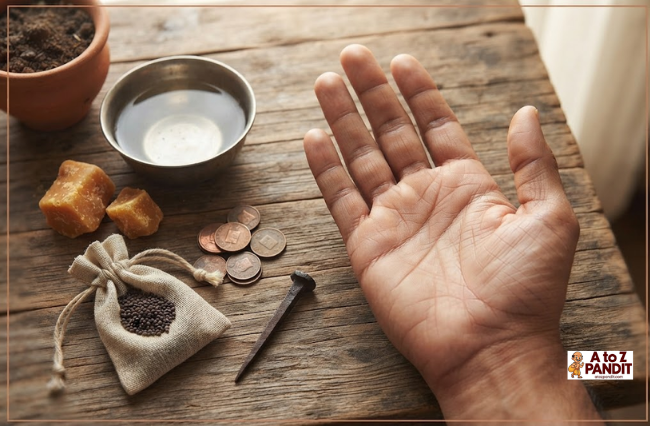
The specific items recur for a reason. A copper coin addresses the Sun or Mercury's metal signature. Raw radish or black items address Saturn's heaviness. A whole coconut, sealed and floated, stands in for a complete offering that carries an affliction fully away rather than partially. Green pulses in a sealed copper vessel address Mercury. None of this is arbitrary substitution — Lal Kitab is explicit that changing a prescribed item for a "similar" one, or performing the act your own way instead of as written, is considered to weaken or reverse the intended result.
What we have consistently observed across seasons of consultations: families who treat the specific item and the specific act as fixed, and only their own sincerity as the variable, get more consistent outcomes than families who improvise the details. This is the Dakshina principle again, in household form — the intention is the address, and the prescribed item is simply the envelope it travels in.
Water and Soil Disposal: Doing It Correctly, and Responsibly
Classical instruction is specific about where a remedy item goes, and the distinction matters more than it first appears. Flowing water — a river or canal — carries an item away permanently; a pond's water sits still, and a sea's water returns to shore, so tradition holds that using either instead of a genuine river can reverse the remedy's intended direction rather than simply weakening it.
This creates a real, modern problem competing guides rarely address honestly: most Mumbai and Thane families don't live near a genuine flowing river, and even where one is reachable, dropping coins, copper vessels, or sealed metal into it raises legitimate environmental concerns that classical-era prescriptions never had to consider. Our practical guidance: where a temple-maintained flowing water channel or a designated immersion point exists, use it instead of an open river or nullah. Where no such option exists, a sincerely performed donation of the same item — to a person, a temple, or an animal shelter, matching the planet's association as closely as possible — is a reasonable modern substitute for the symbolic release, provided nothing edible, metallic, or synthetic ever enters a natural water body untreated. Soil-based remedies (burying an item, or pouring milk at a tree's roots) travel far more easily into an apartment-dwelling family's life than water-based ones, and are worth requesting as an alternative from your astrologer when a genuine river simply isn't accessible.
Common Mistakes That Undo a Lal Kitab Remedy
Three errors account for most of the disappointment we hear about. First, applying Lal Kitab remedies to a Vedic (Parashari) chart reading, or the reverse — the house logic underneath is different enough that the remedy targets the wrong placement entirely. Second, substituting a "close enough" item or skipping the stated day, direction, or duration because the original felt inconvenient — Lal Kitab tradition treats the exact form of the act as load-bearing, not decorative. Third, performing several unrelated remedies simultaneously in the hope that one of them works, which tradition holds actually confuses which planet the effort is even addressing. None of these mistakes make the system "not work" — they simply mean the remedy performed was never quite the remedy prescribed.
FAQ
What makes Lal Kitab different from Vedic astrology?
It reads a planet mainly by its house, not sign, using household items instead of gemstones or rituals.
What is a blind planet (Andha Grah)?
Enemy planets sitting together in the 10th house, making career direction unclear rather than absent.
What is a sacrificial planet (Kurbani ka Bakra)?
A friendly planet that absorbs the fallout when a badly afflicted planet's disturbance passes sideways onto it.
How does Lal Kitab Varshphal work?
Every planet advances one house per year of age, so remedies change annually.
How does palmistry connect to Lal Kitab?
The palm is an independent check on the chart; agreement raises confidence, conflict is diagnostic.
Where do I dispose of a remedy item with no river nearby?
Use a temple-maintained water channel, or a sincere donation matching the planet instead.
Conclusion
Lal Kitab's household remedies can look eccentric from the outside — a buried coconut, an iron ring, a radish floated in a canal — until the house-based logic underneath is made visible. Every item, direction, and timing detail exists to address a specific planetary placement, not to perform folk theatre, and the system's internal consistency is exactly what most surface-level guides strip away when they present remedies as an undifferentiated list. Families who treat this as one connected system — correct chart type first, correct house logic second, correct item and act performed exactly as prescribed third — see more consistent results than families collecting remedies from wherever they find them.
So what should you actually do right now, before performing any remedy? Confirm your astrologer is reading a genuine Lal Kitab chart rather than relabelling a Vedic one, ask whether any planet in your chart is blind, sacrificial, or artificial before accepting a remedy list, and if a prescribed item calls for flowing water you cannot reach responsibly, ask for the donation-based alternative instead of improvising the disposal yourself.
Confused about which of your planets are actually blind, sacrificial, or artificial — and which household remedies genuinely apply to you?
Book a personalised Lal Kitab Chart Reading with a verified Jyotish expert on AtoZPandit.com today.