
Havan Science: Atmospheric Purification & Home Yagya Guide
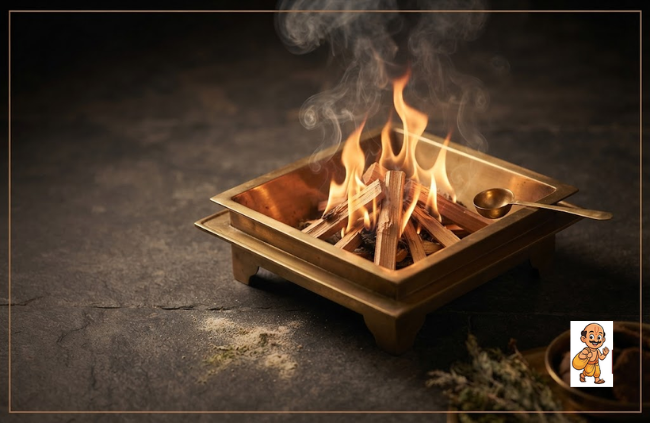
Most articles on havan science stop at a single statistic — smoke kills a percentage of airborne bacteria — and move on. At AtoZPandit.com, families ask us far more specific questions before booking a home havan: which wood, how much samagri, whether cow dung dhoop is actually safe to breathe, and what time genuinely matters versus what's just convention. This piece goes past the headline claim into the actual combustion chemistry, herb composition, and vocal-frequency mechanics behind a havan, cross-checked against Central Pollution Control Board collaboration data, National Botanical Research Institute findings, and direct priest practice — while being honest about where the evidence is strong and where it isn't. Regional variation is real here too, and we've flagged it rather than presenting one tradition as the only correct one.
What Actually Happens Inside a Havan Fire
A havan fire is not ordinary combustion — it's a controlled chemical reaction where ghee, herbs, and wood are converted into airborne vapor-phase compounds rather than simple ash and carbon dioxide, and that vapor phase is where the purification claim actually lives.
When ghee and herbal samagri hit a bed of burning samidha, much of the material doesn't fully combust into inert gas — it sublimates and vaporizes, releasing phytochemicals from the herbs directly into the surrounding air as fine aerosol particles and volatile oils. Researchers studying this process describe it as steam volatilization: the heat drives medicinal compounds out of the plant material and disperses them through the room via the rising smoke column, which is a fundamentally different mechanism from a candle or incense stick simply burning down. Complete combustion — meaning the fire gets enough oxygen and burns hot and clean rather than smouldering — matters enormously here; a starved, smoky havan produces mostly soot and unburned particulate, while a well-fed, properly ventilated fire produces the vapor-phase release the ritual is actually built around. Clean fire, clean air, real difference.
Pandit's tip: and between us, this is what most families never hear — if your havan smoke is thick, black, and stinging your eyes, something is wrong with the fire, not with the tradition. A correctly fed havan smells sharp and resinous, not acrid.
Choosing the Right Samidha — Why Mango Wood Is the Default, Not a Preference
Mango wood (aam ki lakdi) is the default samidha across most North Indian havan traditions, and it isn't simply because mango trees are common — controlled emission testing conducted with the Central Pollution Control Board, Delhi, found mango wood produced near-zero carbon monoxide emissions compared to other tested woods, which is the actual reason it became the standard fuel base.
Mango wood also releases a compound identified as formic aldehyde (formaldehyde) on burning in small, ritual quantities — commonly cited as having antibacterial effects, though families should know this claim mostly traces back to ritual-context sources rather than independent toxicology studies, and formaldehyde in larger industrial concentrations is a recognised irritant, so ventilation still matters even with the "right" wood. Where mango wood isn't available, classical guidance permits Ficus-family alternatives — peepal, banyan, and pakhar — specifically because these trees produce ash rather than solid charcoal residue when burned, which keeps the fire's combustion profile closer to the mango-wood standard. For planetary remedy havans, a separate Navagraha wood correspondence exists entirely — Arka for the Sun, Palash for the Moon, Khadir for Mars, and so on through all nine grahas — a system almost no general-audience article maps out, because it belongs to a more specialised remedial tradition than daily household havan.
Composing Herbal Samagri — What Each Ingredient Is Actually Doing in the Smoke
Herbal samagri is usually sold as a pre-mixed packet, and most buyers never ask what's actually inside it or why. Giloy, Brahmi, and Ashwagandha are Ayurvedic herbs with documented adaptogenic and antimicrobial properties in their raw form — the samagri tradition is essentially aerosolising a subset of Ayurvedic pharmacy directly into the air of the room rather than the body.
Sandalwood and cloves contribute aromatic oils that carry a genuinely calming scent profile, cardamom and camphor burn quickly and cleanly to keep the fire's temperature high enough for full combustion, and resins like guggal and loban produce the dense, fragrant smoke associated with clearing stagnant air in a closed room. Sesame seeds and rice (akshat) burn slower and are offered less for smoke chemistry and more for the ritual completeness of the ahuti — not every samagri ingredient earns its place through combustion science alone, and pretending otherwise would be dishonest. What we have consistently observed across thousands of consultations is that families using a fresh, correctly proportioned samagri notice a distinctly different smoke character — lighter, more aromatic, less acrid — than a stale or bulk-bought packet sitting in storage for months.
Cow Dung Dhoop — Ritual Quantity vs. Bulk Fuel, and Why That Distinction Matters
This is where a lot of online content gets careless, and we want to be direct about it: cow dung burned in bulk as a daily cooking fuel indoors — the practice still common in parts of rural India — is associated in public health research with real respiratory risk, including documented links to higher tuberculosis and anaemia incidence among households that rely on it for cooking. That is not the same question as burning a small dhoop cake or a few ritual chips during a havan.
The difference is quantity, ventilation, and frequency. A cooking hearth burns dung continuously for hours in an enclosed kitchen with poor airflow; a ritual dhoop cake burns for minutes in a ventilated puja space, mixed with ghee and herbs rather than alone. In that ritual quantity, burning cow dung with ghee is credited with releasing compounds that support the same antimicrobial smoke effect as the wider havan, alongside a natural insect-repellent action documented in general pest-control literature on dung smoke. Treating "cow dung smoke is dangerous" and "cow dung smoke is purifying" as a single contradictory claim misses that both are true — at different scales, in different contexts. Same material, different exposure, different outcome — that's the honest answer competitors mostly skip.
Does Havan Really Purify the Air, or Just Feel Like It Does?
The most searched skeptical question about havan is a fair one: doesn't burning anything add pollution rather than remove it? A joint experimental programme conducted with the Central Pollution Control Board, Delhi, addressed this directly by testing wood emissions and havan samagri combustion under controlled conditions rather than assuming the answer.
The mechanism proposed isn't that fire magically produces oxygen from nothing — it's that correctly composed havan samagri, burned with adequate airflow, produces volatile oils and phytochemical vapor that neutralise odour-causing and pathogenic compounds already present in room air, while the carbon dioxide output from a small, controlled ritual fire is negligible compared to what gets treated as a citywide "purification" claim in less careful marketing content. A widely cited 2007 study from the National Botanical Research Institute, Lucknow, reported a substantial reduction in airborne bacteria following havan smoke exposure in a closed room, with the effect persisting for an extended period afterward — a genuinely notable finding, though families should treat it as one study on airborne bacterial load specifically, not a blanket claim that havan resolves every category of indoor air pollution, including particulate matter from the smoke itself. Ventilate the room afterward regardless of what the ritual promises.
Mantra as Vocal Frequency — Where the Chant Does Physical Work
Every ahuti — every spoonful of ghee or samagri offered into the fire — is timed to land on the word "Swaha" at the end of a mantra, and that timing isn't decorative. It synchronises breath, vocal vibration, and physical offering into a single repeated rhythm across the length of the havan.
Sustained chanting, particularly on elongated syllables, works the same diaphragmatic breathing pathway that modern vagal-toning breathwork deliberately targets — slow, controlled exhalation that measurably shifts the nervous system toward calm. The repetitive Swaha-then-offering rhythm across dozens or hundreds of ahutis functions as a pacing mechanism for that breathing, in a room that's also filling with aromatic, phytochemical-rich smoke — sound and chemistry working the same nervous system from two directions simultaneously. This is precisely the kind of ancient-modern mirroring worth stating plainly: nobody performing havan a thousand years ago needed the term "vagal tone" to notice that a long, chanted fire ritual left a room calmer than it found it.
The Energy Exchange in a Havan — Sankalpa, Ahuti, and When You Need a Priest
A havan opens with Sankalpa — a spoken statement of intention, naming the person, the purpose, and often the date according to the Panchang — and every ahuti that follows is treated as fulfilling that stated intention, not as a generic offering into fire.
This is why a home havan performed alone, without a priest, is entirely valid for daily or weekly practice using simple mantras, while larger yagyas — Navagraha Homa, Griha Pravesh Havan, wedding and Mundan ceremonies — call for a trained priest who can correctly recite the specific Vedic hymns the occasion requires. The intention is the address. The mantra is the message. Dakshina to the officiating priest, exactly as with any other puja, closes that same energetic transaction — and the same rule applies here as elsewhere: the amount should reflect the ceremony's length and complexity, offered without bargaining, since haggling over a priest's fee is treated as diminishing the completeness of what was just performed.
When to Perform Havan — The Brahma Muhurta Logic
Most guidance recommends performing havan during Brahma Muhurta, roughly between 4:30 and 6:00 AM, or at sunset — and this isn't purely a scriptural preference. Both windows correspond to lower ambient air movement and cooler temperatures, conditions under which smoke and volatile compounds disperse more slowly through a room rather than escaping instantly through daytime convection currents.
A sunrise or sunset havan also aligns with Agnihotra tradition specifically, the twice-daily Vedic fire offering timed to the sun's movement across the horizon — a practice distinct from occasional havan and treated in classical sources as its own disciplined observance rather than an occasional ritual. For families who cannot manage early mornings, a consistent Vara — the same weekday, same time, each week — matters more for building the practice than chasing the theoretically ideal hour and never actually lighting the fire.
A Simple Home Havan Vidhi, Step by Step
1. Prepare the space. Choose a clean, ventilated area — a balcony or a room with a window open matters more than any other single decision, given everything above about smoke dispersal. 2. Set up the kund. A small copper or clay havan kund, lined loosely with a few dry mango leaves. 3. Arrange the samidha. Cross-hatch small mango wood sticks in the kund, leaving air gaps rather than packing them tight. 4. Light with camphor. A piece of camphor lit first catches the wood faster and cleanly than a direct matchstick attempt. 5. Offer ghee to stabilise. Once the flame holds, offer a spoon of ghee, then wait until it burns steadily before adding samagri. 6. Begin Sankalpa. State your intention softly, facing east or north. 7. Offer ahuti with mantra. With each mantra ending in "Swaha," offer a pinch of samagri or a few drops of ghee using the thumb and ring finger, avoiding the index finger. Eleven, twenty-one, or one hundred and eight repetitions are all traditionally acceptable counts. 8. Close with Purnahuti. A final, larger combined offering of ghee, samagri, and a few flowers marks the ritual's completion. 9. Sit with the smoke briefly, then ventilate the room before resuming normal activity.
FAQ
Q: Is mango wood mandatory for havan? No — it's the default for clean combustion; peepal, banyan, and pakhar are accepted alternatives. Q: Is havan smoke safe to breathe regularly? In small, ventilated, correctly-proportioned quantities, yes; those with respiratory conditions, pregnant women, and young children should keep exposure brief. Q: Does cow dung dhoop purify the air or just feel like it does? Both — ritual quantity with airflow supports antimicrobial smoke; bulk indoor cooking-fuel use is a different, riskier exposure. Q: Can I do havan without a priest? Yes, for simple weekly practice; larger yagyas benefit from a trained priest's recitation. Q: Best time for home havan? Brahma Muhurta or sunset — though a time you'll actually keep beats a theoretically perfect one.
Conclusion
A havan was never simply a devotional gesture performed on faith with no working mechanism behind it — combustion chemistry, herb pharmacology, and vocal-frequency breathing were all present the entire time, centuries before anyone had the vocabulary to describe them separately. Understanding that doesn't reduce the ritual to a chemistry demonstration; it explains why families who've never read a single research paper have trusted this practice for generations; it worked, measurably, long before it was measured. What you should actually do right now: if you're starting home havan practice, begin small — mango wood, a basic samagri packet, the Gayatri mantra, once a week at a consistent time — rather than attempting an elaborate first attempt that discourages a second one. Ventilate the room, don't inhale directly over thick smoke, and treat the timing guidance as genuinely useful rather than symbolic. If your family's tradition differs in wood, herbs, or timing from what's described here, that's regional practice, not error — Bharat's fire rituals were never meant to be identical from a Kerala tharavad to a Punjab haveli.
If you'd like a Pandit to guide your first home havan in person — correct samagri proportion, Sankalpa wording, and mantra pacing for your specific occasion — AtoZPandit.com connects you with a verified local Pandit for a Havan Vidhi Consultation. Book a session and get the exact steps set up for your home, not a generic checklist.