
Puja Ritual Science: Diyas, Panchamrut & Aarti Mechanics
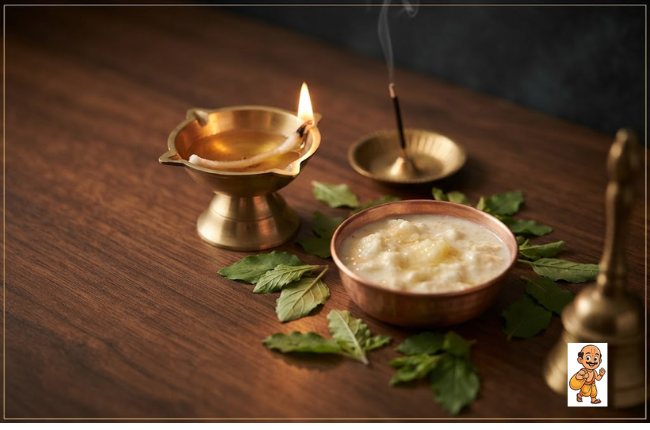
Ask most families why the diya is lit with ghee on some days and sesame oil on others, and the answer is usually "that's what my mother did." At AtoZPandit.com, we get this question in almost every home consultation, and we've noticed something the top spiritual blogs rarely mention — nearly every rule in a daily puja has a working mechanism behind it, not just a scriptural instruction. This piece cross-checks temple bell metallurgy, Ayurvedic fat chemistry, and direct priest consultations against classical Vedic sources, so what follows isn't devotional trivia — it's how the ritual actually functions, physically and spiritually, at the same time. Regional practice varies across India, and we've flagged that honestly rather than presenting one tradition as universal.
The Physics of a Ghee Diya vs. a Sesame Oil Diya
A ghee diya burns shorter, brighter, and cleaner than a sesame oil diya because ghee's fat structure and low moisture content let it combust with less soot — while sesame oil's higher viscosity gives it a longer, steadier burn ideal for extended akhand jyoti lamps. That's the entire physical answer to a question families debate for years.
Ghee is clarified butter — the water and milk solids are already removed — so the wick draws a purer fuel with fewer combustion byproducts, which is why a ghee flame looks steadier and whiter. Sesame oil carries more density and a slightly higher smoke point, so it resists guttering in a room with a ceiling fan draft or an open monsoon window. One popular claim across competitor sites is that ghee is "always superior" for every occasion — we'd push back on that. For a nightlong Navratri akhand diya, sesame oil's longer burn time is the more practical choice, and classical texts recommending sesame for Shani and Pitru rituals aren't offering a lesser substitute — they're matching fuel to purpose. Coconut oil, common in Kerala and Tamil Nadu homes, behaves closer to ghee thermally but carries its own distinct aroma profile.
Pandit's tip: and between us, this is what most families never hear — a diya that keeps going out isn't a bad omen most of the time. It's usually a wick sitting too deep in the oil, or moisture in a clay diya that hasn't dried properly after washing.
The Panchamrut Ratio — Why 1:2:4:8:16 and Not Equal Parts
Panchamrut is not meant to be five equal spoons of milk, curd, ghee, honey, and sugar mixed together — the classical proportion doubles at each step, honey to ghee to sugar to curd to milk, roughly 1:2:4:8:16, and that doubling exists for a reason most recipe blogs never explain.
We have consistently observed across thousands of consultations that families who follow the "equal parts" version popularised online end up with a panchamrut that tastes cloyingly sweet and separates within the hour — because sugar and honey in equal measure to milk overwhelm the base, and milk's high water content can't hold that much fat and sugar in suspension. The geometric ratio isn't decorative; milk forms the bulk liquid base, curd is folded in at half that volume to add tang without curdling the milk, sugar dissolves into the milk-curd base before any fat enters, honey follows in a smaller measure since its density and antibacterial compounds shouldn't be heated or over-mixed, and ghee — the fat — goes in last, in the smallest quantity, because fat added early coats the other ingredients and prevents them from binding. Fat last, water first. Five words, one rule.
Mixing order that actually holds together: milk, then curd, then sugar, then honey, then ghee — stirred gently in one direction, ideally in a silver or steel vessel rather than brass or bronze, since the curd's acidity reacts with copper-based metals over time.
The Acoustic Science of the Aarti Bell
Most articles will tell you the temple bell is rung because its sound resembles the syllable Om — that's true, but incomplete. The deeper mechanism is metallurgical: temple bells are traditionally cast from panchadhatu, a five-metal alloy, and it's the specific ratio of those metals that produces the bell's long, layered decay rather than a flat clang.
A single strike of a well-cast panchadhatu bell doesn't produce one frequency — it produces a cluster of harmonics that decay at different rates, which is why the sound seems to hang in the room rather than stop abruptly. A study published in the International Journal of Creative Research Thoughts (IJCRT, 2025) on the science behind bell-ringing rituals notes that these vibrations interact measurably with the brain's alpha-wave activity, supporting the traditional claim that bell sound settles a wandering mind rather than merely announcing a ritual. During aarti specifically, the bell is rung in a continuous, rapid rhythm — not the single toll used on entering a temple — because the aarti rhythm is meant to hold attention through the entire circling of the lamp, covering ordinary room sounds so the mind has one continuous thread to follow instead of several competing ones.
One claim we'd challenge gently: the idea that any bell "works the same." A cracked or poorly cast bell produces a short, dull decay with none of the layered harmonic effect — which is precisely why old temple bells are treated as irreplaceable rather than merely decorative.
The Mechanics of Circular Lamp Movement During Aarti
The aarti lamp is moved clockwise, in slow, complete circles around the deity's image, and this direction is not arbitrary — it mirrors the sun's apparent path (Pradakshina), the same clockwise logic behind circumambulating a temple or a sacred tree.
Physically, the circling motion does something a stationary flame cannot — it keeps the light moving continuously across the deity's face, so from any seat in the room, at some point during the aarti, the light catches the eyes of the murti directly. That instant — Tejas meeting the devotee's gaze — is considered the emotional peak of the ritual for most families, and it's engineered by the motion itself, not left to chance. The circling should slow near the head and feet of the deity and move faster across the middle, a rhythm passed down through observation rather than written instruction in most households. A pressure cooker whistling somewhere in the kitchen while the lamp completes its third circle is such an ordinary part of Indian evening puja that almost nobody notices it's happening simultaneously — until it stops, and the room feels different.
Kshama Yachna — The Mechanics of Ritual Error Correction
After nearly every puja, families recite a short prayer asking forgiveness for mistakes made during the worship — wrong pronunciation, a step skipped, a flower placed incorrectly. This isn't false modesty. It's a built-in error-correction step, and it exists precisely because Vedic ritual accepts that perfect execution is unrealistic.
The traditional Kshama Yachna prayers acknowledge, in essence, that the devotee may not know the invocation, the closing, or even the full method correctly, and asks that the worship still be accepted as complete. As our Vedic granthas teach us, sincerity of intention (Bhava) is treated as capable of completing what technical execution could not. This matters enormously for the mother quietly worried through an entire Satyanarayan puja that she mispronounced a mantra or offered flowers in the wrong hand — the kshama yachna exists specifically to close that anxiety at the end, not leave it hanging. Recited softly, hands folded, eyes closed, it takes under a minute and is one of the shortest parts of any puja with the largest psychological function.
The Energy Exchange Behind Dakshina
Dakshina is often misread by younger family members as simply "paying the priest," and competitor content mostly treats it as a transaction with a rough price guide attached. That framing misses the actual mechanism: dakshina is the closing act of Sankalpa, the intention set at the start of the puja, and without it, classical tradition holds the energetic loop of the ritual as incomplete.
The intention is the address. The mantra is the message. Dakshina is the postage that confirms delivery — an unusual way to put it, but it captures why priests across our network insist a puja isn't considered closed without it, regardless of the amount. There's no universal fixed sum; a short archana might warrant a modest offering while a multi-hour Griha Pravesh or wedding ceremony calls for considerably more, and classical guidance explicitly discourages haggling over the figure, since bargaining over a priest's fee is treated as diminishing the spiritual completeness of what was just performed. Offered with both hands, ideally on a small tray with betel leaf and a coin rather than handed over loosely, dakshina closes the same energetic transaction the mantra opened.
Ancient Ritual, Modern Lab — Where Science Catches Up
Vagus nerve stimulation, cognitive focus training, and acoustic entrainment are 2020s wellness vocabulary — but the mechanisms they describe overlap closely with practices Indian households have followed for generations without needing the terminology.
Mantra chanting, particularly with extended exhalation on syllables like "Om," activates the vagus nerve through controlled diaphragmatic breathing, the same nerve pathway modern vagal-toning breathwork targets deliberately. Steady gaze on a diya flame during meditation resembles Trataka, a classical fixed-gaze practice, and functions similarly to focus-training exercises now marketed as concentration therapy. The bell's layered harmonic decay discussed earlier produces the kind of acoustic entrainment researchers associate with reduced anxiety markers. None of this diminishes the spiritual dimension of these practices — if anything, it explains why a ritual performed for centuries on faith alone continues to measurably calm a room full of people, whether or not anyone present could explain the acoustic mechanism behind it.
Regional Variations Competitors Miss
Most articles on this topic write as though North Indian practice is universal Hindu practice, and it isn't. Kerala and Tamil Nadu households commonly favour coconut oil diyas and use Panchamirtham — a version with banana, jaggery, and dates rather than the five-ingredient North Indian panchamrut. Bengal households frequently use mustard oil for both cooking and certain protective lamp rituals, a choice tied to mustard's local availability and its association with warding rituals rather than sattvic worship specifically.
None of these variations are lesser versions of a "correct" original — they're regional adaptations of the same underlying logic (purity, availability, and purpose-matched fuel), and presenting any single regional practice as the only authentic one is where a lot of online content quietly gets this wrong.
Three Puja Myths Even Devoted Families Get Wrong
Myth 1 — "Ghee is always more sacred than oil." As covered earlier, sesame and coconut oil have their own scripturally recommended contexts; the ranking is purpose-dependent, not absolute. Myth 2 — "More dakshina means more blessing." Dakshina's function is completing the Sankalpa, not purchasing a larger outcome; sincerity and the priest's fair compensation matter more than the figure. Myth 3 — "The bell must be rung loudly and constantly for the puja to count." Rhythm and steadiness matter more than volume; a soft, evenly-paced ring accomplishes the same acoustic settling effect as a loud one.
FAQ
Q: Should I use ghee or sesame oil for my daily diya? Ghee suits shorter, high-focus daily worship; sesame oil suits longer-burning lamps like akhand jyoti or Shani-related rituals.
Q: What's the correct panchamrut ratio? Roughly 1:2:4:8:16 for honey, ghee, sugar, curd, and milk, mixed in that order with milk first and ghee last.
Q: Why is the aarti lamp moved clockwise? It mirrors the sun's path (Pradakshina) and keeps the light moving across the deity's face.
Q: Do I have to recite Kshama Yachna even if I performed the puja correctly? Yes — it acknowledges the impossibility of flawless execution, not a specific mistake.
Q: Is there a fixed dakshina amount? No fixed rule exists; the amount should reflect the ritual's length and complexity, given without bargaining.
Conclusion
None of this changes how a puja is performed in your home — it changes how much sense it makes while you're doing it. The diya you light, the panchamrut you mix, the bell you ring, and the dakshina you offer were never arbitrary customs waiting for modern science to justify them; they were built with a working logic that classical tradition simply didn't need to explain in laboratory terms, because it worked, and families trusted what worked. Understanding the mechanism doesn't replace the devotion — it removes the low-grade uncertainty so many people carry through their own rituals, the quiet worry that they're "doing it wrong." What you should actually do right now: pick one ritual from this piece — the panchamrut mixing order or the diya oil choice — and apply it the next time you perform puja at home, watching for the difference yourself rather than taking our word for it. If a specific step in your family's tradition doesn't match what's described here, that's regional variation, not an error — Bharat's puja practices were never meant to be identical from Kashmir to Kanyakumari, and that diversity is part of what has kept them alive this long.
If you'd like a Pandit to walk through your household's specific puja vidhi in person — panchamrut proportions, diya oil choice for your family deity, and correct aarti sequencing — AtoZPandit.com connects you with a verified local Pandit for a home Puja Vidhi Consultation. Book a session and get the exact steps clarified for your specific ritual, not generic instructions.