
Navagraha Remedies: Daily Daan, Mantras & Plant Upayas
Ask any Indian family what they do when a period feels heavy — a stalled job, a delayed marriage, a run of small accidents — and the honest answer is usually "we're planning to get a puja done, once we save up." What we have consistently observed across thousands of consultations is that families wait months for the "big" remedy while ignoring the daily ones that cost nothing but attention. This guide is built around that gap. If Sade Sati, Kaal Sarp, or a heavy Dasha has you frightened right now, hold that thought — Vedic science holds that the remedy is always stronger than the malady, and we're here to move you from Bhaya, fear, to Abhaya, fearlessness, before we go anywhere near ritual. This is not medical or financial advice, and it does not replace a qualified Jyotishi for chart-specific concerns. It is the daily upaya system any family member can run themselves.
How to Know Which Planet Needs Your Attention First
Most people don't start with a birth chart reading — they start with a feeling: money slips through the hands, sleep won't come, one relationship keeps repeating the same fight. That feeling is usually pointing at a specific planet, and Vedic tradition gives you a working shortcut even without a full Kundali reading. Persistent delay and heaviness usually trace to Shani. Sudden confusion, addiction-like pulls, or unexplained anxiety trace to Rahu. A sense of drift, disinterest, or repeated small losses trace to Ketu. Anger and accidents point to Mangal; strained authority or father-figure relationships point to Surya; an unsettled, tearful mind points to Chandra. And between us, this is what most families never hear from a consultation: you don't need to identify the planet with laboratory precision before you start. Daily upaya is forgiving. A wrong guess, done with sincerity, still generates Punya — merit. A right guess, done mechanically, generates very little. Start with the planet the feeling points to, run it for forty days, and adjust once you notice a shift. That's the whole diagnostic. For readers who want the full classical framework of all nine planetary influences before choosing a starting point, a broader reference on the Navagraha system is a useful independent starting point alongside this guide.
The Five Rules of Daan That Actually Make It Work
Ask what makes one act of giving a planetary remedy and another act of giving just generosity, and most guides skip straight to lists of items without answering the question. The intention is the address. The mantra is the message. Daan without Sankalpa — a stated, specific intention — is a kind gesture, nothing more; the planet has no address to deliver the result to. Five conditions separate the two. First, state your Sankalpa aloud or silently before giving — name the planet, name what you're asking to shift. Second, give on the planet's day, ideally near sunrise or the planet's ruling hour. Third, give to a recipient the planet actually governs — Saturn to the elderly and the labouring poor, Mars to the injured or those in uniform, Mercury to a student. Fourth, give without watching for a reaction from the recipient or an audience for yourself — one common claim we'd challenge here is that a visible, photographed daan works just as well; classical tradition is fairly clear that giving performed for social reward converts Punya into ego, which is a very different currency. Fifth, don't break a daan vow once started; incomplete Sankalpa is worse than none. Fair Dakshina — paying properly for what you receive, even from a poor recipient's labour — completes the exchange.
Matching Food, Cloth and Metal to Each Graha: The Complete Daily Table
The question every family eventually asks a Pandit is some version of "what exactly do I give, and on which day," and the honest answer is that it varies slightly by region and lineage, so treat this as the working classical framework rather than one universal rule. Surya (Sunday): wheat, jaggery, copper, red cloth, given near sunrise with a simple Arghya of water. Chandra (Monday): rice, milk sweets, silver, white cloth. Mangal (Tuesday): red lentils (masoor), jaggery, copper, red cloth — give to the injured or those serving in uniform where possible. Budh (Wednesday): green moong dal, green cloth, bronze. Guru (Thursday): chana dal, turmeric, yellow cloth, and books to a student — Jupiter responds strongly to anything that builds another person's knowledge. Shukra (Friday): rice, sugar, white cloth, and items for a woman's use such as bangles or cosmetics, given respectfully. Shani (Saturday): black til (sesame), mustard oil, iron, black cloth, urad dal — to the elderly, labourers, or the disabled. Rahu and Ketu don't rule a weekday in the classical seven-day cycle, and traditions genuinely differ on which day to assign them — many North Indian households use Saturday for Rahu, while several South Indian lineages prefer other assignments; we won't present either as the single universal rule. Multicoloured or "sundry grain" (Satnaja) items are commonly used for both.
Gau Seva and the Roti That Costs Nothing: A Daily Practice, Not an Event
Gau Seva is the daily offering of food, water, or care to a cow, and classical tradition assigns it specifically to Shani, Rahu, and pitru (ancestral) karma — not to planets in general, and not as vague goodwill. The mechanism matters more than the mysticism — the theory being that a cow accepts food without any capacity to judge or repay the giver, which is precisely the "transaction-free" quality that satisfies karmic debt fastest. The daily version needs no gaushala visit and no monthly seva subscription: keep the very first roti of the morning's batch — before salt goes into anyone else's — aside for a cow, and walk it to the nearest one on your route to work or the market. Families in flats without a nearby gaushala can equally offer jaggery-stuffed roti to a cow tied near a vegetable market, common on most Indian streets. There is something in the specific weight of that first warm roti, still holding the shape of the hand that rolled it, going to an animal that asks for nothing back — it does something the transaction economy of daily life rarely allows. On Saturdays specifically, add a small offering of green fodder if you can manage it; this is when Shani and Rahu correspondence is strongest. And between us, this is the one remedy in this entire guide that families quietly skip after a few weeks because it feels too ordinary — which is precisely why it works.
Feeding the Street Dog Near Your Gate: The Rahu-Ketu Remedy Nobody Explains Properly
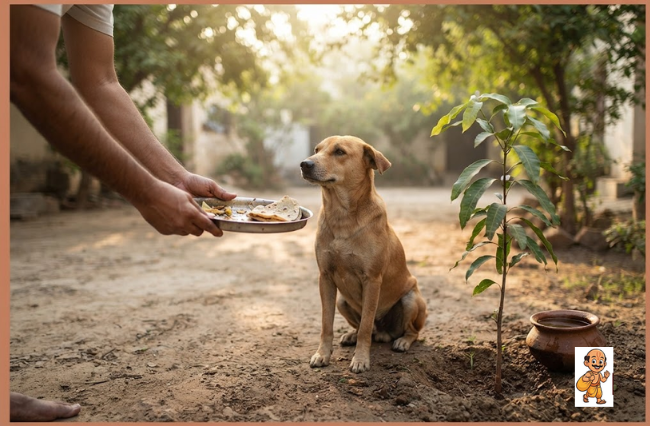
People ask why dogs specifically are tied to Rahu and Ketu, and most articles simply state the correspondence without explaining it, which leaves the remedy feeling arbitrary rather than logical. Dogs in Vedic symbolism sit at the threshold between the domestic and the wild, loyal yet outside full human society — which mirrors exactly what the shadow planets represent: forces operating just outside the visible structure of a chart. Feeding a dog that cannot repay you, cannot even fully trust you at first, closes the same karmic loop that cow service closes, but tuned specifically to Rahu's illusion and Ketu's detachment. The daily practice: keep a small portion of roti or rice, unsalted where possible, and offer it to the same neighbourhood dog consistently rather than a different one each day — consistency with one animal builds the relationship the remedy depends on. Saturday evenings carry the strongest correspondence for Rahu; early morning suits Ketu better. Families uneasy about street animals can donate the equivalent quantity of dog food to a local shelter weekly and achieve a comparable effect — the Sankalpa, not the personal proximity, carries the remedy.
Planting Your Nakshatra Tree When You Live in a Flat, Not a Village
Most guides on nakshatra trees assume a courtyard or ancestral land to plant in, and that gap leaves millions of apartment-dwelling Indian families thinking the remedy simply isn't available to them — it is. Every one of the twenty-seven Nakshatras carries an assigned tree; Ashwini's is Kuchla, Rohini's is Jamun, Mrigashira's is Khair, and so on through Revati's Mahua. If you don't know your birth Nakshatra, any competent Panchang or a five-minute call with an astrologer will confirm it from your birth time. For families without ground to plant in, the classical intention survives in a large container: a Tulsi, Neem, or Ashoka sapling — commonly available Nakshatra trees suited to pot cultivation — placed on a balcony that gets morning sun fulfils the same Sankalpa, watered daily with the same attention you'd give a full-grown tree in open ground. What modern urban living is only now catching up to, ancient Vedic observation already assumed: a living plant tended daily produces a measurable calming effect on the nervous system, the same effect classical tradition attributed to sitting near one's Nakshatra tree for meditation. Water it in the morning, touch the trunk briefly while stating your Sankalpa, and let a five-word truth settle in — the tree does the rest.
The Navagraha Stotram: What It Actually Does When You Chant It Every Morning
What we have consistently observed across thousands of consultations is that families worry far more about pronunciation than the practice actually requires — the Navagraha Stotram does not need a Pandit correcting every syllable to work for a householder's daily recitation. This nine-verse hymn, attributed in classical tradition to Maharishi Vyasa, addresses each of the nine planets in sequence and is traditionally recited once daily, ideally after a morning bath, facing the rising sun or a Navagraha image. Families who recite it inconsistently — a burst of daily chanting for a week, then nothing for a month — report far less benefit than families who recite a shorter, simpler version daily without fail. Consistency over intensity, always. If Sanskrit pronunciation feels difficult, chanting from a transliterated text with sincere attention still carries the intended vibration; classical tradition holds that Bhava — the devotional state behind the sound — matters more than phonetic perfection for a householder's daily practice, as distinct from a formally trained priest's ritual recitation. Ten minutes, every morning, facing the light.
Common Mistakes That Quietly Cancel Your Remedy
A cancelled remedy is one performed correctly but undone by the manner in which it's carried out, and three specific mistakes cause this more than any wrong item or wrong day ever could. Families switch remedies every few days — chanting one week, daan the next, dog feeding after that — never letting any single practice complete its forty-day cycle, which resets the karmic clock each time. Families perform the remedy while mentally rehearsing the problem, turning what should be an act of surrender into another round of anxious repetition, and Ketu's energy in particular resists being approached from a place of fear rather than release. And families treat daan as a transaction with a receipt — checking on the recipient's gratitude, expecting a specific outcome by a specific date — which converts a karmic remedy back into ordinary bargaining. The fix for all three is the same unglamorous discipline: pick one remedy for your primary planet, commit to forty consecutive days, and let go of the outcome the moment the Sankalpa is spoken. Between us, families ask us for the "strongest" remedy far more often than they ask for the sustainable one — and it's almost always the sustainable one that actually delivers.
FAQ
Can Navagraha remedies work without a priest? Yes — daily Daan, animal seva, tree care, and Stotram recitation are householder practices meant to be done personally; priests are needed for formal Homam and Puja, not daily Upaya.
Which day should I donate for Rahu and Ketu? Traditions differ; many households use Saturday for Rahu and a separate day for Ketu based on regional lineage — consistency matters more than the exact day.
Do I need to know my exact Nakshatra to plant a tree? It helps but isn't mandatory; a Tulsi or Neem sapling tended daily with sincere intention still fulfils the remedy's purpose.
How long before I notice any change? Classical practice recommends a minimum forty-day cycle before evaluating any single remedy.
Conclusion
Every remedy in this guide shares one quality: none of it requires money you don't have, or a priest's calendar you have to wait on. A roti set aside before breakfast, ten minutes of chanting facing the window, a sapling on the balcony watered with attention — these are things a working parent, a student, or someone managing a joint family kitchen can genuinely sustain for forty days running, which is the one condition every classical text agrees actually matters. We'd rather see a family run one small Upaya with total consistency than attempt all eight of these with none. If a period feels heavier than a daily remedy can hold — persistent Sade Sati distress, a Dasha that's touching health or finances seriously, or a dosha you can't identify on your own — that's the moment a full chart reading with a qualified astrologer earns its place, not before. So here's what to actually do right now: pick the one section above that matched the feeling you started this article with, and begin it tomorrow morning.
Ready for a complete chart reading before choosing your daily remedies? Book a personalised Navagraha consultation with a verified Jyotishi on AtoZPandit.com today.