
Modern Vastu Handbook: Room-by-Room Home Energy Rules
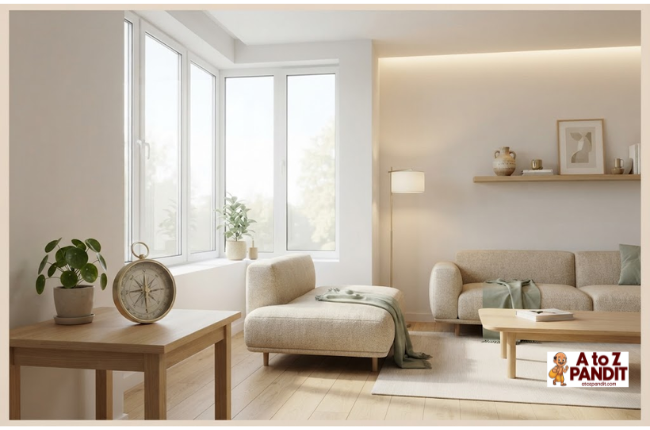
Most Vastu articles assume you own a plot and can build from scratch. Real families in Mumbai's housing societies inherit a builder's floor plan, a fixed kitchen wall, and a bedroom that already faces whichever way the tower faces. The Vastu specialists at AtoZPandit.com work with exactly this reality every week — flats, redeveloped buildings, suburban villas, and everything in between. What we have consistently observed across thousands of consultations is that families don't need a textbook of ideal directions; they need to know what to do with the home they actually have. This guide walks through every major room — entrance, kitchen, bedroom, study, bathroom, and the sacred centre — with practical, non-demolition guidance built for 2026 Indian homes. (Educational and cultural guidance; not a substitute for professional structural or medical advice.)
Main Entrance & Dehleez: Where Your Home's Energy Begins
Most guides treat the main door as a compass reading and stop there. A north, east, or northeast-facing entrance is genuinely favourable — it welcomes Prana, the life-force energy, alongside the morning light. But the door's facing is only half the picture; what happens at the threshold, the Dehleez, decides how much of that energy actually enters. A raised marble or wooden threshold strip, even two centimetres high, is believed to interrupt negative energy from sliding straight in, the way a small step slows down anything moving too fast.
For families in flats, where the builder has already fixed the door's compass direction, this is where the real leverage lies. Keep the entrance clutter-free, well-lit, and free of a shoe rack directly opposite the door. A doorbell placed slightly to the door's right, rather than dead centre, is a small detail most families overlook — and between us, this is what most families never hear from a general contractor. If your entrance opens into a south or southwest wall, a tulsi plant or a small brass bell at the threshold is the classical correction, not a demolition.
Society flats add one more wrinkle traditional texts never had to solve: a common lobby or lift landing sitting right outside your own door, sharing that entrance energy with a dozen other families. A small nameplate with your family's name, a fresh toran of mango leaves refreshed each festival, and a well-swept doormat mark that shared threshold as clearly yours — a boundary that matters more in a crowded Thane or Mumbai tower than it ever did on an open plot.
Kitchen: Flame, Sink & Cooking Direction
The kitchen governs Agni, the fire element that generations of Indian mothers have quietly protected — the specific sound of a pressure cooker whistle cutting through a Mumbai morning is, in a very real sense, the sound of a home's Agni at work. Southeast is the classical seat of the kitchen, with the stove placed so the person cooking faces east. Northwest is the accepted second choice when southeast isn't available in your flat's layout.
The single rule every family should verify today: the gas stove and the kitchen sink must never sit adjacent to each other, and never in a straight line. Fire and water in direct contact is treated as an energetic conflict, not just poor ergonomics — though the two happen to agree here. A gap of at least two to three feet between stove and sink resolves this in nearly every modern platform layout, no plumbing rework required. If your builder-fixed kitchen faces north, place a copper vessel of water near the sink corner and let the stove's own flame do the correcting work over the platform's east-facing zone. The intention is the address. The mantra is the message.
Storage and colour finish the picture: heavy grain, pulses, and drinking water are best stored in the south or southwest cabinets, while the platform itself does well in warm tones — cream, light yellow, or terracotta — rather than deep black granite, which classical guidance treats as absorbing rather than circulating Agni's warmth. None of this is about ripping out a modular kitchen already installed; it's about arranging what's already there with intention.
Master Bedroom: Sleep Direction & Layout
We are frequently asked, almost apologetically, whether the "sleep with your head to the south" instruction really matters once a couple is exhausted from a long commute. It does, and the reasoning is simpler than most guides let on: the southwest zone carries the earth element's stability, and a bed placed against the southwest wall, headboard toward the south or east, is believed to steady both rest and the relationship sharing that bed. For the complete directional breakdown by bedroom position, floor, and existing defects, see our dedicated bedroom Vastu guide.
Avoid a mirror facing the bed directly — reflected sleeping energy is considered draining, not restful. Keep an attached bathroom door closed at all times, and if a beam runs directly above the bed, a simple false ceiling panel resolves what would otherwise be treated as a serious defect. None of this requires touching a load-bearing wall.
Wood over metal for the bed frame, and soft earthy colours — dusty rose, sandalwood, muted green — over stark white or black, are the classical southwest-bedroom recommendations, chosen because they echo the same grounding quality the direction itself carries. And between us, the detail families skip most often isn't the bed direction at all — it's simply decluttering the space under the bed, which is treated as stagnant energy no matter how correctly the room itself is aligned.
Study Room & Work-From-Home Corner: A 2026 Reality
Traditional Vastu texts never anticipated a laptop on a dining table at 9 p.m. This is where ancient guidance genuinely meets modern life, not by diluting the tradition but by extending it: a north or northeast-facing desk draws on the same clarity-supporting energy that scripture assigns to those directions, and modern focus research independently points to north-facing daylight as less fatiguing on the eyes over long screen sessions.
Sit with a solid wall behind you, never a window, while working — the subconscious sense of support this gives is the Vastu equivalent of what ergonomists call a "secure base" for concentration. If your only workspace is a bedroom corner, a simple room divider or curtain keeps working energy from bleeding into resting energy, which is the actual complaint behind most "I can't switch off" evenings.
A small money plant or bamboo on the desk's east side, and a desk lamp that avoids harsh overhead glare, round out a setup that costs a few hundred rupees rather than a room renovation — proof that this particular Vastu correction was built for a laptop era, not against it.
Bathroom Placement: The Room Everyone Gets Wrong
Bathrooms get one paragraph in most Vastu guides and an entire chapter's worth of real anxiety in real homes. Northwest or west is the preferred zone, since these directions carry the air element that helps disperse what a bathroom naturally generates. A bathroom in the northeast — the most sacred zone in the home — is considered the most serious placement error a builder can make, and unfortunately it's common in compact Mumbai flats where plumbing runs are fixed at construction.
If you're stuck with exactly this layout, the classical correction is straightforward: keep the northeast bathroom spotlessly clean, the door closed always, sea salt in an open bowl changed weekly, and a small mirror on the outside of the door to symbolically deflect the zone's energy back. This won't relocate your plumbing, and it isn't meant to. It's meant to manage what can't be moved.
A working exhaust fan matters here more than most families realise — stale, damp air is treated as accumulated negative energy in Vastu, and it happens to be exactly what encourages mould in a Mumbai monsoon. Light blue, sea green, or white tiling supports the air element regardless of which direction your bathroom actually falls in, which is one adjustment every family can make at the next renovation, wrong direction or not.
Brahmasthan: Protecting Your Home's Centre
Families often ask us, apologetically, whether the Brahmasthan rule can simply be skipped in a small flat where every square foot is already spoken for. It cannot. Classical Vastu treats the home's geometric centre as the single most important zone in the entire structure — the space through which every room's energy is believed to circulate, the way a heart circulates blood before it reaches the rest of the body. This centre is where the Vastu Purusha Mandala, the geometric grid underlying the entire discipline, is traditionally anchored. Several popular guides reduce the Brahmasthan to a decorative footnote; the classical texts do not.
The rule is almost embarrassingly simple: keep the centre open, light, and free of heavy furniture, a support pillar, or a toilet. In a compact apartment, this might mean nothing more than not placing your dining table's heaviest end, or a bulky showcase, in the exact middle of the flat. A small crystal or a well-lit hanging lamp at the centre is the traditional way to keep this zone active rather than dead space.
If your flat's centre happens to fall inside a passage or hallway, that's genuinely fortunate — passages are meant to stay open anyway. The families who struggle here are usually the ones whose builder placed a structural column dead centre; for them, wrapping the column in a mirror-finish panel or a tall plant is the accepted softening, since the column itself cannot come down.
North-East Mandir: Placing the Sacred Corner Correctly
The northeast, or Ishan corner, is where most families instinctively want their mandir — and the instinct is correct. This zone is associated with spiritual clarity and the early light of dawn, which is why a mandir here, with idols facing east or west so the worshipper faces east, is considered the gold standard. What almost no room-by-room guide explains is what to do when your flat's northeast corner is already a bathroom, a staircase landing, or simply doesn't exist in your layout.
In that situation, east or north walls of the living room are the accepted next-best choice — never the bedroom, and never directly beneath a beam or above a store cupboard. A tabletop mandir on a small chowki, kept at least a foot off the ground, works in a one-room-kitchen as genuinely as a dedicated room does in a villa. As our Vedic granthas teach us, sincerity of Sankalpa matters more than square footage.
Diya practice matters as much as placement: a family lighting even a single ghee diya at dawn in the correct corner, consistently, is understood to sustain the zone's energy far better than an elaborate mandir lit only on festivals. Some regional traditions — particularly in parts of South India — permit the northwest as a secondary option; this variation is real and worth confirming with your own family's tradition rather than assuming one rule covers every household.
Which Vastu Profile Fits Your Home?
Three profiles cover almost every home in Mumbai and Thane, and knowing yours before applying any correction above saves real confusion. Profile one is the independent villa or bungalow, where structural changes are genuinely possible and full directional correction is realistic. Profile two is the resale or rented flat, where the layout is completely fixed and every fix above must work through placement, colour, and object correction alone. Profile three is the new-construction flat still being finalised, where a family can request minor layout adjustments from the builder before possession.
Most Mumbai and Thane families reading this fall into profile two, and that's precisely why every remedy in this guide was chosen for working without demolition. Our full guide on non-structural Vastu corrections goes deeper if your defects run across more than one or two rooms.
Knowing your profile also tells you how much urgency to bring to any one fix. A profile-three family finalising a booking form can request the kitchen shift southeast for a few thousand rupees in plan changes — genuinely worth asking for. A profile-two family in a fifteen-year-old resale flat is better served spending that same energy on the placement corrections above, applied consistently, rather than chasing a structural change that isn't realistically available.
Three Vastu Myths That Confuse Modern Families
"My flat doesn't face the right direction, so nothing I do will help" is the most damaging misconception we hear, and it simply isn't how classical Vastu works — direction is one input among many, correctable through placement and intention, not a life sentence. The second myth: that Vastu is only for people who own their home outright. Tenants and society-flat owners benefit from every placement correction in this guide exactly as much as a bungalow owner does.
The third, and most persistent: that a single remedy — one pyramid, one wind chime — fixes a defect permanently. Genuine correction is cumulative, observed over weeks, not switched on overnight. A family that adjusts sink placement, clears the Brahmasthan, and fixes bedroom layout together will feel the shift far sooner than one hoping a single object does all the work.
FAQ
Can Vastu really work in a rented flat I can't renovate? Yes. Nearly every correction in this guide — threshold objects, furniture placement, colour, cleanliness — works without touching a wall.
What's the single most important room to fix first? The kitchen, since Agni placement affects health and finances most directly in classical Vastu.
Is a north-facing flat automatically bad? No — north is associated with wealth and career growth; very few directions are inherently unfavourable when properly managed.
Do all these rules apply the same way across India? Broadly yes, though some regional and community traditions vary slightly in emphasis — a local Pandit can confirm nuances for your specific tradition.
Conclusion
A home doesn't need to be a bungalow with unlimited walls to move for Vastu to matter. What changes the energy of a flat, a villa, or a rented 1BHK is the same in every case: the entrance stays open and lit, fire and water stay apart in the kitchen, the centre stays clear, and the northeast corner — wherever it lands in your specific layout — stays respected. Families who apply even three or four of these corrections together, rather than chasing one perfect fix, are the ones who report feeling the shift within weeks, not months.
If there's one thing worth remembering from this entire guide, it's that Vastu was never meant to demand a bungalow. It was meant to work with whatever four walls a family actually has. So here's what to actually do this week: walk through your home room by room using this guide, note where your layout doesn't match the ideal, and start with the one correction that needs no contractor at all — most families find that's usually the kitchen or the entrance threshold.
Get a full room-by-room Vastu analysis for your specific flat or villa layout from a verified expert at AtoZPandit.com.
Book your consultation today — practical corrections, no demolition, no fear-selling.