
Hindu Fasting Manual: Lunar Vrat Rules & Parana Guide
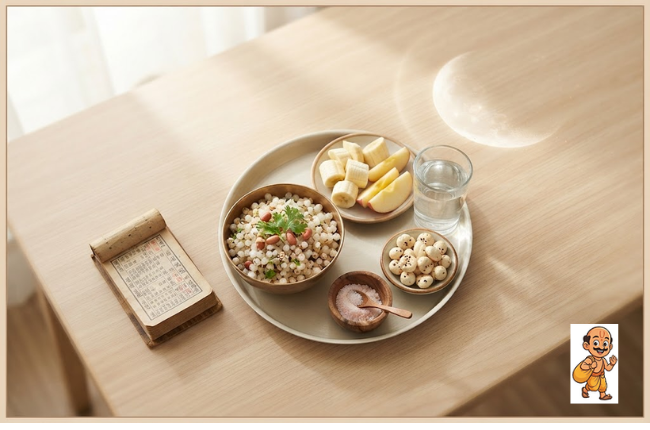
Most fasting guides give you a date and a food list. Families ask AtoZPandit.com something more specific: why the eleventh lunar day, why this particular salt, and whether it's actually safe for a diabetic grandmother to go without water for twenty-four hours. This manual cross-checks classical vrat vidhi against Ayurvedic food science and peer-reviewed research on intermittent fasting and gut microbiome change, rather than treating Hindu fasting as either pure devotion or pure biohacking — because in practice, it was quietly built as both at once. Health circumstances vary enormously between people, and this piece flags that honestly rather than offering a single universal prescription.
The Lunar Mechanics Behind Vrat Days
Nearly every major Hindu fast lands on a specific lunar day — Ekadashi on the eleventh tithi, Pradosh on the thirteenth, Sankashti Chaturthi on the fourth of the waning fortnight — and this isn't scheduling convenience. The Hindu calendar tracks the moon's actual position, not a fixed thirty-day grid, so each vrat day corresponds to a precise, recurring point in the moon's gravitational cycle rather than an arbitrary date.
Ekadashi in particular falls twice a month, roughly fourteen to fifteen days apart, creating a built-in bi-weekly rhythm of nutrient abundance followed by nutrient scarcity — the same spacing that modern intermittent-fasting research on the gut microbiome studies independently, without any reference to the lunar calendar that produced it first. Whether lunar gravity itself measurably affects human fluid balance remains genuinely debated in scientific literature, and we'd rather say that plainly than borrow a claim we can't fully stand behind. What's better supported is simpler: a fixed, recurring fasting rhythm — regardless of what triggers its timing — gives the digestive system predictable rest, and the lunar calendar happens to be the mechanism Vedic tradition chose to enforce that regularity across an entire population without anyone needing a wearable device to remind them.
The Samvat calendar underlying all of this runs on tithis, not fixed dates — a tithi's length varies slightly depending on the moon's actual orbital speed, which is why Ekadashi sometimes appears to shift by a day on the Gregorian calendar even though the lunar count never wavers. This is also why two families can legitimately observe the "same" Ekadashi a day apart — Smartha households typically fast on the day most families follow, while Vaishnava sampradayas sometimes calculate the tithi slightly differently, and both are correct within their own tradition.
Nirjala vs. Phalahar Ekadashi — Matching the Fast to Your Body
Nirjala Ekadashi — complete abstinence from food and water for a full day — is the most austere of the twenty-four annual Ekadashis and is classically said to carry the merit of all the others combined. Phalahar Ekadashi, observed on every other Ekadashi through the year, permits fruits, milk, and root vegetables, along with water.
Pandit's tip: and between us, this is what most families never hear — the merit assigned to Nirjala and its gentler alternative is treated as equivalent in classical framing specifically so nobody feels pressured into the harder version for spiritual credit. Choosing Phalahar over Nirjala isn't a lesser fast; it's the correct fast for a different body. Pregnant women, the elderly, diabetics on regular medication, and anyone with kidney conditions are consistently and specifically advised against the strict waterless form, since a full day without fluid intake carries genuine physiological risk for these groups that has nothing to do with willpower. In Ayurvedic terms, a Vata-predominant body — lighter frame, prone to dryness and anxiety — tolerates waterless fasting far worse than a Kapha-predominant body with more physical reserve, which is a body-type distinction almost no popular fasting content makes explicit. If in doubt, phalahar preserves the observance without the risk. Same devotion, safer body, real difference.
What Fasting Actually Does to Your Gut
A landmark study on Ramadan-associated intermittent fasting found that a month of periodic fasting measurably increased gut microbiome diversity, specifically raising the relative abundance of Lachnospiraceae and Ruminococcaceae — bacterial families associated with beneficial short-chain fatty acid production — and that these changes returned to baseline once normal eating resumed. Vrat fasting produces a comparable metabolic pattern on a tighter, twice-monthly cycle rather than one continuous month.
This is where ancient practice and modern research genuinely converge without needing embellishment: a period of nutrient abundance followed by a period of nutrient scarcity gives the gut's microbial population room to shift and diversify, and the body's cells room to break down and recycle older components — the process researchers call autophagy. Ekadashi's roughly two-week spacing keeps this cycle running continuously across the year rather than concentrating it into one annual month, which is arguably a more sustainable cadence than a single intensive fasting block. We'd gently push back on any content presenting this as proven identical to clinical intermittent fasting protocols — the research base is Ramadan-specific and still developing — but the directional overlap is real, and it's not a coincidence dressed up after the fact.
Sendha Namak, Amaranth, and Sabudana — The Ayurvedic Logic of Vrat Food
Vrat food rules aren't a random restriction list. Sendha namak (rock salt) replaces iodised table salt specifically because it's unrefined and, in Ayurvedic classification, considered to pacify all three doshas rather than aggravating Pitta the way heavily processed salt is said to. Rajgira (amaranth), kuttu (buckwheat), and sabudana (tapioca pearls) replace wheat and rice because none of them are classified as grains under vrat rules, despite functioning like one in the kitchen.
Nutritionally, this isn't merely symbolic substitution: amaranth carries a notably higher protein content than most grain substitutes, sabudana offers a fast, easily digestible carbohydrate source that doesn't demand heavy digestive-fire output during a day when Agni is already reduced by fasting, and rock salt's mineral profile — potassium, magnesium, trace iron — helps offset the electrolyte loss that comes with reduced food intake. One competitor claim worth challenging directly: rock salt is frequently marketed as dramatically lower in sodium than table salt, which overstates the difference — the meaningful distinction is processing and trace mineral content, not a large sodium reduction, and it shouldn't be treated as a blood-pressure intervention on its own.
Parana — The Precise Science of Breaking a Fast Correctly
Breaking an Ekadashi fast incorrectly is treated in classical texts as seriously as observing it incorrectly. Parana must occur after sunrise on Dwadashi, the twelfth lunar day, and specifically must avoid Hari Vasara — the first quarter of the Dwadashi tithi, still considered part of Ekadashi's spiritual window.
Breaking the fast too early, during Hari Vasara, incurs a partial demerit; breaking it after Dwadashi has fully ended incurs a separate demerit called Dwadashi Vyapini Dosha, for having extended the fast beyond its intended close. As our Vedic granthas teach us, the timing here isn't arbitrary ritual precision for its own sake — a body that has fasted for twenty-four hours, particularly without water, genuinely benefits from a structured, gradual refeeding sequence rather than an abrupt heavy meal, and the traditional Parana order — tulsi water first, then fruit, then panchamrit, then a light grain meal — mirrors exactly the gentle-refeeding logic modern medicine recommends after extended fasting, arrived at independently and centuries earlier. Structure first, then food, in that specific order.
Pradosh Vrat and the Twilight Window
Pradosh Vrat falls on the thirteenth lunar day of both fortnights and is observed specifically during Pradosh Kaal — a precise window beginning at local sunset and lasting roughly two ghadis, about forty-eight minutes, calculated from the exact astronomical sunset at the observer's location rather than an approximate evening hour.
This twilight timing places the most demanding part of the fast — the puja itself — right at the body's natural transition from daytime alertness to evening wind-down, a period Ayurveda associates with the Kapha-to-Vata shift in the day's rhythm. Most devotees maintain a light, fruit-and-milk-based day before breaking the fast that same evening after the puja concludes, rather than extending into a second full day the way some Ekadashi observances do. Families combining Pradosh with an Ekadashi fast in the same week should note there's usually a single day's gap between them by design — a gap worth respecting rather than compressing for convenience.
Sankashti Chaturthi and Weekday Vrats — The Planetary Calendar of Fasting
Sankashti Chaturthi, observed monthly on the fourth day of the waning fortnight, is unusual among vrats for breaking specifically at moonrise rather than a fixed clock time — devotees fast from morning, worship Ganesha through the day, and end the fast only after sighting the moon and offering it arghya.
Weekday vrats layer a separate calendar entirely, tied to planetary rulership rather than lunar phase: Monday for Shiva, Tuesday for Hanuman or Mangal-related remedy, Thursday for Vishnu and Brihaspati, and Saturday for Shani. A family following the Samvat calendar for these observances is essentially running two independent tracking systems simultaneously — lunar tithi for Ekadashi and Pradosh, solar weekday for the planetary vrats — which is precisely why a physical or digital Panchang matters more for consistent vrat practice than memory alone. Angarki Chaturthi, when Sankashti falls on a Tuesday, is considered unusually significant for exactly this reason: two independent calendars, lunar and weekday, aligning on the same date.
Dana as the Karma-Completion of a Vrat
Classical guidance is consistent and specific: charity performed alongside a vrat — before Parana, not after — is treated as completing the fast's karmic circuit rather than as an optional add-on. Donating food, grains, or a meal to a Brahmin or someone in need on Ekadashi or Dwadashi carries particular weight in this framing.
The logic mirrors the dakshina mechanism present in every other Vedic ritual: Sankalpa opens the intention, the fast itself is the discipline, and Dana closes the transaction the same way dakshina closes a puja. A vrat observed with perfect dietary discipline but no accompanying charity is, in this classical view, structurally incomplete — not wrong, but unfinished. This is a detail most fasting content skips entirely in favour of food lists, because charity doesn't photograph as well as a sabudana khichdi recipe.
Three Vrat Myths Families Get Wrong
Myth 1 — "Nirjala is always more spiritually valuable than Phalahar." As covered earlier, classical framing treats them as equal in merit; Phalahar is the medically appropriate choice for many bodies, not a compromise. Myth 2 — "Any time on Dwadashi is fine for Parana." Both Hari Vasara and the tithi's actual end matter; breaking too early or too late both carry recognised demerits. Myth 3 — "Fasting means eating nothing at all." Most vrats permit fruit, milk, or specific flours; total food abstinence is reserved for Nirjala Ekadashi specifically, not the default vrat model.
FAQ
Q: What's the real difference between Nirjala and Phalahar Ekadashi? Nirjala prohibits food and water entirely for 24 hours; Phalahar permits fruit, milk, and water, with equivalent classical merit. Q: Why is sendha namak used instead of table salt? It's unrefined and Ayurvedically classified as tridosha-balancing, unlike processed salt. Q: When exactly should I break an Ekadashi fast? After sunrise on Dwadashi, avoiding Hari Vasara, and before the Dwadashi tithi ends. Q: Can diabetics or pregnant women do Nirjala Ekadashi? They're specifically advised against the strict waterless form; Phalahar preserves the observance safely. Q: When is the Sankashti Chaturthi fast broken? At moonrise, after offering arghya and completing Ganesha puja — not at a fixed clock time.
Conclusion
Hindu fasting was never simply willpower dressed in ritual — the lunar spacing, the specific foods, and the precise breaking rules were quietly doing physiological work centuries before gut microbiome research existed to describe it. Understanding the mechanism doesn't reduce the vrat to a wellness trend; it explains why a practice this demanding survived intact across millennia of ordinary households, not just monastic ones. What you should actually do right now: if you're new to vrat practice, start with Phalahar Ekadashi rather than Nirjala, follow the traditional Parana sequence rather than breaking your fast with a heavy meal, and if you have a health condition, treat "which fast is appropriate for me" as a real question worth asking a doctor and a knowledgeable Pandit together, not a test of devotion. If your family's tradition varies in food rules or timing from what's described here, that's regional and sampradaya-specific practice, not error.
If you'd like personalised guidance on which vrats suit your health profile, birth chart, and family tradition — including a full Ekadashi and Pradosh calendar for the year — AtoZPandit.com connects you with a verified Pandit or Jyotishi for a Vrat & Fasting Consultation. Book a session and get a fasting calendar built around your actual body and Kundli, not a generic list.