About Satyanarayan Pooja
The Vrat That Belongs to Every Home
The Satyanarayan Pooja traces its roots to the Skanda Purana, specifically the Reva Khanda, where Lord Vishnu Himself tells Sage Narada that this Vrat is the simplest and most direct path to happiness in the age of Kali. What sets it apart from every other Vedic ritual is this — it is not performed out of fear or to fix a problem. It is performed out of joy. Families have done it for generations to mark new homes, new jobs, new marriages, and new children — and just as often on an ordinary Purnima simply to say thank you to the Lord. The ritual centres on five chapters of the Katha, the Panchamrit offering, and the sharing of Sheera Prasad — a combination of sound, offering, and sweetness that the tradition believes creates a direct channel between the household and divine grace.
India's Most Beloved Act of Gratitude
The Power of E-Pooja: Same Ritual, Same Results
Families often wonder whether the Satyanarayan Katha performed online carries the same weight as one performed in the living room. The Vedic answer is rooted in the three foundations of every authentic ritual: Mantra, which is the precise chanting of the sacred verses from the Skanda Purana; Samagri, the pure and correct offerings made during the ritual; and most crucially, Sankalpa — the personalised dedication where the Acharya takes your full name, Gotra, and your home's exact coordinates and formally offers the entire ceremony to your household. This Sankalpa is what makes the pooja your family's pooja, not a generic one. Because regional customs vary — the way the Sheera is prepared in a Maharashtrian home differs from a Gujarati or Tamil household — our Pandit also guides you through any alternate Shastric solutions or regional variations relevant to your family tradition, ensuring the vidhi is fully personalised to your needs.
Our Pandit also guides you through any alternate Shastric solutions or regional variations relevant to your family tradition, ensuring the vidhi is fully personalised to your needs.
When & How This Pooja Helps Your Life
Satyanarayan Pooja is performed on Purnima, Ekadashi, after a new home purchase, job change, marriage, birth of a child, repayment of a debt, or as a monthly Vrat of gratitude. According to the Skanda Purana, regular observance brings:
• Truth and Mental Clarity: Satyanarayan, meaning the Lord of Truth, is invoked to dissolve hidden confusion and obstacles. Families who perform this Vrat regularly often describe clearer decision-making and a smoother path through life's challenges.
• Relief from Financial Stagnation: The Skanda Purana narrates how families burdened by debt experienced relief after this Vrat. It is not a financial guarantee, but a traditional remedy said to align the household's energy toward abundance and flow.
• Harmony Between Family Members: The five chapters of the Katha each carry the message that devotion protects family bonds. Regular observance is believed to reduce friction and strengthen the connections between people who share a home.
• Gratitude as a Daily Practice: Unlike rituals performed in difficulty, Satyanarayan Pooja is fundamentally an offering of joy. Performing it after any positive event transforms ordinary happiness into a conscious act of devotion.
The Vidhi: Step-by-Step Process of the Ritual
1. Ganesh Sthapana: Lord Ganesha is invoked first to remove all obstacles, a step that opens every Vedic ritual without exception.
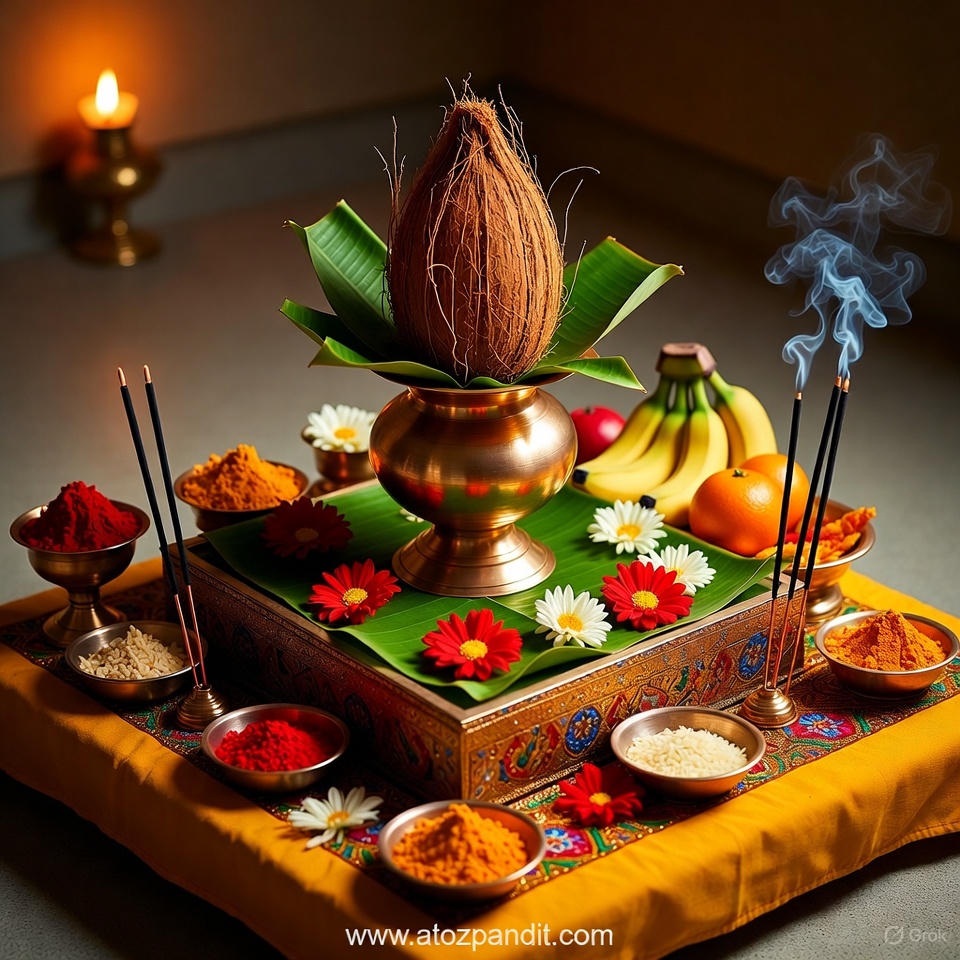
2. Kalash Sthapana: The sacred copper water pot is established, representing all holy rivers and divine energies, making the home a temporary sacred space.
3. Navagraha Puja: A brief invocation of the nine planetary deities ensures that their energies at this moment support the household.
4. Satyanarayan Avahan: Lord Vishnu in his form as Satyanarayan is welcomed through specific verses from the Skanda Purana, with Tulsi leaves, flowers, and sandalwood.
5. Panchamrit Abhishek: The Lord's image is bathed in five sacred substances — milk, curd, honey, sugar, and ghee — each holding its own traditional significance.
6. Satyanarayan Katha: The five chapters of the sacred story are narrated by the Acharya. Listening with a quiet and open mind is considered the most important act of the entire ritual.
7. Aarti and Sheera Prasad: The ceremony closes with the traditional Aarti of Lord Vishnu followed by the distribution of Sheera — the sweet semolina prasad that marks the Vrat's joyful completion.
The AtoZPandit.com Advantage & Commitment
Every Acharya at AtoZPandit.com is Gurukul-trained, traditionally verified, and experienced in conducting E-Poojas for Indian families worldwide. Your booking is confirmed within 15 minutes. The 15-minute refund approval process protects your payment if plans change. If a technical disruption occurs during the live Katha, we shift the session to the next Shubh Muhurat immediately at no additional cost so the Katha is never left incomplete. If you are unsure whether a simple Pooja or a Havan-included version is right for your occasion, our Free Second Opinion service connects you with a senior Vedic scholar at no charge. We handle the expertise and the technology; you handle the prayers.